

Washington's real estate broker exam does include math, but it's less intimidating than it sounds: calculations make up roughly 7% of the national portion's scored questions, plus a handful of related problems tucked inside financing, valuation, and settlement questions. Learn about a dozen formulas – loan-to-value, cap rate, PITI, seller net proceeds, and Washington's own graduated excise tax – and the math section becomes one of the most predictable parts of exam day.
Whether you're finishing your 90-hour pre-license course or already hold your Broker license and want a refresher, these are the exact calculations PSI tests and the ones you'll use at the closing table with real clients.
- Real estate calculations are about 7% of the national exam's scored questions, with related math also appearing in property valuation, financing, and settlement questions.
- You need a scaled score of 70 on each exam portion – not 70% of raw questions correct.
- Washington's REET is graduated and marginal: never apply the top rate to the entire sale price.
- Discount points and loan origination fees are always calculated on the loan amount, never the purchase price.
- Physical calculators are allowed at in-person PSI test centers but not for remote-proctored exams.
How Much Math Is on the Washington Real Estate Exam?
PSI's national examination content outline lists "Real Estate Calculations" as roughly 7% of scored questions – about 7 questions on the national portion. Computational problems also show up inside Property Valuation, Financing, Settlement, and Land Description questions, so the true math exposure runs higher than 7 questions alone. The state portion has no separate math category, but Washington-specific excise tax and closing proration questions appear inside legal and regulatory items.
PSI's candidate outline names these specific calculation competencies:
- Seller net proceeds
- Buyer funds at closing
- Prorations
- Transfer fees
- Principal, interest, taxes, and insurance (PITI)
- Equity
- Rate of return and capitalization rate (cap rate)
- Loan-to-value (LTV) ratio
- Discount points
- Loan origination fees
- Linear and square-foot measurement
Before you dive into formulas, it's worth benchmarking where you stand with our free Washington real estate practice exam, which mirrors PSI's question weighting, including the math categories above. Our guide on how to read your practice exam score report explains what those results actually mean before you dig into formula practice.
Washington Broker Exam Structure, Scoring, and Calculator Rules
The Washington Broker exam is administered by PSI Services LLC under contract with the Washington State Department of Licensing (DOL), in two portions during a single appointment:
- National Portion: 100 scored questions, 150-minute time limit.
- State Portion: 30 scored questions, 90-minute time limit.
PSI also embeds 5 to 10 unscored pretest questions inside each exam form to evaluate future test items. Because pretest questions look identical to scored ones, treat every question with the same care.
Under WAC 308-124A-760, you need a minimum scaled score of 70 on each portion to pass. A scaled score of 70 doesn't mean 70% of raw questions right – psychometric scaling adjusts for difficulty differences across exam forms. If you pass one portion but not the other, that passing score stays valid for six months. Once you've passed both, you have one year to apply for licensure. Statutory eligibility under RCW 18.85.101 requires you to be at least 18, hold a high school diploma or equivalent, and complete 90 clock hours of approved pre-license education (60 hours of Real Estate Fundamentals, 30 hours of Real Estate Practices) within the two years before applying.
Calculator rules depend on your scheduled test format, per current PSI candidate guidelines:
- In-Person Test Centers: A physical calculator is allowed, and the center supplies paper and pencil for rough work.
- Remote Online Proctoring: A physical calculator and scratch paper are not allowed. Confirm PSI's current on-screen tools before your appointment.
Never assume a smartphone or an unapproved app is permitted under any format – confirm your specific tools before exam day.
Core Real Estate Math Formulas Every Candidate Must Know
Rate of Return and Capitalization Rate (Cap Rate)
Formula: Rate of Return = Annual Income / Total Investment
Example: An investor pays $150,000 cash for an asset producing $9,000 in annual net income. $9,000 / $150,000 = 0.06, or a 6.0% Rate of Return.
Cap rate applies the same idea to income property: Cap Rate = Net Operating Income (NOI) / Property Value. A commercial property with $48,000 NOI valued at $800,000 has a cap rate of $48,000 / $800,000 = 6.0%. You can also solve for value: Value = NOI / Cap Rate = $48,000 / 0.06 = $800,000. Exam watchout: always use NOI (gross income minus operating expenses) – never gross rent, and never subtract mortgage payments.
Loan-to-Value (LTV) Ratio
Formula: LTV = Loan Amount / Lesser of Purchase Price or Appraised Value
Example: A buyer purchases a home for $800,000 that appraises at $800,000, with a $680,000 loan. $680,000 / $800,000 = 0.85, or 85% LTV. Exam watchout: if the same home appraised for $790,000 instead, the maximum loan is based on the lower appraised value, not the contract price.
Discount Points and Origination Fees
Formula: Fee Amount = Loan Amount × (Number of Points × 0.01). One point equals 1% of the loan – never the purchase price.
Example: A buyer gets a $680,000 loan with a 1% origination fee and buys 2 discount points. Origination fee: $680,000 × 0.01 = $6,800. Discount points: $680,000 × 0.02 = $13,600. Total lender fees: $20,400.
Monthly PITI Payment
Formula: Monthly PITI = Monthly Principal & Interest + (Annual Taxes / 12) + (Annual Insurance / 12)
Example: A borrower's principal and interest is $3,650/month, with $7,200 annual taxes and $1,800 annual insurance. Monthly taxes: $600. Monthly insurance: $150. Total PITI: $3,650 + $600 + $150 = $4,400.
Homeowner Equity
Formula: Equity = Current Market Value − Total Liens and Encumbrances
Example: A home appraised at $800,000 has a $680,000 mortgage payoff. $800,000 − $680,000 = $120,000 in equity.
Linear Measurement, Area, and Acreage
Formula: Area = Length × Width. One acre = 43,560 square feet.
Example: A 40-foot by 30-foot floor plan is 1,200 square feet. A 217,800-square-foot parcel equals 217,800 / 43,560 = exactly 5.0 acres.
Negotiated Commission Splits
Commission-split math isn't separately named on PSI's list, but it's useful practice with percentages. Washington brokerage commissions are strictly negotiable – never set or prescribed by statute.
Example: A $800,000 sale closes with a negotiated 2.5% commission ($20,000), split 60/40 between broker and firm. Broker share: $20,000 × 0.60 = $12,000. Firm share: $20,000 × 0.40 = $8,000.
Practice makes the numbers automatic: The National Broker Exam Prep course drills every formula above with PSI-style practice questions until the math feels routine. Pair it with the State Broker Exam Prep course to cover the REET and agency-law questions unique to Washington's state portion.
How to Calculate Seller Net Proceeds and Buyer Funds at Closing
Settlement statements balance debits (charges owed) against credits (funds received). Both seller net proceeds and buyer funds at closing follow the same debit-and-credit logic.
Seller Net Proceeds Example
Formula: Seller Net Proceeds = Total Seller Credits − Total Seller Debits
Sale price $900,000, mortgage payoff $500,000, 5% commission ($45,000), state REET $10,575, local REET $4,500, escrow/title charges $4,500, and a $5,500 tax proration credit to the seller.
- Total Credits: $900,000 + $5,500 = $905,500
- Total Debits: $500,000 + $45,000 + $10,575 + $4,500 + $4,500 = $564,075
- Net Proceeds: $905,500 − $564,075 = $341,425
Buyer Funds at Closing Example
Formula: Buyer Funds Required = Total Buyer Debits − Total Buyer Credits
Purchase price $800,000, new loan $680,000, lender fees/points $20,400, other settlement costs $5,600, tax proration owed to seller $2,000, and a $25,000 earnest money deposit already submitted.
- Total Debits: $800,000 + $20,400 + $5,600 + $2,000 = $828,000
- Total Credits: $680,000 + $25,000 = $705,000
- Cash Due at Closing: $828,000 − $705,000 = $123,000
Earnest money is one of the first credits buyers see on a closing worksheet, and it's worth understanding beyond the math too – our guide to how earnest money and contingencies work in Washington transactions covers the contract side of the same numbers.
Washington Real Estate Excise Tax (REET) Calculations for 2026
All Washington property conveyances fall under Chapter 82.45 RCW. Under RCW 82.45.060, the state imposes a graduated, marginal REET structure – different portions of the sale price are taxed at different rates.
2026 Graduated State REET Brackets
For sales closing through December 31, 2026, per the Washington Department of Revenue:
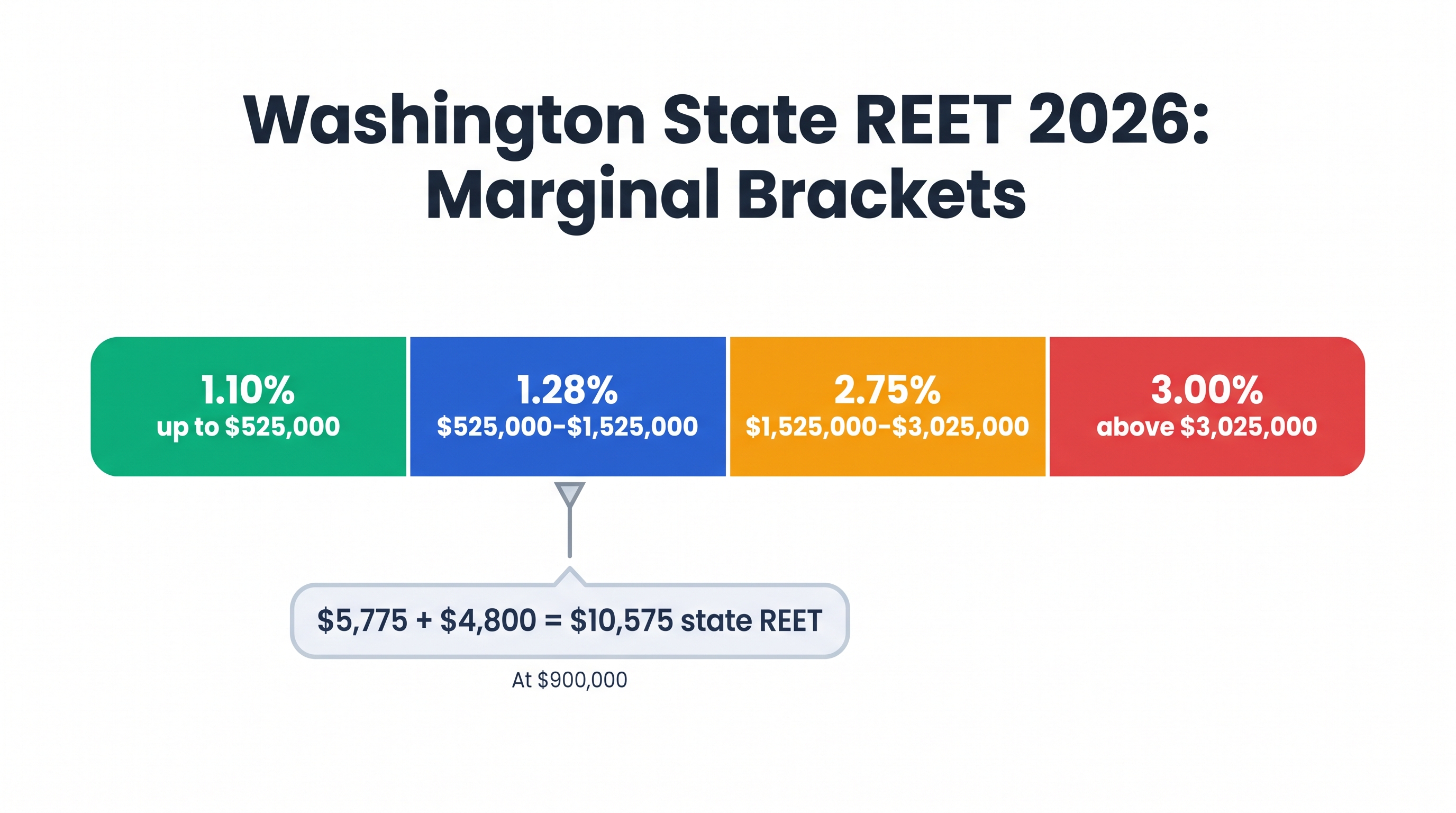
- Tier 1 (1.10%): Portion of the sale price up to $525,000
- Tier 2 (1.28%): Portion from $525,000.01 to $1,525,000
- Tier 3 (2.75%): Portion from $1,525,000.01 to $3,025,000
- Tier 4 (3.00%): Portion exceeding $3,025,000
DOR is required to adjust these brackets for inflation every four years. Confirm the current brackets on DOR's site before relying on them for a live transaction.
Local REET and Seller Liability
Many jurisdictions add local REET on top of the state tax, applied to the full sale price at rates that vary by county – check the DOR schedule for your area. Under RCW 82.45.080, REET is the seller's legal obligation, and under RCW 82.45.070 unpaid REET becomes a lien on the property. Under RCW 82.45.090, REET must be paid to the county treasurer before the deed can be recorded.
Worked REET Examples
Example 1 – $900,000 sale (Tier 2): Tier 1: $525,000 × 0.0110 = $5,775. Tier 2: ($900,000 − $525,000) = $375,000 × 0.0128 = $4,800. State REET subtotal: $10,575. Add an illustrative 0.50% local REET on the full price: $900,000 × 0.0050 = $4,500. Combined total: $15,075.
Example 2 – $2,000,000 sale (Tier 3): Tier 1: $525,000 × 0.0110 = $5,775. Tier 2: $1,000,000 × 0.0128 = $12,800. Tier 3: $475,000 × 0.0275 = $13,062.50. Total state REET: $31,637.50.
Exam Trap Alert: Never multiply the full price by the top marginal rate. Washington REET is graduated – each rate applies only to the dollar portion inside that bracket.
Proration Rules for Washington Closings
Prorations split recurring expenses – property taxes, HOA dues, rental income – between buyer and seller as of the closing date. Standard Washington practice follows NWMLS Form 21, which states that taxes, assessments, and dues are "prorated as of Closing." That's contract language, not statute, so always use your firm's current form.
Washington law doesn't dictate a 365-day calendar year versus a 360-day banker's year, or whether the buyer or seller owns the day of closing. Always check the exam prompt for both assumptions.
Worked Property Tax Proration Example
Annual property taxes of $7,300 are already paid in full. Closing is April 1 in a non-leap year (90 days elapsed through March 31). Daily rate: $7,300 / 365 = $20.00/day.
- Seller owns through the day before closing (90 days): Seller's share = 90 × $20 = $1,800. Buyer's share = 275 × $20 = $5,500. Buyer is debited $5,500; seller is credited $5,500.
- Seller owns through closing day (91 days): Seller's share = 91 × $20 = $1,820. Buyer's share = 274 × $20 = $5,480. Buyer is debited $5,480; seller is credited $5,480.
Remember the distinction: REET is a mandatory statutory seller obligation, while property tax proration is a contractual allocation set by the purchase and sale agreement.
Quick-Reference Formula Table and Common Exam Traps
| Concept | Core Formula | Key Exam Watchout |
|---|---|---|
| Loan-to-Value (LTV) | Loan Amount / Lesser of Price or Appraisal | Base it on the lower of sale price or appraised value. |
| Rate of Return | Annual Income / Total Investment | Divide net annual income by original cash invested. |
| Capitalization Rate | NOI / Property Value | Use NOI only – never gross rents or mortgage debt service. |
| Discount Points / Fees | Loan Amount × (Points × 0.01) | Multiply by the loan amount, never the purchase price. |
| Monthly PITI | P&I + (Taxes / 12) + (Insurance / 12) | Convert annual tax and insurance figures to monthly. |
| Homeowner Equity | Market Value − Total Liens | Deduct all outstanding liens and mortgage balances. |
| Seller Net Proceeds | Total Seller Credits − Total Seller Debits | Deduct payoff, commission, REET, and settlement costs. |
| Buyer Funds at Closing | Total Buyer Debits − Total Buyer Credits | Deduct loan proceeds and earnest money from debits. |
| Graduated State REET (2026) | 1.10% / 1.28% / 2.75% / 3.00% by bracket | Calculate marginal brackets incrementally – never flat-rate the whole price. |
| Acreage Conversion | 1 acre = 43,560 sq ft | Divide square footage by 43,560 – memorize this constant. |
| Closing Prorations | Daily Rate × Applicable Days | Check for 360- vs. 365-day year and closing-day ownership. |
Common Traps to Avoid
- Points on purchase price: applying points or origination fees to the purchase price instead of the loan amount.
- Flat-rate REET error: treating the graduated REET as one flat rate instead of calculating each bracket.
- Calendar day miscounts: assuming 30-day months when the prompt specifies a 365-day year.
- Gross vs. net income: using gross scheduled income instead of NOI for cap rate.
- Debit and credit reversals: flipping the debit/credit columns when solving for net proceeds or buyer cash.
A Five-Step Problem-Solving Framework
- Identify the objective: what is the prompt actually asking for – net proceeds, buyer funds, points, or REET?
- Write down the formula before you enter any numbers.
- Normalize units: convert annual figures to monthly, and square feet to acres, where needed.
- Calculate step by step, keeping decimals until the final rounding.
- Sanity-check the answer: does an LTV over 100% or negative net proceeds make sense? If not, recheck your work.
For more scenario-based practice beyond pure math, work through our 50 WA real estate practice exam questions with explanations.
Frequently Asked Questions
How much of the Washington real estate exam is math?
Real estate calculations make up about 7% of the 100 scored questions on PSI's national portion – roughly 7 questions. Related math also appears inside financing, valuation, and settlement questions. The state portion has no separate math category, though excise tax and proration questions show up in legal and regulatory items.
Can I use a calculator on the Washington broker exam?
Yes, at in-person PSI test centers you may bring a physical calculator and use provided scratch paper. Remote-proctored exams don't allow a physical calculator or scratch paper, so confirm what on-screen tools your session provides before exam day.
What is Washington's Real Estate Excise Tax rate in 2026?
Washington's state REET is graduated: 1.10% up to $525,000, 1.28% up to $1,525,000, 2.75% up to $3,025,000, and 3.00% above that. Local jurisdictions add their own REET on top, and every bracket is marginal, never flat.
How do you calculate seller net proceeds in a Washington closing?
Add the seller's total credits (sale price plus any prorations owed to them), then subtract total debits (mortgage payoff, commission, REET, and settlement charges). What's left is the seller's net proceeds – the same debit-and-credit format used on every settlement statement.
Is the math section hard to pass on the Washington broker exam?
Not with preparation. It's a small set of predictable formulas – LTV, cap rate, PITI, equity, prorations, and REET – reused across different numbers. Candidates who practice each formula with worked examples usually find math one of the most scorable sections on exam day.
Ready to Make Exam Math the Easy Part of Your Test?
You already know the formulas now – the next step is practicing them under real exam conditions. Our State Broker Exam Prep course walks through REET brackets, prorations, and Washington-specific math step by step, alongside the agency and legal topics the state portion tests. Questions about which prep course fits where you are? Call us at 425-775-2313 – a real person picks up.
Master Washington real estate exam math: REET brackets, LTV, PITI and settlement formulas. Try our free 76-question practice exam today.