Preparing for the Washington state real estate licensing exam is a critical milestone. Before assisting buyers and sellers, you must understand national principles and Washington specific laws. The industry operates under strict regulations to protect consumers.
Administered by PSI, the exam tests your knowledge thoroughly. It includes 100 national and 30 state specific questions. You have 3.5 hours (210 minutes) to complete it. To pass, you must score at least 70 on each section.
Passing requires dedicated study of the state legal landscape, governed by the Department of Licensing (DOL) and the Real Estate Commission. This practice exam provides 50 questions mapped to the PSI outline.
1. Licensing and Regulation
This section evaluates knowledge of license laws and state land use policies. Understand the roles of the DOL Director and the Real Estate Commission, plus requirements for obtaining and renewing licenses. Washington uses a tiered system: Broker, Managing Broker, and Designated Broker. Pay attention to continuing education, deadlines, and penalties for unlicensed activity.
1. Aspiring Broker David has completed his pre-licensing education. According to Washington law, how many hours of approved courses must he complete before taking the broker exam?
A) 60 hours of real estate fundamentals
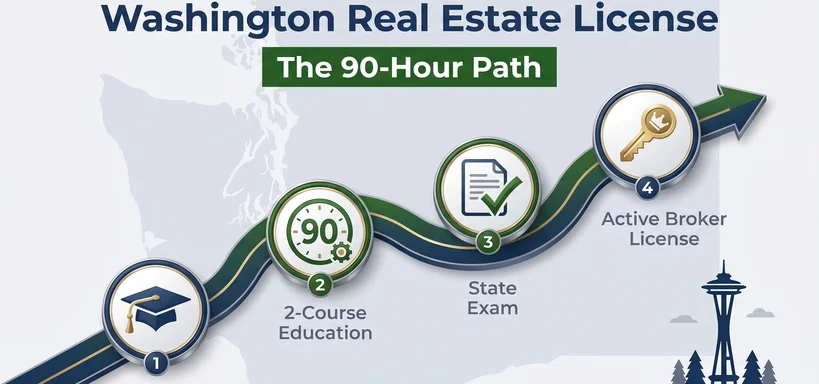
B) 90 hours, including fundamentals and practices
C) 120 hours, including property management
D) 150 hours, with a real estate law module
Answer: B
Explanation: Applicants for a broker license must complete 90 hours of instruction (60-hour fundamentals, 30-hour practices) within two years before applying.
2. Broker Sarah just received her initial Washington real estate broker license. How many hours of continuing education must she complete for her FIRST license renewal?
A) 30 hours
B) 60 hours
C) 90 hours
D) 120 hours
Answer: C
Explanation: First time broker renewals require 90 hours of continuing education (advanced practices, real estate law, core course). Subsequent renewals require 30 hours.
3. An unlicensed assistant hosts an open house and negotiates a minor counteroffer. Under Washington law, what is the penalty for this unlicensed activity?
A) A civil fine not exceeding $1,000
B) A Class C felony
C) A gross misdemeanor
D) A simple misdemeanor
Answer: C
Explanation: Acting as a broker without an active license is a gross misdemeanor. The DOL Director may issue a cease and desist order.
4. Who is responsible for administering the Washington state real estate licensing exam?
A) The Washington Real Estate Commission
B) The Department of Licensing (DOL)
C) PSI Services
D) The National Association of Realtors
Answer: C
Explanation: The DOL regulates the industry, but PSI Services administers the licensing exam.
5. The Washington Real Estate Commission serves in an advisory capacity. It consists of the Director of the DOL and how many appointed commission members?
A) 3
B) 6
C) 9
D) 12
Answer: B
Explanation: The Commission consists of the Director and six members appointed by the Governor to advise on real estate matters.
6. How many years of full-time real estate experience within the last five years are minimally required for a Broker to upgrade to a Managing Broker license?
A) 1 year
B) 2 years
C) 3 years
D) 5 years
Answer: C
Explanation: Upgrading to Managing Broker requires three years of full-time experience within the past five years and 90 hours of education.
7. A broker decides to place their license on inactive status while traveling abroad. How long can a Washington broker license remain inactive?
A) 1 year
B) 2 years
C) 3 years
D) Indefinitely, provided renewal fees are paid every 2 years, though CE is not required
Answer: D
Explanation: A license can remain inactive indefinitely if renewal fees are paid every two years. Continuing education is not required for inactive status.
8. Which license tier in Washington holds the ultimate legal authority and responsibility for all real estate activities of a firm?
A) Broker
B) Managing Broker
C) Designated Broker
D) Branch Manager
Answer: C
Explanation: The Designated Broker holds the firm license endorsement and bears ultimate responsibility for all personnel.
9. Under Washington Growth Management Act (GMA), what is the primary purpose of designating Urban Growth Areas (UGAs)?
A) To eliminate all zoning restrictions outside city limits
B) To encourage unchecked suburban sprawl
C) To concentrate urban growth, prevent sprawl, and protect rural land and natural resources
D) To strictly prohibit any new residential development statewide
Answer: C
Explanation: The Growth Management Act requires rapidly growing areas to develop comprehensive plans. Urban Growth Areas concentrate development, reduce sprawl, and protect rural lands.
2. Agency and Brokerage Relationships
Agency relationships are heavily governed in Washington. As of January 1, 2024, brokers must enter into a clear, written services agreement to represent any party. This eliminates default agency and ensures transparency. Understand limited dual agency, statutory duties, and when to deliver the agency pamphlet. Vicarious liability and imputed knowledge are also tested.
10. As of January 1, 2024, Washington law updated agency rules. If Broker Emily wants to legally represent a buyer and secure compensation, what must she do?
A) Make a verbal agreement
B) Have the buyer sign the agency pamphlet
C) Enter into a written services agreement
D) Sign a dual agency disclosure
Answer: C
Explanation: Brokers must enter into a written services agreement to represent a buyer or seller, outlining services and compensation.
11. Broker Alex is listing a property for Seller Ben. A buyer whom Alex also formally represents wishes to make an offer on Ben house. What type of agency relationship is this?
A) Illegal Dual Agency
B) Limited Dual Agency
C) Designated Agency
D) Transaction Brokerage
Answer: B
Explanation: This is Limited Dual Agency, legal in Washington only if both buyer and seller provide prior written consent.
12. When must a broker provide the Washington pamphlet The Law of Real Estate Agency to a consumer?
A) At the closing table
B) Before the party signs an agency agreement, signs an offer, or consents to dual agency
C) Within 3 days of mutual acceptance
D) Only if the consumer explicitly asks for it
Answer: B
Explanation: The pamphlet must be given to all parties before they sign any agreement, offer, or consent to limited dual agency.
13. Vicarious liability refers to a principal responsibility for the actions of their agent. Under Washington law, when is a client liable for the acts of their real estate broker?
A) Always, since the broker acts on their behalf
B) Never, brokers bear sole liability
C) Only if the client participated in or authorized the act, error, or omission
D) Only in commercial transactions
Answer: C
Explanation: Washington limits vicarious liability. A client is not liable for their broker actions unless they participated in or authorized the conduct.
14. Even if a broker does not represent a consumer in a transaction, they still owe certain statutory duties to that party. Which duty is owed to ALL parties?
A) To deal honestly and in good faith
B) To provide a comparative market analysis
C) To disclose all confidential information
D) To guarantee financing
Answer: A
Explanation: Loyalty and confidentiality are owed to a principal, but the duty to deal honestly and in good faith is owed to all parties.
15. Broker Chloe represents Buyer Dan. Chloe learns the seller of a home Dan likes is facing foreclosure and is desperate to sell, but does not tell Dan. Has Chloe violated her duties?
A) No, she must protect the seller confidentiality
B) No, foreclosure status is not a material fact
C) Yes, she breached her duty of loyalty and disclosure to her principal
D) Yes, but only if the seller authorized disclosure
Answer: C
Explanation: A broker must disclose all known facts that materially affect the transaction or the principal ability to perform, acting in their client best interest.
16. The concept of imputed knowledge presumes that what an agent knows, the principal knows. How does Washington law view imputed knowledge in real estate?
A) It applies to all residential transactions
B) It applies only to limited dual agency
C) Washington abolishes the common law rule of imputed knowledge
D) It applies strictly to commercial property
Answer: C
Explanation: Washington law states a principal does not have imputed knowledge of facts known by the broker that are not actually known by the principal.
17. Broker Frank shows a property to a prospective buyer but does not have a written services agreement with them. Under current Washington law, who does Frank represent?
A) The Buyer by default
B) The Seller by default
C) No one
D) The Listing Broker
Answer: C
Explanation: Following 2024 changes, default buyer agency was eliminated. A broker represents no one until a written services agreement is executed.
18. Which of the following events would NOT automatically terminate an agency relationship in Washington?
A) The death of the principal
B) The broker moving their personal residence to a new city
C) The expiration of the written services agreement
D) The mutual agreement of both parties
Answer: B
Explanation: Agency terminates by fulfillment, expiration, mutual consent, or death. Changing a personal residential address does not sever the relationship.
3. Contracts and Transactions
This section focuses on binding agreements and handling client funds. Brokers must deposit trust funds no later than the next banking day following mutual acceptance or receipt. Mismanagement can result in license revocation. You will be tested on the Statute of Frauds, contract elements, mutual acceptance, and liquidated damages limits.
19. Broker Greg receives an earnest money check from his buyer after mutual acceptance of a contract on a Tuesday. What is the deadline for depositing this earnest money?
A) Within 24 hours of offer submission
B) By the end of business on Friday
C) The next banking day following mutual acceptance or receipt of funds
D) Within 3 business days
Answer: C
Explanation: Brokers must deposit earnest money checks into the firm trust account or escrow account no later than the next banking day.
20. If a broker intentionally deposits a client earnest money check into their personal checking account to cover office rent, this illegal act is known as what?
A) Commingling
B) Conversion
C) Embezzlement
D) Misrepresentation
Answer: B
Explanation: Commingling is mixing funds. Conversion is the serious offense of spending trust funds for unauthorized expenses.
21. In Washington, when a brokerage holds an earnest money deposit of $10,000 or less, where must these funds be deposited?
A) The broker business operating account
B) A pooled interest-bearing trust account where interest is remitted to state housing and education funds
C) A non-interest bearing escrow account
D) An account designated solely by the buyer
Answer: B
Explanation: Trust funds of $10,000 or less must go into a pooled interest-bearing account. Interest is split 75% to the Housing Trust Fund and 25% to the Real Estate Education Program.
22. A buyer wishes to use a promissory note instead of a cash check as earnest money. Is this allowed in Washington, and if so, what is required?
A) It is strictly illegal in all transactions
B) It is allowed only if the note is less than $1,000
C) It is allowed, provided the seller is informed before accepting the offer
D) It is allowed without any special disclosures
Answer: C
Explanation: Promissory notes or personal property can serve as earnest money if explicitly disclosed to the seller prior to acceptance.
23. Which of the following is required for a real estate purchase contract to be legally enforceable under the Statute of Frauds?
A) A 10% earnest money deposit
B) A home inspection contingency
C) It must be in writing and contain an adequate legal description
D) It must be notarized by the county clerk
Answer: C
Explanation: The Statute of Frauds requires real estate contracts to be in writing, signed by bound parties, and include a proper legal description.
24. Broker Lisa wants to act as the closing agent for a transaction she successfully brokered. What must she ensure to do this legally in Washington?
A) She must charge a fee of at least $500
B) She must be a Designated or Managing Broker and cannot receive extra compensation for the escrow services
C) She must transfer her license to an escrow company
D) Brokers can never act as closing agents
Answer: B
Explanation: Brokers may perform escrow acts incidental to their transactions but cannot receive extra compensation without a separate escrow license.
25. A seller receives a buyer offer, changes the closing date, initials the change, and sends it back to the buyer. What is the legal status of this newly modified document?
A) It is a binding contract
B) It is a counteroffer, which terminates the original offer
C) It is an addendum
D) It is a breach of contract
Answer: B
Explanation: Any alteration to original terms constitutes a counteroffer, which legally rejects and terminates the original offer.
26. In a standard Washington real estate transaction, what precisely defines mutual acceptance?
A) When the buyer drafts the offer
B) When the seller receives the offer
C) When all parties have agreed to all terms in writing and that acceptance is communicated back to the offeror
D) When the earnest money clears the bank
Answer: C
Explanation: Mutual acceptance occurs when all terms are accepted in writing by all parties and communicated back to the offeror.
27. A purchase and sale agreement includes a liquidated damages clause. If the buyer defaults, what is the maximum earnest money the seller can retain under Washington safe harbor limit?
A) 3% of the purchase price
B) 5% of the purchase price
C) 10% of the purchase price
D) No limit
Answer: B
Explanation: Washington law allows a seller to retain up to 5% of the purchase price as liquidated damages if a buyer defaults.
4. Property Ownership and Transfer
Washington is a community property state. Property acquired during marriage is generally community property, while property acquired before marriage or via inheritance is separate. Understand the types of deeds. The Statutory Warranty Deed offers the greatest protection, and the Quitclaim Deed offers the least. Other topics include recording deeds, title insurance, and co-ownership.
28. Washington is a community property state. If a married individual purchases a rental home using funds earned entirely from their personal salary during the marriage, how is the property classified?
A) Separate property
B) Community property
C) Joint property
D) Tenancy in common
Answer: B
Explanation: Wages earned during marriage are community assets, making property purchased with those funds community property.
29. A wife inherits a waterfront condo directly from her deceased uncle estate while she is married. How is this property classified under Washington law?
A) Community property
B) Joint tenancy
C) Separate property
D) Trust property
Answer: C
Explanation: Property acquired during marriage by gift or inheritance is legally classified as separate property.
30. Which type of deed provides the greatest liability protection to the buyer in Washington by including absolute covenants against all past encumbrances?
A) Quitclaim Deed
B) Bargain and Sale Deed
C) Special Warranty Deed
D) Statutory Warranty Deed
Answer: D
Explanation: The Statutory Warranty Deed gives maximum protection. The grantor warrants the title against all defects arising before and during their ownership.
31. A property owner in Spokane needs to quickly transfer ownership of their home to their daughter and wants to clear a minor cloud on the title without making any guarantees. Which deed is most appropriate?
A) Statutory Warranty Deed
B) Quitclaim Deed
C) Trust Deed
D) Executor Deed
Answer: B
Explanation: A Quitclaim Deed transfers whatever interest the grantor holds without offering warranties about title validity.
32. Two unmarried friends purchase a cabin. They want to ensure that if one dies, their share automatically passes to the surviving friend without going through probate. How should they take title?
A) Tenancy in Common
B) Joint Tenancy with Right of Survivorship
C) Community Property
D) Severalty
Answer: B
Explanation: Joint Tenancy includes the right of survivorship. Upon death, ownership automatically transfers to the surviving co-owner outside probate.
33. In Washington, what is the primary legal purpose of recording a deed at the local county auditor office?
A) To calculate property taxes
B) To provide constructive notice to the public of the ownership change
C) To make the deed legally valid between the buyer and seller
D) To secure the mortgage loan
Answer: B
Explanation: Recording a deed creates a public record, providing constructive notice regarding ownership and establishing priority.
34. A standard owner title insurance policy is typically paid for by the seller in Washington. What does this standard policy generally protect the buyer against?
A) Future zoning changes
B) Undiscovered defects in the public record, such as forged documents
C) Unpaid future property taxes
D) Physical damage from natural disasters
Answer: B
Explanation: Title insurance protects against financial loss from pre-existing but undiscovered title defects, like forged deeds.
5. Financing and Valuation
Understand how purchases are funded and properties appraised. Washington is a lien theory state using Deeds of Trust. This creates a lien and allows for non-judicial foreclosure. Know the roles of the trustor (borrower), beneficiary (lender), and trustee (neutral third party). Calculate Loan-to-Value (LTV) ratios and distinguish FHA from VA loans. Valuation covers the Sales Comparison, Income, and Cost Approaches.
35. Washington primarily uses Deeds of Trust for real estate financing. In this specific legal document, who is the trustor?
A) The borrower
B) The lender
C) The neutral third party
D) The closing agent
Answer: A
Explanation: In a Deed of Trust, the borrower is the trustor, the lender is the beneficiary, and the neutral third party is the trustee.
36. What is a major advantage for lenders using a Deed of Trust over a traditional mortgage in Washington state?
A) It guarantees government backing
B) It allows for a non-judicial foreclosure process
C) It prevents the borrower from refinancing
D) It eliminates property taxes
Answer: B
Explanation: A Deed of Trust includes a power of sale clause allowing the trustee to foreclose without filing a lawsuit.
37. A buyer purchases a home for $500,000 and secures a loan for $400,000, paying the rest in cash. What is the Loan-to-Value (LTV) ratio?
A) 70%
B) 80%
C) 90%
D) 100%
Answer: B
Explanation: The LTV ratio is the loan amount divided by the purchase price ($400,000 / $500,000 = 0.80, or 80%).
38. An appraiser is valuing a standard single-family residential home in a suburban neighborhood. Which appraisal approach is most appropriate and commonly used?
A) Income Approach
B) Cost Approach
C) Sales Comparison (Market Data) Approach
D) Capitalization Approach
Answer: C
Explanation: The Sales Comparison Approach estimates value by comparing the property to recently sold similar properties. It is preferred for residential housing.
39. When appraising a 30-unit apartment building, an appraiser focuses heavily on the property ability to generate steady rental income. Which approach is this?
A) Sales Comparison Approach
B) Income Approach
C) Cost Approach
D) Gross Rent Multiplier
Answer: B
Explanation: The Income Approach calculates the present value of future net income. It is the primary method for commercial investment properties.
40. Which of the following statements best describes the key difference between FHA and VA loans?
A) FHA loans are guaranteed, while VA loans are uninsured
B) FHA insures loans made by approved lenders, while the VA guarantees a portion of the loan
C) VA loans require a 20% down payment
D) FHA loans are only for veterans
Answer: B
Explanation: The FHA provides mortgage insurance to protect lenders. The VA guarantees a specific portion of the loan for eligible veterans.
41. According to the Truth in Lending Act, if a real estate advertisement contains a trigger term, full financial disclosure is required. Which of the following is considered a trigger term?
A) Beautiful historic home
B) Only $1,500 down!
C) Great neighborhood for families
D) Seller highly motivated
Answer: B
Explanation: Stating a specific financing figure, like the exact down payment, triggers the requirement to disclose all other financing terms.
6. Fair Housing and Disclosures
Protecting consumer rights is a priority. Know federally protected classes and the Washington Law Against Discrimination, which adds sexual orientation and veteran status. Disclosure laws include the Seller Disclosure Statement (Form 17). Buyers have a three-business-day window to rescind their offer. Brokers must disclose all known material facts that adversely affect the property.
42. The Washington Law Against Discrimination includes protected classes not explicitly covered by federal law. Which of the following is protected under Washington state law but NOT federal fair housing law?
A) Race and Color
B) Religion
C) Sexual orientation and veteran/military status
D) Familial status
Answer: C
Explanation: Federal law protects race, color, religion, national origin, sex, disability, and familial status. Washington adds sexual orientation and honorably discharged veteran status.
43. In Washington, sellers of residential property must provide a Seller Disclosure Statement (Form 17). What is the buyer right regarding this form?
A) The buyer cannot cancel the contract based on the form
B) The buyer has 3 business days to review the form and may rescind the agreement for any reason during this period
C) The buyer has 10 days to demand repairs
D) The form is entirely optional and rarely used
Answer: B
Explanation: Upon receipt of Form 17, the buyer has a three-business-day rescission period to cancel the agreement and recover earnest money without penalty.
44. Under the Washington Residential Landlord-Tenant Act, how long does a landlord have to return a tenant security deposit or provide a written statement accounting for any retained funds after the tenant vacates?
A) 14 days
B) 21 days
C) 30 days
D) 45 days
Answer: C
Explanation: A landlord has 30 days from the end of the rental agreement and vacation of the premises to refund the deposit or provide an itemized statement.
45. A broker is listing a house where a highly publicized, tragic murder took place. Under Washington law, is the murder considered a material fact that the broker must proactively disclose?
A) Yes, all crimes must be disclosed
B) Yes, because it affects the property reputation
C) No, stigmatized property facts are not considered material facts under Washington law
D) Only if the buyer asks in writing
Answer: C
Explanation: Psychological stigmas, such as murder or suicide, are not material facts affecting physical condition and do not require proactive disclosure.
46. Broker Sam notices severe, hidden water damage in the basement of a listing, but the seller instructs Sam not to mention it to buyers. What must Sam do?
A) Obey the seller to maintain loyalty
B) Disclose the damage, as brokers must disclose known material facts that adversely affect the property
C) Cancel the listing immediately
D) Conceal the damage with furniture
Answer: B
Explanation: A broker duty to deal honestly and disclose known adverse material facts supersedes client instructions to conceal defects.
7. Practice and Supervision
This section examines operational rules. Brokerages face strict recordkeeping requirements. Transaction records must be maintained for at least three years. Advertising must clearly display the licensed name of the brokerage firm. A Designated Broker holds ultimate responsibility but may delegate supervisory tasks, like reviewing contracts within five business days, to Managing Brokers.
47. According to Washington law, how long must a real estate brokerage retain all transaction records, including rejected offers?
A) 1 year
B) 3 years
C) 5 years
D) 7 years
Answer: B
Explanation: Washington law mandates brokerages retain all real estate transaction records, client files, and trust account documents for a minimum of three years.
48. A Washington broker decides to run a targeted social media ad for a new listing. What information MUST be clearly included in all real estate advertising?
A) The broker home address
B) The firm licensed name as registered with the DOL
C) The exact commission rate
D) The seller phone number
Answer: B
Explanation: All real estate advertising must clearly and conspicuously display the licensed name of the brokerage firm.
49. A Washington broker successfully lists and sells a home for $600,000. The listing agreement specifies a total commission of 6%, to be split equally between the listing firm and the selling firm. The listing broker is on a 70/30 split with their firm (the broker keeps 70%). What is the listing broker net commission before taxes?
A) $12,600
B) $18,000
C) $25,200
D) $36,000
Answer: A
Explanation: Total commission: $600,000 × 6% = $36,000. Split equally: $36,000 / 2 = $18,000 to the listing firm. Apply 70% split: $18,000 × 0.70 = $12,600.
50. Managing Broker Tom is officially delegated the task of reviewing all contracts for his branch office. Within what timeframe must he review transaction documents drafted by affiliated brokers?
A) Within 24 hours
B) Within 5 business days of mutual acceptance
C) Before the closing date
D) Within 30 days
Answer: B
Explanation: When delegated supervisory duties, a Managing Broker must review all transaction documents within five business days of mutual acceptance.
Exam Day Tips and Conclusion
Success comes from consistent preparation and sound test taking strategies. Prioritize rest the night before. Read every question carefully, as exam writers include extra information to distract you. Watch for absolute language like always or never.
Do not linger on difficult questions. Use the flag feature and return later. Answer every question, as there is no penalty for guessing. By understanding written services agreements, earnest money rules, community property laws, and agency duties, you will be ready to pass. Review these 50 questions until the concepts are second nature. Best of luck on your journey to becoming a licensed Washington state real estate Broker.
Practice 50 Washington real estate exam questions with full explanations, mapped to PSI's 140-question format. Test your readiness before exam day.