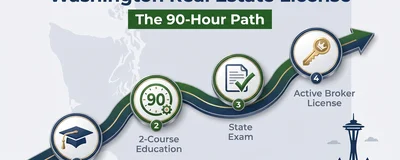
Washington's 90-hour pre-license requirement splits into two courses with different jobs: 60 hours of Fundamentals, which teaches you the legal rules governing agency, property, contracts, and fair housing, and 30 hours of Practices, which teaches you to apply those rules in real transactions. Below are sample lessons from both, plus how to study them for the PSI exam.
These sample lessons come from our courses. The sample questions and tasks are illustrative, not actual exam items.
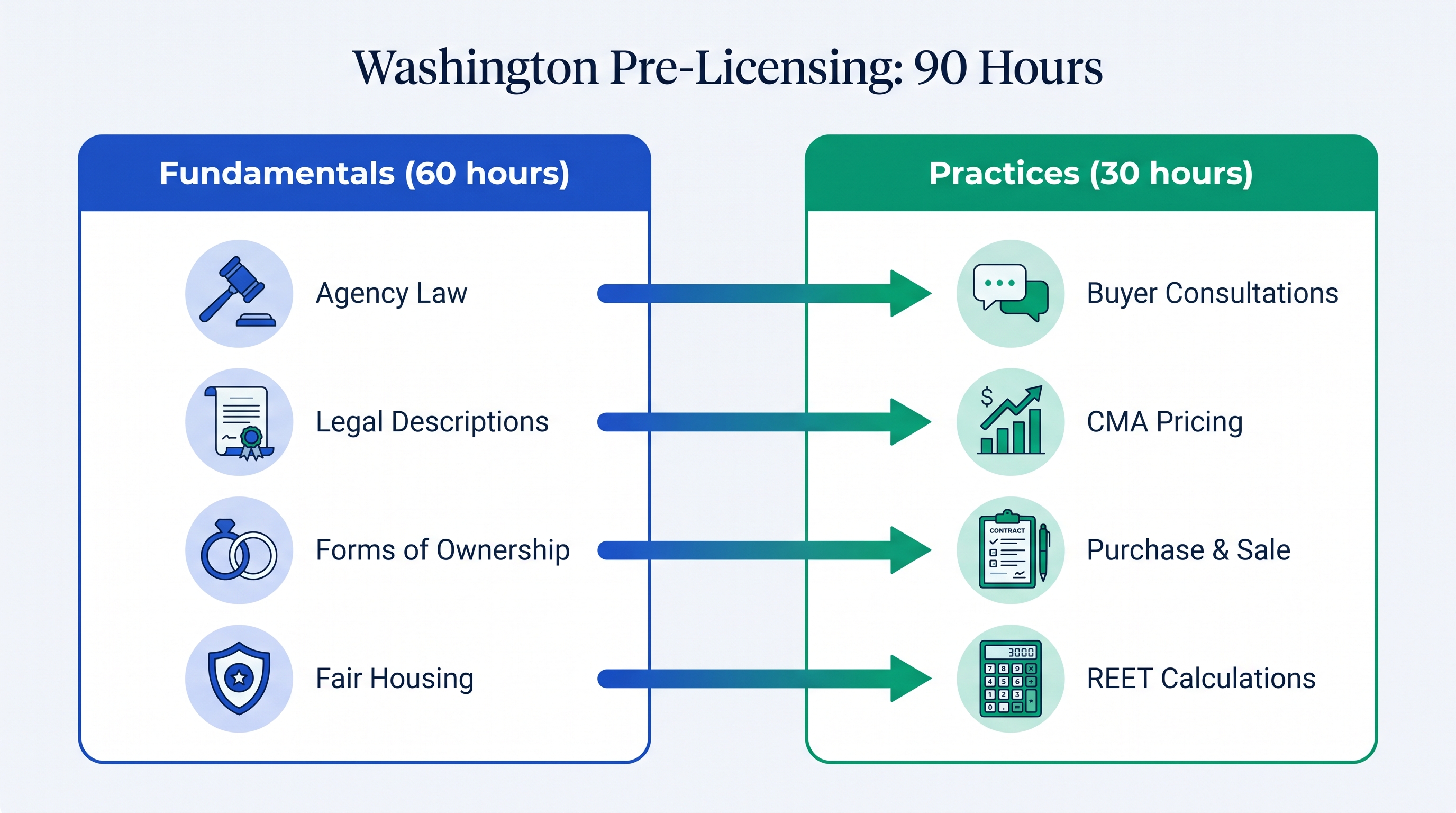
- Washington's 90-hour pre-license course splits into Fundamentals (60 hours, the legal rules) and Practices (30 hours, applying them to real transactions).
- Complete both within two years of applying to test, then pass the national and state exam portions within six months of each other.
- Fundamentals covers ownership, legal descriptions, agency law, and fair housing; Practices covers buyer consultations, pricing, purchase agreements, and REET math.
- Washington's Law Against Discrimination protects more classes than federal fair housing law alone.
- Work REET and proration calculations by hand until they're automatic — the exam won't walk you through the steps.
Washington's 90-Hour Pre-License Path, Explained
Complete both courses within two years before applying to take the exam. Pass the state and national portions within six months of each other. After passing, apply for your license within one year. If you want the full step-by-step, including fingerprinting and the DOL application, our guide to getting a Washington real estate license walks through every stage in order.
Students sometimes assume the two courses map one-to-one onto the two exam portions. They don't. Fundamentals and Practices are education requirements; the national and state exam portions test both bodies of knowledge together. For a full breakdown of every requirement, deadline, and fee, see our complete 2026 Washington license requirements checklist.
Fundamentals: Four Sample Lessons From the 60-Hour Course
1. Forms of Ownership
For community real property, the other spouse or registered domestic partner must join in executing a deed or encumbrance. Property acquired before marriage, by gift, or by inheritance may be separate property. If ownership is uncertain, refer the question to your Managing Broker, a title company, or an attorney. For example, a married seller lists a home titled only in her name — both spouses must still sign the deed.
2. Legal Descriptions
Land can be described by government (rectangular) survey using section, township, and range; by metes and bounds; or by lot and block. A street address or tax parcel number isn't a legal description. For example: “Lot 7, Block 3, Sunrise Addition, as recorded in Volume 12 of Plats, page 34, records of King County.” That recorded lot-and-block description is legal, unlike an address, a parcel number, or “the blue house on the corner.”
3. Agency Law
A firm must enter a services agreement with a client before, or as soon as reasonably practical after, the Broker begins providing services. A narrow exception applies to a buyer's agent working only in commercial real estate. Deliver the pamphlet titled Real Estate Brokerage in Washington before the party signs. State law supersedes an agent's common-law fiduciary duties to a principal; compensation alone doesn't establish agency. A seller paying the buyer's Broker doesn't alone make that Broker the seller's agent.
4. Fair Housing
Washington's Law Against Discrimination covers federal protected classes and adds protections for citizenship or immigration status, sexual orientation, marital status, and honorably discharged veteran or military status. It also protects families with children and people with disabilities, including people who use a trained guide dog or service animal. Fundamentals includes three hours of fair housing and consumer protection. An ad saying “Quiet building, no children” is discriminatory unless the property qualifies for a housing-for-older-persons exemption.
While you're studying Fundamentals: agency law and fair housing are two of the most heavily tested topics on the state portion of the exam. Our State Broker Exam Prep course drills the RCWs, WACs, and agency scenarios Fundamentals introduces, so the rules are second nature before exam day.
Practices: Four Sample Lessons From the 30-Hour Course
1. Agency Relationships
At a buyer consultation, deliver the pamphlet, document receipt, then complete the buyer services agreement. The agreement must state its term. The buyer term defaults to 60 days, with a longer term allowed. It addresses exclusivity and compensation. Consent to limited dual agency must be initialed separately.

Practice task: Script the first ten minutes of a buyer consultation.
2. Pricing Property
A comparative market analysis (CMA) is a Broker's opinion, not an appraisal. The Department of Licensing curriculum requires students to distinguish between them. Adjusted comparable sales of $850,000, $865,000, and $875,000 support a range of roughly $850,000 to $875,000. Document the reasoning in writing. Practice task: explain that range to a seller who wants a $925,000 list price.
3. Purchase and Sale Agreements
NWMLS Form 21 covers the main terms of a residential sale: parties, legal description attached as Exhibit A, price, earnest money, financing and other contingencies, closing, and possession. Forms change periodically, so review current versions. Practices also teaches Brokers to recognize unauthorized practice of law and refer legal questions to the Managing Broker or an attorney. Practice task: if a client asks you to draft a custom easement clause, respond appropriately.
4. Real Estate Calculations
Washington's base real estate excise tax (REET) thresholds are $500,000 and $1.5 million, adjusted by the Department of Revenue every four years. For sales from January 1, 2023, through December 31, 2026, published thresholds are $525,000 and $1,525,000. The seller pays REET. For a $1,000,000 sale, state REET is calculated as follows:
- $525,000 × 1.10% = $5,775
- $475,000 × 1.28% = $6,080
The state total is $11,855. Add the applicable local REET to the state amount; the local rate varies by location. Check the Department of Revenue's thresholds for closings after December 31, 2026. If REET math feels shaky, our guide to REET calculations and settlement worksheets walks through more worked examples.
How Fundamentals and Practices Work Together
Fundamentals defines agency, property, contract, and fair-housing rules; Practices applies them through consultations, pricing, forms, and closing calculations. Neither course stands alone — the exam and your first transactions under a Managing Broker's supervision both draw on both.
How to Study for Both Courses
Pair each rule with a scenario and rehearse the matching procedure. When explaining answers, identify the relevant statute, especially for agency. Work REET and proration calculations by hand until you can do them without a calculator. Check the latest Department of Licensing curriculum documents and current forms.
Once you've worked through both courses, test what's actually stuck. Our 50 WA practice exam questions with explanations are a quick way to spot weak spots in agency law, fair housing, or math before you schedule the real thing.
Frequently Asked Questions
What's the difference between Fundamentals and Practices in Washington's pre-license course?
Fundamentals is the 60-hour portion covering legal rules — agency law, fair housing, contracts, and ownership. Practices is the 30-hour portion that teaches you to apply those rules through buyer consultations, pricing, purchase agreements, and closing calculations. Together they make up Washington's required 90-hour pre-license education.
How many hours are Fundamentals and Practices in Washington?
Fundamentals is 60 clock hours and Practices is 30 clock hours, for a total of 90 hours required before you can sit for the Washington broker exam. You must complete both within two years of applying to test.
Do I need to pass Fundamentals and Practices separately?
You complete both courses, but the state exam has two portions — national and state — rather than one exam per course. You must pass both portions within six months of each other, then apply for your license within one year of passing.
What topics does Practices cover that Fundamentals doesn't?
Practices applies Fundamentals' legal concepts to real transactions: buyer consultations, comparative market analyses, NWMLS Form 21 purchase agreements, and REET calculations. Fundamentals teaches what the rules are; Practices teaches how to use them with real clients and paperwork.
How is Washington's real estate excise tax (REET) calculated?
REET is a graduated state tax paid by the seller, with thresholds and rates set by the Department of Revenue, plus a local REET that varies by location. Practices teaches you to calculate it by hand using current rates — always verify current thresholds before your exam.
Ready to Master Washington's 90-Hour Course?
Fundamentals gives you the legal framework; Practices teaches you to apply it with clients. Master both for the exam and for your first transactions under a Managing Broker's supervision. Check your readiness with our free Washington real estate practice exam, or go deeper with the National Broker Exam Prep course for the 2,000+ practice questions and attorney-led cram video that tie Fundamentals and Practices together.
Questions? Call us at 425-775-2313 — a real person picks up.
See real sample lessons from WA's 90-hour Fundamentals and Practices courses, including REET math and agency law. Try our free practice exam.