What Is Active Listening in Washington Real Estate Compliance?
Active listening turns a buyer’s passing comment or a seller’s hesitation into the specific duties Washington law requires you to perform: disclosure, loyalty, confidentiality, and a written agreement under Chapter 18.86 RCW. When you ask diagnostic questions and reflect a client’s answers back before acting, you convert vague client discovery into documented, defensible representation.
Washington’s brokerage law has changed twice in three years. SSB 5191 made written buyer and seller agreements mandatory starting in 2024, and SSB 6091 adds a public-marketing requirement effective June 11, 2026. National research backs up why structured discovery matters: in the National Association of REALTORS® 2025 Profile of Home Buyers and Sellers, half of buyers said they hired an agent specifically to help find the right home, while sellers prioritized marketing, pricing, and closing timelines. Active listening is the bridge between what a client tells you and what the statute requires you to do about it.
- Active listening operationalizes your non-waivable duties under RCW 18.86.030, .040, and .050 — reasonable skill and care, loyalty, and continuous effort.
- Washington requires written brokerage services agreements for buyers and sellers under RCW 18.86.020, before or as soon as practical after services begin.
- RCW 18.86.130, effective June 11, 2026, requires public marketing of residential listings unless a narrow health or safety exception applies.
- Fair housing law (RCW 49.60.222) lets you share objective crime and school data, but never subjective labels or assumptions based on a client’s protected traits.
- WAC 308-124C sets firm deadlines for submitting agreements to your managing broker — two business days normally, five for brokers licensed under two years.
Before any of that paperwork starts, the relationship starts with a conversation. Getting that first conversation right — what you disclose, what you ask, and in what order — shapes everything that follows. Our guide on onboarding new clients compliantly walks through that first-meeting sequence in more detail.
How Active Listening Fulfills Your Chapter 18.86 RCW Duties
Washington brokerage relationships are statutory, not common-law, and they’re spelled out in RCW 18.86.110. Active listening is simply how you carry those duties out in a real conversation:
- Reasonable skill, care, and disclosure (RCW 18.86.030(1)): Every broker owes every party a non-waivable duty to exercise reasonable skill and care, deal honestly, and disclose known material facts that aren’t readily apparent. Diagnostic listening surfaces those facts early, instead of after an offer is already on the table.
- Loyalty and continuous effort (RCW 18.86.040 & .050): A buyer’s broker can’t take action detrimental to the buyer and must keep searching continuously. A seller’s broker owes the same loyalty and continuous marketing. You can’t fulfill either duty without understanding what the client actually wants — not just what they said in the first five minutes.
- Advising clients to get expert help (RCW 18.86.040(1)(c) & .050(1)(c)): When a client raises something outside your expertise — a crack in the foundation, a tax question — your job is to recommend a licensed inspector, engineer, or attorney in writing, not to guess.
- Confidentiality that survives closing (RCW 18.86.040(1)(d), .050(1)(d), & .070(2)(b)): Clients regularly disclose financial pressure or personal circumstances during discovery. That confidentiality duty doesn’t expire when the transaction closes or falls through — active listening helps you flag sensitive information the moment it surfaces, so you don’t slip later.
Written Brokerage Services Agreements for Buyers and Sellers
RCW 18.86.020 requires a written brokerage services agreement with any principal before, or as soon as practical after, services begin.
Buyer Representation Agreements
Under RCW 18.86.020(2)(b) and RCW 18.86.080, buyer agreements must include:
- Duration: A default term of 60 days, unless both parties agree to longer.
- Broker appointment: The specific appointed broker, named.
- Exclusivity: Whether representation is exclusive or nonexclusive.
- Limited dual agency: Separate, initialed consent under RCW 18.86.060.
- Compensation: Amounts, fee sharing, and whether the broker will show properties that offer no compensation, per RCW 18.86.080(7)(b).
Active listening eases onboarding anxiety here. If a buyer hesitates to sign before touring, a good broker asks what’s behind the hesitation — a bad past experience, worry about being locked in — and explains that the agreement actually protects them by defining duties and compensation up front.
Seller Representation Agreements
Listing agreements follow the same rule: executed before or as soon as practical after services begin, covering term, appointed broker, exclusivity, dual agency consent, and compensation. Listening closely to a seller’s real timeline and pricing expectations — not just their stated asking price — makes sure the marketing plan actually matches what they need. For the full pamphlet-and-agreement sequence, see our walkthrough of pamphlet delivery and services agreement onboarding.
Keep your CE on track: Washington requires 30 hours of continuing education every renewal cycle, including Core and Fair Housing. Review Washington’s CE renewal requirements so skills like these count toward your next deadline, not just your next transaction.
Fair Housing and Public Marketing Guardrails for Client Discovery
Good discovery can tip into a fair housing problem fast if you’re not careful about where the questions lead.
Crime Data, School Metrics, and Fair Housing Law
Under the Washington Law Against Discrimination (RCW 49.60.222), it’s illegal to discriminate based on race, creed, color, national origin, sex, marital status, sexual orientation, gender identity, familial status, veteran or military status, or disability — and that includes failing to bring a listing to someone’s attention on a protected basis. Never infer a neighborhood preference from a client’s race, family status, or disability.
In April 2026, HUD clarified that sharing objective, accurate crime rates and school quality data doesn’t violate the Fair Housing Act, as long as it’s shared consistently with every client. The safer practice: skip subjective labels like “safe,” “transitional,” or “declining,” and point clients to primary sources — municipal crime dashboards and OSPI school report cards — instead of characterizing an area yourself.
The 2026 Public Marketing Rule (RCW 18.86.130)
Effective June 11, 2026, RCW 18.86.130 prohibits marketing residential property to an exclusive group of buyers or brokers without concurrent public marketing. The only exception is when it’s reasonably necessary to protect an owner’s or occupant’s personal health or safety. When a seller asks for an off-market “pocket listing,” active listening usually uncovers a privacy or security worry underneath the request — one you can address with appointment-only showings and pre-screened buyers, without breaking the public marketing rule. We cover this same discovery-to-compliance pattern in Active Listening for Washington Brokers: Client Needs, Agency Duties and Fair Housing.
Supervisory Review and Statutory Enforcement Under WAC 308-124C
If you’re a newly licensed broker, your managing broker is your first call on anything ambiguous — complex contract terms, a gray-area safety exception, an ethical question that doesn’t have an obvious answer.
Under WAC 308-124C-125(11) and -130(7), brokers must deliver transaction documents and brokerage agreements to their managing broker within two business days of mutual acceptance. Under heightened supervision, a managing broker must review any agreement from a broker licensed under two years within five business days. The Department of Licensing’s laws and rules for real estate brokers lay out the full supervision framework.
Enforcement has real teeth. Under RCW 18.86.031, violating either RCW 18.86.030 (general duties) or RCW 18.86.130 (public marketing) counts as a violation of RCW 18.85.361, which exposes a licensee to DOL discipline — suspension, revocation, practice restrictions, or fines. If you’re building toward a supervisory role yourself, our guide to Washington managing broker requirements covers the experience and education you’ll need to get there.
A Five-Step Active Listening Framework for Client Discovery
This isn’t a statutory checklist — it’s a practical interview method, informed by active-listening pedagogy, that you can run in every consultation:
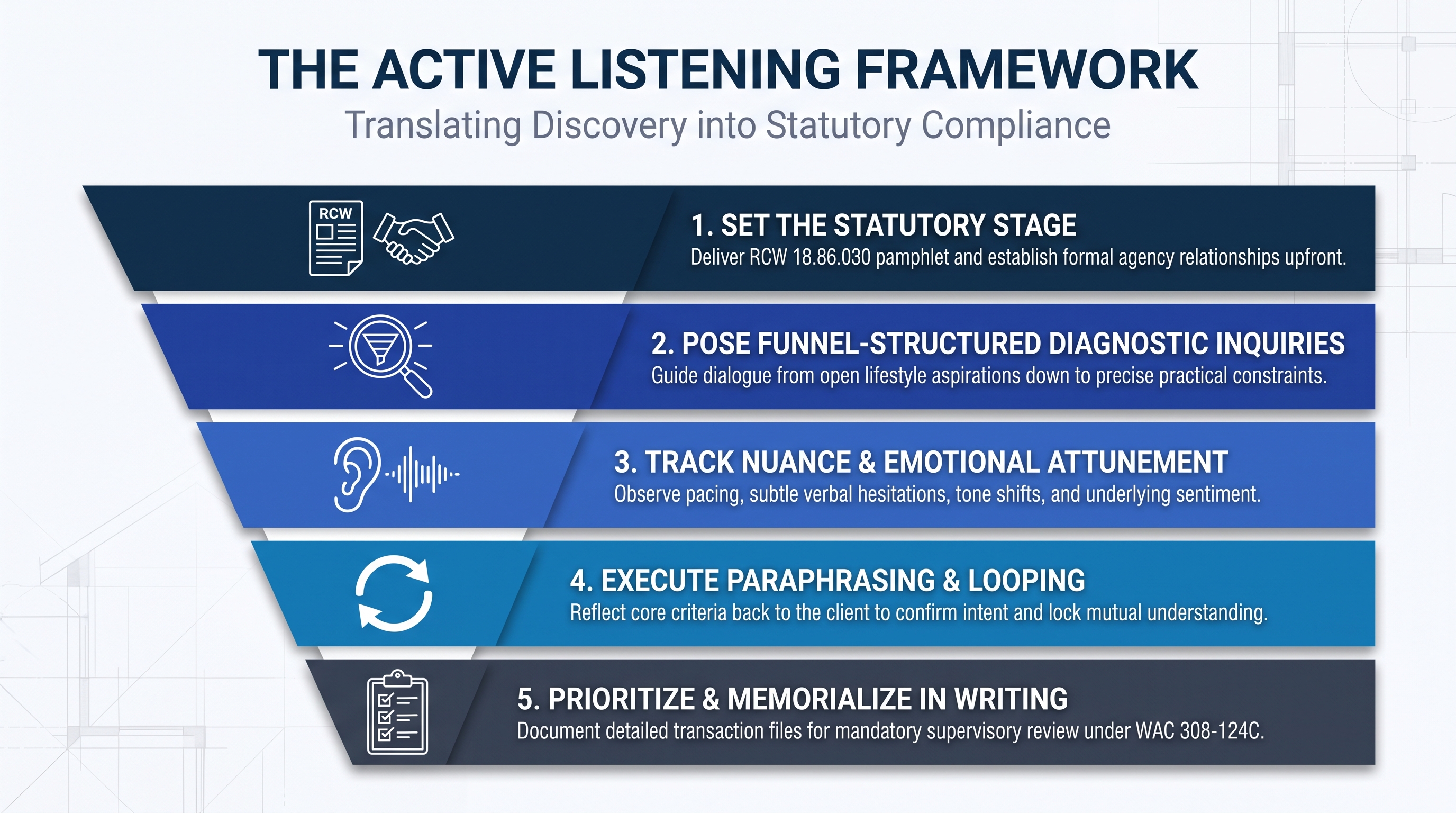
Five-Step Active Listening Framework for Client Discovery
- Set the statutory stage and deliver the pamphlet. Hand over the mandatory Real Estate Brokerage in Washington pamphlet before you ask for anything confidential. Explain agency relationships, confirm confidentiality, and walk through the services agreement.
- Pose funnel-structured diagnostic questions. Move from broad goals to specific constraints. A buyer who says “close to work” might mean a predictable commute, transit access, or school-drop-off logistics. Ask: “What would make the trip workable for you?”
- Track nuance and emotional attunement. Watch pacing, tone, and hesitation. A buyer who lights up about finishes but tenses at down payment numbers is telling you payment predictability is the real priority.
- Paraphrase and loop. Reflect the goal back and expect the client to refine it: “I hear that commute time and school access matter most. I’ll pull transit maps and OSPI report cards and focus our search inside that commute window — does that sound right?”
- Prioritize and memorialize in writing. Separate must-haves from nice-to-haves and document them in the file, so there’s a clean record ready for your managing broker’s review under WAC 308-124C.
Client Scenarios: Turning Requests Into Compliant Action
| Client Statement | Need Behind It | Guardrail | Compliant Response |
|---|---|---|---|
| “Tell us which neighborhoods are safe and crime-free.” | Physical safety, noise, family security. | RCW 49.60.222 & HUD guidance: factual data okay, subjective labels and steering aren’t. | Share links to municipal crime dashboards; skip the labels. |
| “Only show my home quietly to your firm’s buyers.” | Privacy, security, disruption concerns. | RCW 18.86.130: public marketing required absent a narrow safety exception. | Explain the public marketing rule; offer appointment-only showings and pre-approved buyers instead. |
| “Why sign an agreement before we even tour anything?” | Fear of premature commitment or hidden fees. | RCW 18.86.020: written agreement required before or as soon as practical after services begin. | Validate the concern; explain the agreement defines duties and compensation transparently. |
| “We’re behind on the mortgage and must sell fast — keep it quiet.” | Financial distress; needs speed without losing leverage. | RCW 18.86.040(1)(d) & .070(2)(b): confidentiality survives termination. | Keep the distress confidential; confirm pricing strategy and market aggressively within that constraint. |
| “There’s a crack in the foundation — is the house settling dangerously?” | Fear of structural issues and surprise repair costs. | RCW 18.86.050(1)(c): duty to recommend expert advice. | Acknowledge it, skip the amateur opinion, and recommend a licensed inspector or structural engineer in writing. |
Frequently Asked Questions
What statutory duties does active listening help Washington brokers meet?
Active listening helps you fulfill the non-waivable duties under RCW 18.86.030, .040, and .050 — reasonable skill and care, loyalty, continuous effort, and the duty to recommend outside experts. It also helps you catch confidential information early, protecting your RCW 18.86.070(2)(b) confidentiality duty.
Do I need a written agreement before showing a buyer homes in Washington?
Yes. RCW 18.86.020 requires a written brokerage services agreement before, or as soon as practical after, services begin, with a default 60-day term. The agreement must name the appointed broker, state exclusivity, address dual agency consent, and spell out compensation.
Can I tell clients which neighborhoods are "safe"?
You can share objective, accurate crime and school data consistently with every client, per 2026 HUD guidance. You should avoid subjective labels like “safe” or “declining,” and never infer a client’s preference from a protected characteristic under RCW 49.60.222.
What happens if I violate the 2026 public marketing rule?
RCW 18.86.130 requires public marketing of residential listings unless a narrow health or safety exception applies. Under RCW 18.86.031, a violation counts as a violation of RCW 18.85.361, exposing you to DOL discipline, including suspension, revocation, or fines.
How fast must I submit agreements to my managing broker?
Under WAC 308-124C, transaction documents and brokerage agreements go to your managing broker within two business days of mutual acceptance. If you’ve been licensed under two years, heightened supervision gives your managing broker up to five business days to review your agreements.
Keep Your Compliance Skills Sharp With Washington CE
You already know the statutes above cold — now make sure your next renewal reflects that. Our Complete Renewal with Core and Fair Housing package bundles the required Core and Fair Housing hours with electives on risk management and contracts, built by instructors who track every RCW update so you don’t have to. Students rate our courses 4.76/5 from verified reviews. Questions about which electives fit your practice? Call us at 425-775-2313 — a real person picks up.
Washington brokers: translate active listening into RCW 18.86 compliance. Explore 30-hour CE electives and renew your license with confidence today.