
In real estate brokerage, a client's first statement is rarely their complete objective. When buyers insist on a four-bedroom home in a specific school cluster, or sellers demand an inflexible list price while voicing reluctance about public exposure, they are stating positions rather than underlying interests. For Washington real estate professionals, bridging the gap between surface assertions and foundational motivations is a soft skill and also a risk management discipline.
Disciplined active listening connects daily client communication to statutory obligations under Chapter 18.86 RCW, fair housing law under RCW 49.60.222, and supervisory standards under WAC Chapter 308-124C. By identifying real client needs while staying within legal boundaries, Brokers and Managing Brokers protect consumers, prevent transaction disputes, and protect their licenses from Department of Licensing (DOL) disciplinary action.
The Core Mechanics of Active Listening in Brokerage Practice
Active listening is a structured communication discipline focused on understanding, synthesizing, and validating a speaker's message before forming a response. Passive hearing absorbs sound; active listening pulls out functional requirements and unspoken concerns.
To put active listening into practice, real estate professionals can adopt the Ask, Reflect, Confirm, Act, Document framework. (Note: This structured workflow is a professional training method and best-practice framework, not statutory language.)
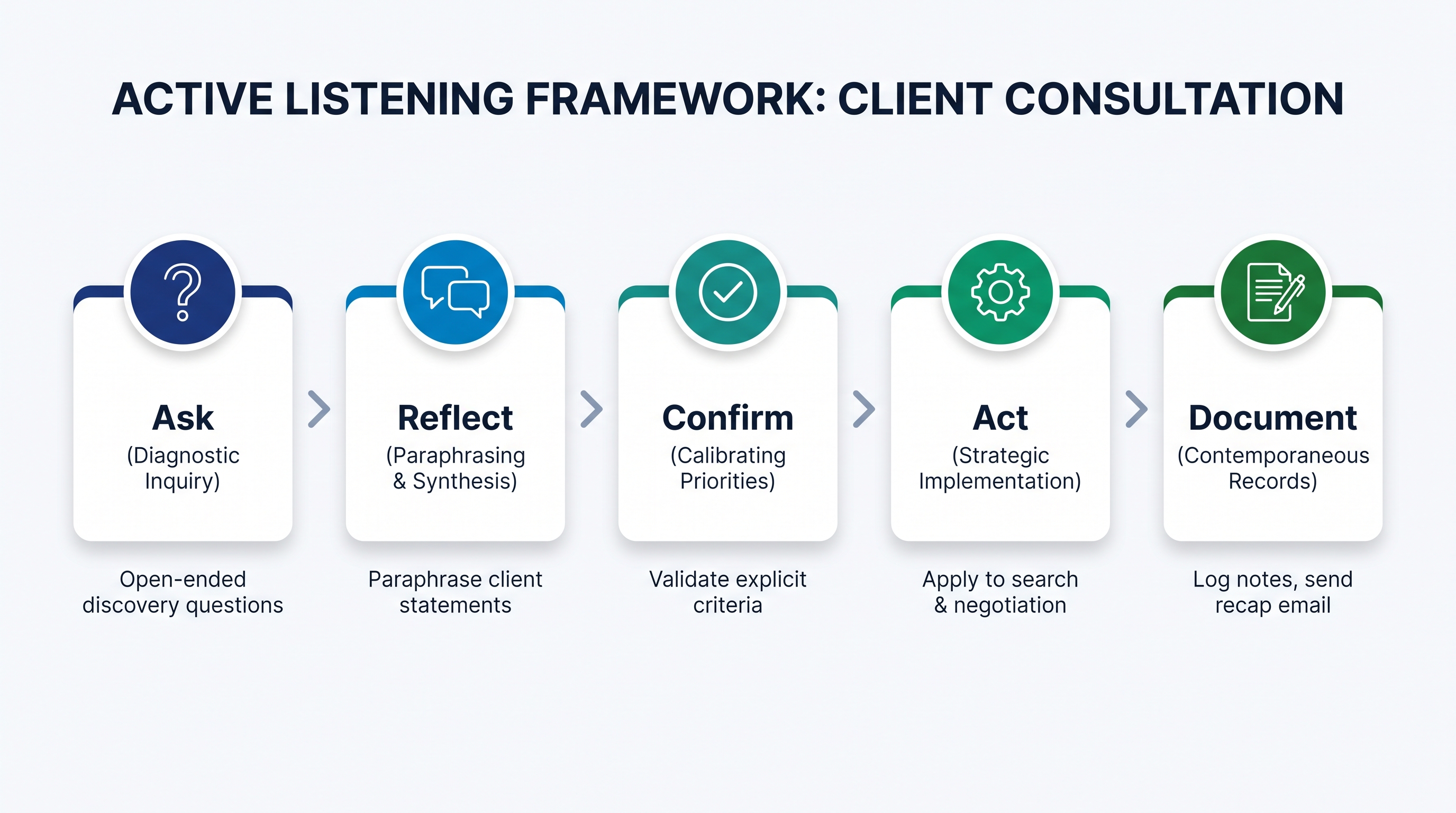
The Ask, Reflect, Confirm, Act, Document framework for structured active listening in brokerage practice.
- Ask (Diagnostic Inquiry): Move beyond closed questions that yield yes-or-no answers. Open-ended questions beginning with "How," "What," or "Help me understand" encourage clients to describe functional living needs and priorities. Rather than asking, "Do you like this floor plan?", ask, "How does this layout support your daily work and family routines?"
- Reflect (Paraphrasing and Synthesis): Restate the practical and emotional essence of what the client said in your own words. Reflective paraphrasing shows engagement, surfaces unspoken assumptions, and prompts clients to clarify vague thoughts.
- Confirm (Calibrating Priorities): Translate qualitative statements into explicit criteria: "To make sure we are aligned, your priority is dedicated remote workspaces for two professionals, and a fourth bedroom is secondary if space permits. Do I have that right?"
- Act (Strategic Implementation): Apply the confirmed criteria to property searches, negotiations, and transaction contingencies.
- Document (Contemporaneous Records): Follow your firm's record-keeping policy. Log detailed notes in the firm's CRM or transaction management system the same day as the client interaction. After consultations or substantive calls, send a short recap email summarizing confirmed priorities and recording any recommendation that the client seek expert help (such as a structural engineer, a boundary survey, or an attorney). Also note in the transaction file the dates of pamphlet delivery, the client's acknowledgment of receipt, and services agreement execution.
Grounding Communication in Washington Statutory Broker Duties (RCW 18.86)
In Washington, brokerage agency relationships are statutory. Under RCW 18.86.110, the duties in Chapter 18.86 RCW "are statutory duties and not fiduciary duties," and the chapter "supersedes the fiduciary duties of an agent to a principal under the common law." Active listening is the practical way Brokers meet these duties, several of which cannot be waived.
Reasonable Skill and Care (RCW 18.86.030(1)(a))
Brokers owe a non-waivable duty of reasonable skill and care to their principal and to all parties in a transaction. Relying on literal client requests without further inquiry risks drafting deficient agreements or missing serious transaction problems. Careful discovery surfaces factors such as financing constraints, restrictive covenants, or unpermitted improvements that competent representation has to account for.
Written Brokerage Services Agreements and Pamphlet Delivery (RCW 18.86.020, RCW 18.86.030(1)(f), and RCW 18.86.120)
Since the agency law revisions in Substitute Senate Bill 5191 (chapter 318, Laws of 2023, effective January 1, 2024), a real estate firm must enter into a written services agreement with the principal "before, or as soon as reasonably practical after," its appointed broker begins rendering brokerage services (RCW 18.86.020(2)(a)). Under RCW 18.86.030(1)(f), the Broker must provide the statutory pamphlet titled "Real Estate Brokerage in Washington" (RCW 18.86.120) and obtain the party's acknowledgment of receipt. The pamphlet goes to a party the broker serves as soon as reasonably practical but before that party signs a services agreement, and to an unrepresented party before that party signs an offer or as soon as reasonably practical.
Under RCW 18.86.020(2)(b), the services agreement must state its term, the broker appointed as agent, whether the relationship is exclusive or nonexclusive, and the principal's limited dual agency consents. For a buyer, the agreement must include "a default term of 60 days with the option of a longer term." Under RCW 18.86.080(7), a firm must have a services agreement stating the terms of compensation in order to be paid. Evolving search criteria are not part of those required terms, so document them in the client's file and CRM notes.
Good Faith and Continuous Effort (RCW 18.86.050(1)(e) and RCW 18.86.040(1)(e))
Unless otherwise agreed in writing, a buyer's agent must make "a good faith and continuous effort to find a property for the buyer," and a seller's agent must make "a good faith and continuous effort to find a buyer for the property." When a search stalls because of scarce inventory or misaligned criteria, active listening can uncover adaptable floor plans, other property types, or nearby sub-markets that still meet the client's underlying goals.
Scope of Expertise and Advising Expert Counsel (RCW 18.86.050(1)(c) and RCW 18.86.040(1)(c))
Agents must advise their principals "to seek expert advice on matters relating to the transaction that are beyond the agent's expertise." The statute does not require that this advice be given in writing, but writing it down is sound risk management. When clients raise concerns about boundaries, drainage, or slope stability, do not offer speculative opinions. Refer the client to qualified experts (such as a structural engineer, a geotechnical engineer, or a licensed surveyor), and protect the client with standard contingency forms such as NWMLS Form 35 (Inspection Addendum) or Form 35F (Feasibility Contingency).
Material Facts vs. Independent Investigation (RCW 18.86.030(1)(d) and RCW 18.86.030(2))
Brokers must disclose "all existing material facts known by the broker and not apparent or readily ascertainable to a party." Under RCW 18.86.010(11), a material fact is information that substantially adversely affects the value of the property or a party's ability to perform, or that materially impairs or defeats the purpose of the transaction. Under RCW 18.86.030(2), unless otherwise agreed, a broker owes no duty to inspect the property independently or to investigate either party's financial condition. Active listening helps Brokers notice when a casual remark reveals a known material defect that must be disclosed.
Preserving Client Confidentiality (RCW 18.86.010(9), .040(1)(d), .050(1)(d), and .070)
Under RCW 18.86.010(9), "confidential information" is information from or about a principal that the broker acquired during the agency relationship, that the principal reasonably expects to be kept confidential, has not disclosed or authorized to be disclosed, would harm the principal if disclosed, and that the principal personally would not be obligated to disclose. Agents may not disclose confidential information except under subpoena or court order, and this duty continues after the agency relationship ends (RCW 18.86.070(2)(b)). The two duties fit together: the material fact duty in RCW 18.86.030(1)(d) is owed to all parties and cannot be waived, and information the principal would be obligated to disclose falls outside the definition of confidential information.
Fair Housing, Objective Data, and Steering Boundaries
Conversations about neighborhood characteristics, safety, and schools carry compliance risk under the federal Fair Housing Act and the Washington Law Against Discrimination (RCW 49.60.222). Washington's protections are broader than federal law. RCW 49.60.222 covers sex, marital status, sexual orientation (which Washington defines to include gender expression or identity), race, creed, color, national origin, citizenship or immigration status, families with children status, honorably discharged veteran or military status, sensory, mental, or physical disability, and the use of a trained dog guide or service animal.
On April 24, 2026, HUD's Assistant Secretary for Fair Housing and Equal Opportunity issued a Dear Colleague letter on neighborhood crime data and school quality. The letter states that real estate agents and brokers "do not violate the Fair Housing Act merely by discussing with prospective homebuyers or renters the prevalence of crime or the quality of schools in neighborhoods." It directs federally funded fair housing agencies and organizations not to pursue findings or complaints based on professionals providing school and crime data "in an equal and consistent manner." The letter is federal enforcement guidance and does not change Washington law. The Washington Law Against Discrimination applies on its own terms, and subjective opinions about a neighborhood's desirability or coded comments about its residents remain strong evidence of unlawful steering.
To handle these questions with active listening while staying compliant:
- Clarify Specific, Measurable Criteria: When a client asks something subjective like "Is this a good area?", ask what objective criteria matter to them (for example, student-teacher ratios, graduation rates, specific academic programs, or reported property crime trends).
- Provide Standardized Third-Party Resources: Give every client the same verified public resources, such as the Washington Office of Superintendent of Public Instruction (OSPI) school report cards and the local police department's published crime data.
- Preserve Buyer Autonomy: Let buyers review the data and decide which neighborhoods meet their standards. Never infer preferences, screen listings, or direct clients toward or away from communities based on protected characteristics.
- Address Demographic Inquiries Directly: If a client asks about neighborhood demographics or mentions the "right kind of families," treat it as a red flag. Politely decline to describe communities by the protected classes of their residents, and explain that fair housing law is the reason.
Managing Broker Supervision and Disciplinary Risk Management
Active listening and careful discovery need to be backed by brokerage supervision under WAC Chapter 308-124C. Supervisory structures make sure that what brokers learn from clients is handled and documented properly:
- Broker Document Delivery Timelines (WAC 308-124C-140(7)): Brokers must deliver transaction documents and brokerage service contracts to the designated broker or delegated managing broker within two business days of mutual acceptance.
- Managing Broker Contract Review (WAC 308-124C-125(9)(c)): The designated broker's written policy must provide for review of all brokerage service contracts involving any broker licensed for less than two years. The designated broker or delegated managing broker must complete the review within five business days of mutual acceptance, and documented proof of review must be kept at the firm's record locations.
- Heightened Supervision (WAC 308-124C-145): Brokers in their first two years of licensing are subject to heightened supervision. That includes participating in all required reviews and securing advice or assistance from the designated broker or appointed managing broker when offering services beyond their level of expertise.
Disciplinary Consequences of Duty Breaches
Breaching statutory duties carries real regulatory consequences. Under RCW 18.86.031, a violation of the general broker duties in RCW 18.86.030 or the residential marketing rule in RCW 18.86.130 (added by chapter 57, Laws of 2026) is a violation of RCW 18.85.361. DOL exercises disciplinary authority under Chapter 18.85 RCW and the Uniform Regulation of Business and Professions Act (Chapter 18.235 RCW). Sanctions available under RCW 18.235.110 include censure or reprimand, remedial education, practice restrictions or monitoring, fines of up to $5,000 per violation, and license suspension or revocation.
Practical Dialogue Applications
Dialogue 1: Needs Discovery vs. Stated Wants
Setting: Initial buyer consultation at a Spokane brokerage office.
Client: "We must have a four-bedroom home in South Hill with at least 2,500 square feet. We won't consider anything smaller."
Broker (Open Question): "South Hill has great neighborhoods. What specific functions and daily routines do those four bedrooms need to accommodate?"
Client: "My partner and I both work remotely full-time and handle confidential client calls throughout the day. Also, my mother lives with us several months every year and cannot navigate stairs."
Broker (Reflective Paraphrasing): "I hear that your essential priorities are two quiet, private office spaces and accessible, main-floor living for your mother."
Client: "Exactly. A three-bedroom home with a main-floor den or finished daylight suite would work better than a traditional four-bedroom layout."
Broker (Confirming and Fulfilling Duties): "That gives us great clarity. As part of my duty to make a good faith and continuous effort to find you a property under RCW 18.86.050(1)(e), we will focus the search on layouts with main-floor living and two workspaces. I will record these priorities in our CRM notes today, send you a short recap email, and adjust our search parameters to match."
Dialogue 2: Addressing Steering Inquiries, Objective Data, and Fair Housing Boundaries
Setting: Buyer property showing in King County.
Client: "This house looks wonderful, but is this neighborhood safe? Are the schools good? We want to make sure we're around the right kind of families."
Broker (Active Listening and Fair Housing Boundary): "I understand that school quality and neighborhood safety are top priorities for you. When you mention the 'right kind of families,' though, I need to be clear: under the Washington Law Against Discrimination (RCW 49.60.222) and the federal Fair Housing Act, I can't describe neighborhoods by the demographic makeup, family status, or other protected characteristics of the people who live there."
Broker (Reframing with Objective Metrics): "Recent HUD guidance confirms that agents can share factual crime and school data under federal law, and Washington law applies on its own terms, so I give every client the same objective third-party sources. What specific, measurable criteria matter most to your family, such as student-teacher ratios, particular academic programs, or property crime trends?"
Client: "We specifically care about STEM programs and property theft statistics."
Broker (Confirming and Supporting Autonomy): "I'll send you direct links to the OSPI report cards for this school district and the local police department's published crime data. You can review the data yourself and decide whether this community fits your family's standards."
Client: "That makes sense. I appreciate the direct sources."
Dialogue 3: Seller Privacy Concerns and Marketing Restrictions (RCW 18.86.130)
Setting: Listing consultation for a residential home in Pierce County.
Client: "I want to sell my home, but I am very private. I don't want crowds of strangers at the house or public open houses. Can you market this quietly to a private circle of high-end brokers and buyers without listing it publicly?"
Broker (Reflecting Underlying Concerns): "It sounds like privacy, security, and control over who enters your home are your main concerns."
Client: "Exactly. I just don't want hundreds of people walking through my home."
Broker (Statutory Marketing Rule): "I understand. Under Washington law (RCW 18.86.130, added by chapter 57, Laws of 2026), a broker may not market the sale or lease of residential real estate to a limited or exclusive group of buyers or brokers unless it is also marketed to the general public and all other brokers at the same time. The only exception is what is reasonably necessary to protect the health or safety of the owner or occupant. If you believe that exception may apply to you, I'll raise it with my managing broker, and you may want to consult an attorney before we decide on a plan."
Broker (Strategic Solution and Supervisory Review): "The same statute says that marketing to the general public does not require you to allow access onto the property or into the home. We can list publicly and still set strict showing rules, such as requiring a buyer pre-approval letter before scheduling, agent-accompanied private showings only, and no public open houses. I'll review these listing terms and our marketing plan with my managing broker today under our firm's policy, as required for brokers in their first two years under WAC 308-124C-145, to protect your security while complying with the marketing law."
Client: "That protects my privacy and keeps us within the law. Let's move forward."
Practical Active Listening and Legal Compliance Checklist
Build this checklist into your standard brokerage workflow:
Phase 1: Intake and Agency Formation
- Deliver the pamphlet "Real Estate Brokerage in Washington" (RCW 18.86.120) and obtain the party's acknowledgment of receipt before they sign a services agreement (RCW 18.86.030(1)(f)).
- Execute a written services agreement that states the term, the appointed broker, exclusive or nonexclusive status, and compensation (RCW 18.86.020(2)(b); RCW 18.86.080(7)).
- For buyer agreements, confirm the agreement includes the 60-day default term, with the option of a longer term (RCW 18.86.020(2)(b)(i)).
- Record the dates of pamphlet delivery, acknowledgment of receipt, and services agreement execution in the firm's transaction file.
Phase 2: Needs Discovery and Documentation
- Use the Ask, Reflect, Confirm steps to uncover core functional requirements.
- Paraphrase client statements to test assumptions and separate firm needs from flexible preferences.
- Recognize client statements that reveal known defects requiring material fact disclosure (RCW 18.86.030(1)(d)).
- Log consultation notes in the firm's CRM or transaction management system the same day.
- Send clients a prompt recap email summarizing confirmed search criteria and priorities.
Phase 3: Fair Housing and Marketing Compliance
- Clarify measurable, objective criteria when clients ask about schools or safety.
- Give every client the same objective third-party data (OSPI report cards, police crime data).
- Decline to describe neighborhoods by demographic makeup or protected classes (RCW 49.60.222).
- Make sure every residential listing meets the concurrent public marketing rule in RCW 18.86.130.
Phase 4: Scope of Expertise and Contractual Protection
- Advise clients to seek expert advice on matters beyond your expertise (RCW 18.86.050(1)(c); RCW 18.86.040(1)(c)).
- Record every expert referral in a client recap email and in the transaction notes.
- Protect clients with standard forms, including NWMLS Form 35 (Inspection Addendum) and Form 35F (Feasibility Contingency).
Phase 5: Supervisory Review and Record Retention
- Deliver transaction documents and brokerage service contracts to the designated broker or delegated managing broker within two business days of mutual acceptance (WAC 308-124C-140(7)).
- For brokers licensed less than two years, confirm the designated broker or delegated managing broker completes and documents contract review within five business days of mutual acceptance (WAC 308-124C-125(9)(c)).
- Consult your managing broker under firm policy, and seek advice or assistance when a transaction goes beyond your level of expertise (WAC 308-124C-145).
- Keep complete, contemporaneous client records and transaction files as your firm's record-keeping policy requires.
Sources
- RCW 18.86.010: Definitions
- RCW 18.86.020: Agency relationship, Services agreement
- RCW 18.86.030: Duties of broker
- RCW 18.86.031: Violation of licensing law
- RCW 18.86.040: Seller's agent, Duties
- RCW 18.86.050: Buyer's agent, Duties
- RCW 18.86.070: Duration of agency relationship
- RCW 18.86.080: Compensation
- RCW 18.86.110: Application
- RCW 18.86.120: Pamphlet on real estate brokerage in Washington, Content, Definition
- RCW 18.86.130: Exclusive real estate property marketing
- RCW 49.60.222: Unfair practices with respect to real estate transactions, facilities, or services
- RCW 49.60.040: Definitions
- RCW 18.85.361: Disciplinary action, Grounds
- RCW 18.235.110: Unprofessional conduct, Finding
- Chapter 18.235 RCW: Uniform Regulation of Business and Professions Act
- WAC 308-124C-125: Designated broker responsibilities
- WAC 308-124C-140: Broker responsibilities
- WAC 308-124C-145: Broker responsibilities (with less than two years experience)
- SSB 5191 (2023) bill summary: chapter 318, Laws of 2023, effective January 1, 2024
- HUD Dear Colleague Letter on Neighborhood Crime Data and School Quality (April 24, 2026)
Disclaimer: This article is for educational and informational purposes only and is not legal advice. Real estate professionals should consult their Designated Broker, and refer clients to a licensed attorney, for specific legal situations.
Active listening helps Washington brokers turn what clients say they want into what they need, and it ties directly to agency duties under RCW 18.86. This guide walks through an Ask, Reflect, Confirm, Act, Document method, how to discuss schools and safety within fair housing law, the 2026 rule against exclusive listing marketing, and the supervision rules for newer brokers, with sample dialogues and a compliance checklist.