
First impressions define every client relationship. In Washington State, however, client intake is more than a customer service touchpoint. It is a legally structured compliance sequence.
Since January 1, 2024, when Substitute Senate Bill 5191 (Laws of 2023, chapter 318) took effect, Washington law has required written brokerage services agreements for buyers and sellers alike. That reform turned client onboarding into a defined regulatory workflow, enforced by the Washington State Department of Licensing (DOL). A second change arrived on June 11, 2026, when a new public-marketing rule for residential listings took effect. For Brokers and Managing Brokers, as well as license candidates, onboarding clients smoothly means pairing high-touch service with statutory compliance.
Statutory Duties vs. Fiduciary Duties (RCW 18.86.110 & RCW 18.86.030)
Real estate professionals must understand how Washington structures representation. Under RCW 18.86.110, "The duties under this chapter are statutory duties and not fiduciary duties." The chapter supersedes the common law fiduciary duties of an agent to a principal, while the common law continues to apply in all other respects.
Under RCW 18.86.030, certain duties are owed to all parties in a transaction and may not be waived. They include exercising reasonable skill and care, dealing honestly and in good faith, timely presenting written offers, notices and communications, disclosing known material facts that are not apparent or readily ascertainable, accounting for all money and property received, and delivering the required pamphlet and disclosures.
The Step-by-Step Onboarding Sequence
A disciplined onboarding sequence protects consumers, satisfies licensing requirements, and safeguards firm compensation from the first contact.
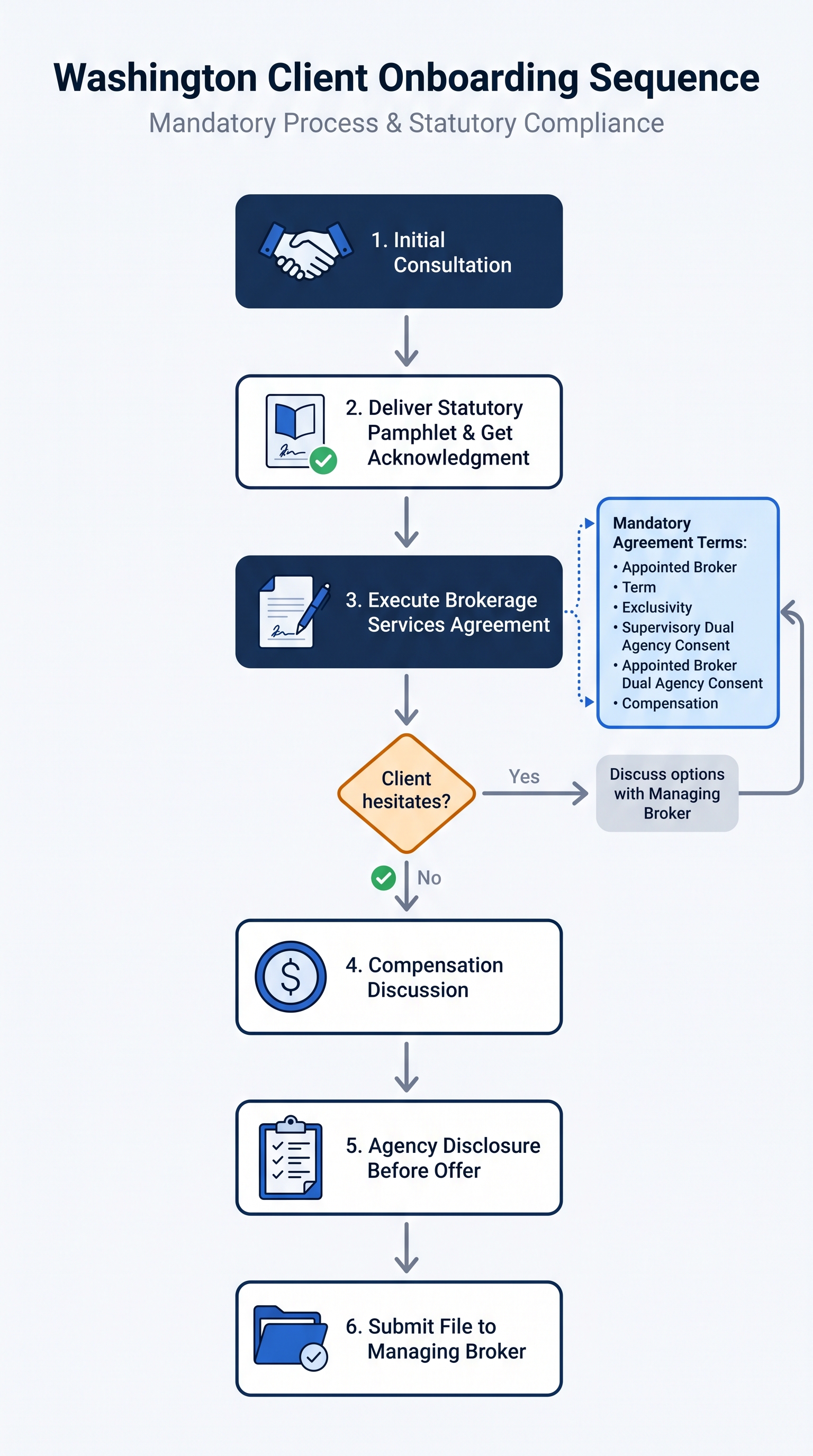
1. The Initial Consultation
Client intake begins with an educational consultation. The Broker outlines representation options, explains the firm's services, and discusses compensation openly, establishing trust before touring homes or reviewing marketing strategies.
2. Delivering the Prescribed Pamphlet (RCW 18.86.120 & RCW 18.86.030(1)(f))
Before a services agreement is signed, the Broker must provide the statutory pamphlet "Real Estate Brokerage in Washington," in the form set out in RCW 18.86.120. Under RCW 18.86.030(1)(f), the pamphlet goes to any party the broker serves "as soon as reasonably practical but before the party signs a services agreement," and the broker must "obtain an acknowledgment of receipt by the party." A signed acknowledgment is the standard way to document it (NWMLS Form 41 builds one in). For a party not represented by a broker, delivery must occur "before the party signs an offer or as soon as reasonably practical."
The pamphlet text changed in 2026. SSB 6091 (Laws of 2026, chapter 57), effective June 11, 2026, added RCW 18.86.130 on marketing residential property and added a "Property Must Be Marketed Publicly" section to the pamphlet. Make sure your firm is handing out the current edition.
3. Executing the Brokerage Services Agreement (RCW 18.86.020)
Under RCW 18.86.020(2)(a), "A firm must enter into a services agreement with the principal before, or as soon as reasonably practical after, its appointed broker commences rendering real estate brokerage services to, or on behalf of, the principal." Under RCW 18.86.020(2)(b) and RCW 18.86.080(7), the agreement must include specific terms:
| Mandatory Element | Statutory Application | Source |
|---|---|---|
| Appointed Broker | Names the broker appointed as agent for the principal. | RCW 18.86.020(2)(b)(ii) |
| Term of Agreement | States the duration. For buyers, the statute sets "a default term of 60 days with the option of a longer term." | RCW 18.86.020(2)(b)(i) |
| Exclusivity Designation | States whether the relationship is exclusive or nonexclusive; buyer agreements must offer checkbox options for either. | RCW 18.86.020(2)(b)(iii) |
| Supervisory Dual Agency | States whether the principal consents to the designated broker and supervising managing broker acting as limited dual agents when different brokers in the same firm represent different parties. | RCW 18.86.020(2)(b)(v) |
| Appointed Broker Dual Agency | States whether the principal consents to the appointed broker acting as a limited dual agent; the consent must be separately initialed. | RCW 18.86.020(2)(b)(iv) |
| Compensation Terms | States the amount the principal agrees to pay, consent (if any) to sharing and to payment by more than one party, and, for buyers, whether the broker will show properties with no compensation offered. | RCW 18.86.080(7) |
Northwest Multiple Listing Service (NWMLS) Form 41 (Buyer Brokerage Services Agreement) is widely used by NWMLS member firms. Brokers should confirm which forms their firm has approved with their Designated Broker.
Statute vs. Firm Policy: The statute allows the agreement "before, or as soon as reasonably practical after" services begin, but your firm may require a signed agreement before any showing. Licensees must follow firm policies that go beyond the statutory minimum.
Commercial Buyer Exception: Under RCW 18.86.020(3), "A services agreement is not required when a broker performs real estate brokerage services as a buyer's agent solely for commercial real estate." RCW 18.86.010(8) gives "commercial real estate" the meaning in RCW 60.42.005, which excludes property improved with one to four residential units, unimproved land zoned for one to four residential units, land classified as farm and agricultural land or timberland, and residential units such as condominiums or townhouses that can be sold unit by unit. This carve-out applies only to commercial buyers. It does not waive the general duties in RCW 18.86.030, and the broker must instead give the written "Compensation Disclosure" described in RCW 18.86.080(8) if relying on it.
Mastering Compensation Conversations (RCW 18.86.080)
Under RCW 18.86.080(7), a firm must have a services agreement containing the required compensation terms to receive compensation for brokerage services from any party or firm. The narrow exceptions are a broker's price opinion, a firm-to-firm referral where the referring firm provided no brokerage services (RCW 18.86.080(9)), and the commercial buyer disclosure above.
The agreement must clearly address:
- Agreed Amount: The compensation the principal agrees to pay (for example, a percentage, flat fee, or other agreed method).
- Sharing and Multiple Payers: The principal's consent, if any, to compensation sharing between firms and parties, and to the firm being paid by more than one party.
- Uncompensated Showings: In buyer agreements, whether the appointed broker will show properties where no party or firm has offered compensation.
- Agency Independent of Compensation: Under RCW 18.86.080(2), paying compensation does not establish an agency relationship. Under RCW 18.86.020(1), a broker who performs brokerage services for a buyer is a buyer's agent unless one of the listed exceptions applies. Who pays the fee does not determine representation.
Dialogue Script:
"Washington law requires a written services agreement before, or as soon as reasonably practical after, I start working for you. Our firm signs it up front so everything is clear. Under our agreement, my firm's fee for buyer representation is [rate, e.g., X% / $X flat fee]. You can ask a seller to pay some or all of that fee as part of your offer, but sellers are not required to. Any part the seller does not pay stays your responsibility under the agreement. The agreement also records whether you want me to show homes where no compensation is offered."
Agency Disclosure vs. Services Agreement
Brokers must distinguish the intake services agreement from the offer-stage Agency Disclosure. Under RCW 18.86.030(1)(g), a Broker must disclose in writing before their principal signs an offer, or as soon as reasonably practical but before the parties reach mutual agreement:
- Whether the broker represents the buyer, the seller, or both parties as a limited dual agent, in a separate paragraph titled "Agency Disclosure" in the purchase agreement or in a separate writing with that title.
- Any terms of compensation offered by a party or a firm to a firm representing another party.
For a seller, the written services agreement is what establishes the agency relationship. For a buyer, the pamphlet explains that the firm and broker "establish an agency relationship by performing those services," and the written agreement must follow before, or as soon as reasonably practical after, services begin. The offer-stage disclosure then confirms representation and compensation terms in the specific transaction.
When a Client Hesitates or an Agreement Ends (RCW 18.86.070 & RCW 18.86.080)
When prospective clients hesitate, Brokers should explain the flexibility the statute offers:
- Addressing Hesitation: If a buyer is uneasy about commitment, explain that the statute provides for a nonexclusive relationship, which lets the buyer work with more than one firm at the same time. The buyer term defaults to 60 days, with the option of a longer term; take any question about a different term to your Designated Broker. If a buyer declines to sign any agreement, talk with your Managing Broker before continuing: the statute requires the firm to enter into a services agreement, and under RCW 18.86.080(7) the firm cannot receive compensation without one.
- Duration and Termination: Under RCW 18.86.070(1), an agency relationship continues until the earliest of completion of performance by the broker, expiration of the agreed term, termination by mutual agreement, or termination by notice from either party. A termination by notice "does not otherwise affect the contractual rights of either party."
- Surviving Duties: Under RCW 18.86.070(2), except as otherwise agreed in writing, a broker owes no further duty after termination other than the duty to account for all moneys and property received during the relationship and the duty not to disclose confidential information.
- File Closure: Document expiration or termination in the transaction file to keep a clear compliance record.
Same-Firm and Limited Dual Agency Scenarios (RCW 18.86.060)
Dual agency in Washington is "limited dual agency" under RCW 18.86.060.
When Broker Jane represents a buyer purchasing a home listed by Broker David at the same firm, RCW 18.86.060(5) provides that each appointed broker "shall solely represent the party with whom the appointed broker has an agency relationship." The firm's designated broker, and any managing broker responsible for supervising both brokers, is a limited dual agent. That supervisory dual agency requires written consent in both clients' services agreements.
When one broker represents both buyer and seller in the same transaction, that broker is a limited dual agent. Under RCW 18.86.060(1), this is allowed only with the written consent of both parties set forth in the services agreement, and the appointed-broker consent must be separately initialed. A limited dual agent may not advocate terms favorable to one principal to the detriment of the other and may not disclose either party's confidential information.
Seller-Side Onboarding and Marketing Rules (RCW 18.86.130)
Seller onboarding centers on a listing services agreement establishing price, marketing terms, and compensation.
Since June 11, 2026, RCW 18.86.130 (SSB 6091, Laws of 2026, chapter 57) provides that "A broker may not market the sale or lease of residential real estate to a limited or exclusive group of prospective buyers or brokers, or any combination thereof, unless the real estate is concurrently marketed to the general public and all other brokers, except as reasonably necessary to protect the health or safety of the owner or occupant." The same section adds that "Marketing to the general public does not require an owner to allow access onto the residential real estate or into the residence." Under RCW 18.86.031, a violation of RCW 18.86.130 (or RCW 18.86.030) is a violation of RCW 18.85.361, which lets DOL impose the sanctions and fines listed in RCW 18.235.110. Because the rule is new, review your firm's listing and marketing procedures with your Designated Broker.
Sellers of improved residential property must also deal with the seller disclosure statement under chapter 64.06 RCW (NWMLS Form 17 follows the statutory form). Under RCW 64.06.030, unless the buyer has expressly waived it, the seller must deliver a completed, signed and dated disclosure statement to the buyer not later than five business days after mutual acceptance, or as otherwise agreed, and some transfers are exempt. The seller answers the questions, not the broker. Explain the process and timing, and refer any question about what must be disclosed, or whether an exemption applies, to the seller's attorney.
File Management, Deadlines, and Broker Supervision
Compliance extends into file administration, trust accounting, and supervisory oversight:
- Supervisory Framework: Under WAC 308-124C-145, brokers are "subject to a heightened degree of supervision for the initial two years of licensing," which includes participating in required contract reviews and seeking help from the designated broker or appointed managing broker when a matter is beyond their expertise.
- Record Retention: Under WAC 308-124C-105(2)(c), the Designated Broker must keep a transaction folder containing all agreements, receipts, contracts, documents, closing statements and material correspondence for each transaction. Under RCW 18.85.361(17), failing to preserve transaction records for three years after they are submitted to the firm is a ground for discipline.
- Third-Party Earnest Money: When earnest money is held by a party other than the firm, WAC 308-124E-110(4) requires the licensee to deliver the deposit to the holder named in the purchase and sale agreement, obtain a dated receipt, deliver that receipt to the designated broker or responsible managing broker, and keep it in the transaction file.
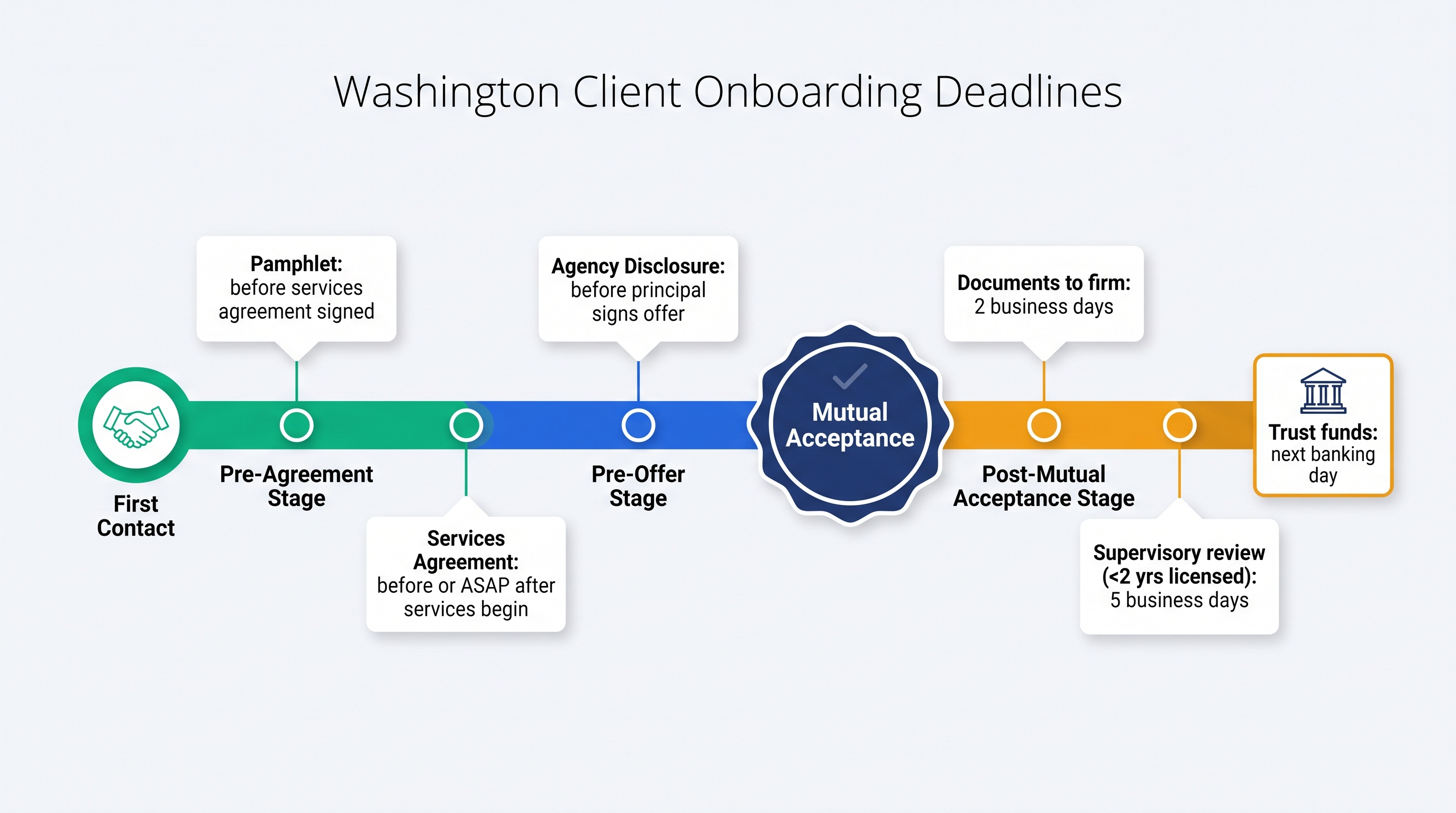
Key Onboarding Deadlines at a Glance
| Step | Deadline | Source |
|---|---|---|
| Pamphlet & Acknowledgment | As soon as reasonably practical, before signing a services agreement; unrepresented party before signing an offer or as soon as reasonably practical | RCW 18.86.030(1)(f) |
| Services Agreement | Before, or as soon as reasonably practical after, the appointed broker begins services | RCW 18.86.020(2)(a) |
| Agency Disclosure | Before the principal signs an offer, or as soon as reasonably practical but before mutual agreement | RCW 18.86.030(1)(g) |
| Document Delivery to Firm | Within 2 business days of mutual acceptance | WAC 308-124C-140(7) |
| Supervisory Review (under 2 years licensed) | Within 5 business days of mutual acceptance | WAC 308-124C-125(9)(c) |
| Trust Fund Deposit | Next banking day following receipt, with limited exceptions | WAC 308-124E-105(6) |
| Seller Disclosure Statement | Seller delivers within 5 business days of mutual acceptance unless waived or otherwise agreed | RCW 64.06.030 |
Risk Prevention as Good Client Care
Beyond the chapter 18.86 requirements, good onboarding habits protect clients from common transaction hazards:
- Wire Fraud Advisories: Warn clients about wire fraud early as a standard risk-management practice. Tell buyers to confirm any wiring instructions by phone with their escrow officer, using a number they looked up independently, and never to rely on emailed instructions alone.
- Fair Housing-Consistent Communications: Keep all communications objective and professional. Remind sellers that fair housing laws apply and that buyer "love letters" can create fair housing risk; many firms advise sellers not to accept them. Refer specific legal questions to an attorney.
Practical Client Onboarding Checklist
Use this checklist to keep each intake complete:
- Deliver the current "Real Estate Brokerage in Washington" pamphlet (RCW 18.86.120), including the 2026 public-marketing section.
- Obtain an acknowledgment of receipt, ideally signed (RCW 18.86.030(1)(f)).
- Execute a written services agreement (RCW 18.86.020) naming the appointed broker, the term (60-day default for buyers, or a longer agreed term), exclusive or nonexclusive status, dual agency consents, and compensation terms (RCW 18.86.080).
- For listings, confirm the marketing plan complies with RCW 18.86.130.
- Provide wire fraud advisories and fair housing guidance as brokerage best practices.
- Give every signatory a copy of each signed agreement promptly (RCW 18.85.361(18) requires copies "within a reasonable time following execution").
- Submit transaction documents and brokerage service contracts to the Designated Broker or delegated Managing Broker within two business days of mutual acceptance (WAC 308-124C-140(7)).
Two Concrete Client Scenarios
Scenario 1: Buyer Onboarding in Spokane
Broker Maya meets Luis in Spokane. Before discussing properties, Maya delivers the statutory pamphlet and has Luis sign an acknowledgment of receipt. They sign her firm's approved buyer services agreement, choosing exclusive representation and the 60-day default term. Maya explains her firm's compensation, notes that a seller may be asked to pay some or all of it but is not required to, and records that Luis wants to see homes even where no compensation is offered. Luis consents to supervisory limited dual agency but does not initial consent to Maya herself acting as a limited dual agent. Maya submits the agreement to her Managing Broker the same day, well inside the firm's review window.
Scenario 2: Seller Onboarding in Seattle
Broker Marcus meets Chloe in Seattle to list her condominium. Chloe asks Marcus to market the listing privately within his firm before any public launch. Marcus checks with his Managing Broker, who points to RCW 18.86.130, in effect since June 11, 2026. Marcus explains that Washington law does not allow marketing a residential listing only to a limited group of buyers or brokers unless it is marketed to the public and all other brokers at the same time, with a narrow exception for the owner's or occupant's health or safety. He also explains that public marketing does not require Chloe to allow showings or access she has not agreed to. Under RCW 18.86.031 and RCW 18.85.361, noncompliant marketing is a licensing violation. Chloe agrees to a public launch. Marcus delivers the pamphlet, obtains her acknowledgment, executes the listing agreement, explains that she must complete and deliver the seller disclosure statement herself, suggests she consult her attorney with any disclosure questions, and logs the file into the transaction folder.
Conclusion and Call to Action
Client onboarding in Washington is where client care meets statutory compliance. By treating each intake as a structured sequence, Brokers protect their clients, safeguard firm compensation, and protect their own licenses.
Review your firm's current buyer and listing agreements, pamphlet edition, and marketing procedures with your Managing Broker or Designated Broker this week.
Disclaimer: This article is provided for educational and informational purposes only and does not constitute legal advice. Washington real estate professionals should consult their Managing Broker, Designated Broker, or legal counsel regarding statutory compliance and brokerage policies.
Sources
- Substitute Senate Bill 5191, Laws of 2023, ch. 318: https://lawfilesext.leg.wa.gov/biennium/2023-24/Pdf/Bills/Session%20Laws/Senate/5191-S.SL.pdf
- Substitute Senate Bill 6091, Laws of 2026, ch. 57 (bill status): https://app.leg.wa.gov/billsummary/?BillNumber=6091&Year=2025&Initiative=false
- Chapter 18.86 RCW, Real estate brokerage relationships (sections .010, .020, .030, .031, .060, .070, .080, .110, .120, .130): https://app.leg.wa.gov/RCW/default.aspx?cite=18.86
- RCW 18.85.361, Disciplinary action, grounds: https://app.leg.wa.gov/RCW/default.aspx?cite=18.85.361
- RCW 60.42.005, Commercial real estate definition: https://app.leg.wa.gov/RCW/default.aspx?cite=60.42.005
- Chapter 64.06 RCW, Real property transfers, sellers' disclosures: https://app.leg.wa.gov/RCW/default.aspx?cite=64.06
- Chapter 308-124C WAC (sections 105, 125, 140, 145): https://app.leg.wa.gov/wac/default.aspx?cite=308-124C
- Chapter 308-124E WAC (sections 105, 110): https://app.leg.wa.gov/wac/default.aspx?cite=308-124E
- Washington State Department of Licensing, Real estate brokers: https://dol.wa.gov/professional-licenses/real-estate-brokers
A step-by-step guide to onboarding buyers and sellers in Washington. It covers the agency pamphlet, what the required brokerage services agreement must contain, and how to talk about compensation. It also covers the 2026 public-marketing rule for residential listings and the firm deadlines that follow mutual acceptance, with a checklist and two worked scenarios for Washington brokers.