Washington's residential rent stabilization law caps most annual rent increases at the lesser of 7% plus inflation or 10% — 9.683% for 2026 and 10.0% for 2027 — and bars any increase during a tenant's first 12 months. For brokers and managing brokers, that cap now sits alongside existing notice, exemption, and enforcement rules that touch almost every rental transaction.
The 2026 legislative session left the core rent cap and notice forms unchanged but added new maintenance, cooling, and smart-access duties that affect how you advise landlord clients. This guide walks through what changed, what stayed the same, and how to apply it in a real transaction.
- Washington caps most annual rent increases at 9.683% for 2026 and 10.0% for 2027, with no increases allowed during a tenant's first 12 months.
- New construction (12 years old or newer), regulated affordable housing, and narrow owner-occupied situations are exempt — but the legal basis must be stated on the notice itself.
- Standard increases require 90 days' written notice statewide; Seattle requires 180 days, and manufactured home lots require three months.
- Violations expose landlords to tenant damages, attorney fees, and Attorney General civil penalties of up to $7,500 per violation.
- This content counts toward your required Core CE hour — see Washington's full continuing education requirements for renewing brokers and managing brokers.
What Is Washington's Rent Stabilization Law for 2026?
Washington law limits rent increases for both month-to-month tenancies and fixed-term leases on covered residential rental properties. Two rules anchor the cap:
- Initial 12-month ban: landlords cannot raise rent during the first 12 months of a tenancy.
- Annual escalation ceiling: after the first 12 months, any increase within a 12-month period cannot exceed the lesser of 7% plus inflation, or 10.0%.
The inflation component uses the June 12-month change in the CPI-U for the Seattle-Tacoma-Bellevue metro area. The Washington State Department of Commerce publishes the official maximum percentage each year:
- 2026 published cap: 9.683%
- 2027 published cap: 10.0% (the statutory hard ceiling)
These figures are recalculated annually, not fixed permanently — always confirm the Commerce figure published for the year the increase takes effect before issuing or advising on a notice. For a deeper breakdown of how the 2026 and 2027 caps interact with the broader Landlord-Tenant Act, see our related post on Washington rent stabilization under the Landlord-Tenant Act.
Worked Example
Current rent: $2,000.00 per month. A 2026 increase using the published 9.683% cap:
Maximum permissible increase = $2,000.00 × 0.09683 = $193.66
Maximum lawful new monthly rent = $2,000.00 + $193.66 = $2,193.66
Key Operational Rules
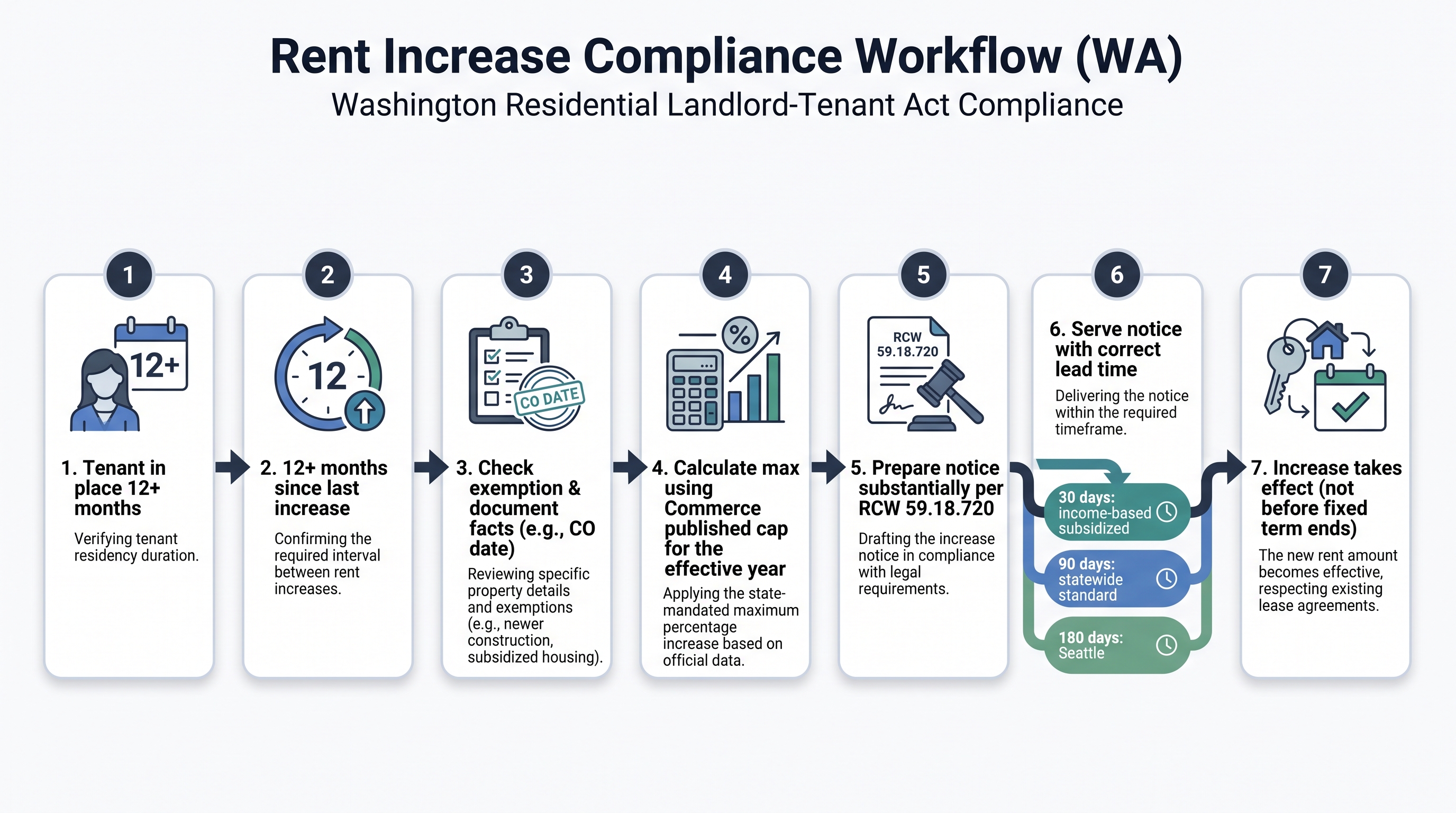
- Dual 12-month restriction: an increase is lawful only if the tenant has lived in the unit at least 12 continuous months, and at least 12 full months have passed since the last rent adjustment.
- Periodic charges count: the cap covers recurring fees named in the agreement, not just base rent — landlords cannot lower base rent while adding new parking, utility, or storage fees.
- Vacancy decontrol: the cap applies to ongoing tenancies only. Once a tenant vacates, the landlord can set a new starting rent for the next tenancy, and the cap applies again from there.
- Statutory sunset: these provisions are set to expire July 1, 2040.
Which Washington Rental Properties Are Exempt From the Rent Cap?
Not every residential property falls under the state rent cap. The Legislature carved out specific exemptions:
- New construction (12-year rolling exemption): dwellings where the initial Certificate of Occupancy was issued 12 or fewer years before the increase notice is served. This is a rolling window — once a building reaches its 13th year, it becomes subject to the cap.
- Regulated affordable housing: units under a public regulatory agreement, deed restriction, or covenant limiting rent based on Area Median Income.
- Qualified owner-occupied living situations:
- Tenancies where the tenant shares a kitchen or bathroom with an owner-occupant.
- Single-family properties where the resident owner rents no more than two total units or bedrooms, including ADUs or DADUs.
- Owner-occupied duplexes, triplexes, and fourplexes where the owner established and maintains primary residency throughout the tenancy.
- Entity limitation: these owner-occupied exemptions are unavailable if the titled owner is a REIT, a corporation, or an LLC with any corporate member.
Mandatory exemption disclosure: if a landlord raises rent above the cap based on an exemption, the written notice must state the specific legal basis and supporting facts — such as the Certificate of Occupancy date — directly on the document. Advise clients to verify occupancy dates through official building department records rather than listing descriptions.
What Notice Must Landlords Give Before Raising Rent?
- Statewide 90-day written notice: any increase in rent or recurring charges requires at least 90 days' advance written notice, served by personal service, substituted service, or posting and mailing.
- Fixed-term leases: a rent increase cannot take effect before an existing fixed-term lease expires.
- Subsidized tenancies: if rent is calculated based on tenant income, a 30-day notice period applies.
- Historical 60-day transitional rule: a temporary 60-day notice option applied only to fixed terms already in effect on May 7, 2025. Outside that scenario, all ongoing increases require the full 90-day notice.
- Mandatory statutory notice form: housing providers must use a notice substantially similar to the official state form, specifying the dollar increase, percentage increase, new total of recurring charges, and the factual basis for any exemption claimed.
- 5% lease-type parity limit: when offering renewal options across lease structures (fixed vs. month-to-month), the rent for the same unit cannot differ by more than 5% between lease types, and the higher option still cannot exceed the annual cap.
Earn CE credit while you read: this entire rent stabilization update — cap mechanics, exemptions, and notice rules — is built into the (CORE) Current Issues in Washington Residential Real Estate 2026-2027 course, which satisfies your required 3-hour Core credit for renewal.
What Penalties Apply for Rent Cap Violations?
Noncompliance creates real legal liability for landlord clients and the brokers who advise them:
- Tenant cure demand: a tenant served with an unauthorized increase must send a written demand giving the landlord a chance to correct it before filing a court challenge.
- Early lease termination: a tenant served with an increase exceeding the cap can terminate the agreement before it takes effect by giving at least 20 days' written notice.
- Private causes of action: tenants and the Attorney General can pursue actual damages, excess rent collected, reasonable attorney fees, and court costs.
- Attorney General civil penalties: the Attorney General can independently pursue civil penalties of up to $7,500 per violation without waiting for a tenant cure demand.
What Other Landlord-Tenant Act Duties Should Brokers Know?
Security Deposits and Trust Accounting
- Trust account custody: tenant deposits must sit in an escrow or trust account at a qualified Washington bank or financial institution, with written disclosure of the institution's name and address to the tenant.
- Condition checklist prerequisite: a landlord cannot withhold any deposit without a written move-in checklist signed by both parties at lease start. Without it, the tenant can recover the entire deposit.
- Statutory deposit limits: standard residential tenancies carry no one-month statutory cap, though mobile home lots are capped at one month's rent (two with pets).
- Seattle overlay: Seattle caps combined deposits and move-in fees at one month's rent, limits move-in fees to screening and cleaning, and sets separate pet-deposit rules.
Habitability, Just-Cause Eviction, and Deposit Refunds
- Habitability and maintenance: landlords must keep premises fit for habitation — structural soundness, weatherproofing, clean common areas, and working plumbing, heating, and electrical systems. 2026 amendments updated these duties, so buyers should weigh inspection findings against current habitability standards.
- Just-cause eviction: landlords cannot end a tenancy without one of the exclusive statutory just-cause grounds. A buyer cannot assume existing tenants can be removed at closing; terminating for owner-occupancy requires strict notice (typically 90 days) and genuine intent.
- Deposit refund timeline: within 30 days of a tenant vacating, the landlord must send a full, specific statement of any withheld amounts and any refund owed. Missing that deadline can make the landlord liable for the full deposit, double damages, and attorney fees.
Manufactured-Home Community Rules
- Separate legal framework: manufactured-home lot tenancies follow their own chapter and rent-increase rules — standard residential percentages don't apply.
- Three months' notice: lot rent increases require at least three months' advance written notice before the rental term ends.
- Deposit limits: manufactured home lot deposits cannot exceed one month's lot rent, or two months where pets are permitted.
Do Seattle and Other Washington Cities Add Stricter Rent Rules?
State law is a baseline floor. Washington cities frequently layer on stricter local ordinances:
- Seattle's 180-day notice mandate: Seattle housing providers must give at least 180 days' advance written notice for any increase in housing costs.
- Economic Displacement Relocation Assistance (EDRA): in Seattle, a housing cost increase of 10% or more triggers mandatory displacement disclosures, and an income-qualified tenant who moves out due to the increase is owed substantial relocation assistance.
- Seattle rental fee restrictions: Seattle's Council Bill 121254 (passed August 11, 2026) establishes new rental fee restrictions effective July 1, 2027 — verify the finalized municipal text before advising clients operating in Seattle.
- Other cities: several Washington cities have adopted their own notice timelines, rental registries, and tenant-rights ordinances. Always verify local code in your market area.
What 2026 Legislative Updates Should Brokers Track?
The 2026 Washington legislative session enacted several updates to landlord responsibilities beyond the rent cap itself:
- Landlord maintenance duty amendments.
- Portable-cooling equipment provisions.
- Smart-access regulations, effective January 1, 2027.
The core rent stabilization caps and notice forms remained unchanged during the 2026 session. Confirm a CE course actually counts toward your renewal before enrolling, and consult your managing broker or an attorney before advising on maintenance, cooling, or electronic access questions.
How Should Brokers Handle Compliance in Rental and Investment Transactions?
Washington licensing law requires brokers and managing brokers to exercise reasonable skill and care, honesty, and good faith under RCW 18.85 and 18.86, and managing brokers must supervise affiliated brokers for firm-wide compliance.
Investor Due Diligence and Underwriting
- Underwrite to legal caps: rent roll projections for multifamily or single-family rentals should use the published annual cap (9.683% in 2026), not assumed open-market growth.
- Verify exemption claims: if a seller claims the 12-year rolling exemption, require official documentation — such as the Certificate of Occupancy from the local building department — during the feasibility contingency period.
- Avoid misleading marketing: never market occupied properties with claims of immediate rent increases. An ownership change does not reset the 12-month clock; a landlord can only set new market rent once a unit becomes vacant and a new tenancy begins.
Broker Workflow Checklist
- Audit lease start dates — confirm 12 continuous months of occupancy before advising a rent adjustment.
- Track the 12-month cadence since the prior rent adjustment.
- Verify exemption proof through municipal building department records, not listing remarks.
- Include all recurring charges (parking, storage, utilities) in increase calculations.
- Remind buyers that existing tenants can't be removed at closing without meeting just-cause grounds.
- Confirm habitability baselines and that deposit accountings go out within 30 days.
- Check for local overlays like Seattle's 180-day rule or relocation payments.
- Stay current on maintenance, cooling, and access-system updates.
- Use standardized state notice forms and formal service procedures.
- Refer complex drafting or legal questions to qualified landlord-tenant counsel.
Washington Rent Stabilization at a Glance
- Statewide rent cap: lesser of 7% plus inflation or 10.0% (9.683% for 2026, 10.0% for 2027); no increases in the first 12 months.
- Notice timelines: 90 days statewide (180 days in Seattle) on the official state form.
- Exemptions: newer construction (12 years or less), income-restricted housing, and qualified owner-occupants, with the factual basis stated on the notice.
- Lease parity: rent differences between lease terms can't exceed 5% for the same unit.
- Additional duties: habitability standards, just-cause eviction limits, and the 30-day deposit refund timeline.
- Penalties: actual damages, excess rent refund, legal fees, and Attorney General penalties up to $7,500 per violation.
Regulatory Comparison Table
| Requirement / Topic | Statewide Residential Tenancies | Manufactured Housing Lots | Seattle Local Overlay |
|---|---|---|---|
| Annual Rent Cap | Lesser of (7% + CPI) or 10% (9.683% in '26; 10.0% in '27) | Governed by separate manufactured housing statutes | State cap applies; displacement assistance at ≥10% increase |
| First-Year Increases | Prohibited during first 12 months | Governed by separate manufactured housing statutes | State prohibition applies |
| Notice Period | 90 days advance written notice | 3 months advance written notice | 180 days advance written notice |
| Notice Form | Substantially the official statutory form | Notice per manufactured housing statutes | State form plus municipal disclosure language |
| Deposit Ceiling | No one-month cap under general state law | Capped at 1 month's rent (2 months with pets) | Capped at 1 month's rent plus move-in fees; separate pet limit |
| Lease Parity Rule | Maximum 5% differential between lease terms | Governed by separate manufactured housing statutes | State 5% rule applies |
| Deposit Refund Deadline | 30 days after lease end and vacancy | Accounting rules per manufactured housing law | 30-day state rule plus local requirements |
| Enforcement Penalties | Damages, attorney fees, civil penalties up to $7,500 per violation | Remedies per manufactured housing statutes | State remedies plus local city enforcement |
Frequently Asked Questions
What is the Washington rent stabilization cap for 2026?
For 2026, Washington's published annual rent increase cap is 9.683% — the lesser of 7% plus inflation or 10%. Landlords cannot raise rent at all during a tenant's first 12 months, and the percentage is recalculated annually by the Department of Commerce.
Which rental properties are exempt from Washington's rent cap?
Buildings with a Certificate of Occupancy issued 12 or fewer years before the increase notice, income-restricted affordable housing, and certain owner-occupied properties (shared kitchens/baths, small ADUs, or owner-occupied 2-4 unit buildings) are exempt — but LLCs with corporate members and REITs cannot claim the owner-occupied exemption.
How much notice must a Washington landlord give before raising rent?
Washington requires at least 90 days' written notice for most rent increases, served through formal statutory procedures. Subsidized, income-based tenancies get 30 days, manufactured home lots require three months, and Seattle requires 180 days — always check both state and city rules.
Can an existing tenant be removed before a home sale closes?
No. Washington's just-cause eviction law means a tenancy survives a change of ownership. A buyer cannot assume tenants will be removed at closing — ending a tenancy requires one of the statutory just-cause grounds, such as genuine owner-occupancy with proper advance notice.
What happens if a landlord violates the rent cap?
Tenants can send a cure demand, terminate the lease early with 20 days' notice, and sue for actual damages, excess rent, and attorney fees. The Washington Attorney General can independently pursue civil penalties of up to $7,500 per violation without waiting for a tenant complaint.
Ready to Turn This Into Your Required CE Hours?
You've built a license — and probably a team — around getting this right for clients. Not sure exactly when your renewal is due? Use our Washington license renewal and CE tracker to find your deadline. When you're ready to complete the full 30 hours, the Complete Renewal package with Core and Fair Housing bundles your required Core and Fair Housing credit with electives in one self-paced course. Questions about which hours you still need? Call us at 425-775-2313 — a real person picks up.
Washington's 2026 rent stabilization law caps increases at 9.683%. Learn the new broker duties, earn CORE CE credit, and renew with realestateschool.org.