
Educational disclaimer: This guide is for education and licensing exam preparation. It is not legal, tax or insurance advice. Brokers should consult their designated broker and refer legal questions to a landlord-tenant attorney.
Washington's rules for residential rental property changed substantially with House Bill 1217 (Chapter 209, Laws of 2025). The act took effect immediately on May 7, 2025, and is codified mainly at RCW 59.18.700 through 59.18.720. It added statewide rent stabilization to the Residential Landlord-Tenant Act (RLTA), chapter 59.18 RCW. For brokers, managing brokers, designated brokers and license candidates, these rules now shape everyday work: advising investor clients, managing rentals, structuring renewals and building acquisition pro formas all depend on the caps, notice rules, exemptions, deposit limits, manufactured housing rules and supervisory duties covered below.
Under RCW 59.18.700(1), after the first 12 months of a tenancy, rent may not rise during any 12-month period by more than "seven percent plus the consumer price index, or 10 percent, whichever is less." The statute defines the index as "the June 12-month percent change in the consumer price index for all urban consumers, all items, for the Seattle area." The Department of Commerce calculates the cap for the following calendar year and posts it on its HB 1217 Landlord Resource Center. The statute says the calculation begins "June 1, 2025, and annually thereafter," but Commerce explains that the figure is "published shortly after release of the June data ... which is typically in early July of each year."
The published figures are:
- 2026 (increases effective 1/1/2026 through 12/31/2026): 9.683%. Commerce shows the calculation: June 2024 index 354.824, June 2025 index 364.344, so ((364.344 - 354.824) / 354.824) + 0.07 = 9.683%.
- 2027 (increases effective 1/1/2027 through 12/31/2027): 10%. The June 2026 index was 380.849, a 4.53% change from June 2025. Adding 7% gives 11.53%, which is above the 10% ceiling, so the cap is 10%.
The cap that applies is the one for the calendar year in which the increase takes effect, not the year the notice is served. Check the Commerce page before advising a client or preparing a notice.
1. Statewide Rent Stabilization Limits (RCW 59.18.700)
RCW 59.18.700 limits both the timing and the size of rent increases for covered tenancies:
- First-year rent freeze: Under RCW 59.18.700(1)(a), a landlord may not increase rent at all "during the first 12 months after the tenancy begins." This applies to "any type of tenancy, regardless of whether the tenancy is month-to-month or for a term greater or lesser than month-to-month."
- Annual cap: After the first 12 months, total increases in any 12-month period may not exceed the Commerce figure for the year the increase takes effect (9.683% for 2026, 10% for 2027).
- What counts as rent (RCW 59.18.030): "Rent" means "recurring and periodic charges identified in the rental agreement for the use and occupancy of the premises, which may include charges for utilities." Recurring charges in the agreement, such as monthly parking, storage or pet rent, are part of the capped amount. Moving part of the rent into a new recurring fee does not avoid the cap; the statutory notice form itself tells tenants that the limit covers "your rent and any other recurring or periodic charges."
- Lease-type parity (RCW 59.18.700(4)): For a given unit, a landlord "may not charge a tenant more than a five percent difference in rent depending on the type of lease or rental agreement offered." A landlord also may not impose terms that are more burdensome for a month-to-month agreement than for a longer or shorter term, "or vice versa."
- Reset on turnover: RCW 59.18.700(1)(b) "does not prohibit a landlord from adjusting the rent by any amount after a tenant vacates the dwelling unit and the tenancy ends." A new tenancy can start at market rent.
2. Practical Application: Worked Rent Increase Example
Here is how the cap and notice rules work together in a common scenario.
Scenario: A tenant has rented a covered single-family home for eighteen months. Total recurring rent is $2,000.00 per month, and there has been no increase during the tenancy. The tenancy is month-to-month. The landlord wants the maximum allowed increase to take effect on March 1, 2027.
- Maximum allowable increase: The increase takes effect in 2027, so the 2027 cap of 10% applies. 10% of $2,000.00 is $200.00. The new maximum monthly rent is $2,200.00.
- Notice timeline: RCW 59.18.140(3)(a) requires "a minimum of 90 days' prior written notice." Counting back 90 days from March 1, 2027 gives December 1, 2026 as the last day to serve. Serving earlier leaves a margin.
- Lease term alignment: RCW 59.18.140(3)(a) also says an increase "may not become effective prior to the completion of the term of the rental agreement." If the tenant instead had a fixed-term lease running through March 31, 2027, the increase could not take effect until April 1, 2027, however early the notice was served.
- Recurring fees: If the $2,000.00 were $1,900.00 base rent plus a $100.00 monthly parking charge identified in the lease, the full $2,000.00 is rent under RCW 59.18.030. Combined recurring charges after the increase may not exceed $2,200.00.
- Seattle: If this home were in Seattle, the city requires 180 days' notice, and an increase that "equals or exceeds 10%" in 12 months requires an Economic Displacement Relocation Assistance notice. A 10% increase meets that threshold.
3. Notice Requirements, Statutory Form, and Service (RCW 59.18.140, .720, and RCW 59.12.040)
An increase within the cap is still invalid if the notice is defective:
- 90-day written notice (RCW 59.18.140(3)(a)): At least 90 days' prior written notice to each affected tenant, and no increase before the current term ends.
- Transition rule for pre-May 7, 2025 leases (RCW 59.18.140(3)(c)): The statute provides: "For a tenant whose lease or rental agreement was entered into or renewed before May 7, 2025, and whose tenancy is for a specified time, if the lease or rental agreement has more than 60 days but less than 90 days left before the end of the specified time as of May 7, 2025, the landlord must provide written notice to the affected tenant a minimum of 60 days before the effective date of an increase in the amount of rent." This was a one-time rule for leases ending in the summer of 2025. It has no practical effect on increases issued now, but it can still appear on exams and in disputes about 2025 increases.
- Subsidized housing (RCW 59.18.140(3)(b)): Where "the amount of rent is based on the income of the tenant or circumstances specific to the subsidized household," the minimum notice is 30 days. Tenancies paid partly through a portable voucher are treated differently: RCW 59.18.720(2) says that for the notice form, "a subsidized tenancy does not include tenancies where some or all of the rent paid to the landlord comes from a portable tenant-based voucher." Refer voucher questions to the housing authority or counsel.
- Statutory form (RCW 59.18.720): The notice must be "substantially the same as the form provided" in RCW 59.18.720(3). Commerce links a copy on its resource center. The form states the effective date, the percentage increase, the added dollar amount per month and the new total monthly amount, and whether the increase is below the maximum, at the maximum or claimed under an exemption. If an exemption is claimed, the landlord must check the exemption and "include facts or attach documents supporting the exemption."
- Service (RCW 59.12.040): The notice must be served under RCW 59.12.040: by personal delivery; or, if the tenant is absent, by leaving a copy with "some person of suitable age and discretion" and mailing a copy; or, only if no such person can be found, by posting a copy "in a conspicuous place on the premises" and mailing a copy.
- Local rules: State law is a floor. Seattle requires 180 days' advance written notice of any housing cost increase and has relocation assistance rules for increases of 10% or more. Check current city rules before advising a client.
4. Statutory Exemptions from Rent Stabilization (RCW 59.18.710)
RCW 59.18.710 lists the only exemptions from the cap:
- New construction (12 years): A unit "for which the first certificate of occupancy was issued 12 or less years before the date of the notice of the rent increase."
- Public and nonprofit housing: Units owned by a public housing authority, a public development authority, or a nonprofit organization "where maximum rents are regulated by other laws or local, state, or federal affordable housing program requirements," and qualified low-income developments owned by those entities.
- Tax credit housing: Low-income housing tax credit developments, "so long as there is an enforceable regulatory agreement with the Washington state housing finance commission."
- Owner-occupied arrangements: A unit where the tenant shares a bathroom or kitchen with an owner who lives there; a single-family owner-occupied residence where the owner "rents or leases no more than two units or bedrooms," including an ADU; and a duplex, triplex or fourplex where the owner lived in one unit at the start of the tenancy and still does. These owner-occupied exemptions do not apply if the owner is a real estate investment trust, a corporation, or an LLC with at least one corporate member (RCW 59.18.710(2)).
- Investor-owned single-family rentals are not exempt by default: A common misconception is that detached single-family homes are exempt. They are not. An investor-owned single-family rental is subject to the cap unless it fits the 12-year rule or another listed exemption.
- Exempt landlords still give notice: Under RCW 59.18.700(2), a landlord relying on an exemption "must include facts supporting any claimed exemptions in the written notice," and the notice must still meet RCW 59.18.720 and 59.18.140 and be served under RCW 59.12.040.
5. Tenant Remedies and Statutory Enforcement (RCW 59.18.700(3) and (5))
RCW 59.18.700 spells out what happens when a landlord raises rent above the cap without a valid exemption:
- Cure demand first: Under RCW 59.18.700(3), "the tenant must offer the landlord an opportunity to cure the unauthorized increase by providing the landlord with a written demand to reduce the increase to an amount that complies with the limit."
- Tenant right to leave: The tenant "may terminate the rental agreement at any time prior to the effective date of the increase by providing the landlord with written notice at least 20 days before terminating." The tenant owes rent for the full month in which they move out, and the landlord "may not charge a tenant any fines or fees" for this termination.
- Court remedies: Under RCW 59.18.700(5)(a), a tenant or the Attorney General may sue to enforce RCW 59.18.700, .710, .720 or .140. If the court finds a violation, it "shall award" the tenant damages for "any excess rent, fees, or other costs paid," damages of "up to three months of any unlawful rent, fees, or other costs charged," and reasonable attorneys' fees and costs.
- Attorney General penalties: The Attorney General may sue whether or not the tenant offered a cure and may recover "civil penalties of not more than $7,500 for each violation" (RCW 59.18.700(5)(b)).
- No screening reports: A landlord may not report a tenant to a tenant screening service for failing to pay the unlawfully increased portion of rent (RCW 59.18.700(7)).
- Refer disputes: Brokers can explain these timelines, but a dispute over whether a notice is valid, or whether damages are owed, belongs with an attorney. Refer the owner or tenant to legal counsel.
6. Move-In Costs, Installments, and Security Deposits
HB 1217 did not change these rules, but they remain central to residential leasing compliance:
- Holding fees (RCW 59.18.253): A fee or deposit to hold a unit may not exceed "twenty-five percent of the first month's rent." The landlord must give a receipt and a written statement of the conditions under which it may be kept. If the tenant moves in, the landlord "must credit the amount of the fee or deposit to the tenant's first month's rent or to the tenant's security deposit."
- Installment payments (RCW 59.18.610): On the tenant's written request, a landlord must allow deposits, nonrefundable fees and last month's rent to be paid in installments: three equal monthly payments for a term of three months or more, two otherwise. The 25% figure here is an exception to the installment right, not a cap on charges. A landlord need not offer installments "if the total amount of the deposits and nonrefundable fees do not exceed twenty-five percent of the first full month's rent and payment of the last month's rent is not required." Refusing a valid request exposes the landlord to "a statutory penalty of one month's rent and reasonable attorneys' fees." Keep this separate from the 25% holding-fee limit under RCW 59.18.253.
- Nonrefundable fees in writing (RCW 59.18.285): The written rental agreement must "clearly specify that the fee is nonrefundable." If it does not, the fee is treated as a refundable deposit.
- Move-in checklist (RCW 59.18.260): "No deposit may be collected by a landlord unless the rental agreement is in writing and a written checklist or statement" of the unit's condition is provided, "signed and dated by the landlord and the tenant."
- Deposit accounting (RCW 59.18.280): Within 30 days after the tenancy ends and the tenant vacates, the landlord must give "a full and specific statement of the basis for retaining any of the deposit," with supporting estimates or invoices, together with any refund due.
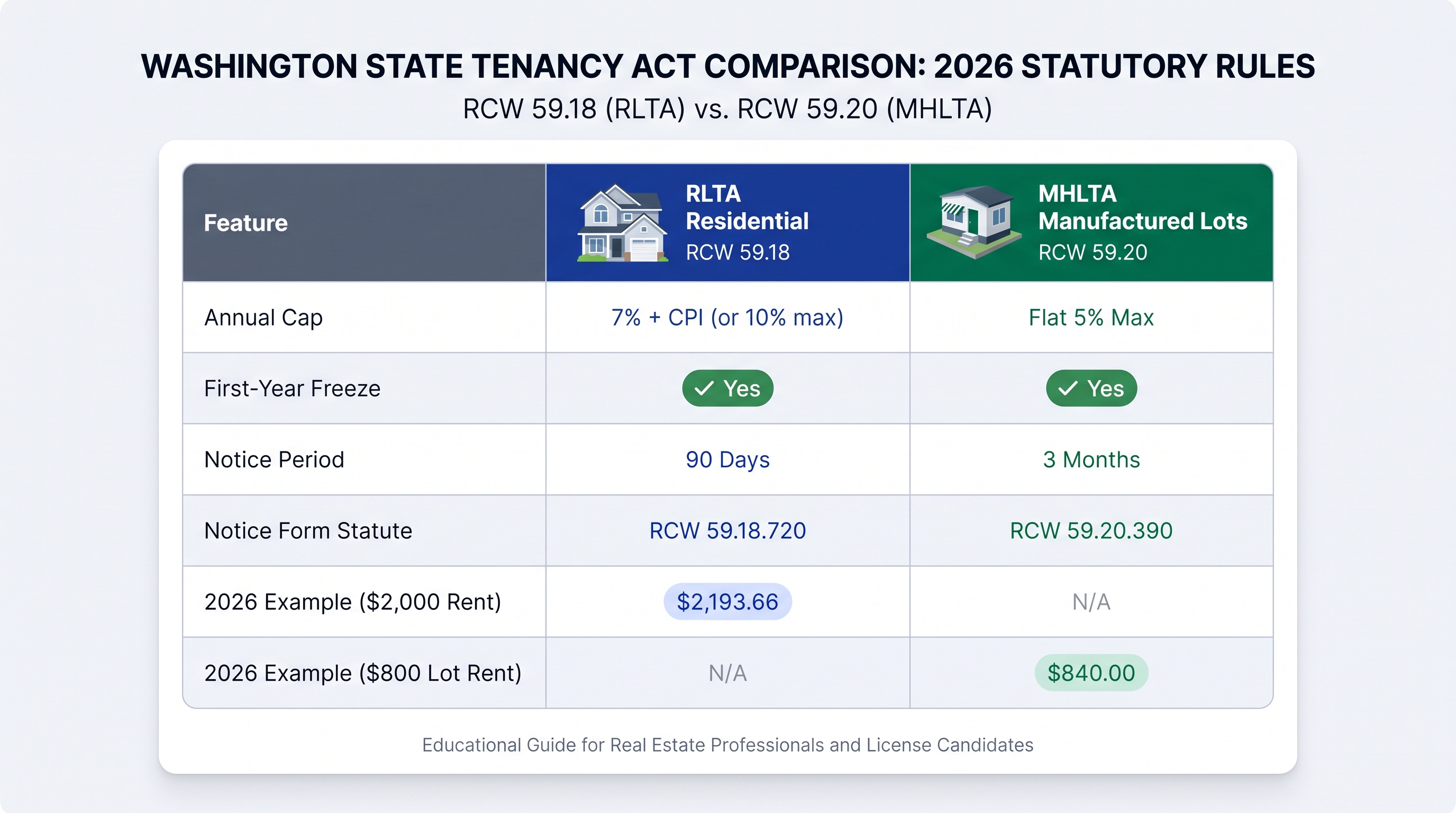
RLTA vs. MHLTA: key rent stabilization differences (examples use the 2026 residential cap)
7. Manufactured and Mobile Home Community Rules (Chapter 59.20 RCW)
Manufactured and mobile home lot tenancies fall under a separate law, the Manufactured/Mobile Home Landlord-Tenant Act (MHLTA), chapter 59.20 RCW. HB 1217 gave these tenancies their own limits:
- Flat 5% cap (RCW 59.20.370): Lot rent may not rise "during the first 12 months after the tenancy begins" or "during any 12-month period of the tenancy, in an amount greater than five percent." There is no CPI formula.
- Exceptions (RCW 59.20.380): Increases above 5% are allowed only under the listed exceptions (for example, lots owned by public housing authorities, public development authorities or qualifying nonprofits; a limited first-year increase after a qualified sale of the community to an eligible preservation organization with majority homeowner approval; and a one-time increase on first renewal after a home sale transfers the lot agreement, if the buyer got advance notice) or as provided in RCW 59.20.060(2)(c).
- Three months' notice (RCW 59.20.090(2)): The landlord must "notify the tenant in writing three months prior to the effective date of any increase in rent." Notice is served under RCW 59.20.150.
- Separate form (RCW 59.20.390): Lot rent increases use the manufactured housing notice form in RCW 59.20.390, not the RLTA form.
- Tenant exit: A lot tenant facing an unlawful increase may terminate with at least 30 days' written notice before the increase takes effect (RCW 59.20.370(3)), compared with 20 days under the RLTA.
- Worked example: For a lot renting at $800.00 per month, a 5% increase is $40.00, for a maximum new lot rent of $840.00.
8. Statewide Just-Cause Eviction Framework (RCW 59.18.650)
Rent stabilization works alongside Washington's just-cause rules. Under RCW 59.18.650 (the version effective until January 1, 2028), "A landlord may not evict a tenant, refuse to continue a tenancy, or end a periodic tenancy except for the causes enumerated" in the statute. Common grounds include:
- Nonpayment of rent: Requires the 14-day pay-or-vacate notice in the form set out in RCW 59.18.057.
- Material breach: Requires written notice to remedy the breach by a date "at least 10 days after service of the notice."
- Owner occupancy or sale of a single-family home: Each requires "at least 90 days' advance written notice."
- A rent increase notice is not a termination notice: A notice under RCW 59.18.140 changes the rent; it does not end the tenancy. Ending a tenancy still requires one of the causes in RCW 59.18.650.
9. Broker Licensing, Supervisory Duties, and Trust Accounts (Chapter 18.85 RCW and Chapter 308-124E WAC)
For licensees and license candidates, leasing and property management are governed by the real estate license law:
- Property management is brokerage (RCW 18.85.011): "Real estate brokerage services" include "Performing property management services, which includes with no limitation: Marketing; leasing; renting; the physical, administrative, or financial maintenance of real property." Performing these services for others for compensation requires a license with a firm. RCW 18.85.151 exempts owners acting for their own account and their employees, and some limited-role workers, such as someone who only delivers lease documents or receives payments made payable to the firm or owner.
- Supervision (RCW 18.85.275): "The designated broker or managing broker shall supervise the conduct of brokers and managing brokers for compliance with this chapter, chapter 18.235 RCW, and RCW 18.86.030." A sound supervision practice for a property management firm includes checking rent increases against the Commerce cap, confirming use of the RCW 59.18.720 form, and keeping proof of service under RCW 59.12.040.
- Trust funds (RCW 18.85.285 and WAC 308-124E): "If any licensee exercises control over real estate transaction funds, those funds are considered trust funds." Under WAC 308-124E-105, a broker holding funds for a property management agreement "shall hold the funds or moneys in trust" and may not use them for the broker's benefit. WAC 308-124E-115 sets specific rules for property management trust accounts and tenant security deposits.
- Practical guidance for non-managerial brokers:
- Stay out of legal advice: Explain statutory timelines and caps as facts. Drafting custom legal addenda, advising on contested evictions or deciding disputed exemptions belongs with a landlord-tenant attorney. Refer the client.
- Escalate: If a client insists on an improper notice or on getting around the cap, take it to your managing broker or designated broker.
- Underwrite conservatively: When helping buyers evaluate rental properties, build the caps (9.683% in 2026, 10% in 2027) and the 12-month freeze into pro forma projections instead of assuming unconstrained market increases. Refer tax and financing questions to the client's own advisers.
10. Real Estate Broker Rent Increase Compliance Checklist
Complete and document these checks before preparing or serving a rent increase:
- Total rent: Add base rent and every recurring or periodic charge identified in the rental agreement (RCW 59.18.030).
- Tenancy length and prior increases: Confirm the tenancy is past its first 12 months and that total increases in any 12-month period stay within the cap (RCW 59.18.700(1)).
- Commerce cap: Confirm the published cap for the calendar year the increase takes effect (9.683% for 2026, 10% for 2027).
- Exemptions: If claiming an exemption under RCW 59.18.710, gather documents and state the supporting facts on the form. Investor-owned single-family homes are not exempt by default.
- Lease term: Confirm the effective date is after the current fixed term ends (RCW 59.18.140(3)(a)).
- Form: Use a notice substantially the same as the RCW 59.18.720 form.
- Service and proof: Serve at least 90 days ahead (longer where a city requires it, such as 180 days in Seattle) by a method allowed under RCW 59.12.040, and keep proof of service in the file.
- Just cause: Confirm the increase is not being paired with an attempt to end the tenancy outside RCW 59.18.650.
Educational Disclaimer
This guide is for educational and licensing exam preparation purposes and is not legal advice. Consult your designated broker, and refer specific compliance questions to brokerage counsel or a licensed landlord-tenant attorney.
Sources
- Washington State Department of Commerce, HB 1217 Landlord Resource Center (2026 and 2027 maximum rent increase): https://www.commerce.wa.gov/housing-policy/hb1217-landlord-resource-center/
- RCW 59.18.700, Rent increase limits, enforcement and penalties: https://app.leg.wa.gov/RCW/default.aspx?cite=59.18.700
- RCW 59.18.710, Exemptions: https://app.leg.wa.gov/RCW/default.aspx?cite=59.18.710
- RCW 59.18.720, Notice of rent increase form: https://app.leg.wa.gov/RCW/default.aspx?cite=59.18.720
- RCW 59.18.140, Notice of rent increase: https://app.leg.wa.gov/RCW/default.aspx?cite=59.18.140
- RCW 59.18.030, Definitions: https://app.leg.wa.gov/RCW/default.aspx?cite=59.18.030
- RCW 59.18.253, Holding deposits and fees: https://app.leg.wa.gov/RCW/default.aspx?cite=59.18.253
- RCW 59.18.260, Deposits and move-in checklist: https://app.leg.wa.gov/RCW/default.aspx?cite=59.18.260
- RCW 59.18.280, Deposit statement and refund: https://app.leg.wa.gov/RCW/default.aspx?cite=59.18.280
- RCW 59.18.285, Nonrefundable fees: https://app.leg.wa.gov/RCW/default.aspx?cite=59.18.285
- RCW 59.18.610, Installment payments: https://app.leg.wa.gov/RCW/default.aspx?cite=59.18.610
- RCW 59.18.650, Just-cause eviction (effective until January 1, 2028): https://app.leg.wa.gov/RCW/default.aspx?cite=59.18.650
- RCW 59.18.057, 14-day notice form: https://app.leg.wa.gov/RCW/default.aspx?cite=59.18.057
- RCW 59.12.040, Service of notice: https://app.leg.wa.gov/RCW/default.aspx?cite=59.12.040
- RCW 59.20.370, Manufactured home lot rent increase limit: https://app.leg.wa.gov/RCW/default.aspx?cite=59.20.370
- RCW 59.20.380, Manufactured home lot exemptions: https://app.leg.wa.gov/RCW/default.aspx?cite=59.20.380
- RCW 59.20.090, Manufactured home lot notice: https://app.leg.wa.gov/RCW/default.aspx?cite=59.20.090
- RCW 59.20.390, Manufactured home lot notice form: https://app.leg.wa.gov/RCW/default.aspx?cite=59.20.390
- RCW 18.85.011, Definitions: https://app.leg.wa.gov/RCW/default.aspx?cite=18.85.011
- RCW 18.85.151, Exemptions from licensing: https://app.leg.wa.gov/RCW/default.aspx?cite=18.85.151
- RCW 18.85.275, Designated broker and managing broker duties: https://app.leg.wa.gov/RCW/default.aspx?cite=18.85.275
- RCW 18.85.285, Trust funds and records: https://app.leg.wa.gov/RCW/default.aspx?cite=18.85.285
- WAC 308-124E-105 and 308-124E-115, Funds held in trust: https://app.leg.wa.gov/WAC/default.aspx?cite=308-124E
- City of Seattle, Renting in Seattle, Housing Cost Increases: https://www.seattle.gov/rentinginseattle/housing-providers/managing-the-rental-relationship/housing-cost-increases
Washington's HB 1217 caps residential rent increases at 7% plus Seattle-area CPI or 10%, whichever is less: 9.683% for 2026 and 10% for 2027. Manufactured home lot rent is capped at 5%. This guide walks brokers and license candidates through the 12-month freeze, 90-day notice and statutory form, exemptions, tenant remedies, deposit rules and supervisory duties, with a worked 2027 example.