What Is Driving Washington's $2M+ Luxury Market Reset in 2026?
Washington's luxury market is resetting, not collapsing: buyers are still closing deals near the $2M+ mark, but they've regained leverage on price, inspections, and timelines. Inventory is up, list-to-sale ratios have softened, and the automatic bidding-war premium sellers grew used to is gone. For brokers, the reset changes how listings are priced, marketed, and negotiated — and it raises the compliance stakes on every high-dollar file.
- $2M+ closed sales held nearly flat in 2025 versus 2024 — luxury demand hasn't disappeared, it's just slower to convert.
- The overall list-to-sale ratio slipped below 100%, ending the era of automatic over-asking offers.
- Months of supply climbed, giving buyers more room to negotiate inspections, concessions, and price.
- Compliance risk intensifies with deal size — trust accounts, agency agreements, advertising, fair housing, disclosures, and REET all carry bigger consequences at $2M+.
- Brokers who master net sheets, hyper-local data, and supervision requirements are positioned to win luxury listings in this environment.
What Do the 2025 NWMLS Luxury Sales Numbers Show?
To understand the reset, start with the hard data. Recent Northwest Multiple Listing Service figures comparing 2024 to 2025 tell a consistent story: transaction volume is essentially flat, but the conditions surrounding each sale have changed.
In combined residential and condominium price ranges, there were 3,140 closed sales in the $2M+ bracket in 2025, compared to 3,168 the year before. Looking only at high-end single-family homes, 2,757 detached homes sold at $2M+, with King County accounting for 2,287 of those. That negligible shift confirms the bottom hasn't fallen out of the luxury market — high-net-worth buyers are still actively transacting.
What has changed is the terms. Across the broader market, the overall list-to-sale price ratio dropped from 100.2% to 99.6%. On a $3,000,000 listing, that 0.6-point drop represents roughly an $18,000 shift in baseline expectations. New listings are up 8.9%, and months of supply rose from 2.11 to 2.83 — still technically a seller's market, but one that feels sluggish to high-end sellers used to multiple offers.
The luxury condo segment is under the most pressure: $2M+ condo sales fell 10.3% year-over-year, from 175 units in 2024 to 157 in 2025, while King County's Eastside remains the heavyweight for detached luxury sales.
| Metric | 2024 | 2025 |
|---|---|---|
| $2M+ combined closed sales (residential + condo) | 3,168 | 3,140 |
| $2M+ detached homes sold | — | 2,757 |
| King County share of $2M+ detached sales | — | 2,287 |
| Overall list-to-sale price ratio | 100.2% | 99.6% |
| Months of supply | 2.11 | 2.83 |
| $2M+ condo sales | 175 | 157 |
For a broader read on how these shifts fit into this year's statewide picture, see our guide to Washington real estate market shifts and statutory changes in 2026.
What Does a Luxury Market Reset Mean for Brokers in Practice?
A reset means the balance of power is swinging back toward the center. Longer days on market require traditional, high-touch marketing — brokers can no longer enter a listing into the MLS and wait for competing offers to appear. Managing client psychology is now half the job, and sellers need to prepare for extended market times and strategic price reductions. Our guide to managing client expectations in a shifting market covers the conversation scripts that help here.
The era of waived inspections is largely behind us. Inspection leverage has shifted back to buyers: a $2.5M buyer is perfectly willing to walk away over a failing retaining wall if a seller won't negotiate, and seller concessions are becoming standard rather than exceptional.
This is a shift in bargaining power, not a value collapse. Properties still command historically high prices, but frictional costs — negotiation time, concessions, repair credits — have increased. Brokers must operate as skilled negotiators, not order-takers.
Ready to lead in this market? Handling $2M+ files well — and supervising the newer brokers who land them — is exactly what the Washington managing broker credential prepares you for. The Managing Broker Platinum Package bundles Brokerage Management, Business Management, and Advanced Law with practice exams and live instructor cram sessions, so you're ready for the exam and for the oversight this market now demands.
Which Regulatory Obligations Intensify in Washington's Luxury Market?
As the market slows, the regulatory spotlight shines brighter, and the stakes are magnified in the $2M+ space. The Washington Department of Licensing expects the same rigor on a $3M file as on a $300K one — but the consequences of a misstep scale with the deal.
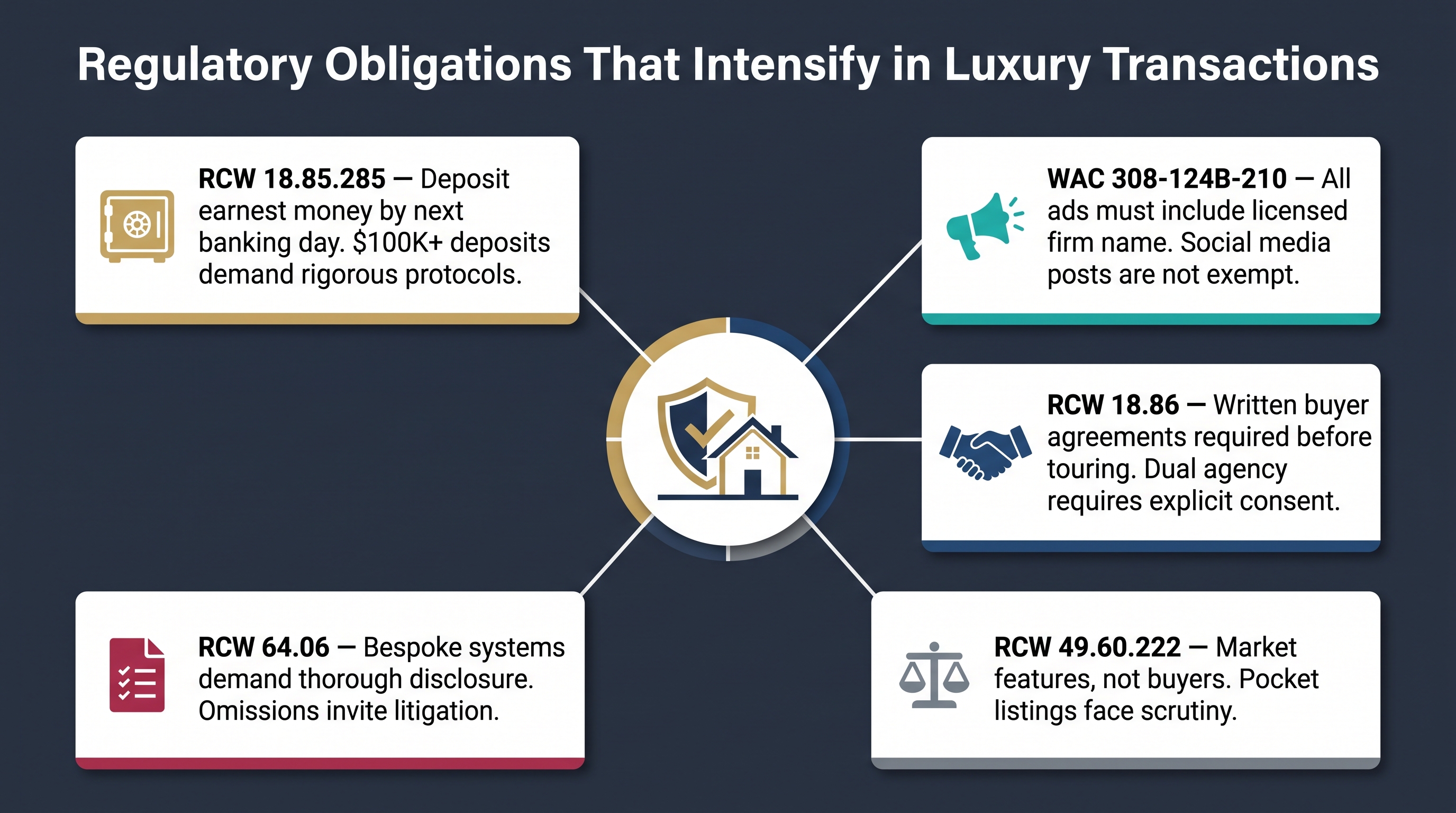
Five regulatory areas where compliance stakes are magnified in the $2M+ market. Each carries distinct obligations that brokers and designated brokers must rigorously enforce.
Trust Accounts and Earnest Money
Earnest money deposits on luxury deals frequently exceed $100,000. State law requires brokers to deposit client funds no later than the first banking day following receipt, unless the agreement states otherwise. Mishandling a $150,000 earnest money check is a fast track to disciplinary action, so designated brokers must ensure trust account policies and escrow delivery protocols are followed without exception.
Advertising Compliance
Luxury properties demand luxury marketing, but state rules still require every piece of real estate advertising to display the firm's assumed name as licensed with the state, clearly and conspicuously. Omitting your brokerage's name from a stylized social post to protect a clean aesthetic is a direct violation. Managing brokers should audit their team's digital footprint accordingly.
Agency Duties and Services Agreements
Agency requirements are more stringent than ever. Brokers must have buyers sign a written representation agreement before touring properties, which locks in compensation and protects your time in a market where buyers take longer to decide. On $2M+ deals, one broker is often approached by both sides — limited dual agency carries amplified fiduciary risk and requires explicit written consent from every party. See our full guide to Washington's written services agreement law (RCW 18.86) for the details.
Fair Housing in Luxury Marketing
Exclusive marketing must never cross into exclusionary marketing. State law prohibits discriminatory advertising, so listing copy for gated communities or private waterfronts should describe the property's features, not an ideal buyer. State agencies scrutinize pocket listings and exclusive networking groups that can inadvertently limit housing availability based on protected classes.
Seller Disclosures
Sellers of residential property must provide a completed Seller Disclosure Statement, and high-end properties often carry complex systems worth flagging carefully. With buyers conducting rigorous inspections, an omitted disclosure — say, past water intrusion in a $3M home — can quickly become high-stakes litigation. Counsel sellers that thorough disclosure is protection, not paperwork.
Graduated Real Estate Excise Tax (REET)
Washington uses a graduated REET system with state tiers of 1.10% up to $525,000; 1.28% from $525,000.01 to $1,525,000; 2.75% from $1,525,000.01 to $3,025,000; and 3.00% on the portion above that. A $3.5M sale carries a substantial state REET liability before local municipal portions are added. Brokers must walk sellers through these thresholds well before closing.
What Practical Strategies Help Brokers Navigate the Luxury Reset?
Master the net sheet. Because of graduated REET thresholds, sellers face a real tax obligation on top of commission and closing costs. Brokers must provide detailed estimated net sheets during the listing presentation — surprising a seller with an unexpected excise tax bill days before closing reflects a fundamental gap in preparation.
Commit to segmented data analysis. A macro-level market update is of little use to a high-net-worth client. The Eastside detached market behaves differently from the Seattle luxury condo segment, which saw sales decline year-over-year. Pricing a downtown penthouse using blended King County data will result in a severely overpriced listing — speak to the specific micro-market instead.
Ensure proper supervision. State law mandates heightened supervision for brokers during their first two years of licensure. A newly licensed broker who secures a $4M listing must work closely with their managing broker on custom contingencies, high-dollar escrow handling, and intense negotiations. Firms should implement mandatory review processes for luxury contracts. If you're the one providing that oversight, our Washington managing broker requirements guide breaks down the experience and education path.
Re-educate sellers on listing preparation. When months of supply approach 3.0, a property must be flawless. Staging is no longer optional, and providing a clean pre-inspection report alongside a $2.5M listing builds buyer confidence and helps accelerate the transaction.
Frequently Asked Questions
Is Washington's luxury real estate market crashing in 2026?
No. Combined $2M+ closed sales were nearly flat between 2024 and 2025 (3,168 versus 3,140), showing high-net-worth buyers are still transacting. What's changed is negotiating power: buyers now have more room on price, inspections, and concessions than they did during the frenzy years.
Why did the list-to-sale price ratio drop in the $2M+ market?
Rising inventory and slower absorption gave buyers more choices and less urgency, so sellers stopped seeing automatic over-asking offers. The overall list-to-sale ratio slipped from 100.2% to 99.6%, meaning sellers are now more likely to negotiate down from list rather than up from it.
Do buyers still waive inspections on luxury properties in Washington?
Far less often. With months of supply rising, buyers have regained inspection leverage and are willing to walk away or renegotiate over significant defects. Sellers should expect inspection contingencies and be prepared to negotiate repairs or credits rather than count on an as-is sale.
What continuing education topics matter most for Washington brokers handling luxury deals?
Trust account handling, agency law and written services agreements, advertising compliance, fair housing, seller disclosures, and REET calculations all carry higher stakes as deal size grows. Brokers active in the $2M+ space should prioritize CE electives and advanced coursework covering these exact areas.
How does the Washington Real Estate Excise Tax affect a luxury sale?
Washington's REET is graduated, so higher-priced sales are taxed at higher marginal rates on the portion above each threshold, up to 3.00% on amounts above $3,025,000.01 at the state level, plus local municipal portions. Brokers should walk sellers through the estimated tax well before listing.
Ready to Lead Through Washington's Luxury Market Reset?
Washington's $2M+ market is resetting, not collapsing — and brokers who understand the data, sharpen their negotiation, and stay ahead of the regulatory obligations that intensify at this price point are the ones who'll thrive. If you're ready to formalize that expertise, the Managing Broker Platinum Package is built by instructors who've supervised exactly these transactions, covering everything the managing broker exam asks. Questions? Call us at 425-775-2313 — a real person picks up.
Washington's $2M+ market cooled in 2025 (3,140 closed sales). See what brokers must do to stay compliant and competitive. Read the full breakdown.