Washington's real estate market is shifting from the hyper-competitive seller's conditions of the pandemic era to a more balanced one in 2026, with median prices near $595,000, roughly two months of supply, and homes sitting on the market close to 50 days. For managing brokers, this shift lands alongside a new pocket listing law, updated agency requirements, and continuing education rules that carry real compliance stakes.
Understanding these shifts – and your statutory duties around marketing, disclosure, and compensation – is no longer optional professional polish. It's the standard your affiliated licensees are held to under Washington law, and the gap between knowing the market and knowing the statute is where firms get exposed.
- Washington's median home price reached $595,000 in January 2026 (NWMLS), with days on market stretching to roughly 50 days statewide.
- A new pocket listing law effective June 11, 2026 requires concurrent public marketing of actively marketed residential listings.
- Washington's agency and compensation framework had already absorbed most of the NAR settlement's impact years before August 2024, thanks to earlier RCW 18.86 and NWMLS changes.
- Managing brokers carry distinct CE obligations, and affiliated licensees still owe 90 hours at first renewal, 30 hours after that.
- Regional markets vary sharply – Seattle/King County softness contrasts with more resilient Eastern Washington submarkets.
Washington Real Estate Market 2026: Transitioning Toward Balance
Recent data confirms the shift. The Washington State Office of Financial Management and Redfin put the statewide median home price at $611,300 in December 2025 – a 142.3% increase since 2014, though growth has clearly plateaued. Statewide inventory sits near two months of supply, active listings are climbing, and median days on market has stretched to roughly 50 days in many regions.
Northwest Multiple Listing Service data from January 2026 showed a median closed price of $595,000, a modest year-over-year cooling. Forecasts for late 2026 suggest a roughly 50-day median days on market becomes the new normal – a listing sitting for a month is tracking with the market, not underperforming it. Managing brokers should prepare affiliated licensees to reset seller expectations at the listing table using verified, current data rather than last year's assumptions.
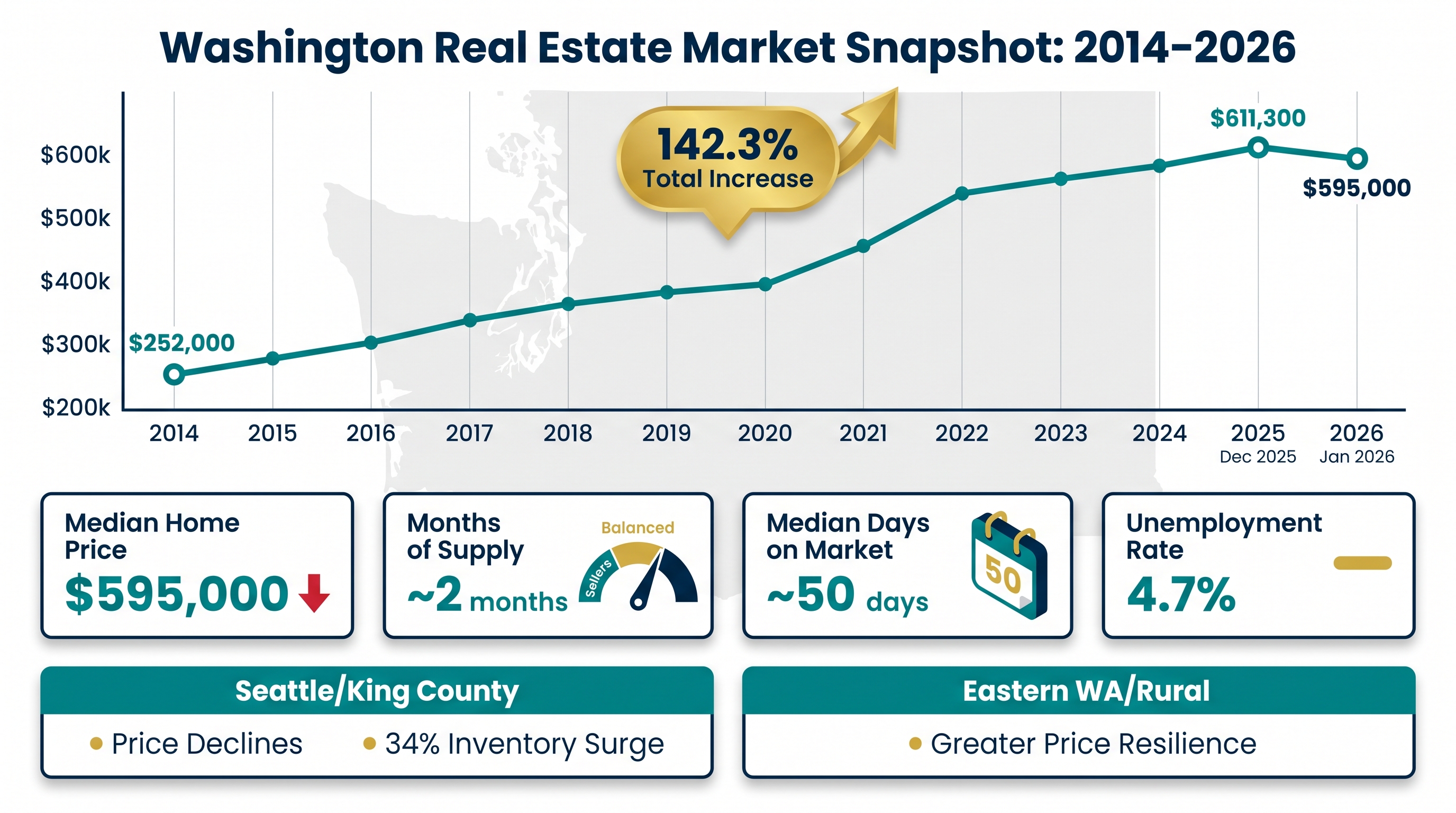
Washington Real Estate Market Snapshot: key metrics show a decisive shift toward balance after years of hyper-competitive conditions. Sources: OFM, NWMLS, Redfin, WA Employment Security Dept.
What Economic Drivers Are Shaping the 2026 Washington Housing Market?
Affordability constraints and a mixed macro picture are driving the cooldown. Mortgage rates remain a real barrier for first-time buyers, and Washington's unemployment rate has hovered around 4.7% – not recessionary, but enough to make buyers cautious about job security and long-term commitments.
Inflation is stabilizing too. The Seattle metro Consumer Price Index recently measured 3.1%, while shelter inflation cooled to an estimated 1.7% as supply increased and rent growth flattened. Buyers who feel priced out often need this reframed: slower shelter inflation and more inventory mean more negotiating power and choice than they've had in years – explaining that context is part of representing them well.
Regional Variations: Why Washington Is Not One Market
Statewide averages are a starting point, not the whole story. Late-2026 projections point to flat-to-mildly-negative growth statewide, while high-cost tech corridors have cooled more sharply.
Seattle and King County illustrate this. Early 2026 Redfin data showed slight year-over-year price declines in Seattle proper, and Axios reported metro-core inventory up as much as 34%. Brokers working King, Snohomish, and Pierce counties should expect inventory levels structurally higher than in prior years. Eastern Washington and rural coastal markets are showing more resilience, helped by different demographics and lower baseline prices – though buyers there are taking their time too. A real market analysis has to go beyond the statewide number and into hyper-local comparables.
| Market Factor | Seattle Metro / King County | Eastern & Rural Washington |
|---|---|---|
| Price trend (early 2026) | Slight year-over-year declines (Redfin) | Comparatively steadier, lower baseline prices |
| Inventory levels | Metro-core inventory up ~34% (Axios) | Rising, but less pronounced |
| Buyer behavior | Cautious, tech-sector sensitive | Patient, less urgency-driven |
| Listing strategy | Requires aggressive, data-anchored pricing | Still benefits from hyper-local comps |
Keep your office current: Translating these market and legal shifts into office-wide policy starts with knowing exactly what's required of a Washington managing broker. Review the current supervisory education and experience requirements before you build your 2026 compliance plan.
New Pocket Listing Legislation and Fair Housing Compliance in 2026
The most consequential operational change for listing brokers in 2026 is new state legislation restricting pocket listings. Signed March 16, 2026 and effective June 11, 2026, the law requires that once a residential property is actively marketed, it must be concurrently marketed to the public or all brokers.
The statute doesn't require MLS submission specifically – it prohibits exclusionary marketing practices. That intersects directly with the Washington Law Against Discrimination: by closing off hidden, off-market networks, the law aims to stop protected classes from being shut out of available inventory before they ever see a listing.
The stakes are real. Violating the new marketing requirements is subject to disciplinary action, and the law also requires updates to the statutory real estate pamphlet. Managing brokers need clear written policy on what counts as a legitimate privacy exception versus a disguised pocket listing – the Washington Department of Licensing can pursue licensing sanctions for violations.
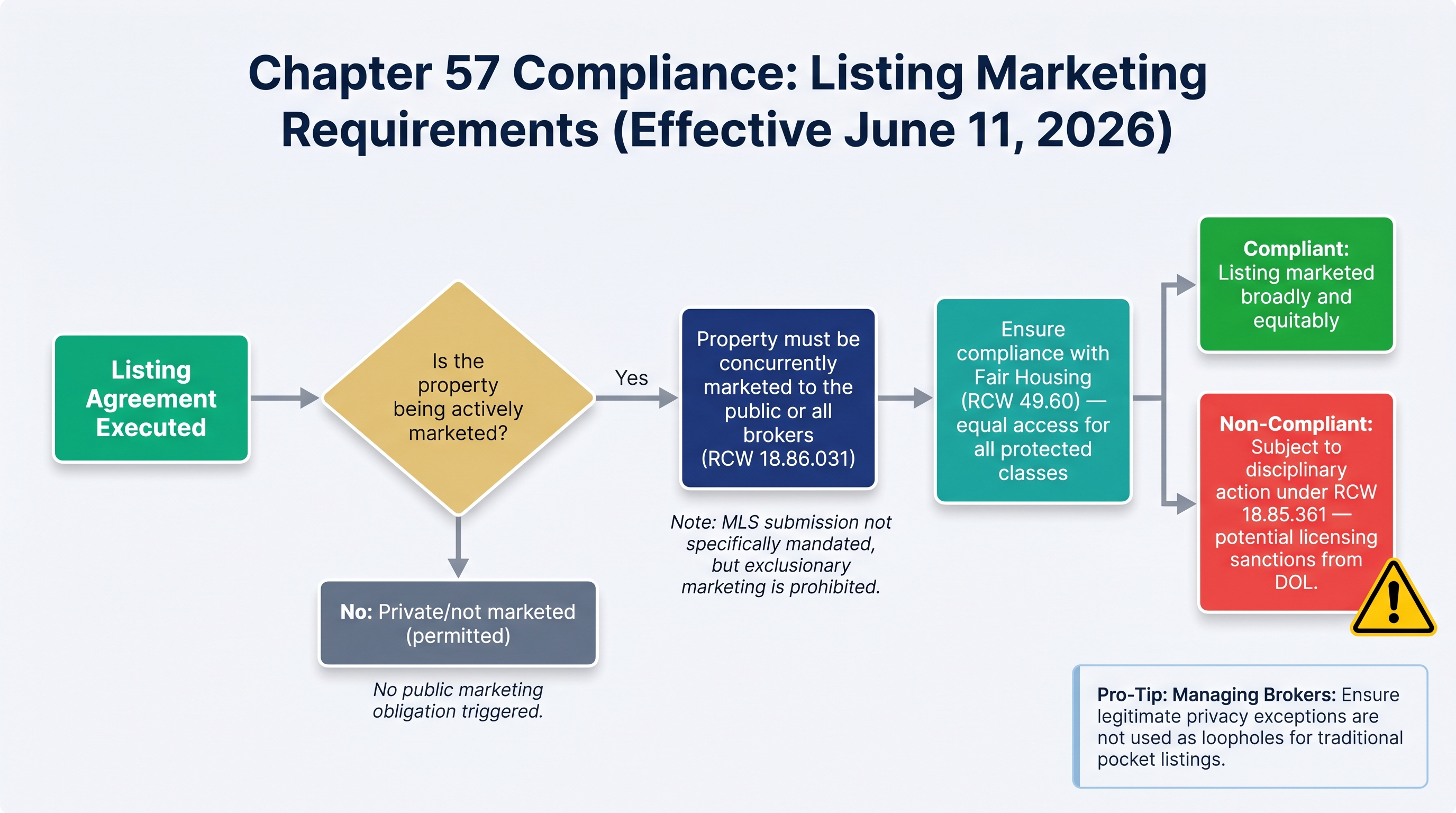
Chapter 57 Compliance Flowchart: effective June 11, 2026, actively marketed residential listings must be concurrently marketed to the public or all brokers. Violations may result in disciplinary action under RCW 18.85.361.
Evolving Seller Disclosure Statement Requirements
Statutory paperwork keeps moving too. Brokers should verify the current Washington Seller Disclosure Statement directly against the official state form rather than relying on an older firm template – outdated versions expose both seller and broker to liability. Completing the disclosure is the seller's job, but confirming the transaction uses the correct, current statutory form is squarely the broker's.
For a fuller compliance checklist covering DOL audits and transaction file documentation, see our guide to audit-proofing your WA real estate practice in 2026.
Agency Law, Compensation, and the NAR Settlement in Washington
National coverage of the real estate industry has focused heavily on Burnett v. NAR and the practice changes that followed in August 2024. Washington's story is different, because our regulatory layers were already ahead of it.
Washington brokers work under three layers of rules: state law, NWMLS rules and forms, and NAR requirements where they apply. Washington already required written buyer brokerage services agreements starting January 1, 2024 – before the NAR settlement changes took effect nationally. NWMLS itself isn't affiliated with NAR and didn't opt into the settlement; it had decoupled compensation back in 2022 and dropped mandatory seller-to-buyer-broker compensation offers as far back as 2019. That's why the NAR settlement landed with far less disruption here than in much of the country.
For the full requirements of the written services agreement itself, see our breakdown of Washington's RCW 18.86 agency law.
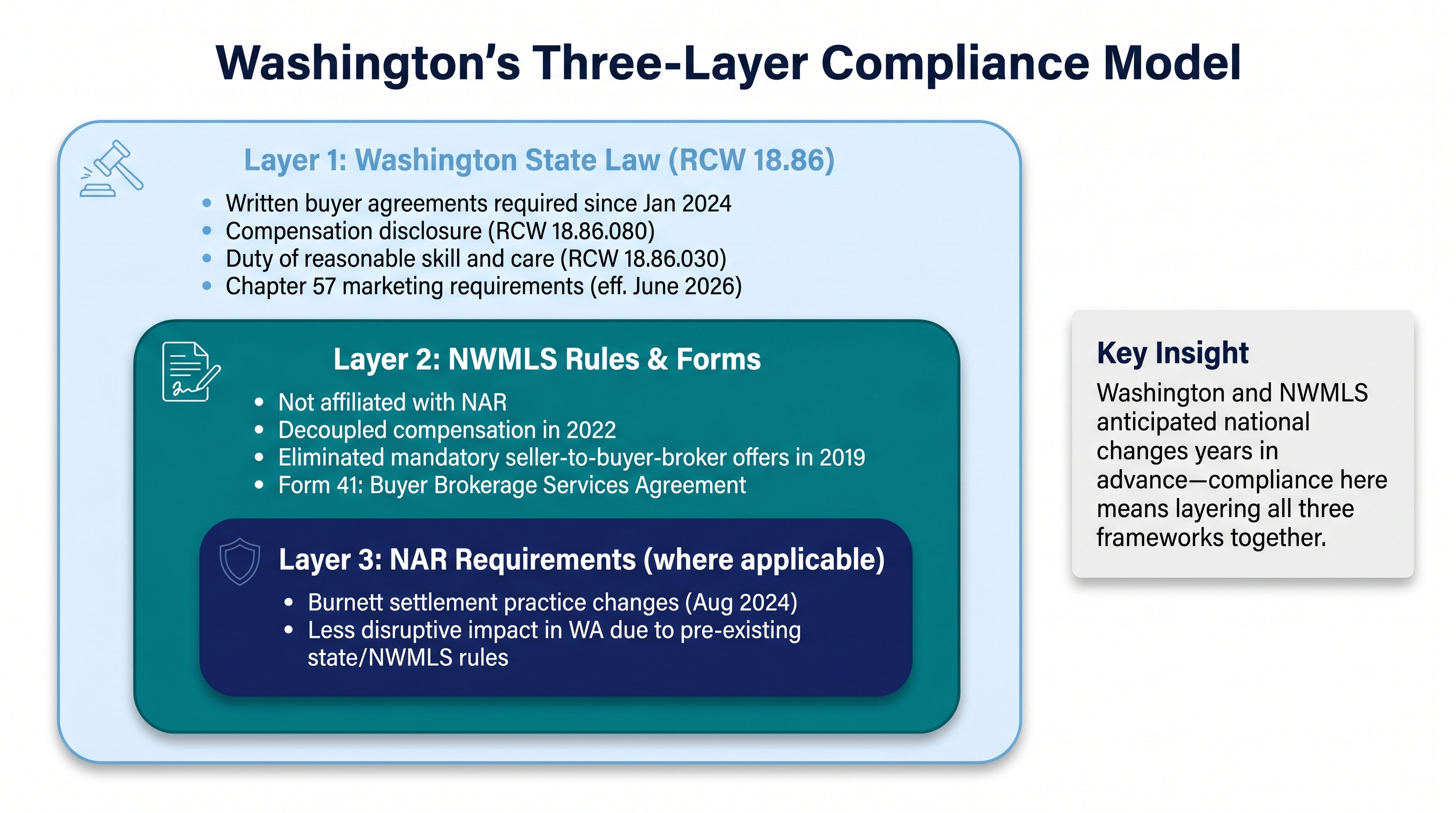
Washington brokers operate under a unique three-layer compliance framework. Understanding how state law, NWMLS rules, and NAR requirements intersect is essential for full regulatory compliance.
In practice, this means less sudden disruption and more refinement of existing protocols. Before performing any brokerage services for a buyer, a broker must execute a written agreement covering compensation and scope of work. In a market where properties sit for roughly 50 days, buyers have real leverage to negotiate seller concessions toward brokerage fees – and brokers need to keep those negotiations documented and fully transparent under both state law and NWMLS rules.
How Market Competence Connects to Continuing Education Requirements
Staying current on these market and legal shifts isn't optional professional polish – it's a statutory duty. Washington's CE rules are built to keep that competence current.
A broker's first active license renewal requires 90 hours of continuing education; every renewal after that requires 30 hours, including a mandatory 3-hour fair housing course. See our full Washington continuing education requirements for the current course breakdown. Managing brokers carry their own distinct CE obligations tied to their supervisory role – our guide on becoming a Washington managing broker walks through the full education and experience path.
The DOL's Current Issues curriculum leans heavily on exactly the legislative updates covered here. A broker owes every party reasonable skill and care under state law – in a shifting market, current knowledge of both economics and the law is what that duty looks like in practice. Managing brokers should confirm their affiliated licensees are actually absorbing this material, not just clicking through it.
Practical Guidance for Managing Brokers in Late 2026
Translating all of this into daily practice comes down to three habits:
- Lead with primary data. Build listing presentations on OFM, NWMLS, and Washington Center for Real Estate Research numbers, not gut feel – anchor sellers expecting an instant over-asking offer to the current supply and days-on-market reality.
- Price for the trend, not the peak. In a balancing market, overpricing stigmatizes a listing fast. Guide sellers toward pricing that reflects where the market is headed, not where it was two years ago.
- Document every buyer relationship. Treat the buyer brokerage services agreement as the start of the relationship, not paperwork to rush through – spell out compensation and scope up front so buyers can negotiate seller concessions with full transparency.
Mid-to-late 2026 is a genuinely different market than the one most offices trained on. Mastering the economic drivers, the new marketing law, the three-layer compliance model, and the CE requirements above is what separates a compliant office from an exposed one.
Frequently Asked Questions
What is Washington's new pocket listing law and when does it take effect?
Effective June 11, 2026, Washington law requires that once a residential listing is actively marketed, it must be concurrently marketed to the public or all brokers – restricting private, off-market "pocket listings" and tying directly to fair housing protections against exclusionary marketing.
How is the Washington real estate market changing in 2026?
The state is shifting from a seller's market to a more balanced one, with NWMLS reporting a $595,000 median closed price in January 2026, about two months of supply, and roughly 50 days on market – a "new normal" brokers should use to reset seller expectations.
Did the NAR settlement change how Washington brokers get paid?
Less than in most states. Washington already required written buyer brokerage services agreements starting January 1, 2024, and NWMLS – which isn't affiliated with NAR – had decoupled compensation in 2022 and dropped mandatory seller-to-buyer-broker offers back in 2019.
How many continuing education hours do Washington brokers need for license renewal?
A broker's first active license renewal requires 90 CE hours; every renewal after that requires 30 hours, including a mandatory fair housing course. Managing brokers have their own distinct CE requirements tied to their supervisory duties.
What should managing brokers do to prepare their office for these changes?
Build listing presentations on primary data sources like OFM, NWMLS, and WCRER, update compliance policy for the new marketing law, verify current statutory disclosure forms, and confirm every affiliated licensee is current on required CE and services agreements.
Ready to Keep Your Brokerage Compliance-Ready in 2026?
Keeping every affiliated licensee current on state law, NWMLS rules, and this year's compliance updates shouldn't fall entirely on you. Our Real Estate Brokerage Management course covers the agency, marketing, and statutory duty updates your team needs for 2026 – state-approved and built for working brokers.
Questions about which course fits your office? Call us at 425-775-2313 – a real person picks up.
Washington real estate market 2026: track price shifts, new pocket listing law, and 90-hour CE rules, review compliance steps for managing brokers.