
For Washington real estate professionals, relying on a hyper-accelerated market to mask communication gaps is over. Today's shifting market features normalizing inventory, fluctuating interest rates, and lingering seller nostalgia for recent bidding wars. This environment demands refined communication skills. Mastering these difficult conversations is a strict statutory requirement. With Washington's sweeping 2024 agency law changes, brokers must fundamentally rethink how they manage client expectations.
The revised laws mandate written services agreements, explicit compensation disclosures, and the timely provision of the Washington statutory pamphlet before rendering brokerage services. Under the oversight of the Washington State Department of Licensing (DOL), compliance is critical for license retention. Framed correctly, these statutory obligations are powerful tools for establishing professional boundaries and building trust. Approaching expectation management as a legal obligation and core competency helps brokers protect their licenses and provide exceptional service.
The Legal Foundation for Honest Communication
Before examining specific market scenarios, you must understand the legal bedrock of a Washington broker's duties. Washington agency duties are strictly statutory, defined clearly within state law. Your duties provide an unambiguous standard for professional conduct and cannot be waived by either the broker or the principal.
Under Washington law, brokers owe specific, nonwaivable duties to all parties in a transaction. These include exercising reasonable skill and care, dealing honestly and in good faith, presenting all written communications in a timely manner, and disclosing all existing material facts known by the broker that are not apparent to a party. When you engage in a difficult conversation, you are actively fulfilling your statutory duty of honesty and good faith. Avoiding hard truths is poor customer service and a potential violation of state law. You must warn a seller about a declining neighborhood valuation or point out a severe structural concern to a buyer.
When presenting the required statutory pamphlet, use it as a conversation starter rather than a compliance checkbox. Explain that your role is defined by Washington state law to ensure transparency, loyalty, and honest dealing throughout the entire transaction.
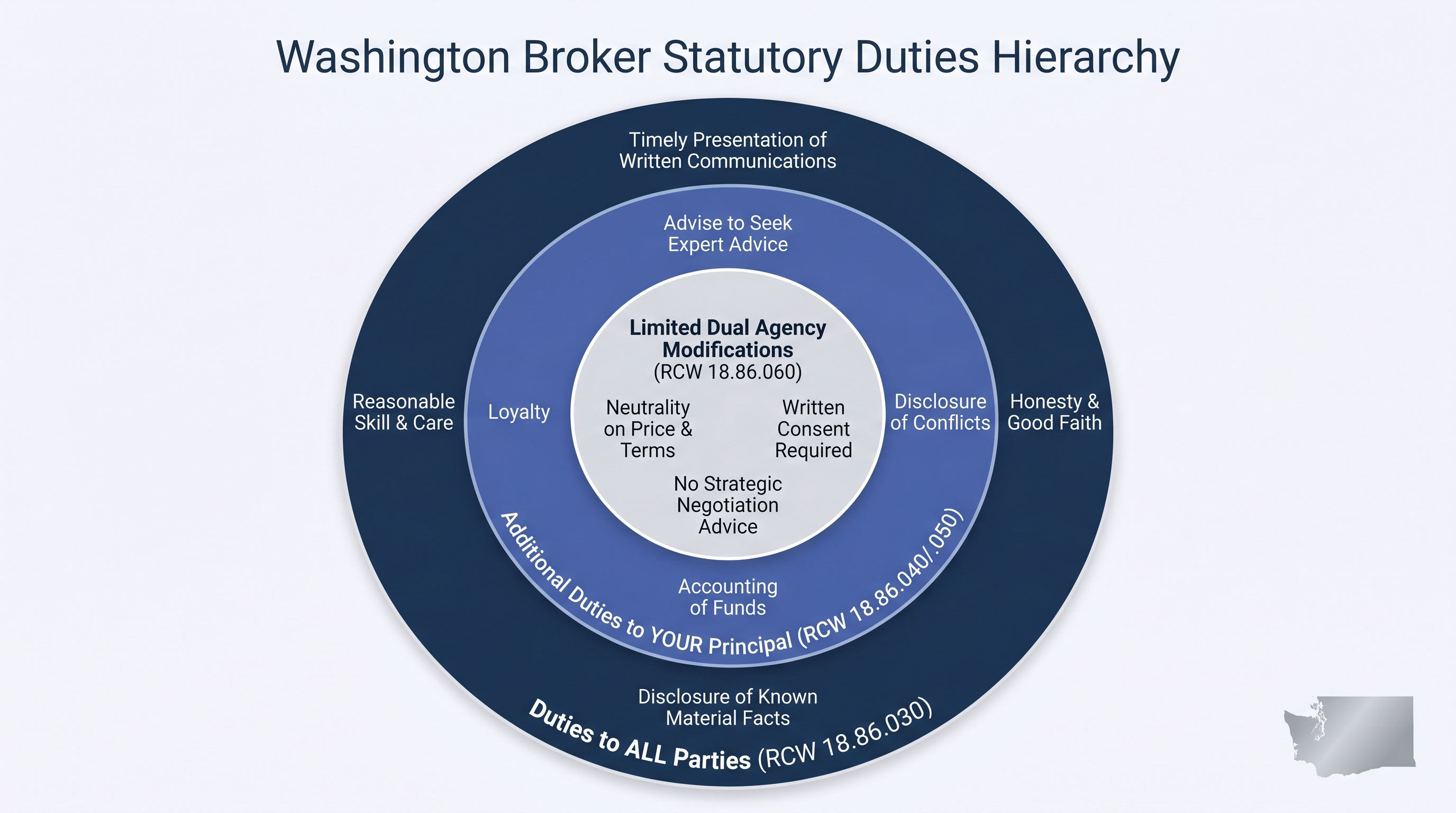
Washington Broker Statutory Duty Structure: Understanding the three tiers of obligations under RCW 18.86
Seller Conversations in a Shifting Market
The most common difficult conversation brokers face today is the pricing discussion with a prospective seller. Many sellers remain psychologically anchored to the peak valuations of 2021. When a seller expects an immediate offer at ten percent above comparable sales, managing that expectation requires tact, empirical data, and a clear understanding of your statutory duty of loyalty.
Your duty of loyalty requires you to act in the principal's best interest, prioritizing objective market facts over wishful thinking. Agreeing to an unrealistically high list price simply to secure a signed listing agreement does not serve the principal. Instead, use data to illustrate the reality of the current market. Present current days-on-market metrics, absorption rates, and recent price reductions. If a home sits on the market for thirty days without an offer, revisit the data with the seller.
Additionally, state law requires brokers to advise their principals to seek expert guidance on matters outside the broker's expertise. If a seller is relying on sale proceeds to address a complex tax liability, advise them in writing to consult a CPA or an attorney. Never guarantee market outcomes or provide financial or legal advice.
Managing seller expectations also extends to marketing strategy. Some sellers may ask you to keep their property off-market to restrict inventory artificially. Brokers must align these requests with emerging regulatory frameworks. Recently enacted legislation, effective June 11, 2026, imposes strict new regulations on pocket listings. Explain to sellers that state law and local multiple listing service rules govern how properties must be marketed to the public, ensuring fair housing compliance and maximum exposure.
Buyer Conversations about Compensation and Representation
The 2024 revisions to Washington agency law fundamentally transformed how brokers interact with buyers. Brokers are legally required to enter into a written services agreement with a buyer before, or as soon as reasonably practicable after, commencing real estate brokerage services. This brings the compensation and representation conversation to the forefront.
The written services agreement is a highly effective expectation-management tool. It establishes a clear dialogue about compensation, representation, and the duration of the agency relationship. If a duration term is not explicitly specified, the agreement carries a statutory default term of sixty days. Brokers must explain whether the agreement is exclusive or nonexclusive, what specific services will be provided, and exactly how compensation will be calculated and paid.
Inevitably, some buyers will resist this requirement, declining to sign a services agreement before touring homes. When this occurs, the broker must hold firm. Explain clearly that under Washington law, providing real estate brokerage services is legally prohibited until the agreement is executed. This includes unlocking doors for private showings or drafting offers. If the buyer remains unwilling to sign, the broker must respectfully decline to proceed.
Brokers should approach the compensation conversation with straightforward transparency. Clarify that the agreement outlines exactly what you do for them and how your brokerage is compensated. If a seller is offering a cooperating brokerage firm commission, explain that the amount will be applied toward the compensation agreed upon in the document.
Navigating Limited Dual Agency Disclosures
One of the most complex situations a Washington broker can encounter is limited dual agency, representing both the buyer and the seller in the same transaction. This frequently arises when an unrepresented buyer contacts a listing broker directly to submit an offer.
In Washington, a broker may act as a limited dual agent only with the written consent of both parties. Managing expectations in this context is critical because the broker's role fundamentally changes. As a limited dual agent, the broker can no longer advocate for one principal over the other. You cannot advise the buyer on what price to offer, nor can you advise the seller on what price to accept. The duty of loyalty is effectively neutralized in favor of absolute neutrality regarding price and terms.
The broker must explain what limited dual agency means in practice. You must clarify that you can facilitate the transaction and manage timelines, but you cannot provide either party with strategic negotiation advice. Correcting this misconception early protects the broker from claims of undisclosed dual agency.
When a principal requires dedicated advocacy, the statutory framework offers designated agency. Under state law, the buyer's and seller's services agreements can authorize the designated broker or managing broker to act as a limited dual agent while assigning different affiliated brokers within the same firm to represent each party exclusively. This preserves full advocacy for both the buyer and the seller while keeping the transaction within the firm.
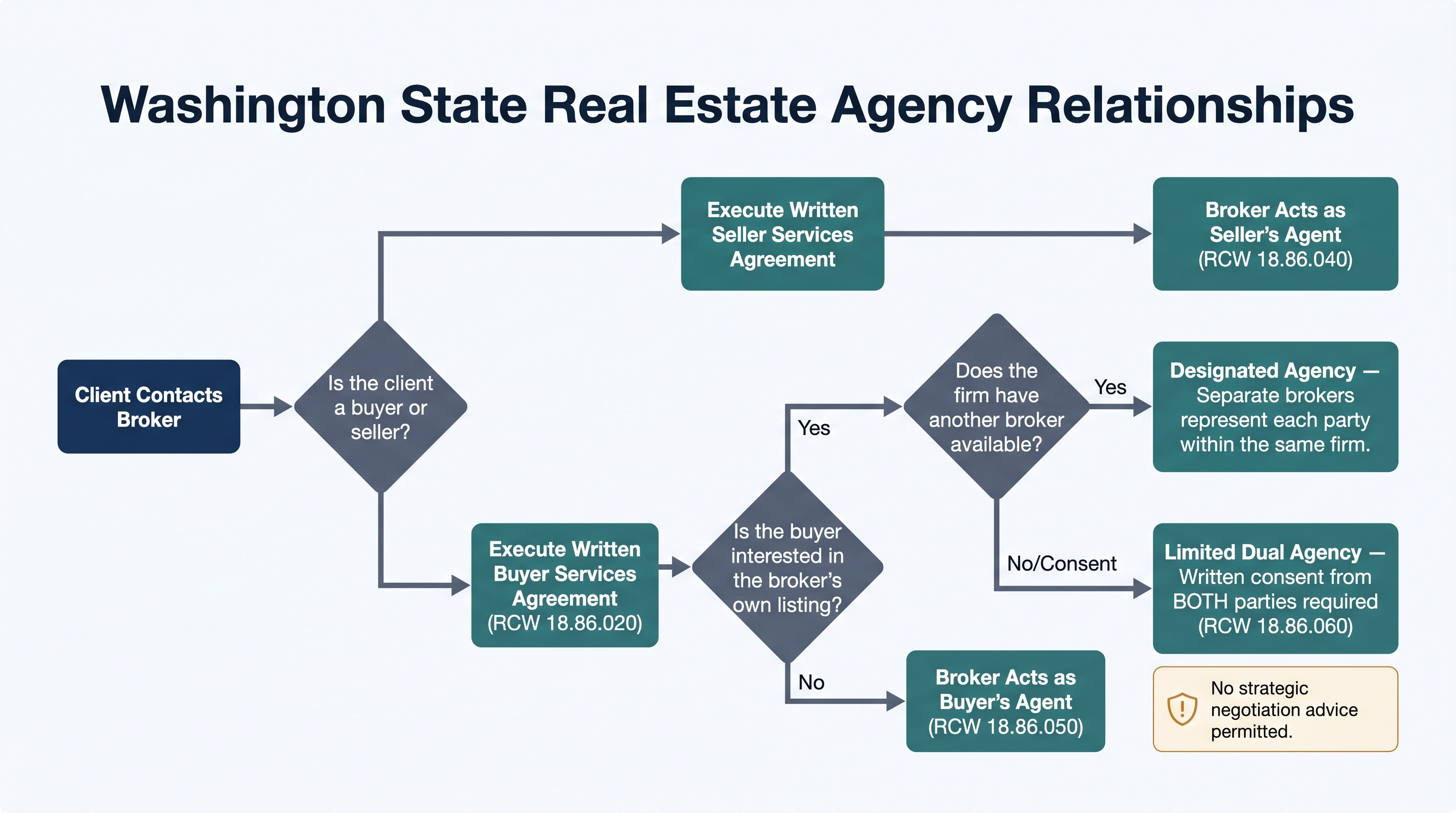
Agency Relationship Decision Flowchart: Navigating representation types under Washington's 2024 agency law revisions
Documenting Everything: Protecting the Broker and the Firm
Conducting a difficult conversation is only half the task. Documenting it is the essential follow-through. For Washington brokers, rigorous documentation is both a professional best practice and a strict regulatory requirement.
Under state administrative codes, the designated broker holds ultimate responsibility for brokerage records. Individual brokers are required to submit all transaction documents to the firm within two business days of mutual acceptance. Documentation extends well beyond the purchase and sale agreement. Brokers should maintain written records of significant conversations.
If you advise a seller to reduce their asking price based on market data and they decline, follow up with an email summarizing the discussion. If you recommend that a buyer obtain a sewer inspection and they choose to waive it, secure that waiver in writing. In the eyes of DOL auditors and the courts, if it is not documented, it did not happen. Thorough records protect the broker and satisfy the managing broker's oversight obligations.
A Practical Framework for Difficult Conversations
To bring together these legal and professional requirements, brokers should adopt a structured framework for managing principal expectations.
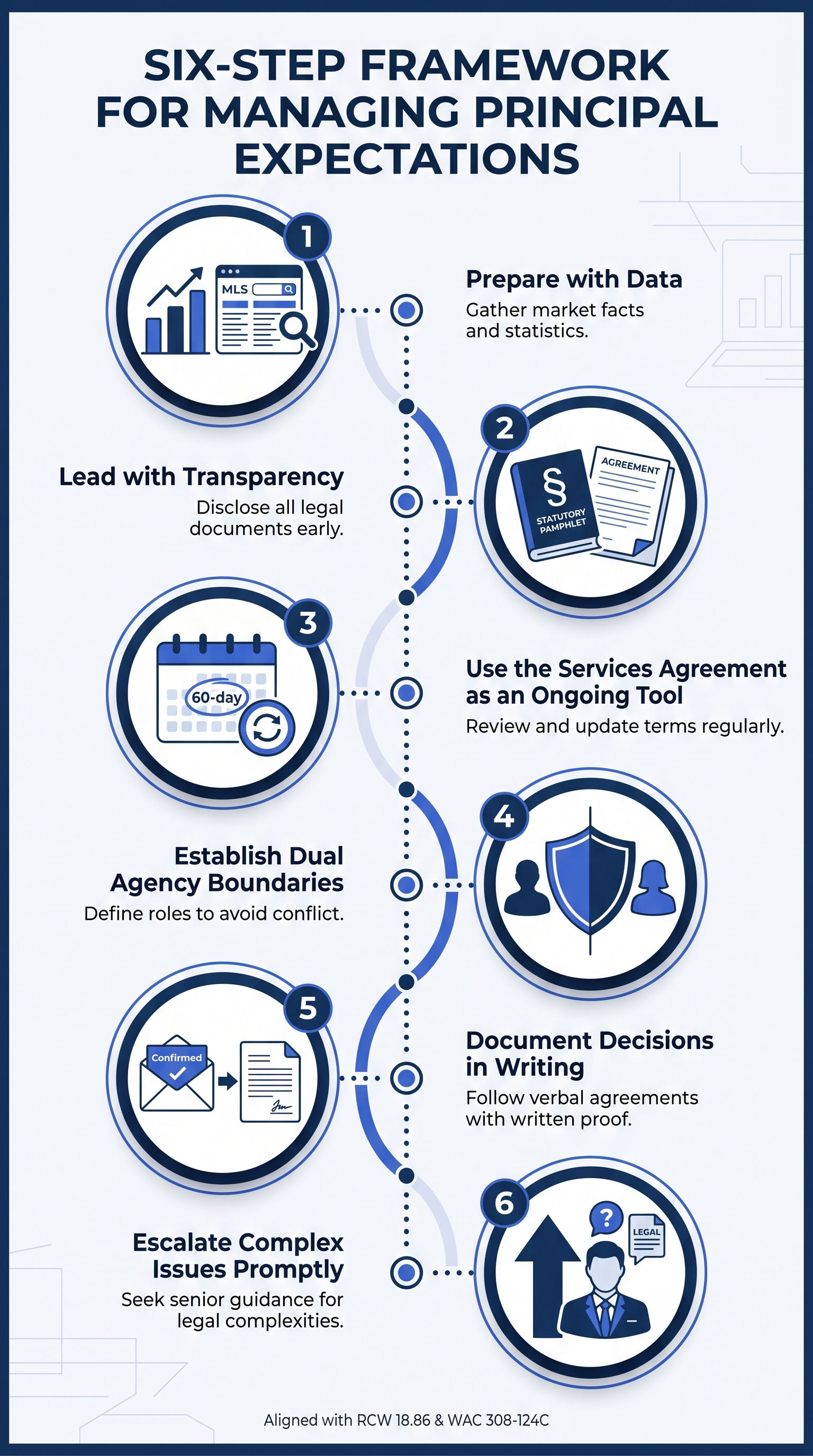
A Repeatable Six-Step Framework for Managing Principal Expectations in Any Market Condition
First, prepare with data. Pull the latest MLS statistics, review applicable state laws, and have your comparable sales analysis ready. Data depersonalizes the discussion.
Second, lead with transparency. Use the required statutory pamphlet and written services agreement as the foundation of your professional relationship.
Third, use the services agreement as an ongoing conversation tool. If a buyer's sixty-day statutory default term is nearing expiration, use that milestone to review market shifts and reset expectations.
Fourth, establish clear boundaries regarding limited dual agency. Prepare language in advance for situations where an unrepresented buyer approaches you on your own listing.
Fifth, document decisions promptly and confirm them in writing. A straightforward email summarizing agreed-upon pricing and market realities provides meaningful protection against future disputes.
Sixth, escalate complex issues promptly. If you encounter nuanced compliance questions or escalating disputes between principals, consult your managing broker without delay. Escalating issues early draws on their experience to resolve problems efficiently and fulfills your professional obligation.
Conclusion
Managing client expectations in a shifting market is genuinely challenging, but it is the true measure of a real estate professional. By drawing on the strong framework provided by Washington's agency laws, brokers can transform difficult conversations into demonstrations of unmatched professionalism. Embrace the required transparency, document your actions diligently, and recognize that honest, data-driven communication is the most effective means of serving your principals and building a sustainable practice.
Master difficult client conversations under Washington's 2024 agency law. See how 30-hour CE renewal keeps your brokerage compliant. Call today.