Dense RCW and WAC language gets easier the moment you stop reading statutes line-by-line and start mapping where each rule lives, defining its terms, then running it through a simple five-part worksheet: who, what, when, exception, consequence. This is the same habit that separates students who memorize phrases from students who can apply Washington law correctly under exam pressure.
The state portion of the broker exam tests exactly this skill, and the habit keeps paying off after you're licensed — through your first active renewal and into daily practice.
- Map your sources first — RCW 18.85, RCW 18.86, and Title 308 WAC — before trying to memorize anything.
- Run every statute through one worksheet: Who / Must Do What / When / Exception / Consequence.
- Turn each rule into a scenario question — that's exactly how the exam tests Washington law.
- Track your deadlines: a two-year prelicensing window, six-month exam validity, and a one-year licensing window.
- Date your notes. Washington agency law keeps changing, most recently in 2024 and again in 2026.
Why Washington Real Estate Law Feels So Dense on the Exam
The state portion of the Washington broker exam covers Washington real estate licensing laws and regulations, and candidates must earn a scaled score of 70 on both the national and state portions. A scaled score is not the same thing as “70 percent correct,” which is part of why the state-law content trips up otherwise well-prepared candidates. Confirm the current scoring details with PSI or DOL before your test date.
Before you ever sit for the exam, you'll complete 90 clock hours of pre-license education — 60 hours of Real Estate Fundamentals and 30 hours of Real Estate Practices. Those courses introduce the law, but reading statutes and rules on your own is a separate skill, and it's one this guide walks you through from exam prep straight through your first renewal.
Map the Sources First: RCW, WAC, and DOL Guidance
Before you try to memorize a rule, know where to find it.
- RCW 18.85 governs licensing, education, and discipline.
- RCW 18.86 governs brokerage relationships — meaning agency.
- Title 308 WAC divides Washington's real estate rules into separate chapters: WAC 308-124 (definitions and brief adjudicative proceedings), WAC 308-124A (licensing and examination), WAC 308-124B (firms, branch offices, and advertising), WAC 308-124C (records and responsibilities), WAC 308-124D (operational procedures), and WAC 308-124E (trust account procedures).
Each source carries a different weight. The table below shows how they relate.
| Source | What It Contains | Authority Level |
|---|---|---|
| RCW (Revised Code of Washington) | Permanent statutes enacted by the Legislature or by initiative | Highest — statutory law |
| WAC (Washington Administrative Code) | Agency rules adopted under statutory authority, including Title 308's real estate chapters | Carries the force of law; must stay within the authority the RCW grants |
| DOL guidance | Explains how the Department of Licensing applies the law in practice | Informational — does not override the RCW or WAC |
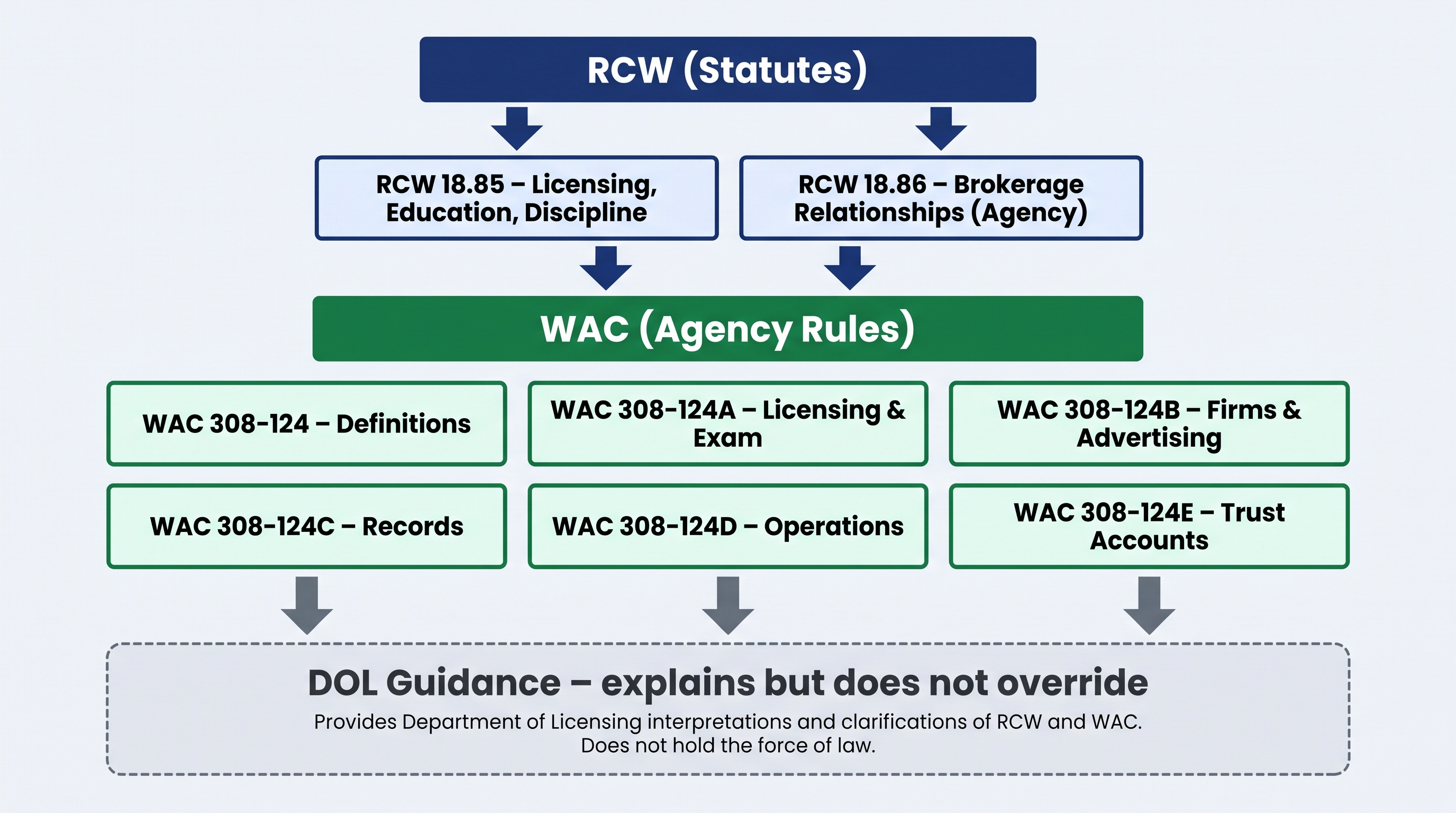
Washington real estate law source hierarchy: statutes govern rules, rules govern guidance.
Use a Repeatable Reading Method for Washington Real Estate Law
Start with definitions. Read RCW 18.85.011 and RCW 18.86.010 first. A “principal” is the client a broker represents. A “services agreement” is the written agreement between a real estate firm and a principal that appoints a broker to represent that principal and sets out the terms RCW 18.86.020 and RCW 18.86.080 require.
Cite the full subsection — RCW 18.86.030(1)(g), not just the section number — so you can find your way back to it fast.
Underline qualifiers such as “unless,” “solely,” “before,” and “as soon as reasonably practical.” These words usually determine the correct answer on the exam.
Follow cross-references. RCW 18.86.020 (services agreements), RCW 18.86.030 (duties and disclosures), and RCW 18.86.080 (compensation) all work together — read them as a set, not in isolation.
For every provision you study, fill out one worksheet: Who / Must Do What / When / Exception / Consequence.
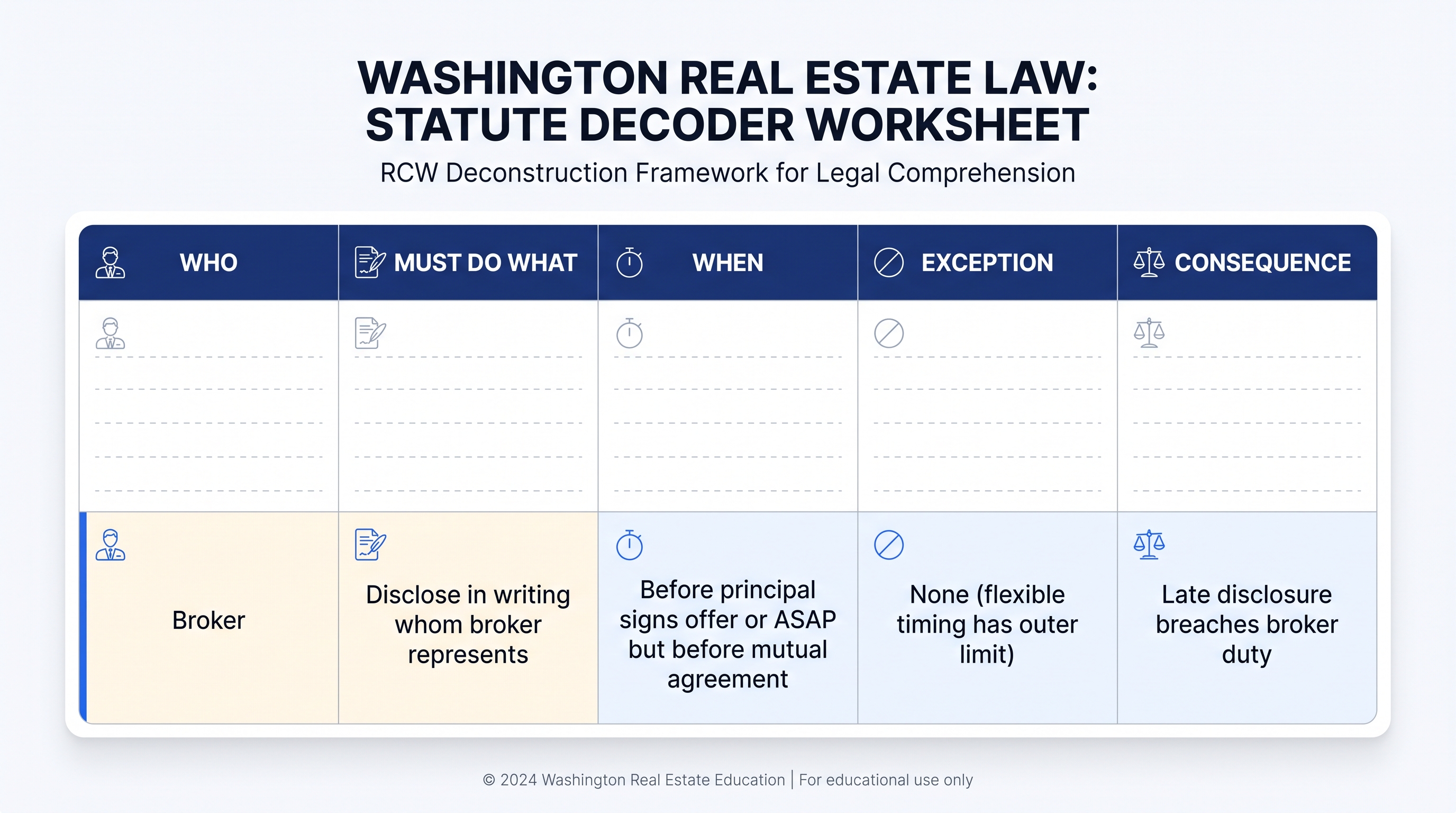
Use this worksheet for every statute section you study.
Worked Example 1: RCW 18.86.080(2)
“An agreement to pay or payment of compensation does not establish an agency relationship between the party who paid the compensation and the broker.”
- Who: the party who pays or agrees to pay compensation
- Must do what: nothing — the sentence limits what payment proves
- When: whenever compensation is paid or promised
- Exception: none in this sentence
- Consequence: identify representation by the agency relationship, not by who pays
Worked Example 2: RCW 18.86.030(1)(g)
- Who: the broker
- Must do what: disclose in writing whom the broker represents
- When: before the broker's principal signs an offer, or as soon as reasonably practical, but before the parties reach mutual agreement
- Exception: none — the flexible timing still has an outer limit
- Consequence: late disclosure breaches a broker's duty under RCW 18.86.030
Put the method into practice: Once you can work through a statute with this worksheet, test yourself against real state-law questions in the free Washington real estate practice exam — it's weighted to match the actual broker exam format, with instant scoring and topic-level explanations.
Turn WA Real Estate Rules into Exam-Style Scenarios
A seller offers to pay the buyer's firm. Payment alone does not create an agency relationship with the seller.
Two brokers in one firm represent opposite sides. Each broker represents only their own principal. The designated broker and any managing broker who supervises both brokers are limited dual agents representing both sides, which requires the written consent of both parties in the services agreement.
Drafting a buyer services agreement. The agreement must include a default 60-day term, with the option of a longer term, and a checkbox choice of exclusive or nonexclusive representation.
Private marketing. Under RCW 18.86.130, effective June 11, 2026, a broker generally may not market residential real estate for sale or lease exclusively to a limited group unless it is concurrently marketed to the general public and all other brokers. A narrow exception covers what is reasonably necessary to protect an owner's or occupant's health or safety. Public marketing does not require the owner to allow access onto the property or into the residence — an owner who allows public advertising but refuses showings is not committing a violation.
Now apply it: a listing is marketed only to a private buyer network because the seller prefers it. Seller preference alone does not qualify for the health or safety exception, so the broker must concurrently market to the public and all other brokers.
Washington's exam format and question types lean heavily on scenario questions like these, so practicing this translation from rule to fact pattern is time well spent.
Keep Your Study Current as Washington Law Changes
Washington law changes. Agency reforms effective January 1, 2024 added buyer services agreement requirements and revised disclosures, and the 2026 private marketing law layered on top of those. Check app.leg.wa.gov and DOL rulemaking notices, and date your notes so you always know which version of the law you studied.
Track these deadlines:
- Pre-license courses must be completed within two years before you apply to sit for the exam.
- Passed exam portions are valid for six months.
- You must become licensed within one year of passing the exam.
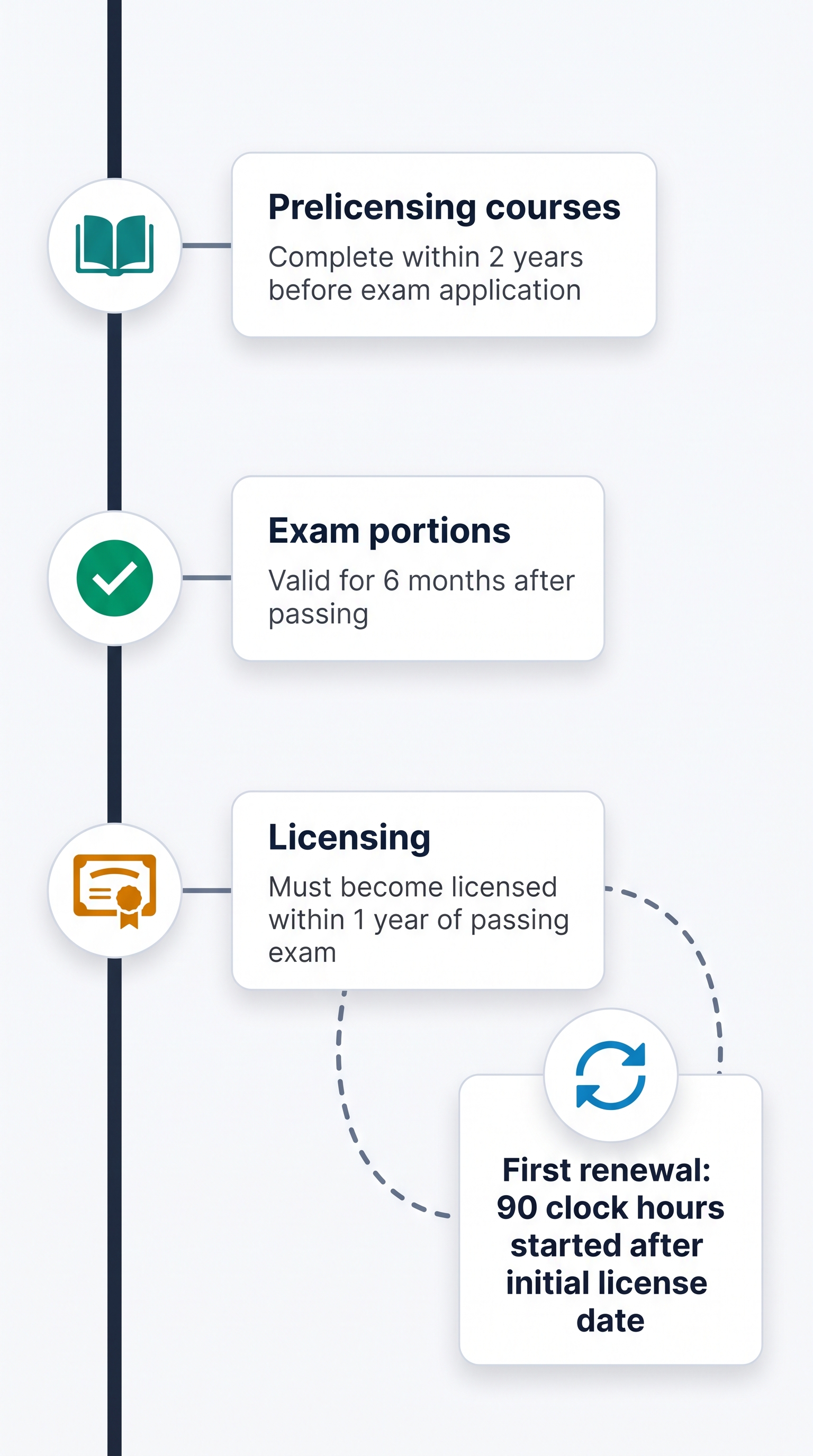
Key Washington licensing deadlines at a glance.
Study-Schedule Tips for the Washington Broker Exam
- Read one RCW section per session, and complete the worksheet before moving to the next.
- Alternate statute days with scenario days so the law and its application reinforce each other.
- Keep a running qualifier list of every “unless” and “before” you find.
- Reread definitions weekly — most missed questions trace back to a misread term, not a misunderstood rule.
- Check your readiness with a full-length practice exam before test day, not after you've run out of study time.
For a deeper look at where most students lose points, our breakdown of 50 WA real estate practice exam questions with explanations and our guide to gauging your exam readiness with the free practice exam both pair well with the method above.
Frequently Asked Questions
What score do I need to pass the Washington real estate exam?
Candidates must earn a scaled score of 70 on both the national and state portions of the broker exam. A scaled score is not the same as “70 percent correct” — confirm the current scoring method with PSI or DOL before test day.
What's the difference between the RCW and the WAC?
The RCW is Washington's permanent statutory law, enacted by the Legislature or by initiative. The WAC contains the administrative rules state agencies adopt under that statutory authority, including Title 308's real estate chapters. Both carry the force of law; DOL guidance explains how they're applied but doesn't override either.
How long is a passed exam portion valid in Washington?
A passed national or state exam portion is valid for six months. If you pass one portion but not the other, you'll need to pass the remaining portion within that window, or your passing score expires and you'll need to retest both.
Do I need to restudy the law before my first license renewal?
Yes. Your first active renewal requires 90 clock hours of education completed after your original licensing date, separate from your pre-license hours. The reading habits in this guide — mapping sources, using the worksheet, building scenarios — carry over directly.
Where can I find the official Washington real estate statutes?
Search RCW Title 18.85 and 18.86 at app.leg.wa.gov, and Title 308 WAC for the administrative rules. The Washington Department of Licensing also publishes guidance and rulemaking notices worth bookmarking as you study.
Closing: Plan for Your First Active Renewal
This method keeps working after you're licensed. Your first active renewal requires 90 clock hours of education started after the date you were first licensed, separate from pre-licensing — plan early so it doesn't crowd your first year in practice.
Don't leave the exam to chance. The State Broker Exam Prep course is built by instructors who know exactly what the WA state portion asks, so you walk in having already practiced the law, not just read it. Questions? Call us at 425-775-2313 — a real person picks up.
This article is for educational purposes only and is not legal advice. Consult the current statutes and rules, the Washington Department of Licensing, or an attorney for guidance on your specific situation.
Washington real estate exam preparation gets easier with the RCW/WAC method behind our 90-hour course. Start studying smarter today.