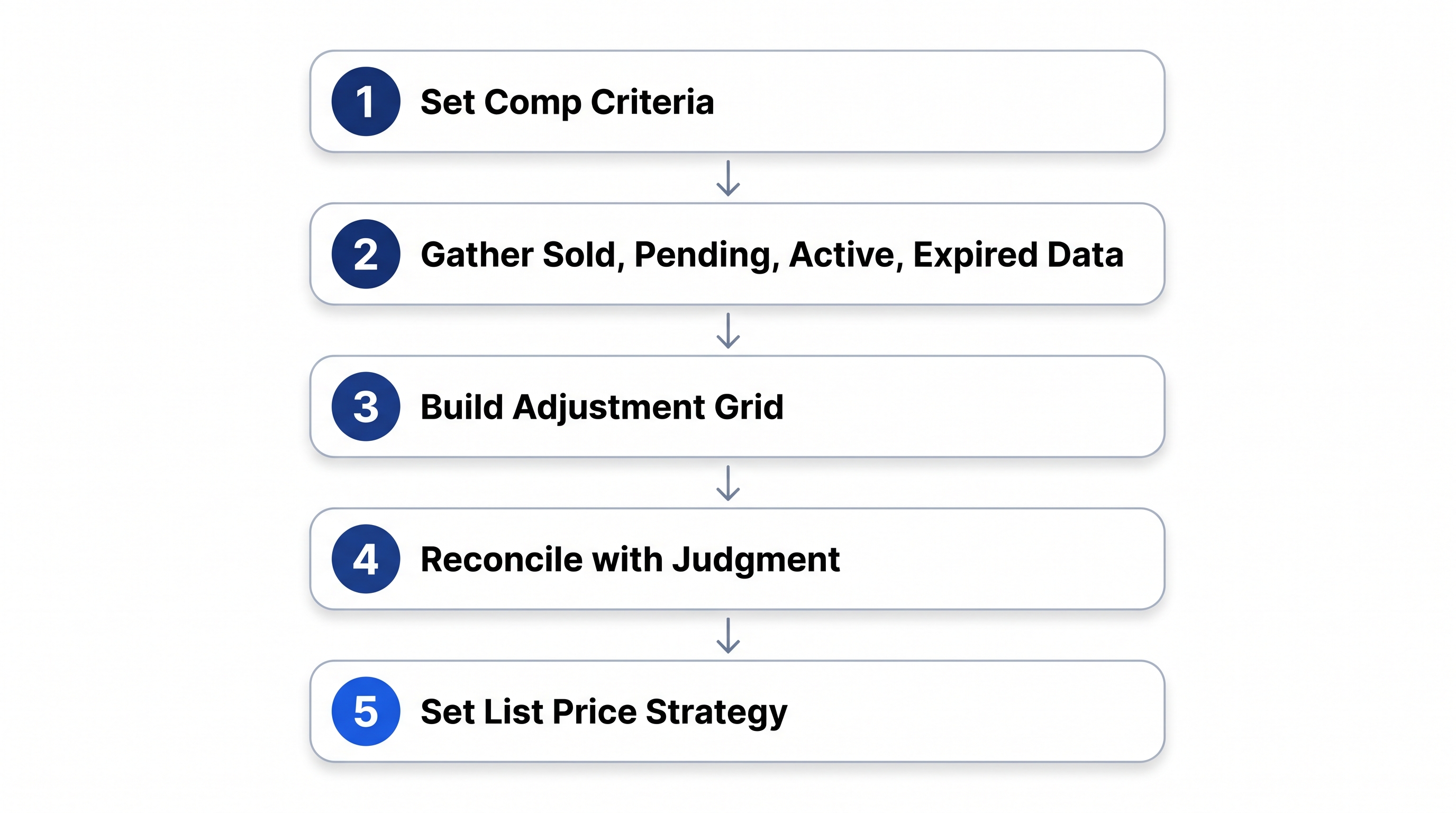
A Washington comparative market analysis walks a subject property through five steps: set comp criteria, gather sold/pending/active/expired data, build an adjustment grid, reconcile adjusted prices into a value range, and translate that value into a list-price strategy. Below is a full worked example — a fictional Spokane Valley rambler — showing exactly how a broker gets from raw comps to a defensible number.
Getting this right protects both your client and your license: a sloppy CMA can mislead a seller, invite disciplinary scrutiny, or simply cost you the listing. This walkthrough also draws the legal line between a CMA, a BPO, and an appraisal — a distinction that trips up even experienced brokers.
- A CMA is built in five steps: comp criteria, data gathering, adjustment grid, reconciliation, and list-price strategy.
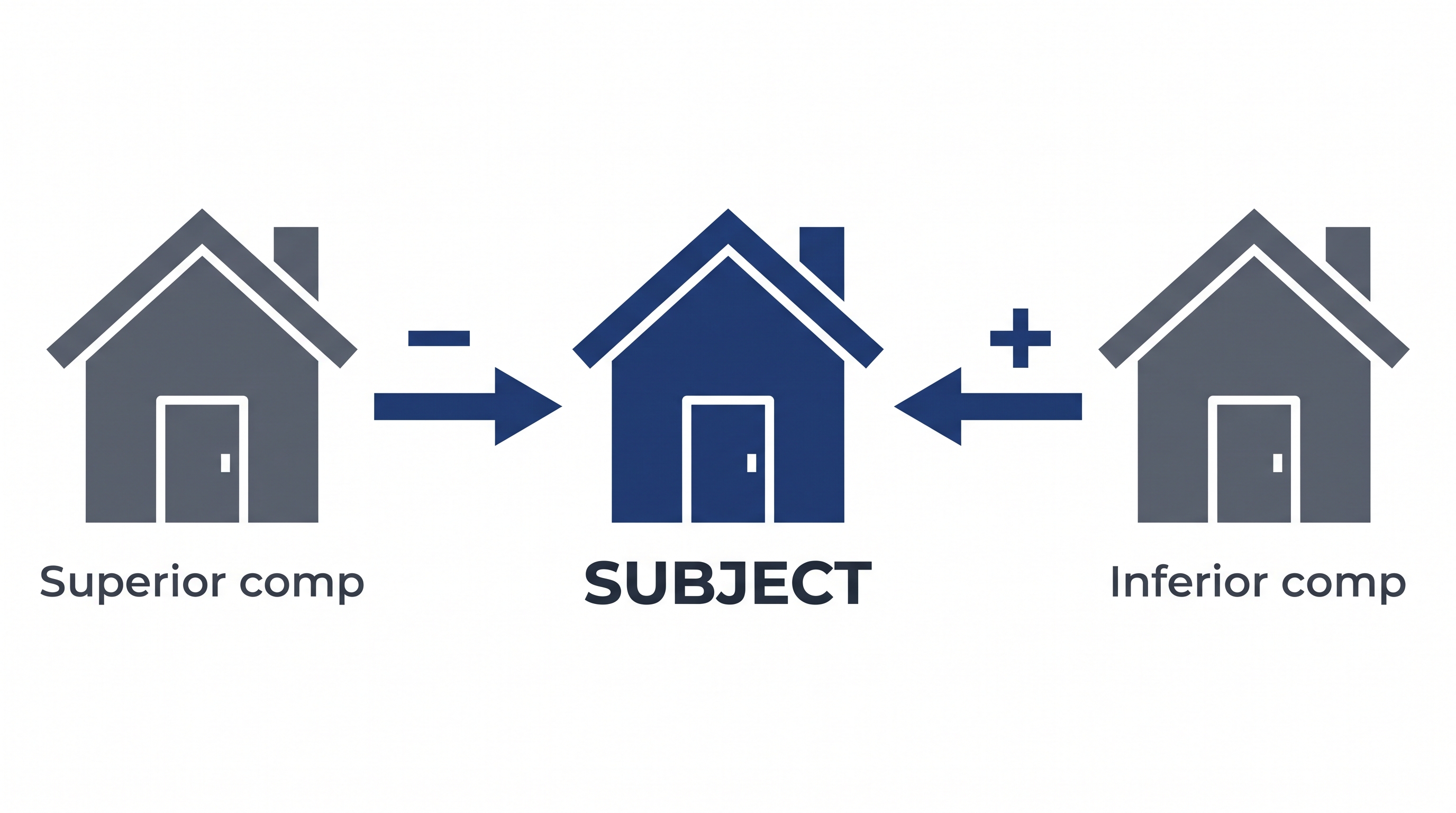
- Adjustments move comp prices toward the subject property, never the other way around.
- Net adjustment shows direction; gross adjustment shows total adjustment size and comp reliability.
- Weight comps by reliability — not a simple average — to land on a supported value range.
- A CMA is not an appraisal, and Washington law requires a clear non-appraisal disclosure on certain written BPOs.
What Is a Comparative Market Analysis in Washington Real Estate?
A CMA is a broker's evidence-based estimate of a property's most probable market price, built from comparable sales rather than a formal appraisal methodology. Washington brokers prepare them constantly — for listing presentations, buyer offer strategy, and pre-listing pricing conversations. The grid-building math below also shows up directly on the managing broker state exam, so sharpening this skill pays twice if that's your next step.
The Subject Property: A Spokane Valley CMA Example
A fictional 3-bed, 2-bath Spokane Valley rambler has 1,850 sq ft of gross living area (GLA, finished above-grade living space), was built in 1998, and is in average condition. It has a 2-car garage and a 0.20-acre lot.
Step 1: Set Comp Selection Criteria
| Criterion | Guideline |
|---|---|
| Distance | Same subdivision or competing area, ideally within ~1 mile; explain wider searches |
| Date | Closed within ~3–6 months; for older sales, analyze market change and support a time adjustment or no adjustment |
| Size | Roughly ±15–20% of subject GLA (about 1,480–2,220 sq ft) |
| Age | Built within ~10 years of the subject |
| Condition | Similar, or adjustable with evidence |
These are practice guidelines, not Washington law. No statute sets comp count, radius, or date limits; skill and care govern.
Step 2: Gather Four Types of Data
- Sold: Comps 1–3 anchor the value analysis.
- Pending: 1,880 sq ft, listed at $509,000, pending in 6 days. This suggests buyer acceptance near asking; the final price is unknown until closing.
- Active: 1,820 sq ft, listed at $519,000 after a cut from $529,000, with 38 days on market. It is competition, but that asking price hasn't attracted a buyer.
- Expired: 1,860 sq ft, listed at $535,000, expired after 90 days without an accepted offer. That asking price didn't attract buyers at that level.
Active and expired listings support, but don't prove, value.
Step 3: Build the Adjustment Grid
Adjust each comp toward the subject: subtract for superior features and add for inferior ones.
Illustrative rates: GLA $100/sq ft; age $1,000/year; condition lump sums supported by market evidence; garage bay $8,000; time based on documented local trends.
| Comp 1 | Comp 2 | Comp 3 | |
|---|---|---|---|
| Sale price | $512,000 | $478,000 | $525,000 |
| Distance | 0.3 mi | 0.6 mi | 0.4 mi |
| Date | 2 months ago | 4 months ago | 1 month ago |
| Time adj. | $0 | +$7,000 | $0 |
| GLA | 1,950 | 1,750 | 1,900 |
| Size adj. | −$10,000 | +$10,000 | −$5,000 |
| Year built | 2001 | 1995 | 1998 |
| Age adj. | −$3,000 | +$3,000 | $0 |
| Condition | Average | Fair (dated kitchen/baths) | Updated/good |
| Condition adj. | $0 | +$15,000 | −$20,000 |
| Garage | 2-car | 2-car | 3-car |
| Garage adj. | $0 | $0 | −$8,000 |
| Net adj. (gross) | −$13,000 ($13,000) | +$35,000 ($35,000) | −$33,000 ($33,000) |
| Adjusted price | $499,000 | $513,000 | $492,000 |
Comp 2: $478,000 + $7,000 + $10,000 + $3,000 + $15,000 = $513,000.
Net adjustment sums increases and decreases; gross adjustment totals all changes regardless of sign, showing how much adjustment the comp needed. Support adjustments with market evidence, such as paired sales (similar sales differing in one feature) or trend data. A $0 time adjustment still claims prices held steady. Contributory value — what a feature adds to market price — differs from cost: a $40,000 kitchen may add only $15,000.
Practice this on real course files: Listings and Valuation (7 Hrs) walks Washington brokers through CMA components, adjustment-grid math, and pricing strategy in changing markets — the natural next step once this grid makes sense on paper.
Step 4: Reconcile With Judgment, Not a Simple Average
Adjusted prices range from $492,000 to $513,000. Give Comp 1 the most weight: it is recent, close, and required the smallest gross adjustment.
- 0.50 × $499,000 = $249,500
- 0.25 × $513,000 = $128,250
- 0.25 × $492,000 = $123,000
- Total = $500,750
These weights reflect judgment about comp reliability; an equal-weight average is $501,333. The indicated value is about $500,000, with a supported range of $495,000–$505,000. The range is centered on the weighted indication and within the adjusted comps' span ($492,000–$513,000), excluding extremes that required the largest adjustments.
The pending listing at $509,000 is consistent with this value. Unsuccessful asking prices of $519,000 and $535,000 suggest, but don't prove, limited buyer interest above roughly $510,000.
Step 5: Separate List Price From Market Value
Value is the evidence-based most probable price. List price is the seller's marketing strategy, chosen with your advice. Supply is 42 active listings ÷ 21 average monthly sales = 2.0 months. A common rule of thumb treats under about 4 months as favoring sellers, about 6 as balanced, and more as favoring buyers; thresholds vary by market.
| Market | Strategy |
|---|---|
| Seller's (2.0 months) | List at $499,900 to draw multiple offers; expect possible escalation |
| Balanced | List at $505,000, top of range, leaving room to negotiate |
| Buyer's (7+ months) | List at $494,900–$499,900; plan concessions and price reviews at 14 and 30 days |
Never inflate a CMA to win a listing. Clearly state in the report if you, your managing broker, or your firm has an interest in the property.
CMA vs. Appraisal: Know the Legal Difference
| CMA/BPO | Appraisal | |
|---|---|---|
| Prepared by | Licensee, possibly advocating for a client | State-licensed or certified appraiser |
| Standard | Brokerage law, including skill and care | State appraisal law and USPAP (Uniform Standards of Professional Appraisal Practice); unbiased role |
Licensees may prepare and be paid for BPOs without appraiser credentials, but a BPO can't serve as an appraisal in a federally related transaction. Compensation flows through the firm, which may be paid for a BPO without a services agreement. Federal law also bars using a BPO as the primary basis to value a consumer's principal dwelling for purchase-money mortgage origination.
Written BPOs, or those offered as evidence in a legal proceeding, require a conspicuous disclosure when the only intended user isn't a prospective seller, buyer, lessor, or lessee — such as a lender or attorney. It must state that the report isn't an appraisal, was prepared by a Washington licensee, and whether the preparer is also a state-certified or state-licensed appraiser. Give this disclosure orally when testifying. Misrepresentation remains disciplinary ground under Washington DOL licensing law, so best practice is a non-appraisal statement in every written CMA and designated-broker involvement in third-party assignments.
Frequently Asked Questions
What is a comparative market analysis (CMA) in Washington real estate?
A CMA is a broker's estimate of a property's likely market price, built from recent sold comps and adjusted for differences in size, age, condition, and location. Washington brokers use it to advise sellers on list price and buyers on offer price. It's not an appraisal and carries no state-mandated format.
How many comps does a Washington CMA need?
No Washington statute sets a comp count, radius, or date cutoff. Practice norms call for three or more closed sales within about a mile and six months, sized within roughly 15–20% of the subject's square footage. Wider searches are fine if you explain why in the report.
Can a CMA replace an appraisal?
No. A CMA or BPO is prepared by a licensee under brokerage law, while an appraisal is prepared by a state-certified or state-licensed appraiser under USPAP. Federal law also bars using a BPO as the primary basis for valuing a consumer's home in a purchase-money mortgage.
What's the difference between net and gross adjustment?
Net adjustment nets increases against decreases to show a single directional total. Gross adjustment adds every adjustment's absolute value, revealing how much total change a comp needed regardless of direction. A low gross adjustment generally signals a more reliable, more comparable comp.
Does building CMAs count toward my Washington CE hours?
Yes, when the hours come from a DOL-approved course covering valuation topics. Check your personal timeline with our license renewal and CE deadline tracker before enrolling, since first-renewal and standard-renewal hour requirements differ.
Keep Your CMA and Valuation Skills Sharp
You've put in the work to build a license worth leveling up. Markets shift, adjustment rates move, and disclosure forms get refreshed almost every renewal cycle — so valuation skill isn't a one-time study, it's ongoing CE. Washington's continuing education requirements cover exactly where CMA, BPO, and pricing-strategy electives fit into your 30-hour renewal.
Before you enroll in anything, confirm it actually counts using our pre-purchase CE checklist, and use our renewal deadline tracker to see exactly when your hours are due. Questions? Call us at 425-775-2313 — a real person picks up.
Washington comparative market analysis example: comps, adjustments, pricing strategy, rated 4.76/5 by students. Build your CMA skills today.