How Are Interest Rates Shaping Washington Home Sales in 2026?
Interest rates near 7% are the reason Washington's housing market feels stuck: inventory keeps rising while closed sales barely move, because buyers can't stretch their budgets and sellers won't trade a 3% mortgage for a much higher one. For a new broker, that gap between listings and sales is exactly where financing knowledge starts to matter.
Real estate education alone doesn't prepare you for this market, you also need to read it. Washington's active listings have climbed sharply over the past two years, marking some of the highest inventory levels in nearly a decade, while the number of closed sales and median prices have stayed comparatively flat year over year.
Economists point to a "rate lock-in effect" driving this pattern. Owners holding pandemic-era mortgages near 3% are reluctant to sell and finance a replacement home near 7%, and today's buyers are more rate-sensitive than any cohort in recent memory.
- Rising inventory and flat closed sales in Washington both trace back to elevated interest rates keeping buyers and rate-locked sellers on the sidelines.
- Brokers aren't loan officers, but WA law still requires honesty about known material facts that affect a buyer's ability to close.
- The NWMLS Financing Addendum (Form 22A) only protects earnest money when deadlines and disclosures are handled correctly.
- Seller contributions toward a buyer's costs are capped differently for Conventional, FHA, and VA loans — know the limits before you write the offer.
- Quoting a rate, promising approval, or negotiating loan terms without a Mortgage Loan Originator (MLO) license is a federal violation.
With nearly every buyer stretching their budget, a financing contingency is no longer boilerplate — it's often the single most important clause in the contract. A buyer whose rate locks half a point higher than expected can suddenly exceed debt-to-income limits, putting the deal and their earnest money at risk.
What Does Washington Law Require Brokers to Know About Financing?
Washington law expects you to perform as a competent real estate professional — not as a loan officer or a financial investigator. You have no independent duty to audit a client's bank statements or dig into their finances.
What the law does require is honesty and disclosure of known material facts. If your buyer loses a job and can no longer qualify for their loan, that's a material fact, and staying silent about it can trigger disciplinary action from the Washington Department of Licensing (DOL). State regulations also prohibit misrepresenting a buyer's financial strength to win a bidding war.
You also carry a statutory duty to point clients toward expert advice you're not licensed to give. When a buyer asks about origination fees, rate buydowns, or private mortgage insurance, the right answer is almost always a referral to their loan officer — not a guess.
Financing Concepts Every New Washington Broker Should Master
You can't act as a lender, but you do need to speak the language fluently enough to protect your clients and your license. These are the concepts that come up in nearly every Washington transaction.
Preapproval vs. Prequalification
These terms get used interchangeably by clients, but they mean very different things when you're structuring an offer.
| Term | What It Actually Means | Reliability |
|---|---|---|
| Prequalification | An estimate based on unverified, self-reported income and credit information | Low — treat with caution in a competitive offer |
| Preapproval | Credit pulled, income verified, and run through automated underwriting | High — the standard a competitive Washington offer needs |
Financing Contingencies and Earnest Money
The Financing Addendum (NWMLS Form 22A) protects earnest money if a buyer can't secure a loan — but only within its terms. If the buyer misses the application deadline, or the seller issues a Right to Terminate and the buyer doesn't respond, the contingency can be waived. Once waived, a financing failure means the earnest money is forfeited.
Mortgage Types
Conventional, FHA, and VA loans each carry different underwriting rules. FHA and VA loans in particular carry strict property condition requirements — an intact roof, working systems, no safety hazards — so recognize potential appraisal issues before drafting an offer on a fixer-upper for an FHA or VA buyer.
Interest Rate Buydowns
A permanent buydown pays discount points at closing to lower the rate for the life of the loan. A temporary buydown, like a 2-1 buydown, uses upfront funds — often a seller concession — to cut the rate by 2% in year one and 1% in year two. Understanding the difference helps you structure a smarter concession request.
Assumable Mortgages
A seller's assumable 3% FHA or VA loan can be a genuine selling point, but assumption is complicated: it requires lender approval and can create an equity gap the buyer has to finance separately. VA loans add entitlement implications on top of that. Flag these opportunities early, then hand off to an assumption specialist.
The Boundary of MLO Licensing
Federal law requires anyone who negotiates loan terms or takes a residential mortgage application to hold a Mortgage Loan Originator (MLO) license. As a broker, that means you cannot quote a specific interest rate, promise loan approval, or negotiate loan terms — full stop.
See where this fits in your career path: Everything above — contingencies, forms, financing math — is built into a Washington broker's core education. The Gold Broker Pre-License package covers the 90-hour requirement plus exam prep, so you walk into your first transaction already speaking this language.
Real-World Financing Scenarios New WA Brokers Will Face
Here's how financing knowledge and legal compliance intersect in practice.
Scenario 1: Preapproval Language Pitfalls
A buyer's preapproval letter states, "Approval is subject to the sale and closing of the borrower's current home." Skip the Contingency for Sale of Buyer's Property (Form 22B) and you've left your buyer exposed — if their home doesn't sell, the seller may argue the buyer misrepresented their ability to purchase, potentially costing them their earnest money.
Scenario 2: Lender Referral and Kickback Risks
A loan officer offers you a referral fee for every closed deal you send their way. Accepting it violates federal and Washington state law. Regulations strictly prohibit undisclosed compensation or kickbacks from settlement service providers, and participating puts your license and your firm at risk.
Scenario 3: Handling a Buyer's Changed Financial Circumstances
Your buyer finances a new truck before closing, their DTI ratio shifts, and the lender denies the loan. You're now obligated to promptly tell the listing broker your buyer can't perform — that's a known material fact, and concealing it breaches your duty to deal honestly.
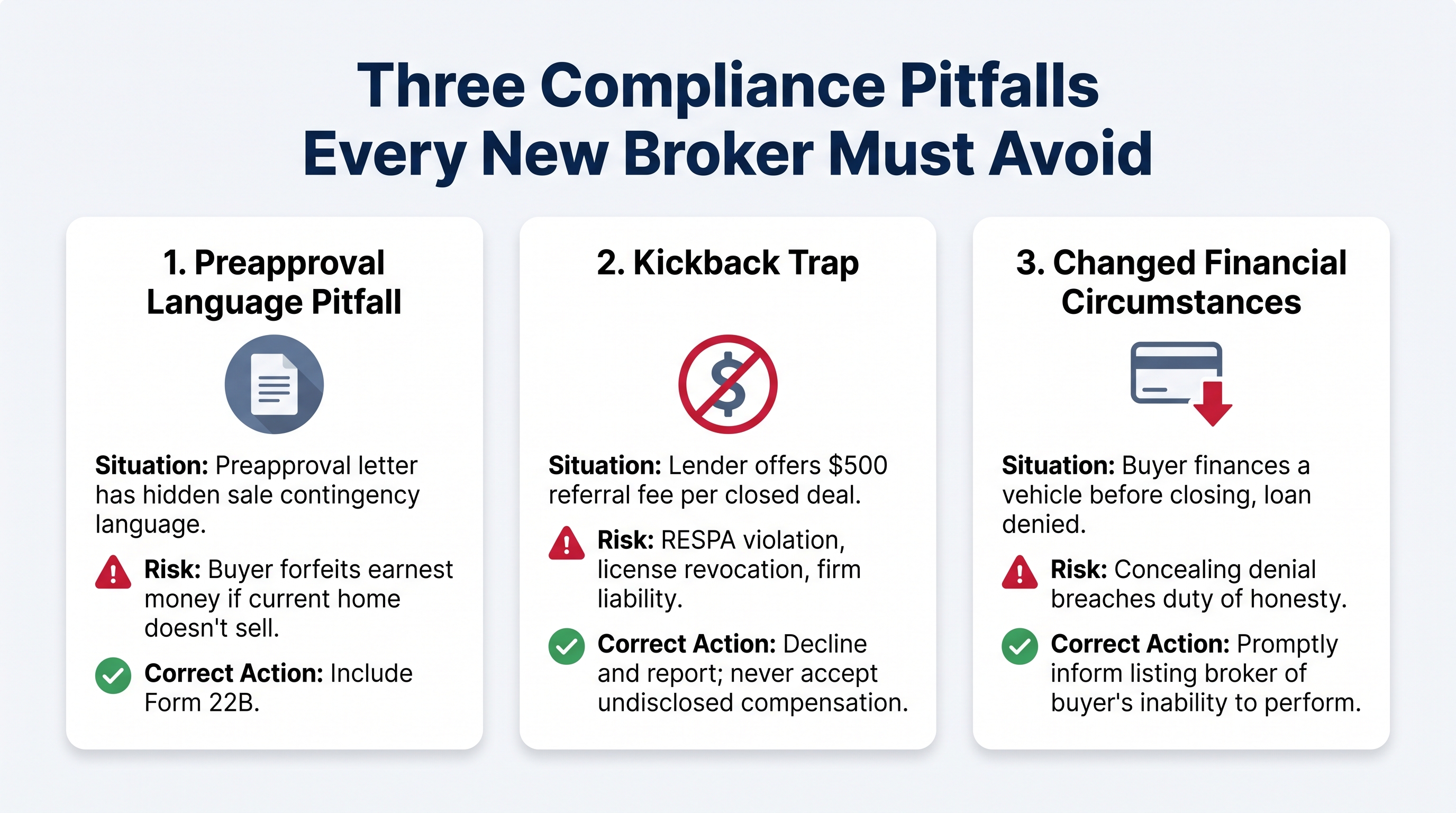
Scenario Quick Reference: Recognize the risk, take the right action, and protect your client and your license.
Buyer Compensation, Seller Concessions, and Financing Compliance
Since January 1, 2024, Washington law has required brokers to enter into a written Buyer Brokerage Services Agreement (BBSA) before, or as soon as reasonably practical after, rendering services. Separately, a national settlement removed offers of compensation from the MLS — a policy shift, not a state law change, but one that makes financing conversations even more important. Read more about the written agreement requirement in our guide to Washington's agency law and written services agreements.
Compensation is fully negotiable and must be disclosed transparently. Buyers may pay their broker's fee out of pocket, request a seller concession, or negotiate it into the transaction — which means your very first conversation with a buyer should cover how they plan to pay you.
Work with the buyer's lender to see whether a seller concession can cover your fee, and stay mindful of interested party contribution (IPC) limits, which vary by loan type:
| Loan Type | IPC Limit | Key Condition |
|---|---|---|
| Conventional | 3% – 9% of price | Scales with loan-to-value: 3% above 90% LTV, 6% between 75–90% LTV, 9% below 75% LTV |
| FHA | 6% flat | Based on the lesser of sales price or appraised value |
| VA | 4% | Excludes reasonable and customary closing costs, which can be covered in addition |
For a deeper look at how down payment assistance and concessions interact with these limits, see our guide to navigating DPA programs, seller concessions, and VA limits.
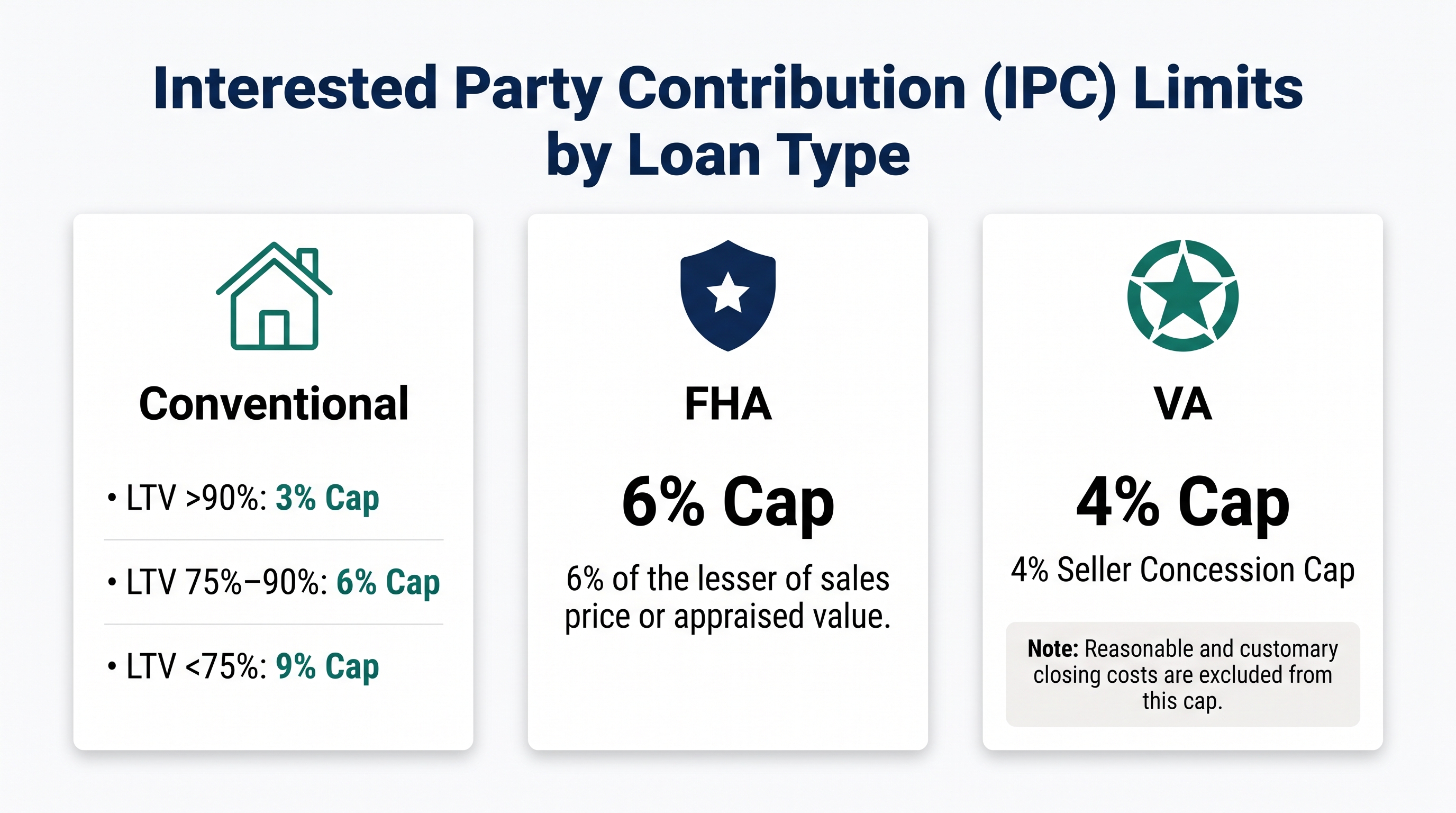
Quick Reference: Know these IPC limits before you structure seller concessions to cover buyer compensation.
Building Your Financing Competence as a New WA Broker
Build a roster of reliable local lenders so you understand real loan products and real underwriting challenges, not just textbook versions. Lean on your managing broker — who is legally responsible for supervising your activity — whenever a compliance question comes up. And keep working through NWMLS standard forms until Form 22A, 22B, and their addenda feel automatic.
Every financing contingency you handle correctly protects a client's earnest money, and every material fact you disclose protects your license. Also worth reviewing before your first transaction: how earnest money and contingencies work in Washington real estate, since financing contingencies are only one piece of that picture. In a market shaped by fluctuating rates and regulatory oversight, financing competence isn't a nice-to-have — it's the bedrock of a real Washington real estate career.
Frequently Asked Questions
How do interest rates affect Washington home sales for new brokers?
Higher interest rates keep buyers priced out and sellers reluctant to give up low pandemic-era rates, which is why Washington's active listings have climbed while closed sales stay flat. New brokers should expect longer timelines, more price negotiation, and financing contingencies to matter in nearly every offer.
Do Washington real estate brokers need to be licensed loan officers?
No. Brokers are not required to investigate a buyer's finances and cannot quote rates or negotiate loan terms without a separate Mortgage Loan Originator (MLO) license. You must still disclose known material facts about a buyer's ability to close and refer financing questions to a licensed lender.
What happens to earnest money if a buyer's financing falls through?
The NWMLS Financing Addendum (Form 22A) protects earnest money while the financing contingency is active. If a buyer misses the application deadline, waives the contingency, or financing fails after waiver, the earnest money can be forfeited to the seller.
Can a Washington broker accept a referral fee from a lender?
No. Accepting undisclosed fees or kickbacks from a lender or other settlement service provider violates federal law and Washington real estate regulations. Any referral relationship must be transparent, and brokers should never accept payment tied to a buyer's loan closing.
How much can a seller contribute toward buyer compensation or closing costs in Washington?
Limits depend on loan type: conventional loans cap contributions between 3% and 9% of price based on loan-to-value, FHA caps contributions at 6%, and VA loans allow up to 4% in concessions plus reasonable closing costs. Always confirm current limits with the buyer's lender before structuring an offer.
Ready to Start Your Washington Real Estate Career?
Everything covered here — contingencies, buydowns, compensation compliance — is exactly the kind of real-world skill your Washington pre-license education is meant to prepare you for. If you haven't started, or haven't finished, your 90-hour requirement yet, the Gold Broker Pre-License package bundles the required Fundamentals and Practices courses with exam prep so you walk into your first transaction ready, not guessing. You can also review the full licensing path, from education hours to the PSI exam, in our guide to getting a Washington real estate license. Questions? Call us at 425-775-2313 — a real person picks up.
Understand WA home financing, interest rates & broker compliance. Start your 90-hour pre-license course today and build real skills.