Educational disclaimer: This is general education, not legal advice. Review the signed forms, follow brokerage policy, and refer legal questions to an Oregon attorney.
A low Oregon appraisal doesn't automatically let a buyer cancel the contract. The outcome depends on three separate questions: whether the signed OREF 001 includes an appraisal contingency, what the lender's loan-to-value math requires, and whether an FHA or VA escape clause applies.
Getting that sequence right — and in the right order — protects your client's earnest money and your own license. It's also exactly the kind of practical skill the Oregon Real Estate Agency expects a broker to keep sharp long after pre-license coursework ends.
- A low appraisal alone doesn't void the deal unless the signed OREF 001 Section 3 includes an appraisal contingency.
- Lender loan-to-value calculations run independently of the appraisal contingency — always ask whether financing is denied or still possible with more buyer cash.
- FHA and VA loans carry separate escape clauses (commonly OREF 097) that protect buyers regardless of the appraisal contingency election.
- Oregon's default deadlines are a 20-business-day appraisal period and a 2-business-day response period — both count business days only, and a pending reconsideration of value never extends them.
- Route every reconsideration of value (ROV) request through the lender with factual comparables, never pressure.
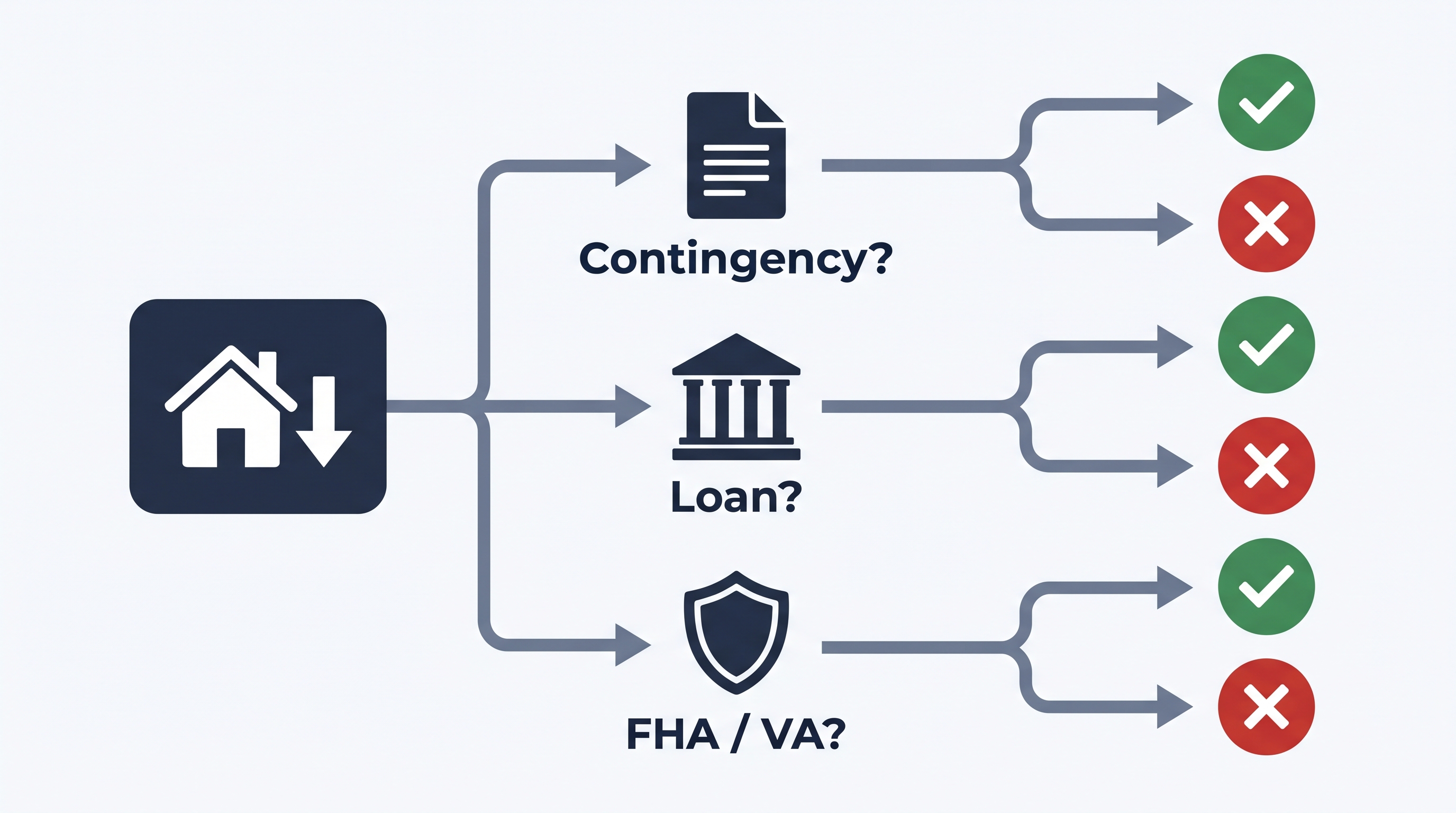
A low appraisal triggers three separate inquiries. Each has its own answer.
Does a Low Appraisal Let an Oregon Buyer Walk Away?
Not automatically. Check all three of these before advising a client on next steps.
1. Is there an appraisal contingency?
Section 3 of the 2026 OREF 001 Residential Real Estate Sale Agreement asks whether an appraisal contingency applies. If the parties marked “No,” Section 6 doesn't apply, and a low appraisal alone doesn't give the buyer an exit. Check the signed form first — don't assume.
2. What do the loan contingency and lender's decision require?
The 2026 forms separate appraisal and loan contingencies; lender underwriting is independent of both. Even if the buyer waived appraisal protection, the lender still uses its own valuation and loan-to-value (LTV) — the loan amount divided by property value, usually the lower of price or appraised value. A low appraisal doesn't permit termination under the loan contingency if appraisal protection was waived and the lender will still fund. Always ask whether financing is denied outright or still possible with more buyer cash.
3. Do FHA or VA protections apply?
FHA loans generally require an amendatory clause. For VA loans, if the contract price exceeds VA's reasonable value and the veteran signed before receiving notice of that value, the contract must include the VA escape clause. Under either clause, the buyer isn't obligated to complete the purchase or forfeit earnest money if the contract price exceeds the FHA appraised value or VA reasonable value — though the buyer may still choose to proceed at the higher price. Oregon commonly uses OREF 097 for this; confirm the addendum is in the file.
What Are the OREF 001 Appraisal Contingency Deadlines?
Under the executed agreement, the default periods are:
- Section 6.1 appraisal period: 20 business days after the Effective Date.
- Section 6.2 response period: 2 business days after the buyer's timely low-appraisal notice.
During the response period, the parties may agree in writing to an adjustment, the buyer may waive the contingency, or the buyer may terminate. OREF 057 is commonly used for these steps.
Count business days as the agreement defines them. Deadlines end at 5:00 p.m. local time where the property is located, excluding legal holidays. Give notice by the original deadline — a reconsideration of value or ongoing negotiation doesn't extend it. If more time is needed, get a signed written extension before the deadline passes.
Example: A buyer gives low-appraisal notice on Monday, November 9, 2026, under the 2-business-day default response period. Wednesday, November 11, is Veterans Day, a legal holiday, so it doesn't count. Day one is Tuesday, November 10; day two is Thursday, November 12. The deadline is 5:00 p.m. local time where the property is located on November 12. Confirm the count against the signed form with your principal broker — this is the kind of detail worth double-checking every time.
What Are a Buyer's Options After a Low Oregon Appraisal?
The buyer may renegotiate the price, bring extra cash, split the difference with the seller, request an ROV, seek a written extension, or terminate if the agreement allows it.
For example, assume a $600,000 price, a $570,000 appraisal, and an 80% LTV loan:
| Item | Before appraisal | After low appraisal |
|---|---|---|
| Price | $600,000 | $600,000 |
| Value used by lender | $600,000 | $570,000 |
| Maximum loan at 80% | $480,000 | $456,000 |
| Buyer cash needed, excluding closing costs | $120,000 | $144,000 |
The buyer needs $24,000 more for the down payment — not the full $30,000 gap — because 80% LTV applies to the lower value. Actual amounts vary by loan program, mortgage insurance, and lender overlays (requirements beyond program minimums). Get the lender's revised analysis in writing before the buyer decides anything.
Keep this skill sharp: Reading a loan-to-value recalculation correctly, on the spot, in front of a client, is exactly the kind of elective topic Oregon's continuing education cycle is built to reinforce. If you've completed your first renewal, the Oregon Pro CE Bundle pairs your required LARRC and Fair Housing hours with elective courses like Oregon Property Valuation and Negotiation and Pricing Traps — built for exactly these situations.
How Does a Reconsideration of Value (ROV) Work in Oregon?
Federal appraisal independence rules cover consumer credit secured by the consumer's principal dwelling. They prohibit coercing or influencing an appraiser to reach a target value but allow sharing information or requesting correction of errors.
Oregon's appraisal management company (AMC) rules, enforced by the Oregon Real Estate Agency, are narrower. They prohibit AMCs and their personnel from coercing or improperly influencing appraisers. At a consumer's request, on behalf of and with a financial institution's approval, an AMC may ask the appraiser for more information about the valuation, correction of objective factual errors, or consideration of comparable sale prices.
Program rules differ:
- Fannie Mae: Generally permits one borrower-initiated ROV per appraisal report, submitted through the lender.
- FHA: March 2025 guidance rescinded the 2024 borrower-initiated ROV framework and restored underwriter-requested ROV language. In July 2026, federal law directed USDA, VA, FHA, and FHFA to implement review-and-resolution procedures for consumer-initiated reconsiderations of value on transactions secured by a consumer's principal dwelling. Confirm current implementation with the lender — HUD's handbook still bars ordering another appraisal simply to get a higher value.
- VA: The Tidewater process lets the requester submit data before the value is final. A separate ROV is available after the Notice of Value, VA's official statement of reasonable value.
A useful request gives facts: “Comparable sale at 123 Elm closed on 9/14, 0.3 miles away, with similar square footage. Was it considered? The report lists 3 bedrooms; the home has 4 (permitted).” Avoid pressure such as “We need $600,000 or the deal dies. Please revisit your value.” Route every ROV through the lender and provide factual information only.
What Are an Oregon Broker's Duties During a Low Appraisal?
- Reasonable care and communication: Provide reasonable care and promptly deliver written communications.
- Limited agency: A disclosed limited agent may not reveal the seller's minimum price or buyer's maximum price without required permission.
- No misrepresentation: Never overstate an appraisal's effect or a client's rights — misrepresentation can lead to discipline.
- Attorney advice: Don't discourage any party from seeking legal advice; suggest an Oregon attorney for legal questions.
- Records: Keep notices, addenda, and extensions in the transaction file.
- Appraisal-gap addenda: Involve your principal broker or managing principal broker before drafting. Address the dollar cap, which appraisal controls, the deadline, the effect on the loan contingency, and signatures from all parties.
For covered credit applications secured by a first lien on a dwelling, the creditor must provide appraisal copies promptly after completion or three business days before consummation, whichever comes first, subject to waiver conditions. This timing doesn't extend a contingency deadline.
This scenario is one of several places new brokers slip up in year one — see our rundown of 5 rookie mistakes new Oregon brokers commonly make for related compliance pitfalls around disclosure, earnest money, and renewal deadlines.
Practical Checklist for Handling a Low Oregon Appraisal
- Check OREF 001 Section 3 for an appraisal contingency.
- Ask the lender whether financing is denied or possible with more cash.
- Confirm the FHA or VA addendum, commonly OREF 097.
- Calendar the 20-business-day appraisal period and 2-business-day response period under the signed agreement.
- Route any ROV through the lender and use factual data.
- Get written extensions before deadlines pass.
- Involve your principal broker and keep all documents in the file.
Every Oregon broker owes 30 hours of continuing education each renewal cycle, and transaction-level skills like this are exactly what the elective hours are for — see the full Oregon continuing education requirements for deadlines and course categories.
Frequently Asked Questions
Does a low appraisal automatically let an Oregon buyer cancel the contract?
No. It only gives the buyer an exit if the signed OREF 001 Section 3 includes an appraisal contingency. If the parties marked “No” appraisal contingency, a low appraisal alone doesn't create a termination right under Section 6 — always confirm against the executed form.
How many days does an Oregon buyer have to respond to a low appraisal?
Under the default OREF 001 terms, the buyer has 2 business days after giving timely low-appraisal notice to agree to an adjustment, waive the contingency, or terminate. Deadlines end at 5:00 p.m. local time where the property sits, excluding legal holidays.
What form do Oregon brokers use for FHA or VA appraisal protection?
Oregon commonly uses OREF 097 to document the FHA amendatory clause or VA escape clause. Under either, the buyer isn't obligated to complete the purchase or forfeit earnest money if the contract price exceeds the FHA appraised value or VA reasonable value.
Can a buyer order a second appraisal to try to get a higher value?
No. HUD's handbook specifically bars ordering another appraisal just to secure a higher number. The correct path is a reconsideration of value (ROV) routed through the lender, supported by factual comparable sales or correction of objective errors — not pressure on the appraiser.
Does requesting a reconsideration of value extend the contract deadline?
No. An ROV or ongoing negotiation never extends a contract deadline on its own. If more time is needed to resolve a low appraisal, the parties must sign a written extension before the original deadline passes.
Ready to Keep Your Oregon Contract Skills CE-Current?
You've put in the work to build a practice your clients trust — situations like a low appraisal are where that groundwork pays off. If this is your first active renewal, Oregon requires the one-time Advanced Practices course before anything else; see your first Oregon renewal requirements to see exactly what's included. Past your first renewal, round out your 30 hours with electives built for real transactions — like Oregon Property Valuation and Negotiation and Pricing Traps — in the Oregon Pro CE Bundle. You can also browse more guidance on our Oregon real estate education blog. Questions? Call us at 425-775-2313 — a real person picks up.
Oregon's appraisal contingency gives buyers a 2-business-day response window. Learn the OREF 001 deadlines and sharpen your skills with 30-hour CE.