A Reading Sequence for Every RMLS Listing
You read an RMLS listing like a document, not a photo gallery: status and dates first, then price history, then the structured fields, then remarks, photos, and finally disclosures and showing instructions. Skip the order and you'll anchor on the price before you've confirmed the property is even still available.
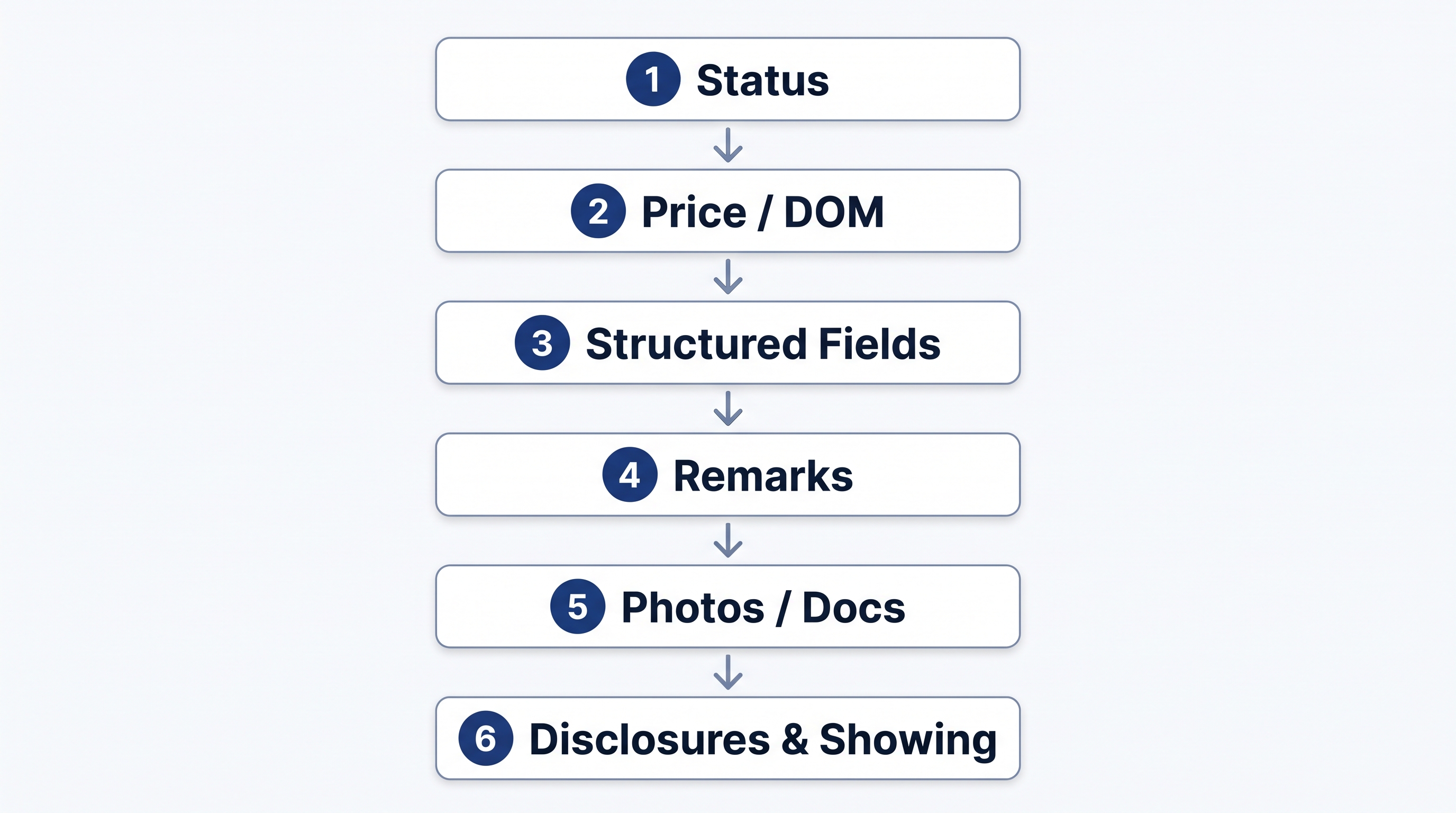
| Step | Review | Why |
|---|---|---|
| 1 | Status and dates | Transaction claim |
| 2 | Price, DOM/CDOM, history | Pricing context; consult RMLS's “How CDOM Is Calculated” guide; don't assume resets |
| 3 | Structured fields: size, sewer, water, year built | Compare with public records and remarks |
| 4 | Public and private remarks | Check against fields |
| 5 | Photos and documents | Check for “Virtually Staged” watermarks |
| 6 | Disclosure indicators and showing instructions | Determine requests and access |
- An RMLS listing is advertising, not a verified record — compare status, price history, structured fields, remarks, photos, and disclosures every time.
- Status codes like PEN and BMP don't behave the way most new brokers assume; an old expiration date alone doesn't prove a sale or representation ended.
- Compensation offers have been gone from RMLS since August 13, 2024 — those conversations now happen off-platform, not in the remarks.
- Private remarks are written for other brokers, not clients. Investigate any conflict between the remarks and the structured fields before you draft a client report.
- An MLS disclosure indicator is not the seller's property disclosure statement — confirm what's actually been delivered.
RMLS Status Codes New Oregon Brokers Get Wrong
- ACT (Active): An active record. Confirm availability and current showing instructions — it doesn't verify the data or authorize entry.
- PEN (Pending): An accepted offer exists, but the sale isn't closed and contingencies may remain. Pending doesn't automatically expire on the listing's expiration date; an old date alone doesn't prove the sale or the brokerage representation ended.
- BMP (Bumpable Buyer): Only for an accepted offer contingent on the buyer selling their own property within a limited time, when that property qualifies for an RMLS listing. If the seller receives another acceptable offer, the first buyer gets a stated period to remove the contingency. BMP isn't for inspection or financing contingencies, and the contract — not habit — sets the notice and removal period. Don't assume 24, 48, or 72 hours.
- SLD (Sold): A closed transaction. Report a property as sold only after closing, never when an offer is simply accepted.
- SSP (Short Sale Pending): The seller accepted an offer, but required third-party approval, such as lender approval, is still outstanding.
- WTH (Withdrawn) vs. CAN (Canceled): WTH stops active marketing while the listing agreement stays in force; a withdrawn owner may still be bound by that listing relationship. CAN means the listing contract itself was canceled or terminated.
- SNL (Sold, Not Listed): A sold record for a transaction that wasn't previously marketed in RMLS the usual way. Not every sold comparable had normal MLS exposure.
Listing changes require written seller authorization and must be reported within 24 hours of the effective date — including failed sales.
If status codes are tripping you up this early, you're in good company. Our rundown of common first-year compliance mistakes covers the related errors that tend to show up alongside listing misreads: agency disclosure, earnest money handling, and recordkeeping.
Public vs. Private Remarks: What You Can Share With Clients
Public remarks describe the property for consumers; private remarks carry information meant for other brokers. Don't forward broker-facing material wholesale to a client — prepare a client-facing summary instead, and investigate any conflict between the remarks and the structured fields before you pass anything along. A known material condition sitting in private remarks doesn't satisfy anyone's disclosure duties.
Mid-guide note: habits like this are exactly what keeps a license in good standing between renewals. If you're still inside your first year or two of practice, Oregon's 30-hour continuing education requirement is the structure that keeps this kind of file discipline current — worth understanding now, before your first renewal notice arrives.
Oregon Compensation Rules Since the August 2024 RMLS Changes
RMLS removed compensation fields on August 13, 2024, ahead of the August 17 national deadline. Compensation offers can't appear anywhere on the platform — not in public or private remarks, documents, photos, or videos, and not through workaround links. General seller concessions may be communicated only if they're not conditioned on retaining or paying a buyer representative. RMLS notes that consumers can still pursue compensation arrangements off-MLS, through direct negotiation and consultation with real estate professionals.
A missing compensation field doesn't mean none is available, and it doesn't mean a buyer must pay entirely out of pocket. RMLS guidance calls for a written buyer agreement before any in-person or live-video tour. Oregon law requires a written buyer representation agreement before — or as soon as reasonably practicable after — you begin efforts to assist a buyer. Meet both timing requirements, and disclose the amount and terms of any compensation-sharing arrangement to your client before you agree to it.
Legal Obligations an RMLS Listing Doesn't Replace
- Advertising: MLS listings are advertising. Keep them truthful and not misleading, make the registered business name immediately noticeable, and get written permission from the owner or an authorized agent before advertising real estate for sale, exchange, or lease. Material misrepresentation, or knowingly or recklessly misleading advertising, can lead to discipline.
- Material facts and agency: Disclose known material facts that aren't apparent or readily ascertainable to a party. Give each party the initial agency disclosure pamphlet at first contact, including electronic contact — though the pamphlet itself doesn't create agency.
- Seller disclosures: An MLS disclosure indicator isn't the seller's property disclosure statement. Unless properly waived, a buyer may revoke an offer by separate signed written revocation delivered within five business days after the statement is delivered; that right ends at closing. If a seller refuses to provide a required statement, the buyer may revoke at any time before closing. Exemptions are specific — don't assume new construction or an estate sale qualifies.
- Teams: New team-branded listing requirements took effect January 1, 2026. Review any team-branded listing with your principal broker before it goes live.
When any of this feels uncertain, the Oregon Real Estate Agency is the authoritative source for current rule text — worth bookmarking alongside your course materials.
Worked Example: Spotting a Listing Discrepancy Before It Becomes a Problem
A listing reports a $600,000 price, 2,000 square feet (about $300 per square foot), and a “finished lower level.” Public records show 1,600 square feet (about $375 per square foot). The sewer field says public sewer; the remarks mention septic.
| Item | Listing | Other source | Status |
|---|---|---|---|
| Size | 2,000 sq ft | 1,600 sq ft (public records) | Unresolved |
| Price/sq ft | ~$300 | ~$375 | Depends on size |
| Lower level | “Finished” | Not confirmed | Unresolved |
| Sewer | Public (field) | Septic (remarks) | Contradiction |
Verification steps
- Ask the listing broker in writing to clarify the square-footage source and the sewer type.
- Request the seller's property disclosure statement.
- Recommend your client consider an appraisal, a measurement, and an inspection by qualified professionals.
- Check with the local jurisdiction about sewer connection and any permits for the lower level.
- Discuss the findings with your principal broker.
Neutral client explanation
“The listing reports 2,000 square feet; public records show 1,600. The difference may relate to the lower level, but we haven't confirmed that. The listing shows public sewer, while the remarks mention septic. I've asked the listing broker to clarify, and I'd recommend verifying both before we rely on them in an offer.”
That script avoids accusing the seller, avoids guessing at an explanation, and treats neither source as definitive until someone confirms it.
Frequently Asked Questions
What does Pending (PEN) status actually mean on an RMLS listing?
It means an accepted offer exists, but the sale hasn't closed and contingencies may remain. Pending doesn't automatically expire with the listing's original expiration date — an old date by itself doesn't prove the sale, or the brokerage relationship behind it, has ended.
Can I still see what's offered to buyer brokers on an RMLS listing?
No. RMLS removed compensation fields on August 13, 2024, and offers can't appear anywhere on the platform, including remarks, documents, photos, or linked pages. Those conversations now happen off-MLS, through direct negotiation and consultation with real estate professionals.
What's the real difference between Withdrawn (WTH) and Canceled (CAN)?
Withdrawn stops active marketing while the listing agreement stays in force — the owner may still be bound by that relationship. Canceled means the listing contract itself was terminated. Confirm which applies before assuming a property is fully off-market.
Do I have to disclose something I only saw in private remarks?
Private remarks are written for other brokers, not for clients, so never forward them wholesale. But a known material condition sitting in private remarks doesn't excuse you from disclosure duties — investigate any conflict with the structured fields before preparing a client report.
How often do Oregon brokers need continuing education after licensing?
Active brokers complete CE on a recurring renewal cycle, with a first renewal that requires the Broker Advanced Practices course in addition to Fair Housing and LARRC. After that, standard CE requirements repeat each cycle — check current hour totals and deadlines before your renewal window opens.
Keep Your Oregon License Compliant Every Renewal
Reading a listing this carefully is a habit, and habits like it are exactly what keeps a license in good standing. If you're coming up on your first Oregon license renewal, it requires the Broker Advanced Practices course alongside Fair Housing and LARRC — worth mapping out before the notice lands in your inbox. For more compliance-focused reading between now and then, browse more Oregon real estate compliance guides. Questions about what you still owe, or when? Call us at 425-775-2313 — a real person picks up.
Decode all eight RMLS status codes and spot compliance pitfalls before they become license risk. Read the full Oregon broker guide now.