This article is for educational purposes only. It is not legal or tax advice. Confirm specifics with your Designated Broker, the Department of Licensing (DOL), and qualified advisors.
1. There Is No Part-Time License
Washington law defines a “Broker” by the activities the person performs on behalf of a firm.¹ It does not define a part-time category. The relevant distinction is between an active license and an inactive license. You may provide real estate brokerage services only while your license is active.² Whether you close one transaction a year or forty, the same standard applies.
2. Firm Affiliation and Supervision
An active license must be affiliated with a firm. The Designated Broker, or a delegated Managing Broker, supervises your work. During your first two years of licensure, that supervision is heightened.³⁴ These deadlines do not change to accommodate a limited schedule:
- Two business days. You must deliver transaction documents and brokerage service contracts to your firm within two business days after mutual acceptance.⁵
- Five business days. For Brokers licensed fewer than two years, the Designated Broker or delegated Managing Broker must complete and document a review of your brokerage service contracts—such as listing agreements, buyer brokerage agreements, and purchase and sale agreements—within five business days after mutual acceptance.⁶ Your firm can meet that deadline only if you submit the documents promptly.
3. Getting Paid
Under RCW 18.85.361(19), accepting compensation for brokerage services from anyone other than the firm you are licensed with is grounds for discipline.⁷ Separately, compensation from more than one party to a transaction requires full written disclosure to all parties (RCW 18.85.361(10)).⁷ If you pay any part of your commission to anyone else, licensed or not, the payment must go through your firm’s Designated Broker (RCW 18.85.301(3)).⁸
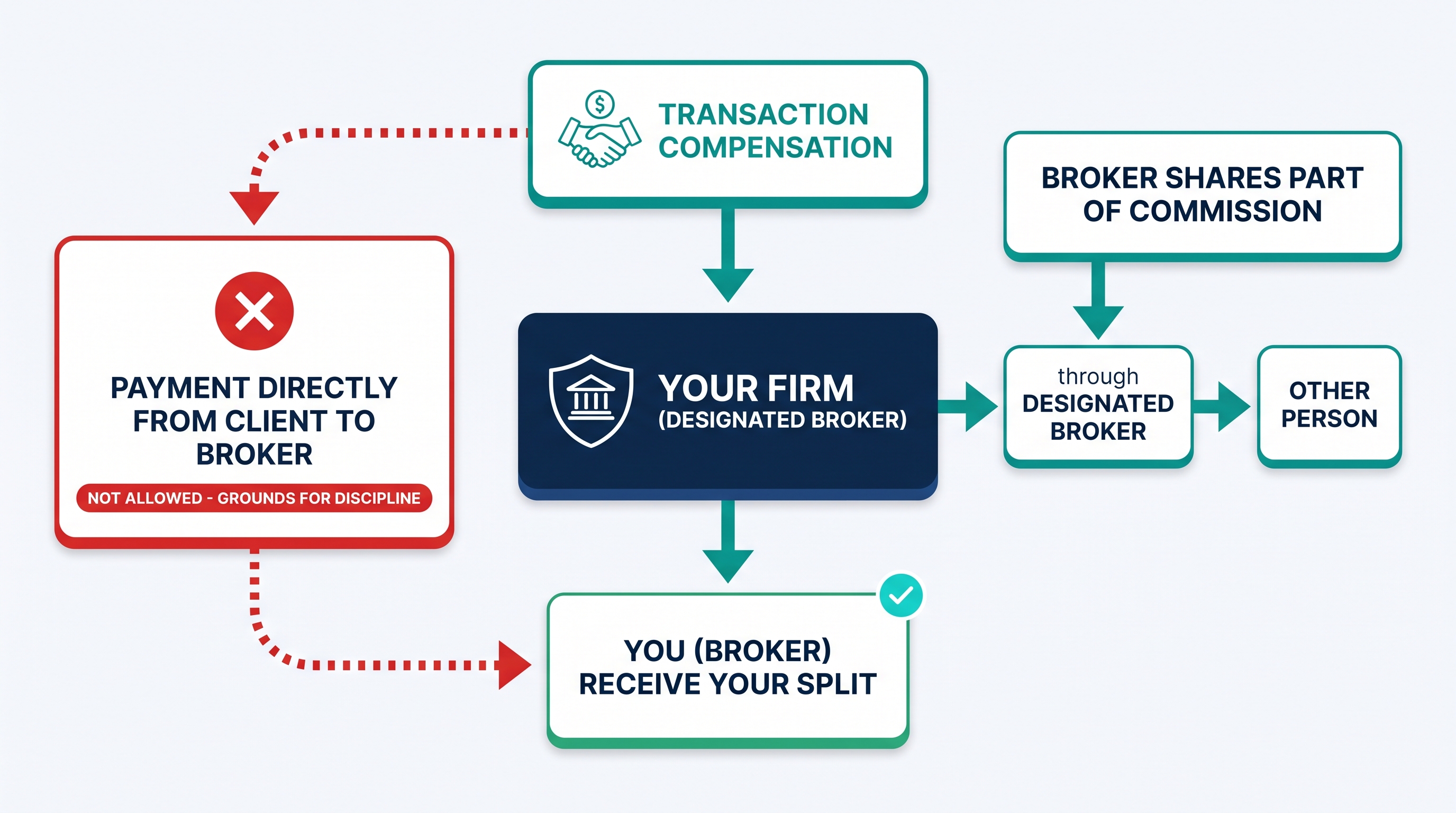
For example, if a grateful buyer offers you a $500 bonus at closing, do not accept it directly. Route the matter through your firm.
Many Brokers are independent contractors. Under Washington’s definition, an independent contractor Broker remains subject to firm supervision.⁹ Tax and insurance classifications raise separate questions:
- The IRS treats many real estate agents as “statutory non-employees,” a federal tax classification meaning they are not treated as employees for federal tax purposes. This does not exempt you from firm supervision.¹⁰
- Labor & Industries has its own treatment of real estate Brokers.¹¹
- Business and occupation (B&O) tax on commissions is generally reported by the firm.¹²
Confirm your own situation with a tax professional.
Hypothetical budget (illustration only, not a projection):
| Item | Amount |
|---|---|
| 4 closings × $8,000 firm-side fee | $32,000 |
| Your 70% split | $22,400 |
| Annual expenses (dues, multiple listing service (MLS) fees, marketing, education) | –$6,400 |
| Net before taxes | $16,000 |
Before relying on numbers like these, run a zero-closing scenario: Can you cover your expenses for a full year with no commission income?
4. Building a Workable Schedule
Consider a Seattle Broker who works a weekday office job. A workable plan might include:
- A licensed backup approved by the firm to handle showings and urgent matters during work hours.
- Calendared deadlines for every inspection, financing, and closing date.
- Electronic submission to meet the two-business-day rule on busy days.
Your client duties do not pause while you are at your other job. For example, you must present all written offers in a timely manner.¹³ If an offer arrives at 10 a.m., “I’ll look tonight” may not be timely.
Advertising, including social media posts from a personal account, must clearly and conspicuously include your firm’s licensed or assumed name. The exception is advertising property you personally own, for which you need only disclose that you hold a real estate license (RCW 18.85.361(8)).¹⁴
Also note RCW 18.86.130, recently enacted and effective in 2026, which restricts marketing listings only to limited or exclusive groups.¹⁸ An “office exclusive” generally means a listing marketed only within one firm rather than through the MLS. A “pre-market strategy” promotes a property to a select audience before its public launch. Confirm your firm’s procedures before using either.
5. Education and Renewal
Licenses renew every two years. Your first active renewal requires 90 clock hours of post-licensing education in courses started after your first licensure:¹⁵
- 30 hours of Advanced Real Estate Practices
- 30 hours of Real Estate Law
- The 3-hour core Current Issues course
- A 6-hour fair housing course, if not previously completed
- Remaining elective hours to reach 90
Later renewals require 30 hours, including a 3-hour fair housing course.¹⁶
A realistic part-time plan is about 3 hours per week for 30 weeks. Continuing education is not required merely to keep an inactive license,² but you cannot go inactive to avoid continuing education or post-licensing requirements.¹⁶ If your license has been inactive for more than three years, you must complete a 30-hour course within the year before activation, subject to a statutory exception.²
6. Thinking Long-Term
One route to Managing Broker eligibility is three years of full-time experience as a Broker within the preceding five years. The law also allows another qualifying practical-experience route prescribed by rule.¹⁷ Part-time years may not count automatically. Ask DOL early how your experience will be evaluated, and keep detailed records of your transactions and time.
Practical Checklist
Legal requirements
- Keep your license active and affiliated with a firm before providing services.
- Deliver transaction documents and brokerage service contracts within two business days after mutual acceptance.
- Accept brokerage compensation only from your firm.
- Route any commission sharing through your Designated Broker.
- Include your firm’s licensed or assumed name in advertising; for property you personally own, disclose your license.
- Present all written offers in a timely manner.
- Complete your 90 post-licensing hours before your first active renewal.
Recommended practices
- Learn your firm’s supervision and submission procedures.
- Arrange a licensed backup approved by your firm.
- Calendar every contract deadline.
- Confirm your firm’s policy under RCW 18.86.130.
- Budget for a zero-closing year.
- Track your experience for future Managing Broker eligibility.
Working part-time as a WA real estate broker? The 2-day deadline and 90-hour post-license requirement still apply. Learn the rules before you list.