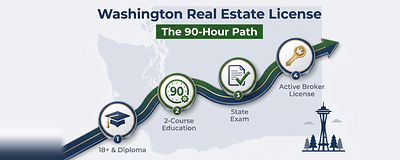
Washington overhauled its agency law effective January 1, 2024. Materials printed earlier may describe outdated rules.
Licensing and Supervision Terms (RCW 18.85)
- Broker: A natural person who performs brokerage services on behalf of a firm under the supervision of a designated broker or managing broker.
- Managing broker: A licensee who may supervise other brokers or managing brokers licensed to the firm.
- Designated broker: The individual, holding a managing broker license, whom the firm designates as responsible for the firm, including supervision of its licensees.
- Real estate firm: The licensed business entity. Licensees performing brokerage services must be licensed to a firm.
- Inactive license: An unexpired license not affiliated with a firm. Its holder cannot perform activities requiring a license.¹
A designated broker may delegate supervisory duties, but only in writing and to a managing broker licensed to the same firm. Brokers in their first two years of licensure require heightened supervision.²
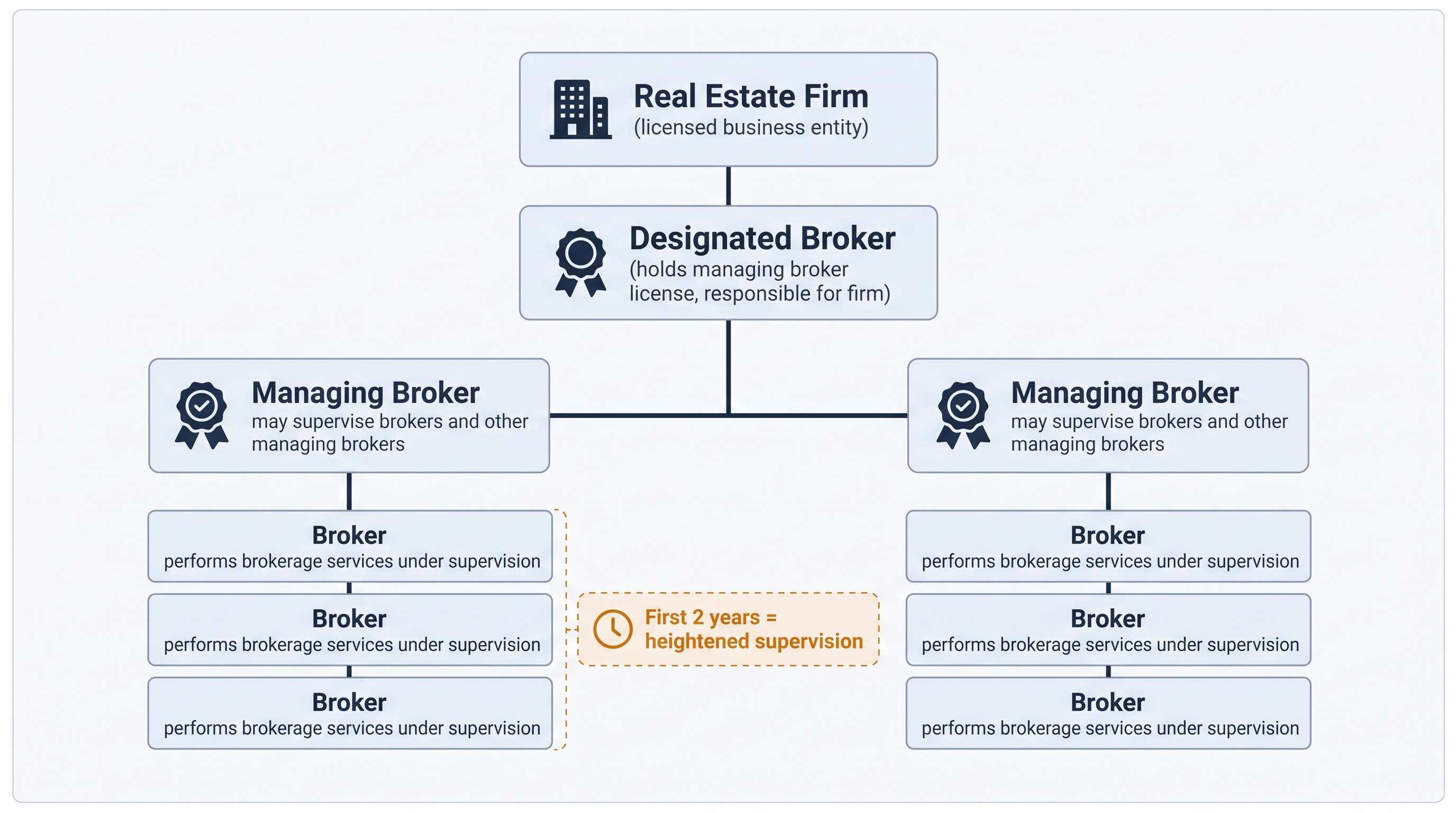
Washington real estate licensing hierarchy under RCW 18.85
Agency Terms (RCW 18.86)
- Agency relationship: The relationship between a firm and its principal—the party the firm represents.
- Buyer’s agent / seller’s agent: A broker who has an agency relationship with only the buyer or only the seller.
- Limited dual agent: A broker representing both parties, which requires written consent from both. Know these two scenarios:
- One broker represents both the buyer and the seller.
- Two brokers in the same firm represent opposite sides. Each represents only their own client, but the designated broker and any managing broker supervising both sides become limited dual agents.³
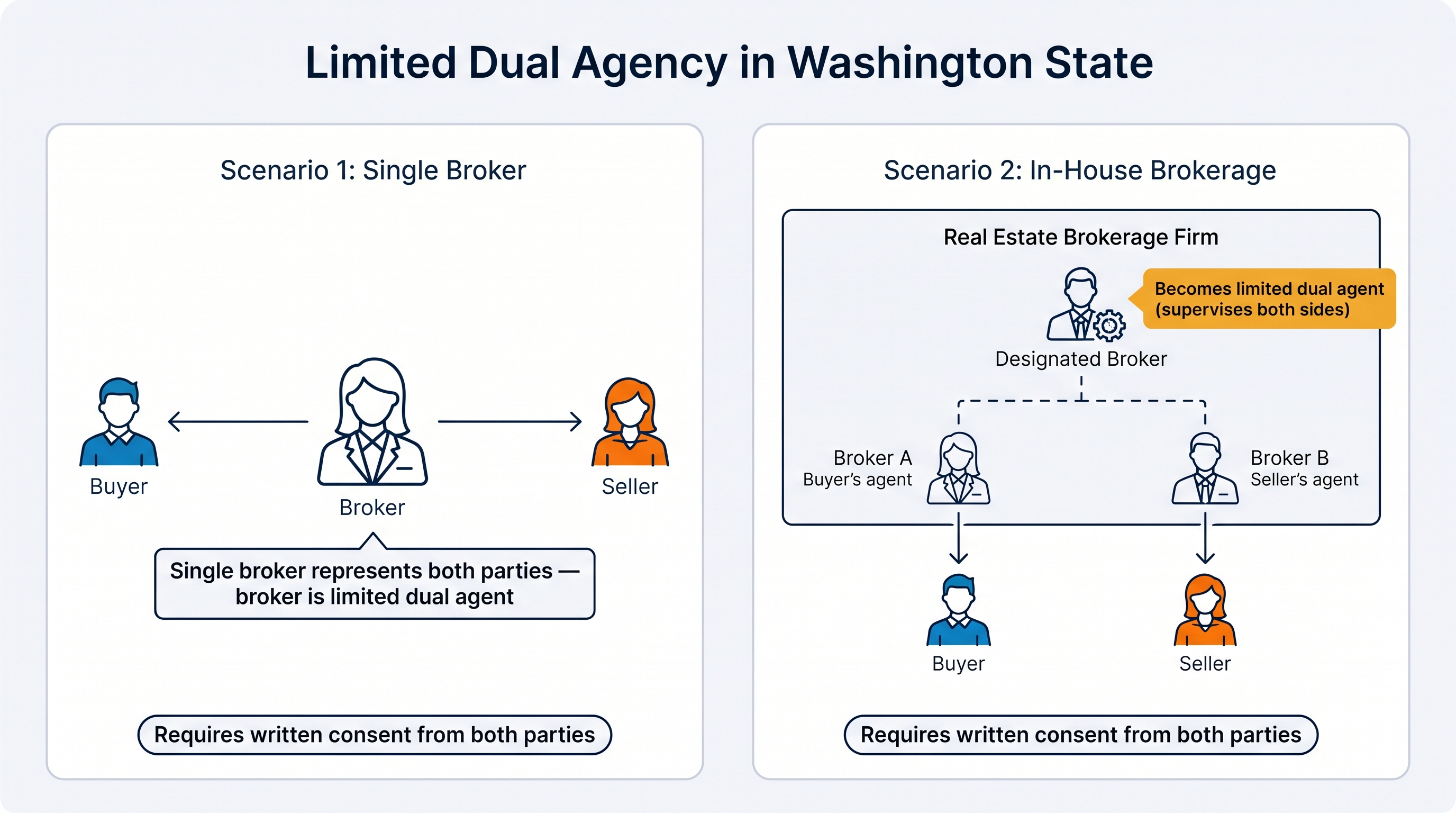
Two paths to limited dual agency under RCW 18.86
- Brokerage services agreement: A written agreement between a firm and a buyer or seller, entered into before services begin or as soon as reasonably practical afterward. It must state its duration. A buyer agreement defaults to 60 days unless the parties agree to a longer term.
- Agency pamphlet: The statutory law pamphlet, delivered before the party signs a services agreement. The broker must obtain the party’s acknowledgment of receipt.
- Agency Disclosure: A transaction-level written disclosure of whom the broker represents—the buyer, seller, both, or neither. It must be made before mutual acceptance; RCW 18.86.030 sets the exact timing. It is separate from the services agreement and pamphlet.⁴
- Mutual acceptance: Both parties have signed and delivered the agreement.
- Material fact vs. confidential information: A material fact is information that substantially adversely affects the property’s value, a party’s ability to perform, or the transaction’s purpose.
- A seller’s bottom-line price may be confidential information if it meets the statutory conditions—for example, if the broker obtained it from the client during the relationship and the client requested or reasonably expected confidentiality. If so, the broker may not disclose it without permission.
- Known water intrusion is a material fact that must be disclosed to all parties. A known material defect does not become confidential because the seller wants it hidden.⁵
- Compensation does not determine representation: Who pays the broker does not determine whom the broker represents.
Effective June 11, 2026, brokers generally may not market residential property only to an exclusive or limited group without concurrently marketing it to the general public and other brokers. A narrow exception covers health or safety concerns.⁶
Trust Account Terms (WAC 308-124E)
- Trust funds: Money held for others, such as earnest money.
- Commingling vs. conversion: Commingling mixes client funds with firm or personal funds. Conversion uses client funds for an unauthorized purpose and is more serious.
- Next banking day: Trust funds generally must be deposited by the next banking day. Funds received Friday are due Monday, unless Monday is a bank holiday.
- Check-holding exception: An earnest-money check (not cash) may be held if the purchase agreement provides for it.
- Pooled housing trust fund account: Covered sales and business-opportunity deposits of $10,000 or less generally go into this interest-bearing pooled account.⁷
Washington Property and Transaction Terms
- Community property: Property generally acquired during marriage or registered domestic partnership. Both spouses or partners must join in conveying or encumbering (placing a mortgage or lien on) community real property.⁸
- Seller disclosure statement (“Form 17”): Delivered within five business days after mutual acceptance, unless otherwise agreed. The buyer generally may rescind (cancel) within three business days after delivery. It is not a warranty. A revised form takes effect January 1, 2027.⁹
- Homestead exemption: Protection of a portion of a homeowner’s equity from certain creditors: the greater of $125,000 or the prior year’s county median sale price for a single-family home. It does not protect against mortgage foreclosure.¹⁰
- REET (real estate excise tax): Washington’s transfer tax, usually paid by the seller. State rates are graduated; the first tier is 1.10% on the portion through $525,000. Thresholds adjust January 1, 2027.¹¹
- Residential Landlord-Tenant Act: A security deposit is refundable; a nonrefundable fee is not and cannot be called a deposit. Within 30 days after the tenancy terminates and the tenant vacates (or the landlord learns of abandonment), the landlord must provide a full and specific written statement explaining the basis for retaining any portion, with required documentation, and refund any remaining balance.¹²
Study Tips
Make deadline cards.
| Term | Deadline |
|---|---|
| Trust fund deposit | Next banking day |
| Seller disclosure / rescission | 5 / 3 business days |
| Deposit statement and refund | 30 days |
| Pass both exam portions; apply after passing | 6 months; 1 year (check handbook) |
Draw role diagrams. Sketch the firm, designated broker, managing brokers, and brokers. Then trace who becomes a limited dual agent in a same-firm transaction.
Practice two-sided scenarios. For each fact pattern, ask: Whom does this broker represent? Is this fact confidential or material?
This article is educational, not legal advice. Confirm requirements with DOL, PSI, and current RCW and WAC.
Learn the Washington real estate exam vocabulary tested by PSI. Review RCW & WAC terms used by 48,452 students, then try our free practice exam.