Why Title Matters to a Washington Broker
Title insurance protects a buyer's equity or a lender's loan against covered defects in a property's ownership history — such as forged deeds, undisclosed heirs, or incorrect legal descriptions — in exchange for a one-time premium paid at closing. In a Washington residential sale, it's the executed purchase agreement, not custom alone, that determines which title standard applies and who pays for which policy.
Brokers who understand the difference between marketable and insurable title, and who know when to bring in a title officer or attorney, keep closings on schedule and keep their clients protected.
- Marketable title and insurable title are different standards — your purchase agreement decides which one applies.
- An owner's policy protects the buyer's equity; a lender's policy protects only the loan amount.
- A preliminary commitment is an offer to insure, not proof of clean title — review every exception with your client.
- RCW 18.86.030 limits a broker's duty to investigate title, but known material facts must still be disclosed.
- RCW 18.85.053 restricts inducements and prohibits requiring a buyer to use a title agent tied to the broker's financial interest.
What Is Title Insurance, and How Does It Protect You?
Title insurance is generally purchased with a one-time premium paid at closing, not an ongoing premium like homeowner's or auto insurance. It looks backward: it protects against covered defects arising from past events — forged documents, undisclosed heirs, fraud in the chain of title, or an incorrect legal description — rather than future damage to the property.
Every policy also contains exclusions and exceptions. Excepted matters, such as a recorded easement or a specific lien listed on the commitment, are not insured. Brokers should never describe a policy as covering "everything" — it covers only what the policy insures and what hasn't been excepted.
Owner's vs. Lender's Title Insurance Policy: What's the Difference?
| Feature | Owner's Policy | Lender's Policy |
|---|---|---|
| Who is insured | Buyer/owner | Lender |
| Typical amount | Purchase price | Loan amount |
| Protects buyer's equity? | Yes | No |
| Usually required by | Purchase agreement terms | The lender |
Washington's Office of the Insurance Commissioner notes that only an owner's policy protects a buyer from personal loss, and that most sellers customarily pay for the owner's policy. That's custom and contract practice, not a statute — keep three questions separate in every transaction: who is insured, who must obtain the policy, and who pays for it.
Example: In a $900,000 Seattle sale with a $720,000 loan, the lender will typically require a lender's policy of about $720,000. That policy protects the lender — not the buyer's $180,000 down payment or future equity. The owner's policy protects the buyer, and the purchase agreement determines who pays for it.
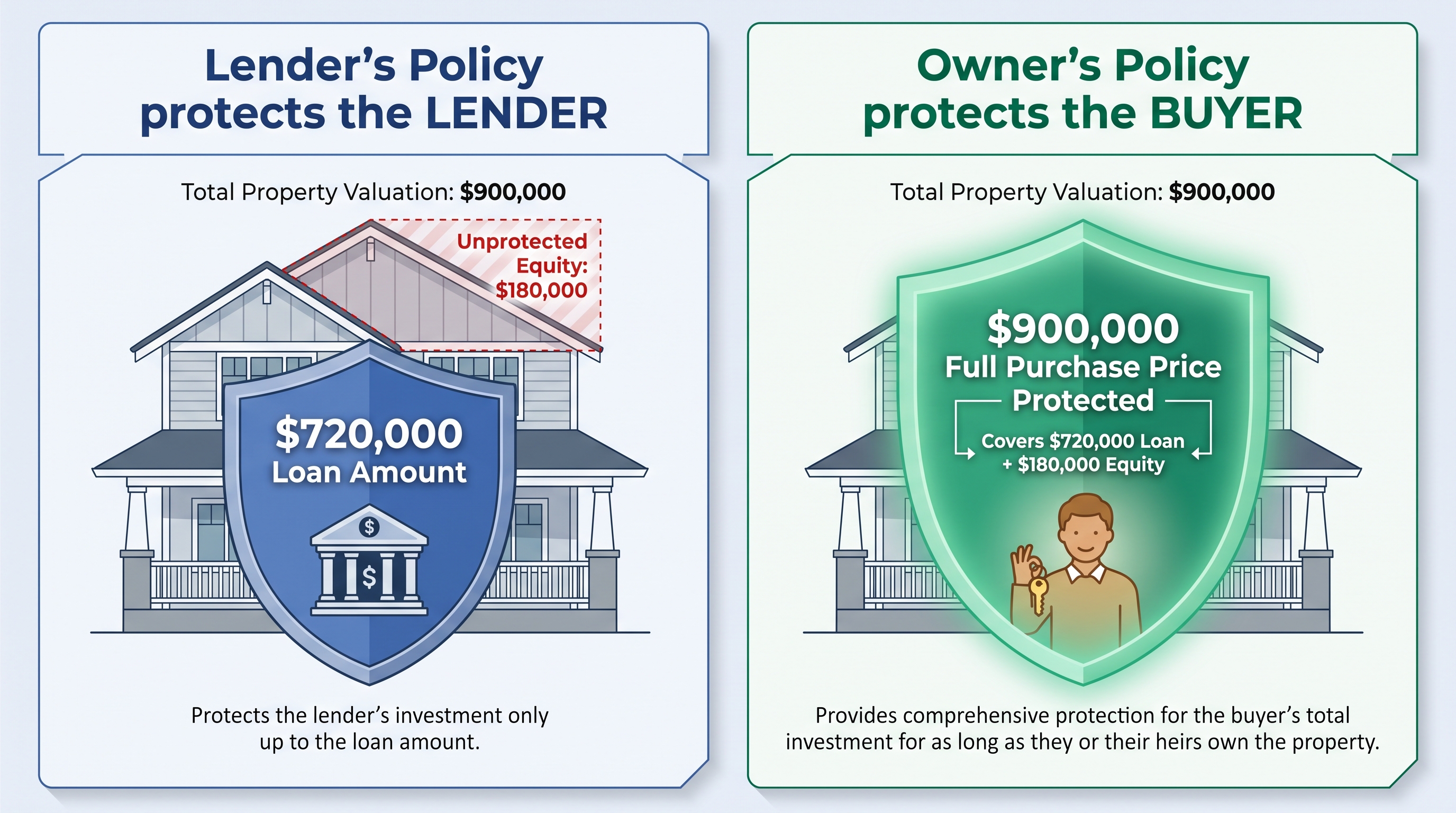
In a $900,000 purchase with a $720,000 loan, only the owner's policy protects the buyer's $180,000 equity and future appreciation.
Cash buyers: No lender's policy is needed. Owner's coverage remains a choice informed by the agreement and policy terms, but risks such as forgery or undisclosed heirs remain regardless of financing.
The Preliminary Title Commitment Is an Offer, Not Proof of Clean Title
Under Washington law, a preliminary report, commitment, or binder reflects the terms on which an insurer is willing to issue a policy; it is not an abstract of title or a representation of the actual condition of title. Avoid ever calling a commitment "clean title" in front of a client. Review these fields together instead:
- Proposed insureds (the parties who will be named in the policy)
- Insured amounts
- Legal description
- Requirements for issuance
- Exceptions
- Endorsements (add-ons that modify or expand coverage)
A title company may provide copies of exception documents to the proposed insured without charge — ask for them every time an exception is unclear.
Example: A buyer plans to expand a detached garage, and the commitment lists a recorded access easement. A sound workflow is to:
- Request the recorded easement from the title company.
- Deliver it promptly to your client.
- Recommend review with an attorney, surveyor, or contractor.
- Calendar the title review and objection deadlines in the executed agreement (for example, NWMLS Form 21 and any addenda).
- Document communications and consult your managing broker if questions arise.
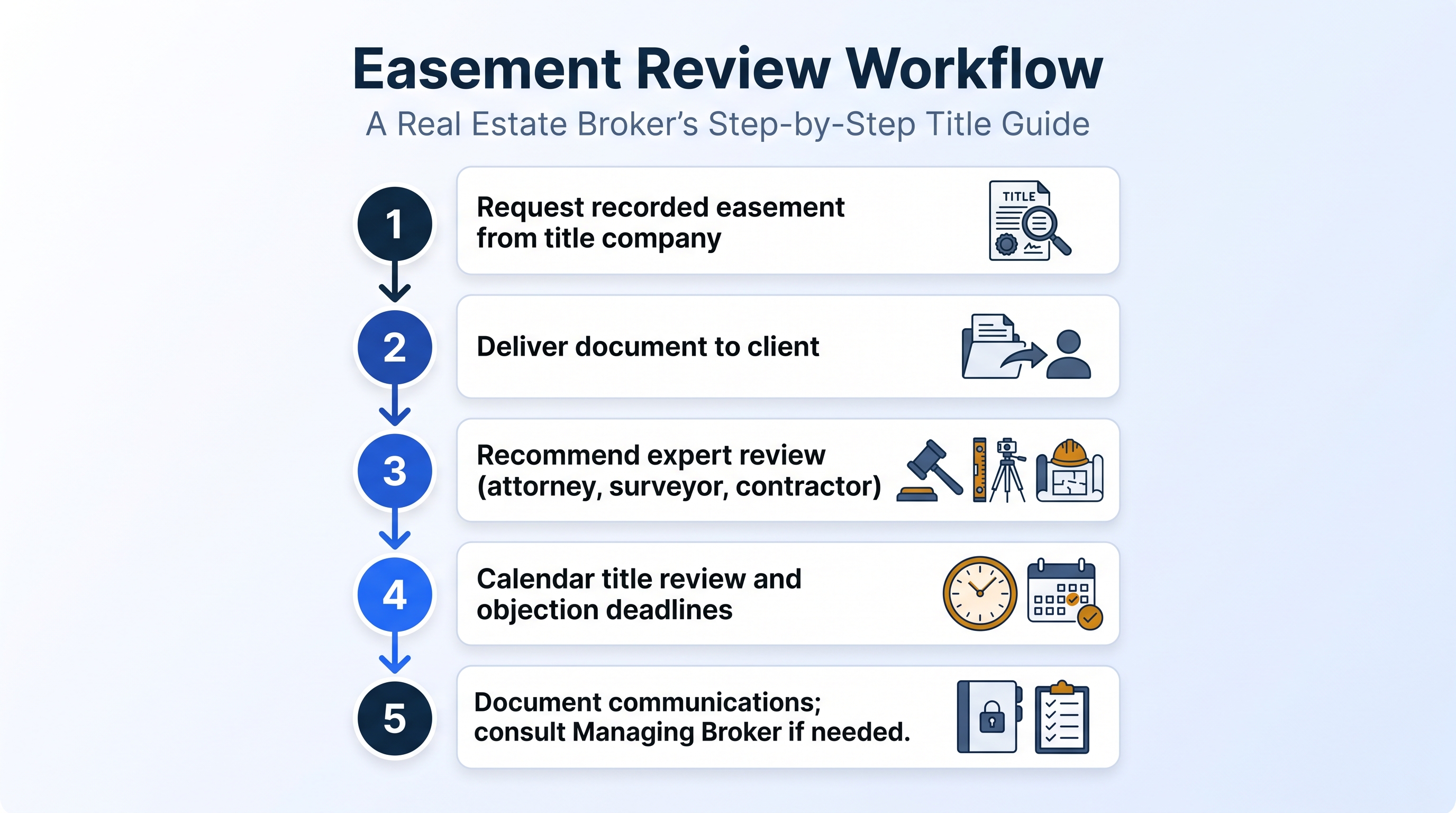
A sound workflow when a commitment lists an exception that may affect your client's plans.
Next step for your own license: Title review, agency duties, and compliance questions like these are exactly what Washington's managing broker requirements are built to prepare you for. If you're the broker everyone on your team already asks these questions to, it may be time to make that official.
Title Insurance vs. Escrow: What's the Difference in a WA Closing?
Title insurers examine and insure title; escrow agents handle the closing process. Escrow completion involves signing, satisfying escrow instructions, disbursing funds, and recording documents. The insurer issues the title policy separately, often after recording, and the title premium and escrow fee are separate charges on the settlement statement. Explaining this distinction up front helps clients understand when the transaction is actually "done."
Broker Duties Under RCW 18.86 When Title Issues Arise
A broker owes all parties reasonable skill and care, honesty and good faith, timely presentation of written offers and communications, and disclosure of known material facts that are not apparent or readily ascertainable. Under Washington State Department of Licensing guidance and RCW 18.86.030(2), unless otherwise agreed to in writing, a broker has no duty to independently inspect the property, investigate either party's financial condition, or verify statements from a party or a source reasonably believed reliable.
That limit on investigation duty doesn't erase the disclosure duty: a broker must still timely present written communications and disclose known material facts, such as a known title problem. Brokers should not act as title examiners or offer legal opinions on easements — instead, advise clients to seek expert advice on matters beyond their own expertise.
Title Insurance Compliance: Inducements, Referrals, and RCW 18.85
An inducement is anything of value offered to win or reward title business, and Washington restricts title insurers and agents from giving them. Licensees may not solicit or accept anything of value from a title insurance company or agent, or their employees or representatives, that the title company or agent isn't permitted by law or rule to give (RCW 18.85.053(2)). A licensee also may not require a consumer, as a condition of providing real estate services, to obtain title insurance from a title agent in which the licensee has a financial interest (RCW 18.85.053(4)).
Things of value are prohibited unless specifically permitted. A title company may give a producer a promotional item only if it bears the title company's preprinted logo, costs the title company $5 or less, isn't money or a gift card, and contains no name, logo, or reference to the producer. Free educational programs must stay limited to title insurance, title to real property, and escrow, with refreshments capped at $15 per person per program under amendments effective January 19, 2026.
Example: A broker may share several title company options with a cash buyer but cannot require the buyer to use a title agent in which the broker has a financial interest as a condition of service. The broker also may not accept anything of value that the title company isn't permitted to give.
Closing Checklist Before You Close a Washington Transaction
Before closing, confirm that:
- The purchase agreement's title and owner's policy terms are met.
- Every commitment exception has been reviewed and its documents delivered.
- Requirements for issuance are satisfied or scheduled.
- Objection deadlines were met and documented.
- Escrow instructions, disbursement, and recording are on track, and the client knows when the policy will issue.
- No prohibited thing of value was solicited or accepted, and the client was not required to use a title agent in which you have a financial interest.
Frequently Asked Questions
Does the buyer or seller pay for title insurance in Washington?
Washington law doesn't dictate who pays — the purchase agreement does. Custom often has the seller pay for the owner's policy and the buyer pay for the lender's policy, but brokers should always confirm the actual terms in the executed agreement rather than assume local custom applies.
Is a title commitment the same as clear title?
No. A preliminary commitment states the terms on which an insurer will issue a policy — it isn't an abstract of title or proof of the property's actual condition. Brokers should review every exception with clients rather than describe a commitment as "clean title."
What's the difference between an owner's and lender's title policy?
A lender's policy protects only the lender, up to the loan amount, and is typically required by the lender. An owner's policy protects the buyer's equity up to the purchase price and is optional, though strongly recommended, especially for cash buyers with no lender requirement.
Can a broker recommend a specific title company in Washington?
Brokers may share title company options, but RCW 18.85.053 prohibits requiring a buyer to use a title agent in which the broker holds a financial interest as a condition of service, and prohibits accepting inducements the title company isn't permitted to give.
Does a broker have to investigate title problems for a client?
No. Under RCW 18.86.030(2), a broker has no independent duty to investigate title unless otherwise agreed in writing. Brokers must still disclose known material facts and advise clients to consult a title company, attorney, or other expert for anything beyond their own expertise.
Ready to Advance Your Washington Broker Career?
Questions like these — title standards, broker duties, inducement rules — are core to the 90-hour education Washington requires for the next step in your license. The Managing Broker Platinum package covers everything the state exam asks, starting at $246.75, self-paced and DOL-approved, built by instructors who've handled these exact closing-day questions. Join the 48,452 students who've trained with realestateschool.org.
Questions? Call us at 425-775-2313 — a real person picks up.
Washington brokers: understand title insurance, RCW 18.86 duties, and inducement rules. Start the 90-hour Managing Broker path to level up today.