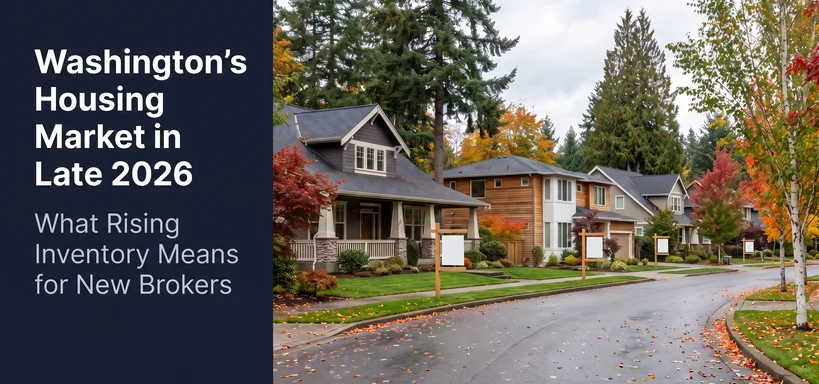
The year 2026 has brought a clear shift to the Washington housing market. The hyper-competitive, low-inventory conditions of recent years are giving way to a more balanced, normalizing landscape. For newly licensed real estate professionals across the Evergreen State (licensed as brokers in Washington and working under the supervision of managing brokers), this shift brings both opportunity and a distinct set of challenges.
Rising inventory is the defining characteristic of the 2026 market. Across the state, "For Sale" signs stay up longer than the frantic weekend-only listings of the past. New brokers need to understand, and clearly communicate to their clients, that a rise in inventory does not mean a crashing market. It signals a return toward historical norms.
A normalizing market requires a change in strategy. The days of placing a property on the Northwest Multiple Listing Service (NWMLS), taking basic photos, and sorting through a dozen offers on Monday are largely behind us. For new brokers, this environment demands a higher level of professionalism, sharper analytical skills, and a deeper understanding of market dynamics. You are not simply facilitating transactions. You are stepping into the role of a strategic advisor.
Understanding the Numbers
To position yourself as a credible market expert, you must speak the language of data. The latest NWMLS figures, released September 3, 2026, show 24,675 active listings across the NWMLS service area at the end of August 2026, up 22.0% from 20,219 a year earlier. This influx of available properties is giving buyers welcome breathing room.
Mortgage rates add to the picture. Freddie Mac's Primary Mortgage Market Survey put the 30-year fixed rate at 6.95% for the week of September 17, 2026, up from 6.26% a year earlier and far above pre-2022 levels. Higher borrowing costs cut into buyer purchasing power and limit affordability. Buyers are highly sensitive to monthly payments, which makes pricing accuracy and market positioning even more important for sellers who want to attract qualified prospects.
At the August sales pace, the NWMLS service area had 4.21 months of inventory, up from 3.19 months in August 2025. Months of supply (also called the absorption rate) measures how long it would take to sell all current inventory at the current pace of sales. A common rule of thumb, cited in the state's own economic reporting, treats 4 to 6 months as a balanced market. Under 4 months leans toward sellers, and over 6 months leans toward buyers. By that measure, the NWMLS area as a whole has moved into balanced territory, a long way from the sub-one-month supply of the peak frenzy.
Pricing reflects the same normalization. The NWMLS median sales price for homes and condominiums sold in August 2026 was $635,000, down 2.3% from $650,000 in August 2025. That is slight softening and stabilization, not the double-digit appreciation of the past. Closed sales fell 7.6% year over year and pending sales fell 6.5%, so buyers are taking their time to inspect, negotiate and weigh their options.
Price reductions are a telling statistic for a new broker to internalize. Redfin data cited in the state Office of Financial Management's May 2026 economic report showed that 23.4% of Washington homes had price drops in April 2026, up from 20.0% a year earlier. Sellers who price their homes on 2024 or 2025 comparables, without adjusting for today's inventory, are finding their properties sitting on the market. Your ability to interpret these numbers, and to explain to clients that rising inventory signals normalization rather than collapse, is central to your statutory duty to exercise reasonable skill and care.
Regional Variations Matter
Statewide and MLS-wide statistics give a useful overview, but real estate is a hyperlocal business. A common mistake among new brokers is applying broad trends uniformly across different counties or neighborhoods. Washington's diverse economy and geography mean that a broker in Seattle faces a very different market from one in Ellensburg or Spokane.
Consider King County. The economic engine of the Puget Sound region had 4.3 months of inventory in August 2026, up from 3.9 in July, and a median sales price of $845,000. King County has moved from a seller-leaning market into the balanced range. Well-priced, move-in-ready homes still attract strong buyer interest, but buyers now have more room to negotiate. Brokers working in Bellevue or Shoreline should still prepare buyers to act decisively on the right property, while preparing sellers for longer marketing times.
Contrast this with Kittitas County, which had 6.5 months of inventory in August 2026. At over six months, Kittitas County is in buyer's-market territory. Sellers there face real competition, and buyers have leverage to negotiate price, ask for seller concessions and request repairs.
These differences shape your daily strategy as a new broker. Study the local absorption rates, time on market and pricing trends for the specific neighborhoods and property types you serve. Relying on national or statewide headlines does your clients a disservice. Your value lies in translating broad trends into actionable, neighborhood-specific advice.
What This Means for New Brokers
The shift toward higher inventory changes the day-to-day work of a real estate broker. When homes sell in three days, the main challenge is speed. When homes sit for weeks, the main challenges are strategy, marketing and steady client communication.
For listing brokers, more active inventory means more properties to potentially list, but those listings take more work to sell. Pricing strategy becomes the most important part of the listing process. Mastering the Comparative Market Analysis (CMA) is essential. You must know how to account for the share of homes taking price reductions, and you must counsel your sellers firmly against aspirational pricing. Longer timelines also mean managing seller anxiety, providing regular marketing updates and continuously analyzing the active competition.
For brokers representing buyers, clients now have more choices, which is a double-edged sword. It is positive that buyers no longer feel compelled to waive every contingency to secure a home, but an abundance of choice can lead to "analysis paralysis." Your role is to help clients narrow their options based on clearly defined core criteria.
Navigating Agency Disclosure and Compensation
This market raises the stakes on formalizing client relationships, handling agency disclosure correctly and explaining compensation clearly.
Washington's agency rules are in Chapter 18.86 RCW. Under RCW 18.86.030, a broker must give the agency law pamphlet described in RCW 18.86.120 to any party they provide brokerage services to "as soon as reasonably practical but before the party signs a services agreement," and obtain an acknowledgment of receipt. An unrepresented party must receive it "before the party signs an offer or as soon as reasonably practical." The same section requires you to disclose in writing whom you represent (buyer, seller, or both as a limited dual agent) "before the broker's principal signs an offer, or as soon as reasonably practical, but before the parties reach mutual agreement." That disclosure goes in a separate paragraph titled "Agency Disclosure" or in a separate writing.
Since January 1, 2024, Washington law has required a written services agreement for buyer representation, not just seller representation. Under RCW 18.86.020, the firm must enter into a services agreement with the buyer "before, or as soon as reasonably practical after," the appointed broker starts providing brokerage services. The agreement must state its term (60 days by default for a buyer, unless a different term is chosen), the appointed broker, and whether the relationship is exclusive or nonexclusive. Under RCW 18.86.080, a firm must have a services agreement containing the compensation terms in order to be paid for those services.
Washington's requirement came from state law, ahead of the national NAR settlement practice changes that took effect in August 2024. NWMLS is broker-owned and did not opt into the NAR settlement. It had already decoupled buyer broker compensation in 2022, and any compensation a seller offers to the buyer's broker is stated on the first page of the purchase and sale agreement. In practice, a seller may or may not offer buyer broker compensation on a given property. That makes it essential to negotiate your compensation with your buyer upfront, write it into the services agreement, and explain what happens when a seller offers less than the agreement provides or nothing at all.
Treat this as more than a compliance step. In a market where buyers may tour dozens of homes over several months, a clear written agreement sets expectations and shows the value of your time and expertise. Your firm's policies and your managing broker will guide how your office handles these conversations.
Building Your Skills for a Shifting Market
Entering the profession requires a solid foundation, and thriving in a normalizing market takes ongoing learning. In Washington, aspiring brokers must complete 90 hours of approved pre-license education (a 60-hour Real Estate Fundamentals course and a 30-hour Real Estate Practices course) before sitting for the licensing exam. The real test of your knowledge begins the moment you affiliate your license with a firm and managing broker.
The Washington State Department of Licensing (DOL) recognizes the steep learning curve facing new brokers. Under WAC 308-124A-785, a broker's first active license renewal requires 90 clock hours of education. DOL lists a 30-hour Advanced Practices course, a 30-hour Real Estate Law course, the 3-hour Current Issues in Washington Residential Real Estate (Core) course, and at least 27 hours of other approved continuing education. You must also complete the 3-hour Washington Real Estate Fair Housing course each time you renew. Use these hours strategically to deepen your skills in negotiation, property valuation and real estate finance.
Beyond required education, new brokers should become consistent consumers of market data. The Washington Center for Real Estate Research (WCRER), the research center contemplated by RCW 18.85.471 and operating at the University of Washington, publishes quarterly housing market and apartment market reports and an annual report, "The State of the State's Housing." NWMLS publishes monthly market snapshots with county-level breakouts. Studying these regularly will lift your client consultations from basic property tours to real advisory sessions.
Finally, lean on your managing broker and firm resources. Washington's supervisory structure is designed to protect both the public and new brokers. Ask your managing broker to review your CMAs or to role-play pricing conversations before you meet with a client.
Practical Tips for New Brokers
Moving from real estate student to producing broker in a higher-inventory market takes deliberate strategy. Consider these steps:
Master the Absorption Rate. Do not stop at median prices. Calculate the months of supply for every neighborhood you work in. Keep the common benchmark in mind: under 4 months leans toward sellers, 4 to 6 months is generally considered balanced, and over 6 months leans toward buyers. Walk every client through this metric to ground their expectations in data.
Practice the Price-Reduction Conversation Early. With close to a quarter of Washington listings taking price drops earlier this year, prepare sellers for the possibility at the listing appointment. Agree on parameters in advance, for example: "If we receive fewer than five showings and no offers within 14 days, we will reduce the price by 2%." This keeps sellers from feeling blindsided later.
Present Your Buyer Services Agreement as a Value Proposition. Do not treat the agreement required under RCW 18.86.020 and 18.86.080 as mere paperwork. Use it to explain your specific value and exactly how you will be compensated. Outline what you will do for the buyer, from market research and property tours to negotiation and contingency management. It sets professionals apart from those treating real estate as a side pursuit.
Elevate Your Marketing. With nearly 25,000 active listings in the NWMLS area, smartphone photos will not do. Invest in professional photography, floor plans and staging consultations. A property must stand out online before a buyer will step through the door.
Focus on Condition and Seller Disclosures. Buyers in 2026 are selective and have time to scrutinize a property's condition. With mortgage rates near 7%, buyers are less willing to absorb major renovation costs. Encourage sellers to address deferred maintenance before listing. Under RCW 64.06.020, a seller of improved residential property must generally deliver a completed seller disclosure statement to the buyer (NWMLS Form 17 is the standard form), unless the buyer waives it or the transfer is exempt. Brokers should not advise sellers on what the law requires them to disclose; refer sellers with legal questions about their disclosure obligations to a real estate attorney. An accurate, complete Form 17 helps prevent problems that can derail a transaction when buyers have the leverage to demand repairs or walk away during the inspection period.
Looking Ahead: The Rest of 2026
For the rest of 2026, current data points to continued stabilization in Washington. With the NWMLS median price down 2.3% year over year and inventory up 22%, flat to modestly lower prices are plausible in some saturated micro-markets, while highly desirable neighborhoods are likely to hold value more firmly. Buyers will likely stay selective, favoring turnkey properties or meaningful seller concessions.
For new brokers, this may be the best kind of market in which to build a professional foundation. A frenzied market can reinforce shortcuts and bad habits; a balanced market teaches the fundamentals of real estate practice. Stay current with NWMLS and WCRER data, follow Washington's agency and disclosure rules closely, and approach your business as a strategic advisor rather than a transactional salesperson. That is how you build a resilient career that can weather future economic shifts. Embrace the inventory, master the numbers and step confidently into your role as a Washington real estate professional.
Sources
- Northwest Multiple Listing Service. "Market Snapshot August 2026" (released September 3, 2026). https://www.nwmls.com/market-snapshot-august-2026/ (checked September 24, 2026)
- Seattle King County REALTORS. "NWMLS August 2026 Market Report" (county figures). https://www.nwrealtor.com/2026/09/04/nwmls-august-2026-market-report/ (checked September 24, 2026)
- Freddie Mac. Primary Mortgage Market Survey. https://www.freddiemac.com/pmms (checked September 24, 2026)
- Washington State Office of Financial Management. "Washington Monthly Economic Report," May 2026 (Redfin housing data) and August 2026. https://ofm.wa.gov/wp-content/uploads/2026/06/May_2026_economic_report.pdf and https://ofm.wa.gov/wp-content/uploads/2026/08/August_2026_Economic_report.pdf (checked September 24, 2026)
- Washington State Legislature. Chapter 18.86 RCW, including RCW 18.86.020, 18.86.030, 18.86.080 and 18.86.120. https://app.leg.wa.gov/RCW/default.aspx?cite=18.86 (checked September 24, 2026)
- Washington State Legislature. RCW 64.06.020. https://app.leg.wa.gov/RCW/default.aspx?cite=64.06.020 (checked September 24, 2026)
- Washington State Legislature. WAC 308-124A-785. https://app.leg.wa.gov/WAC/default.aspx?cite=308-124A-785 (checked September 24, 2026)
- Washington State Department of Licensing. Real estate broker licensing and renewal pages. https://dol.wa.gov/professional-licenses/real-estate-brokers (checked September 24, 2026)
- Northwest Multiple Listing Service. "NWMLS Leads the Industry in Providing Consumers with Transparency, Choice and Options to Negotiate" (May 28, 2024). https://www.nwmls.com/nwmls-leads-the-industry-in-providing-consumers-with-transparency-choice-and-options-to-negotiate/
- Washington Center for Real Estate Research, University of Washington. https://wcrer.be.uw.edu/ (checked September 24, 2026)
Washington's housing inventory is up 22% from a year ago, and the NWMLS area has moved into balanced-market territory at 4.21 months of supply. Here is what the latest numbers mean for new brokers: pricing, regional differences from King to Kittitas County, and the agency disclosure and buyer services agreement rules under Chapter 18.86 RCW.