Educational Disclaimer: This guide is for educational purposes only and is not legal, tax or insurance advice. Brokers should consult their designated broker, and refer legal questions to an attorney, before relying on it for a specific campaign.
Introduction: The Strategic Imperative of a Compliant Marketing Plan
In Washington State's competitive real estate marketplace, building a profitable practice demands disciplined business planning, measurable targets, and steady regulatory adherence. Real estate professionals must operate as business owners who generate client pipelines while complying with standards set by the Washington State Department of Licensing (DOL), Title 18 of the Revised Code of Washington (RCW), and Title 308 of the Washington Administrative Code (WAC).
While licensed brokers have creative freedom in marketing, every promotional campaign remains subject to the supervisory authority of their designated broker or delegated managing broker. Non-compliant marketing exposes both the broker and the firm to license discipline, and some outreach violations also carry liability under Washington's Consumer Protection Act. This guide gives brokers a practical roadmap for designing, funding, and executing a marketing plan that balances financial goals with fair housing law, firm-name rules, digital outreach restrictions, and supervisory approval workflows.
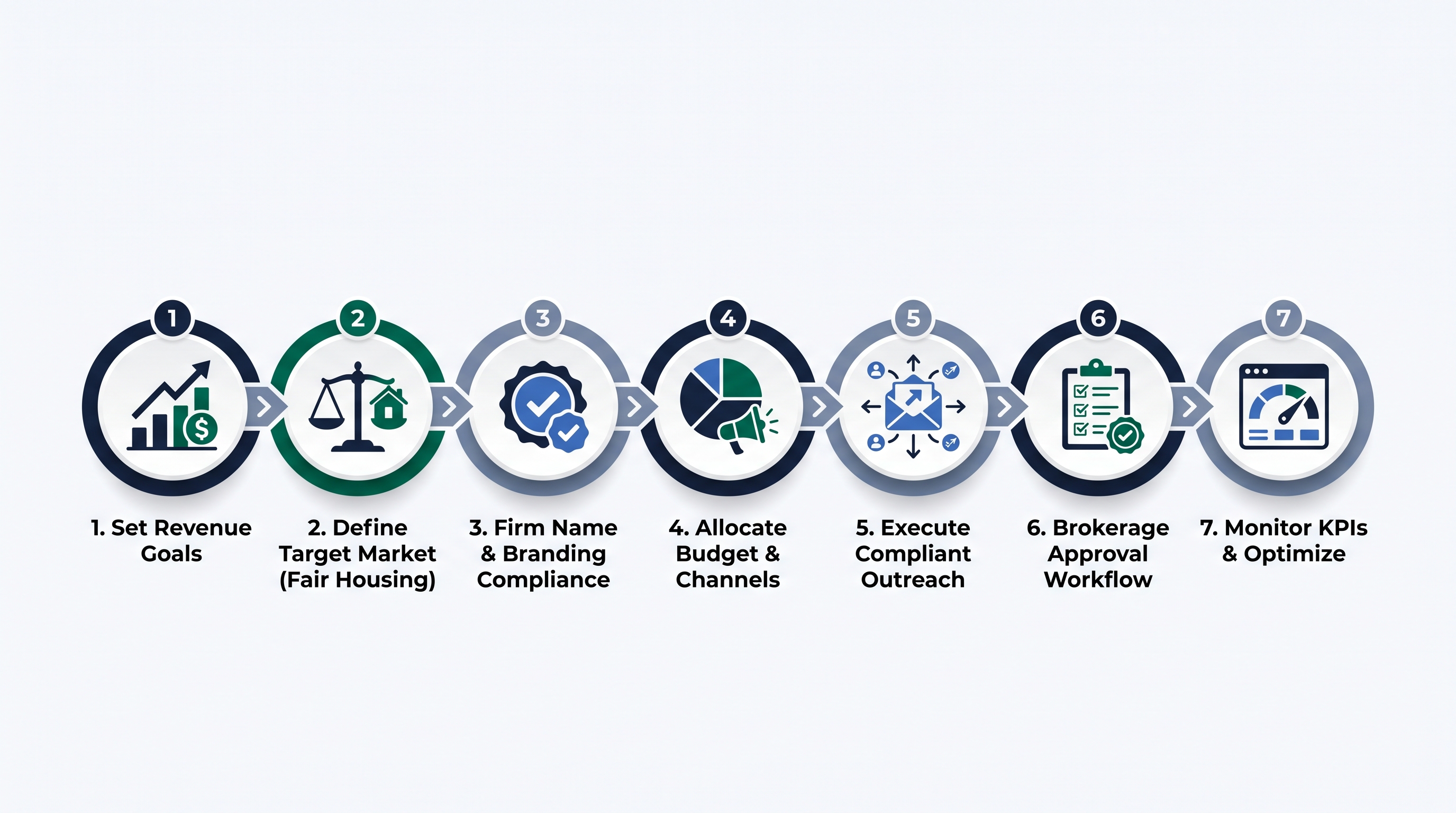
The 7-step compliant marketing plan framework
Step 1: Establish Measurable Business Goals and Revenue Models
A high-performing marketing plan begins with quantifiable production targets built on the SMART framework (Specific, Measurable, Achievable, Relevant, Time-Bound). Real estate professionals should reverse-engineer annual financial targets into concrete transaction volumes, consultations, and marketing touches.
Calculating GCI and Volume (Illustrative Assumptions)
Consider these illustrative planning figures (hypothetical modeling, not regulatory benchmarks). For tax planning, consult a tax professional.
- Target Income and Overhead: A broker targeting $120,000 in personal pre-tax income, with $35,000 in operating overhead (marketing, MLS dues, licensing fees, technology subscriptions) and $35,000 in tax reserves, requires $190,000 in net revenue.
- Brokerage Split: Under an illustrative 80/20 firm split, the required Gross Commission Income (GCI) is $237,500 ($190,000 / 0.80).
- Transaction Volume: Assuming an average sales price of $600,000 and compensation of 2.5% per side ($15,000 per closed side), the broker must close 16 transactions annually (approximately 1.3 per month). Compensation is negotiable and set in each services agreement, so use your own figures.
Funnel Conversion Modeling (Illustrative Assumptions)
To close 16 transactions, a broker might model an acquisition pipeline using these illustrative conversion assumptions:
- Written Services Agreements: Closing 16 transactions requires approximately 20 executed brokerage services agreements to account for transaction fallout. Under RCW 18.86.020, as amended effective January 1, 2024, a firm must enter into a services agreement with each principal, buyer or seller, "before, or as soon as reasonably practical after, its appointed broker commences rendering real estate brokerage services." RCW 18.86.010 defines a services agreement as a written agreement, and a buyer agreement must carry a default term of 60 days with the option of a longer term. A buyer's agent working solely on commercial real estate is exempt.
- Client Consultations: Securing 20 signed agreements requires approximately 32 to 35 formal buyer or seller consultations (assuming a 60% conversion rate).
- Qualified Leads: Booking 35 consultations requires cultivating 100 to 120 qualified prospects intending to transact within 12 months.
- Outreach Database: Nurturing 120 qualified prospects requires an active database of 500 to 800 contacts receiving consistent touches throughout the year.
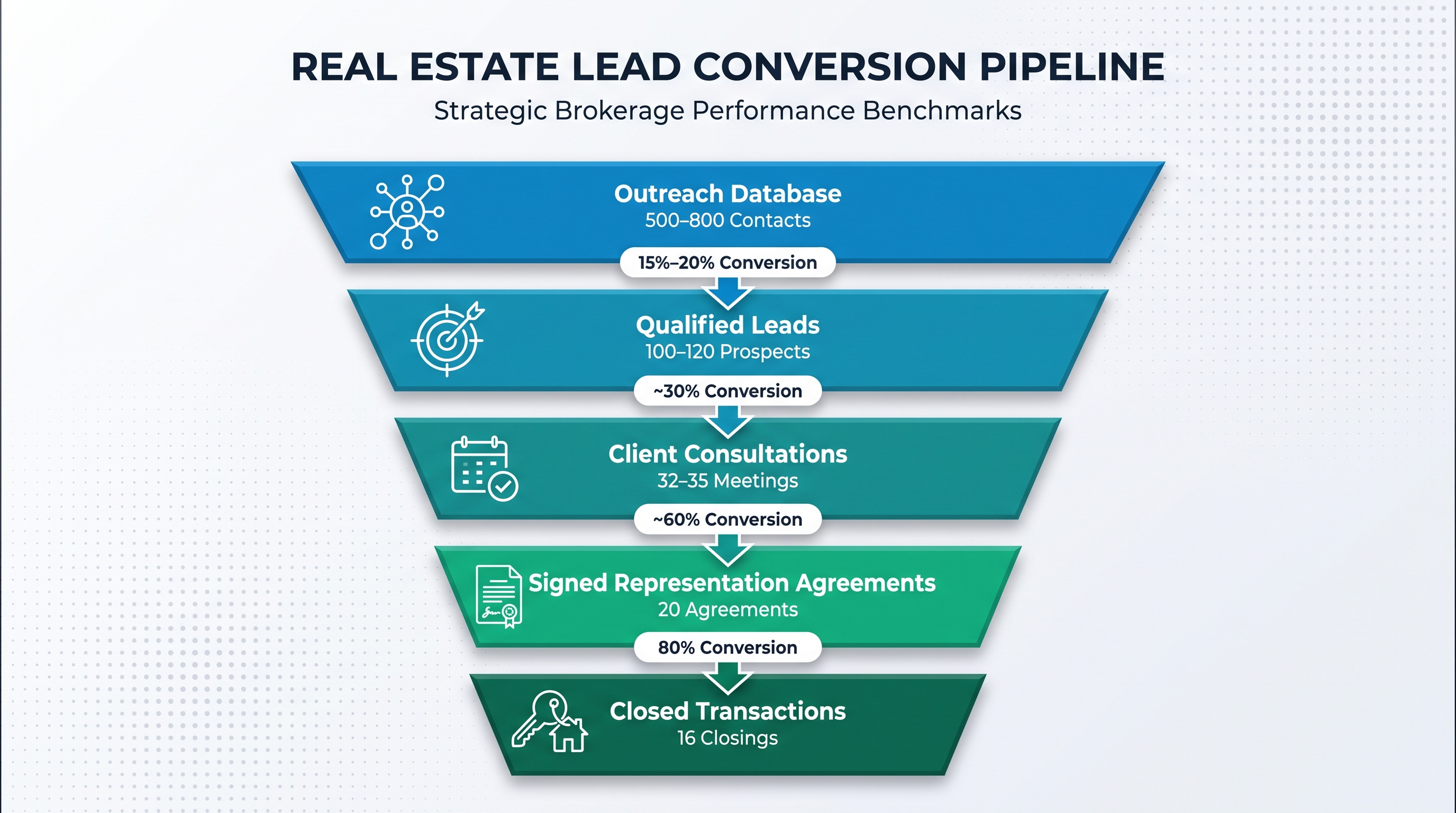
Illustrative lead-to-close conversion funnel for a 16-transaction annual target
Brokers must balance leading indicators (outreach calls, booked consultations) against lagging indicators (closed transactions and earned commissions).
Step 2: Define Your Target Market with Fair Housing Compliance
Market segmentation directs marketing spend toward productive niches, such as geographic farming territories or first-time buyers, but every campaign must conform to civil rights law.
Federal, State, and Local Protected Classes
Under the federal Fair Housing Act (42 U.S.C. § 3604(c)), advertising housing with any preference, limitation, or discrimination based on race, color, religion, sex, familial status, national origin, or disability is unlawful. HUD's regulation at 24 C.F.R. § 100.75(c)(3) confirms that discriminatory advertising includes "selecting media or locations for advertising the sale or rental of dwellings which deny particular segments of the housing market information about housing opportunities" because of a protected class. That rule applies to digital ad targeting as much as to print.
The Washington Law Against Discrimination (RCW 49.60.222) reaches further. It makes it an unfair practice to publish an advertisement that indicates a limitation, specification, or discrimination based on sex, marital status, sexual orientation (which Washington law defines to include gender expression or identity), race, creed, color, national origin, citizenship or immigration status, families with children status, honorably discharged veteran or military status, the presence of any sensory, mental, or physical disability, or the use of a trained dog guide or service animal.
For rentals, Washington also protects source of income statewide. RCW 59.18.255(2) bars a landlord from publishing any advertisement relating to the rental of real property "that indicates a preference, limitation, or requirement based on any source of income," which includes housing vouchers. Local ordinances can add more; in Seattle, the Open Housing Ordinance (Seattle Municipal Code Chapter 14.08) protects renters who use Section 8 vouchers and other alternative sources of income. A rental ad that says "No Section 8" is unlawful in Washington.
Compliant Marketing Language in Practice
Brokers should advertise the objective physical features and amenities of the property, never the demographic composition of prospective occupants or current neighbors:
- Prohibited Phrasing: "Ideal for young tech bachelors," "safe Christian community," "exclusive adult enclave," "neighborhood perfect for married couples without kids," or "no housing vouchers."
- Compliant Phrasing: "Three-bedroom home with fenced backyard and patio," "two-bedroom condominium two blocks from commuter light rail," "single-level layout with step-free entry," or "spacious kitchen with quartz countertops."
Social platforms such as Meta route housing ads through a special ad category that limits targeting options. Use that category when it applies, and still review where your ads are delivered, since the Fair Housing Act and WLAD apply regardless of the tool. Maintaining an accessible website, with alternative text (alt text) for imagery and readable color contrast, is a recommended inclusive marketing practice; ask your firm or its counsel about any accessibility obligations that apply to your site.
Step 3: Master Firm-Name, Team Branding, and MLS Listing Rules
DOL's advertising guidelines state that "DOL expects firms to exercise robust oversight of all licensee advertising." Under RCW 18.85.361(8), "advertising in any manner without including the real estate firm's name or assumed name as licensed in a clear and conspicuous manner in the advertisement" is grounds for disciplinary action.
Firm-Name Visibility and Team Moniker Rules
Under WAC 308-124B-210(1), "all advertising or solicitations without limitation for brokerage services, to include the internet-based advertising, web pages, email, newspaper, and other visual media must include the firm name or an assumed name as licensed." The safest practice is to put the licensed firm name in the advertisement itself. For social media, DOL's guidelines say the firm's and the broker's licensed names "should be prominently displayed and easily understood and be no more than one click away from the viewable page." Check your firm's policy, which may be stricter. The statute has one exception for personally owned property: brokers advertising their own real property "must only disclose that they hold a real estate license."
Teams and brands that are not licensed assumed names face specific limits under WAC 308-124B-210(2):
- Firm Name Always Displayed: The firm's licensed name or licensed assumed name must appear "in a clear and conspicuous manner in conjunction with the use of such name, title, or brand."
- No Legal Entity Designations: Team names cannot suggest a separate legal entity, such as "Inc.," "LLC," "LLP," "Corp.," "firm," or "company."
- No Firm or Office Terms: Teams cannot use words commonly understood to reference a firm or an office, such as "realty," "realtors," "firm," or "real estate." For example, "The Sound Group" can work, but "Sound Group Realty" or "Sound Real Estate LLC" cannot be used unless the firm holds it as a licensed assumed name.
- Designated Broker Approval: Brokers must "receive advance written approval from the firm's designated broker to use an unlicensed title or brand."
- Logos and URLs Do Not Count: DOL's advertising guidelines state that "including a firm logo or website address does not qualify as including the firm's licensed name."
MLS and Industry Advertising Standards
Brokers marketing property listings must also follow MLS and professional ethics standards:
- NWMLS Rules: NWMLS members must follow the NWMLS Rules and Regulations on listing data and advertising, including the rule that restricts advertising another member's listing without the listing firm's written permission. Read the current rules on the NWMLS member site before running listing ads.
- NAR Code of Ethics Article 12: REALTOR® members must present a "true picture" in their advertising and representations. Standard of Practice 12-4 states that "REALTORS® shall not offer for sale/lease or advertise property without authority."
Step 4: Allocate Marketing Channels and Construct a Realistic Budget
A sustainable marketing plan diversifies lead generation across multiple pillars. Real estate professionals should allocate marketing funds based on projected production targets.
Illustrative Budget Distribution (Illustrative Assumptions)
Allocating around 10% of projected GCI (about $23,750 on the $237,500 target from Step 1) fits inside the $35,000 overhead assumption. Early-career brokers who plan to spend 20% or more during their ramp-up should raise the overhead figure in Step 1 to match. Consider this illustrative channel model:
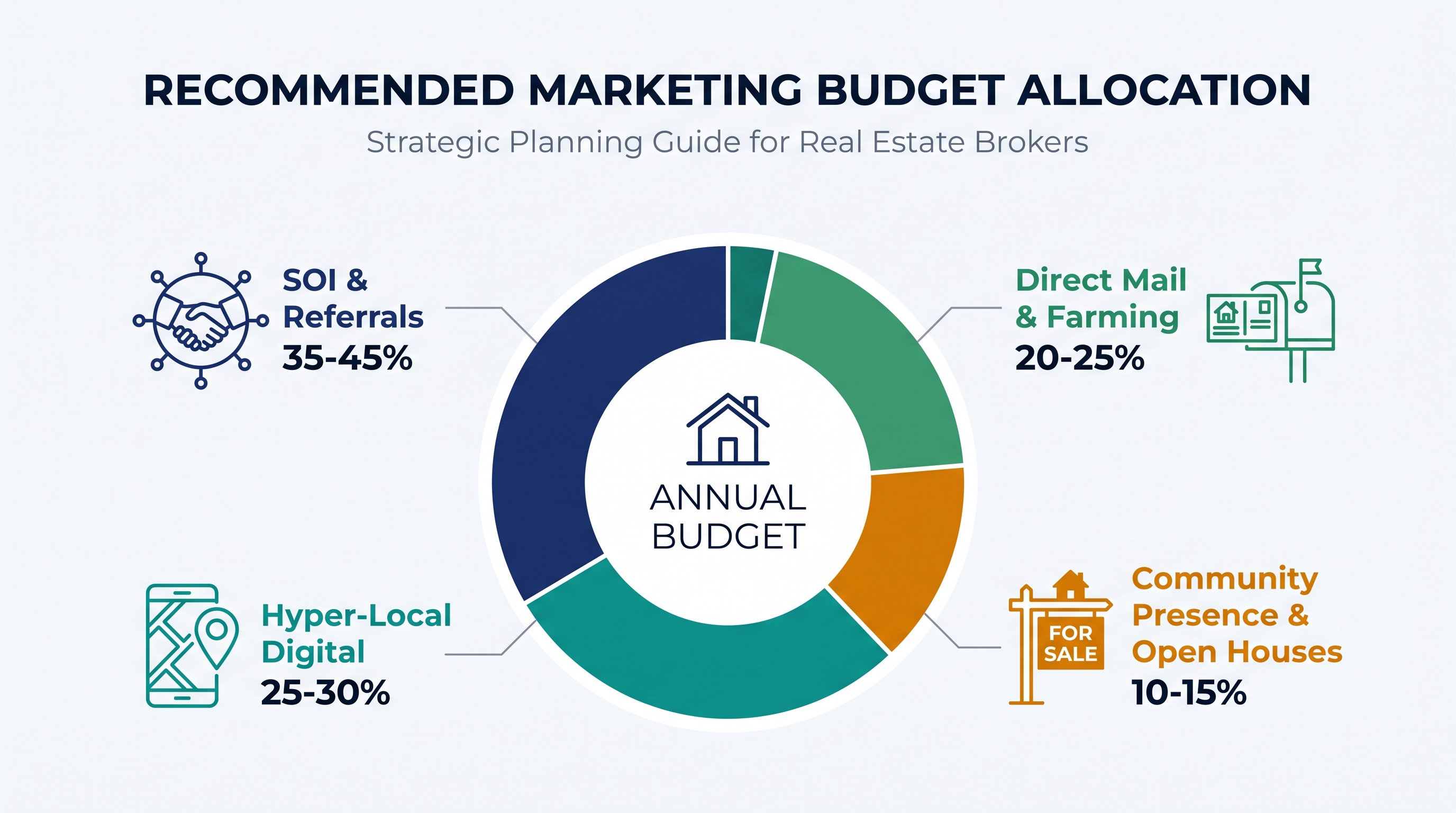
Illustrative marketing budget allocation by channel
- Sphere of Influence (SOI) & Referrals (Illustrative 35%–45%): Client events, quarterly touchpoints, handwritten notes, and referral networking with lenders, attorneys, and past clients.
- Hyper-Local Digital Marketing (Illustrative 25%–30%): Mobile-responsive IDX website, Google Business Profile optimization, local SEO, video tours, and fair-housing-compliant ads.
- Direct Mail & Geographic Farming (Illustrative 20%–25%): Monthly mailers sent to a farm of 400 to 600 homes featuring neighborhood sales data and market insights.
- Community Presence & Open Houses (Illustrative 10%–15%): Branded directional signs, print feature sheets, and local event sponsorships.
Online Reviews and Testimonials Compliance
Customer reviews build credibility, but they also carry legal risk. The FTC's Endorsement Guides (16 C.F.R. Part 255) and its Rule on the Use of Consumer Reviews and Testimonials (16 C.F.R. Part 465, in effect since October 21, 2024) bar fake reviews, undisclosed material connections (such as payments or incentives for reviews), and buying positive reviews. Brokers must also screen testimonials for fair housing problems: publishing a client quote that praises a broker for steering them away from particular groups, or that celebrates a neighborhood's demographic makeup, creates fair housing risk.
Step 5: Execute Compliant Outreach: Email, Text Messaging, and Off-Market Solicitations
Direct prospecting accelerates pipeline growth but requires careful adherence to telecommunications and consumer protection statutes.
Washington Commercial Electronic Mail Act (CEMA) and Email Compliance
Commercial email outreach is governed by Washington's Commercial Electronic Mail Act (Chapter 19.190 RCW). A "commercial electronic mail message" includes email "sent for the purpose of promoting real property, goods, or services for sale or lease." RCW 19.190.020 prohibits commercial email to Washington residents that misrepresents or obscures its point of origin or transmission path, or that uses a subject line containing false or misleading information. The legislature amended that section in 2026 (chapter 135, Laws of 2026), and the amendment applies to all causes of action commenced on or after June 11, 2026, so review the current text before launching an email campaign.
Under RCW 19.190.030, sending such messages is a violation of the Consumer Protection Act (Chapter 19.86 RCW). Under RCW 19.190.040, a recipient's damages are "$100, or actual damages, whichever is greater." Federal CAN-SPAM Act rules (15 U.S.C. § 7701 et seq.) add separate requirements for commercial email, such as honoring opt-out requests; review the FTC's current guidance before sending.
Commercial Text Messaging Restrictions
Under RCW 19.190.060, no person conducting business in Washington may send a commercial text message to a Washington resident's cell phone number. RCW 19.190.070 allows it when "the subscriber has clearly and affirmatively consented in advance to receive these text messages." A violation is a Consumer Protection Act violation, and RCW 19.190.040 sets recipient damages at $100 or actual damages, whichever is greater. Cold-texting property owners from purchased lists is the conduct these sections target. The federal Telephone Consumer Protection Act (47 U.S.C. § 227) and FCC rules impose separate requirements; check them with your firm before any text campaign.
Off-Market Solicitations under Chapter 61.40 RCW
Chapter 61.40 RCW protects owners who receive unsolicited offers. For real estate transactions executed on or after January 1, 2026, RCW 61.40.010 applies when a potential buyer, or someone representing one, actively solicits the purchase of property that is not listed or publicly available, through public advertising or written, electronic, or in-person contact with the owner.
The key point for licensees is subsection (4): "This section does not apply to a buyer or seller represented by a real estate broker licensed in accordance with chapter 18.85 RCW." When you represent a buyer who makes an off-market offer, or the owner is represented, these contract terms do not apply. They matter when you meet unrepresented solicitations in the field, such as an owner who signed with a wholesaler or cash investor. In a covered transaction:
- Appraisal Right: The owner has the right to an appraisal by an appraiser licensed under Chapter 18.140 RCW. The owner selects the appraiser, the buyer pays, and the appraisal must be ordered within three business days after the contract is executed.
- Cancellation Right: The owner may cancel without penalty within four business days after receiving the appraisal, or, if no appraisal is wanted, within 10 business days after execution.
- Contract Disclosure: The purchase contract must state both rights "in at least size 10-point boldface type," and the seller must affirmatively acknowledge them in writing.
A violation is an unfair or deceptive act under the Consumer Protection Act. A 2026 amendment (chapter 198, Laws of 2026) exempts certain public-entity, tribal, and conservancy purchases. Refer owners with questions about a signed solicitation contract to an attorney.
Step 6: Brokerage Creative Approval and Supervisory Workflows
In Washington State, brokers operate under statutory supervisory oversight.
Supervisory Oversight and Written Firm Policies
Under RCW 18.85.275(1), "the designated broker or managing broker shall supervise the conduct of brokers and managing brokers" for compliance with the licensing law. Subsection (6) adds that during a broker's first two years of licensure, "a managing broker must provide a heightened level of supervision." WAC 308-124C-125 requires the designated broker to maintain a written policy that addresses levels of supervision and review of all brokerage service contracts involving brokers licensed less than two years, and to keep written delegations to managing brokers that address duties including advertising. DOL's guidelines recommend that designated brokers "establish a policy and training system within the firm or branch that ensures compliance with advertising requirements," and WAC 308-124C-140 requires every broker to follow licensing laws and rules on "proper and legal advertising."
Compliance Workflow
Brokers should follow a standardized internal compliance protocol. The timelines below are examples; your firm's written policy controls.
- Advance Review: Submit marketing designs, direct mail proofs, and digital campaigns to your managing broker a few business days before release (for example, 3 to 5).
- Written Brand Approval: Secure advance written approval from your designated broker before using any unlicensed team name, title, or brand (WAC 308-124B-210(2)(d)).
- Record Archiving: The designated broker must keep transaction records, and WAC 308-124C-110(2) requires required records to be retained "for a minimum of three years" (see also RCW 18.85.361(17)). Keep copies of your advertisements, written approvals, and text or email consent records as your firm's policy directs.
Step 7: Monitor Metrics, Track Key Performance Indicators (KPIs), and Optimize ROI
To ensure marketing spend drives profitable production, real estate professionals should monitor essential KPIs:
- Customer Acquisition Cost (CAC): Total channel expenses divided by closed transactions generated.
- Return on Marketing Investment (ROMI): (GCI generated minus marketing costs) divided by marketing costs.
- Lead-to-Agreement Conversion Rate: Percentage of leads who sign a written brokerage services agreement.
- Cost Per Qualified Lead (CPL): Total expenditure divided by vetted prospect inquiries.
Brokers should track leading indicators weekly, analyze lead costs monthly, and review quarterly ROMI with their managing broker to reallocate budget into high-yield, compliant channels.
One-Page Real Estate Marketing Plan Template
The following compact template outlines key channels, illustrative budget allocations, legal checkpoints, and supervisory workflows:
| Marketing Channel & Strategy | Core Objective | Illustrative Budget % (Assumed) | Compliance Checkpoints | Supervisory & Approval Actions |
|---|---|---|---|---|
| Sphere of Influence (SOI) & Referrals | Retain past clients and build professional referral partnerships | 35% – 45% | Accurate sender and truthful subject lines on email (RCW 19.190.020); prior clear and affirmative consent for commercial texts (RCW 19.190.070). | Submit newsletter templates and outreach scripts to your managing broker per firm policy. |
| Hyper-Local Digital Marketing | Capture local buyer/seller search traffic; build brand awareness | 25% – 30% | Licensed firm name clear and conspicuous in the ad (RCW 18.85.361(8)); no discriminatory targeting (24 C.F.R. § 100.75); FTC review and endorsement rules. | Obtain designated broker's advance written approval for any team or brand name (WAC 308-124B-210). |
| Direct Mail & Geographic Farming | Establish market presence in targeted neighborhoods | 20% – 25% | Licensed firm name on every piece (WAC 308-124B-210(1)); describe property, not people (RCW 49.60.222). | Submit mailer proofs and market statistics to your managing broker before distribution. |
| Community Presence & Open Houses | Connect directly with prospective buyers and local neighbors | 10% – 15% | Signs and flyers show the licensed firm name (WAC 308-124B-210); written permission before advertising another firm's listing (NWMLS Rules). | Confirm listing advertising authority and follow firm sign guidelines. |
| Off-Market Purchase Solicitations | Identify unlisted properties for buyer clients | Discretionary / Direct | Solicitation ads carry the firm name; if a counterparty is unrepresented, know the chapter 61.40 RCW appraisal and cancellation rights (they do not apply when a buyer or seller is broker-represented). | Review solicitation letters and resulting contracts with your managing broker (RCW 18.85.275). |
Conclusion: Executing a Sustainable, Compliant Growth Engine
Building a thriving real estate practice in Washington State requires blending marketing ambition with disciplined regulatory compliance. By setting reverse-engineered financial targets, following federal and Washington fair housing law, displaying the licensed firm name under RCW 18.85.361(8) and WAC 308-124B-210, keeping email and text outreach within CEMA, understanding when Chapter 61.40 RCW applies, and working with managing brokers through structured supervisory workflows, real estate professionals build a resilient foundation for long-term career growth.
Sources
- RCW 18.86.010 and 18.86.020, Real Estate Brokerage Relationships: https://app.leg.wa.gov/rcw/default.aspx?cite=18.86.020
- 42 U.S.C. § 3604(c), Fair Housing Act.
- 24 C.F.R. § 100.75, Discriminatory advertisements, statements and notices: https://www.ecfr.gov/current/title-24/subtitle-B/chapter-I/subchapter-A/part-100/subpart-B/section-100.75
- RCW 49.60.222, Washington Law Against Discrimination, real estate transactions: https://app.leg.wa.gov/rcw/default.aspx?cite=49.60.222
- RCW 59.18.255, Source of income: https://app.leg.wa.gov/rcw/default.aspx?cite=59.18.255
- City of Seattle Office for Civil Rights, Fair Housing and Seattle Municipal Code Chapter 14.08: https://www.seattle.gov/civilrights/housing-rights/fair-housing
- RCW 18.85.361, Disciplinary action grounds: https://app.leg.wa.gov/rcw/default.aspx?cite=18.85.361
- WAC 308-124B-210, Advertising: https://app.leg.wa.gov/wac/default.aspx?cite=308-124B-210
- Washington State Department of Licensing, Real Estate Advertising Guidelines (RE-620-400): https://dol.wa.gov/sites/default/files/2023-03/real-estate-advertising-guidelines.pdf
- Northwest Multiple Listing Service, Rules and Regulations (member access).
- National Association of REALTORS®, 2026 Code of Ethics and Standards of Practice: https://www.nar.realtor/about-nar/governing-documents/code-of-ethics/2026-code-of-ethics-standards-of-practice
- 16 C.F.R. Part 255, FTC Endorsement Guides; 16 C.F.R. Part 465, Rule on the Use of Consumer Reviews and Testimonials: https://www.ecfr.gov/current/title-16/chapter-I/subchapter-D/part-465
- Chapter 19.190 RCW, Commercial Electronic Mail Act (RCW 19.190.010 through .070): https://app.leg.wa.gov/rcw/default.aspx?cite=19.190
- 15 U.S.C. § 7701 et seq., CAN-SPAM Act (Federal Trade Commission).
- 47 U.S.C. § 227, Telephone Consumer Protection Act (Federal Communications Commission).
- RCW 61.40.010, Solicited real property: https://app.leg.wa.gov/rcw/default.aspx?cite=61.40.010
- RCW 18.85.275, Designated broker or managing broker authority and duties: https://app.leg.wa.gov/rcw/default.aspx?cite=18.85.275
- WAC 308-124C-110, -125 and -140, Records and responsibilities: https://app.leg.wa.gov/wac/default.aspx?cite=308-124C
A step-by-step plan for Washington brokers that turns an income goal into a marketing budget, channel mix and lead funnel. It then walks through the rules that apply: fair housing advertising, firm-name and team-name requirements, email and text consent under CEMA, when the 2026 off-market solicitation law applies, and supervision by your managing broker.