
Why Math Matters for Aspiring Washington Brokers
For people preparing for the Washington broker license examination, computational questions often cause more anxiety than they should. Real estate math is the most objective part of the exam. Questions on agency law or contract clauses ask you to interpret; a math problem has one defensible answer. Learning a handful of formulas turns a common stumbling block into a reliable source of points.
Math matters after the exam too. A Washington broker is licensed to one firm at a time and is supervised by a designated or managing broker. In daily practice, brokers review closing figures, check financing terms, prorate property taxes, work out commission splits and estimate transfer taxes. Strong number skills help new brokers protect client funds and catch errors before closing. When a client asks what a figure means for their taxes or their loan, the broker's job is to refer them to a tax professional, attorney or lender.
Exam Architecture: The PSI Format and Standards
The Washington broker examination is administered by PSI, the Department of Licensing's (DOL) testing vendor. Before you can sit for it:
- Prelicensing education: You must complete 90 hours of approved real estate education: a 60-hour Real Estate Fundamentals course and a 30-hour Real Estate Practices course.
- Timing of courses: Under RCW 18.85.101, each course must be completed within two years before you apply for the broker's license examination.
The examination has two separately timed portions, according to PSI's current Washington Candidate Information Bulletin:
- National portion: 100 scored multiple-choice questions, 150 minutes.
- State portion: 30 scored multiple-choice questions on Washington laws and rules, 90 minutes.
- Experimental questions: A small number (5 to 10) of unscored experimental questions may also appear. They do not count toward your score, but they do count against your exam time, so budget your pace for the full set and give every question full effort.
- Math weighting: PSI's national content outline lists "Real Estate Calculations" at 7% of the broker exam, roughly 7 of 100 questions. Math also shows up inside other topics, such as financing and valuation.
Passing and timing rules:
- Passing score: Under WAC 308-124A-760(1), you need a minimum scaled score of 70 on each portion. PSI explains that a scaled score "is not the same as a percentage"; it keeps the passing standard consistent across test forms.
- Six-month window: Under WAC 308-124A-760(3), a passing score on one portion is valid for six months. DOL states that you must pass both portions within six months of each other, or you will have to retake both. If you pass one portion, you retake only the failed portion within that window.
- Applying for the license: DOL states that you must apply for your license within one year of passing your final exam.
- Calculators: PSI's bulletin allows physical calculators at test centers but not for remotely proctored exams. Confirm the current device rules with PSI before test day.
The Universal Method: Deconstructing Word Problems
Real estate calculations call for careful reading more than advanced algebra. Many mistakes come from setting up the problem wrong rather than from bad arithmetic. A four-step framework handles most questions:
- Identify the Base (Whole): Find the core figure (total purchase price, loan principal balance or gross annual income).
- Identify the Rate: Pull out the percentage or multiplier (commission rate, capitalization rate or interest rate) and convert it to a decimal (6% = 0.06; 2.5% = 0.025).
- Identify Dates and Timeframes: Decide whether the question wants an annual, monthly or daily amount, and note the closing date and whether an expense is accrued or prepaid.
- Identify the Party: Decide whether the question asks for the listing firm's fee, the broker's split, the buyer's closing cost or the seller's net proceeds.
The Universal "T-Bar" Formula
Most foundational real estate calculations rely on the Part, Whole and Rate relationship:
$$text{Part} = text{Whole} times text{Rate} quadBig|quad text{Rate} = frac{text{Part}}{text{Whole}} quadBig|quad text{Whole} = frac{text{Part}}{text{Rate}}$$
In a "T-bar" diagram, the Part sits on top, and the Whole and Rate sit side by side below the horizontal bar. Divide the Part by either bottom element to find the other, or multiply the two bottom elements to find the Part.
Core Computations: Step-by-Step Worked Scenarios
1. Commission Splits and Statutory Compliance
- Scenario: A home sells for $800,000. The listing firm charges a 2.5% commission ($20,000). The listing broker has a 60/40 split with the firm (the broker keeps 60%). What is the broker's commission?
- Calculation:
$$text{Firm Commission} = $800,000 times 0.025 = $20,000$$
$$text{Broker Commission} = $20,000 times 0.60 = $12,000$$ - Statutory Framework: Commission rates and splits are negotiated, not set by law. Since January 1, 2024, RCW 18.86.080 requires a firm to have a written services agreement to receive compensation, and that agreement must state the compensation terms, including whether the client consents to compensation sharing between firms and to the firm being paid by more than one party. Under RCW 18.85.301, a firm may pay part of its commission only to brokers licensed to that firm, and a broker may pay part of their commission to anyone else only through the firm's designated broker. The commission in this example flows from the firm to the broker for that reason.
2. Loan-to-Value (LTV) and Discount Points
- Scenario: A buyer purchases a property for $800,000 with an 80% LTV mortgage. The lender charges 2 discount points. What is the dollar cost of the points?
- Calculation:
$$text{Loan Amount} = $800,000 times 0.80 = $640,000$$
$$text{Cost of Points} = $640,000 times 0.02 = $12,800$$ - Exam Rule: Points are calculated on the loan amount ($640,000), not the purchase price ($800,000). Each discount point equals 1% of the loan amount.
3. Capitalization Rate (Cap Rate) Valuation
- Scenario: A commercial property produces annual Net Operating Income (NOI) of $48,000. Investors require a 6% capitalization rate. What is the property's indicated value?
- Calculation:
$$text{Value} = frac{text{NOI}}{text{Cap Rate}} = frac{$48,000}{0.06} = $800,000$$ - Exam Rule: The IRV relationship ($text{Income} = text{Rate} times text{Value}$) follows the T-bar format. Operating expenses do not include debt service (principal and interest payments).
4. Property Tax Proration
- Scenario: Annual property taxes are $7,300 and unpaid. Closing is July 1, and the buyer owns the day of closing, so the seller owns January 1 through June 30. What is the seller's share?
- Calculation (365-day calendar year):
$$text{Daily Tax} = frac{$7,300}{365} = $20.00 text{ per day}$$
$$text{Days: } 31 + 28 + 31 + 30 + 31 + 30 = 181$$
$$text{Seller's Share} = $20.00 times 181 = $3,620.00$$ - Same problem, 360-day banker's year: Every month counts as 30 days, so January 1 through June 30 is 6 × 30 = 180 days.
$$text{Daily Tax} = frac{$7,300}{360} = $20.2778 text{ per day}$$
$$text{Seller's Share} = $20.2778 times 180 = $3,650.00$$ - Why it matters: The two methods differ by $30 on the same facts, and both answers will usually appear among the choices. Read the question for the year basis and for which party owns the closing day.
- Who gets what: Because the taxes are unpaid, the seller's share is a debit to the seller and a credit to the buyer. On the buyer's side of the statement, the $3,620 (calendar-year method) shows up as a credit that reduces the buyer's cash to close.
5. First-Month Loan Amortization
- Scenario: A borrower takes a $400,000 loan at 6% annual interest, with a monthly principal and interest payment of $2,398.20. What is the principal reduction in month one?
- Calculation:
$$text{First Month Interest} = frac{$400,000 times 0.06}{12} = $2,000.00$$
$$text{Principal Reduction} = $2,398.20 - $2,000.00 = $398.20$$
$$text{New Principal Balance} = $400,000.00 - $398.20 = $399,601.80$$
6. Land Area and Acreage Measurements
- Scenario: A parcel measures 330 feet by 660 feet. How many acres is it?
- Calculation:
$$text{Square Footage} = 330 text{ ft} times 660 text{ ft} = 217,800 text{ sq ft}$$
$$text{Acreage} = frac{217,800 text{ sq ft}}{43,560 text{ sq ft/acre}} = 5.0 text{ acres}$$ - Exam Constant: One acre contains 43,560 square feet.
Washington Graduated State Real Estate Excise Tax (REET)
Unlike states with a flat transfer tax, Washington imposes a graduated state Real Estate Excise Tax (REET) under RCW 82.45.060. Under RCW 82.45.080, the tax "is the obligation of the seller."
Current State REET Tiers (Sales Through December 31, 2026)
The statute sets the rates, and the Department of Revenue (DOR) adjusts the dollar thresholds every four years. For sales from January 1, 2023 through December 31, 2026, DOR's published thresholds are:
- Tier 1 ($525,000 or less): 1.10%
- Tier 2 ($525,000.01 to $1,525,000): 1.28%
- Tier 3 ($1,525,000.01 to $3,025,000): 2.75%
- Tier 4 ($3,025,000.01 or more): 3.00%
Worked Example: $1,800,000 Residential Sale
To compute state REET on a $1,800,000 sale closing in 2026:
- Tier 1: First $525,000 at 1.10%:
$$$525,000 times 0.0110 = $5,775.00$$ - Tier 2: Next $1,000,000 (above $525,000 up to $1,525,000) at 1.28%:
$$$1,000,000 times 0.0128 = $12,800.00$$ - Tier 3: Remaining $275,000 (above $1,525,000 up to $1,800,000) at 2.75%:
$$$275,000 times 0.0275 = $7,562.50$$ - Total State REET:
$$$5,775.00 + $12,800.00 + $7,562.50 = $26,137.50$$
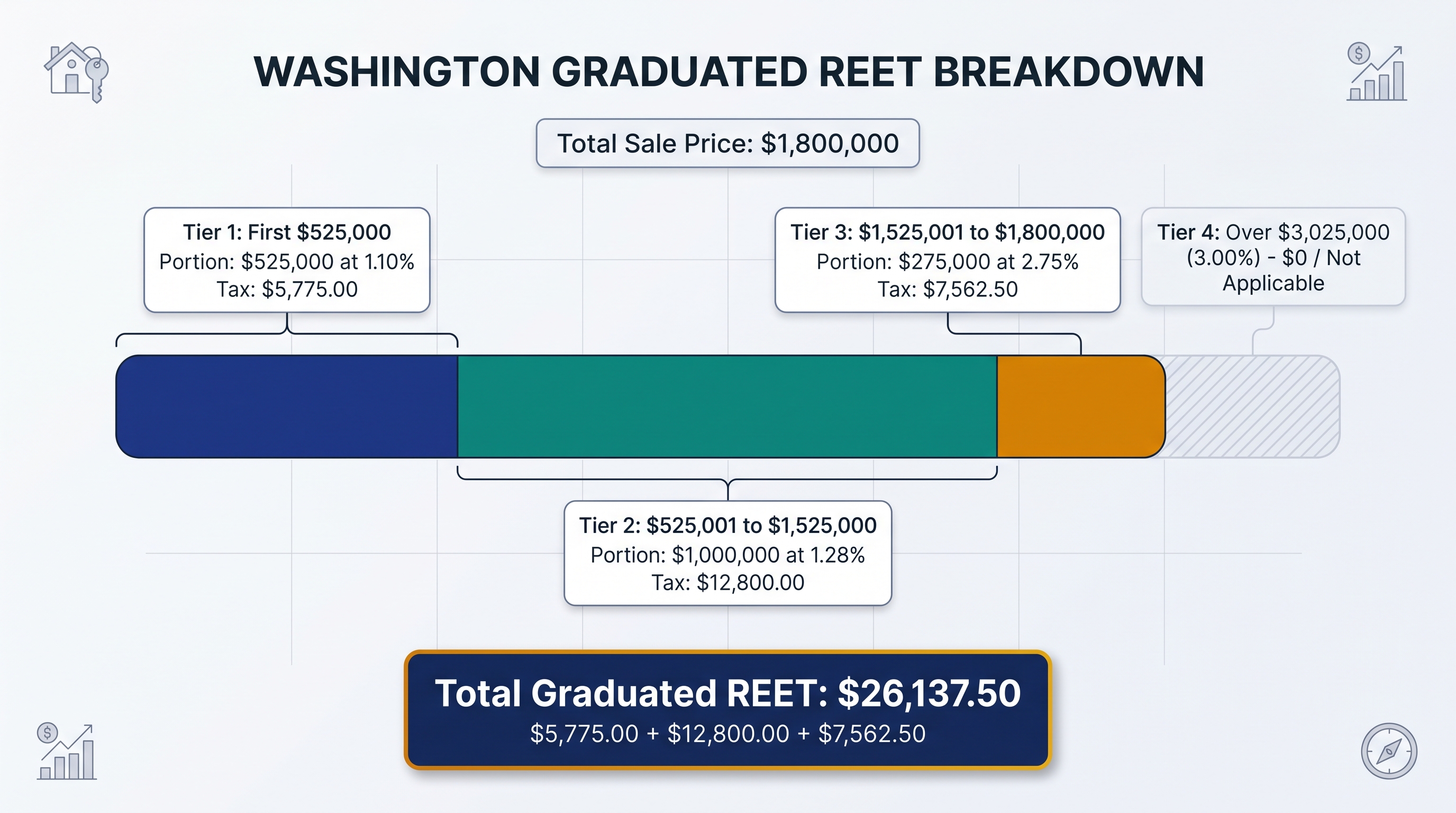
Washington Graduated State REET: Each portion of the selling price is taxed at its corresponding tier rate.
Thresholds Change on January 1, 2027
Under RCW 82.45.060(2), the thresholds adjust every four years. DOR has published the thresholds for sales beginning January 1, 2027:
- Tier 1 ($551,000 or less): 1.1%
- Tier 2 (over $551,000 up to $1,551,000): 1.28%
- Tier 3 (over $1,551,000 up to $3,051,000): 2.75%
- Tier 4 (over $3,051,000): 3.0%
The same $1,800,000 sale closing in 2027 would owe $6,061.00 + $12,800.00 + $6,847.50 ($249,000 × 2.75%) = $25,708.50. The rates are unchanged; only the brackets moved. Always check which thresholds apply to the date of sale.
Local REET and Other Rules
- Local REET: Under RCW Chapter 82.46, cities and counties may add their own excise tax, calculated as a percentage of the full selling price and added to the state tax. Rates vary by location and change over time, so look them up in DOR's current local REET rate table.
- Agricultural and Timberland Classification: Sales of real property classified as timberland or agricultural land are taxed at a flat 1.28% state rate instead of the graduated tiers, and DOR states that rate remains 1.28% in 2027.
- Refer tax questions out: Exemptions, property classification and how REET affects a client's overall tax picture are questions for DOR, a tax professional or an attorney. A broker's role is to point the client to them.
Putting It Together: A Seller Net Sheet
A seller net sheet combines these formulas into one estimate of the seller's proceeds: the contract price minus commission, excise taxes, prorations and loan payoffs. On the job, a net sheet is an estimate; the escrow or closing agent prepares the final figures.
Worked Example: Stipulated 2026 Transaction
Consider a stipulated 2026 residential sale:
- Sale Price: $600,000
- Total Commission: 5% as stipulated in the listing agreement = $30,000 ($600,000 × 0.05)
- State REET (RCW 82.45.060, 2026 thresholds):
- Tier 1 ($525,000 × 1.10%): $5,775
- Tier 2 ($75,000 × 1.28%): $960
- Total State REET: $5,775 + $960 = $6,735
- Local REET: A stipulated 0.50% = $3,000 ($600,000 × 0.0050)
- Property Tax Proration: Unpaid property tax credited to the buyer = $3,620 (from the calendar-year proration example)
- Mortgage Payoff: $350,000
Seller Net Settlement Summary
| Transaction Line Item | Credit | Debit | Balance |
|---|---|---|---|
| Sale Price | $600,000.00 | $600,000.00 | |
| Commission (5% stipulated) | $30,000.00 | $570,000.00 | |
| State REET (RCW 82.45.060) | $6,735.00 | $563,265.00 | |
| Local REET (0.50% stipulated) | $3,000.00 | $560,265.00 | |
| Unpaid Property Tax Credit to Buyer | $3,620.00 | $556,645.00 | |
| Mortgage Payoff | $350,000.00 | $206,645.00 | |
| Net to Seller | $206,645.00 |
$$text{Net to Seller} = $600,000 - $30,000 - $6,735 - $3,000 - $3,620 - $350,000 = $206,645$$
Buyer-Side Check: Cash to Close
The same formulas work from the buyer's side. Using the $800,000 purchase from the LTV example, with stipulated other closing costs of $6,000 and the $3,620 tax proration credit:
- Down payment: $800,000 − $640,000 = $160,000
- Discount points: $12,800
- Other closing costs (stipulated): $6,000
- Less proration credit from seller: −$3,620
$$text{Cash to Close} = $160,000 + $12,800 + $6,000 - $3,620 = $175,180$$
Common Exam Pitfalls and Strategic Study Approaches
Candidates run into predictable traps that careful habits can prevent:
- Base Misidentification: A frequent error is applying a rate to the wrong figure, such as calculating discount points on the purchase price instead of the loan amount.
- Proration Date Confusion: Miscounting days or misreading who owns the closing day leads to wrong answers. Check whether the question uses a 360-day banker's year or a 365-day calendar year, and whether the taxes are paid or unpaid at closing.
- Premature Rounding: Rounding intermediate figures too early builds up errors. Carry full decimals on your calculator until the final step.
- Unit Mismatches: Mixing linear feet with square feet, or square feet with acres, produces large errors. Make sure the units match.
Strategic Study Approaches
- Formula Memorization: Write the main formulas, the 43,560 sq ft/acre constant and the T-bar on your scratch paper as soon as the exam begins.
- Label Every Variable: List the Base, Rate, Time and Target Party before calculating.
- Reasonableness Checks: Make sure the answer makes practical sense; a closing cost or fee larger than the sale price signals an error.
- Timed Practice Sets: Work practice questions under timed conditions that match PSI's pacing, remembering that unscored experimental questions also use your time.
Formula Quick-Reference Table
| Concept | Primary Formula | Exam Application Notes |
|---|---|---|
| Universal T-Bar | $text{Part} = text{Whole} times text{Rate}$ | Base for commission, tax, points or loan calculations |
| Broker Commission | $text{Sales Price} times text{Firm %} times text{Broker Split %}$ | Firm pays only brokers licensed to it (RCW 18.85.301) |
| Loan Amount (LTV) | $text{Lesser of Price or Value} times text{LTV %}$ | Base for financing fees and discount points |
| Discount Points | $text{Loan Amount} times 1% text{ per point}$ | Charged on the loan amount, not the purchase price |
| Cap Rate Valuation | $text{Value} = frac{text{Net Operating Income (NOI)}}{text{Cap Rate}}$ | Net income capitalized into value (IRV); excludes debt service |
| Daily Tax (Calendar) | $text{Daily Rate} = frac{text{Annual Property Tax}}{365}$ | Use exact calendar days |
| Daily Tax (Banker's) | $text{Daily Rate} = frac{text{Annual Property Tax}}{360}$ | Every month counts as 30 days |
| Monthly Interest | $text{Interest} = frac{text{Loan Balance} times text{Annual Rate}}{12}$ | Subtract from P&I to find monthly principal reduction |
| Acreage Conversion | $text{Acres} = frac{text{Total Square Feet}}{43,560}$ | Key constant for land and lot area problems |
| Graduated REET | $sum (text{Tiered Portion} times text{Statutory Rate})$ | RCW 82.45.060; check the thresholds for the sale date (new brackets January 1, 2027); local REET added on the full price |
Conclusion
For people pursuing a Washington broker license, math is a skill you can master, and it pays off on the PSI exam. Calculation questions are reliable points toward the scaled score of 70 you need on each portion. Learn the T-bar method, Washington's graduated REET (including the 2027 brackets), how compensation flows through the firm, and how the pieces fit on a net sheet, and you will walk into the exam and your first transactions better prepared.
Sources
- RCW 18.85.101, "Broker's license, requirements, renewal." https://app.leg.wa.gov/rcw/default.aspx?cite=18.85.101
- WAC 308-124A-760, "Grading of examinations." https://app.leg.wa.gov/wac/default.aspx?cite=308-124A-760
- PSI Services LLC, Washington Real Estate Candidate Information Bulletin (dated 3/28/2024; check PSI for the newest edition). https://test-takers.psiexams.com/api/content/bulletin/4658
- RCW 18.86.010 and 18.86.080, "Definitions" and "Compensation." https://app.leg.wa.gov/rcw/default.aspx?cite=18.86.080
- RCW 18.85.301, "Sharing commissions." https://app.leg.wa.gov/rcw/default.aspx?cite=18.85.301
- RCW 82.45.060, "Tax on sale of property." https://app.leg.wa.gov/rcw/default.aspx?cite=82.45.060
- RCW 82.45.080, "Tax is seller's obligation." https://app.leg.wa.gov/rcw/default.aspx?cite=82.45.080
- RCW Chapter 82.46, local real estate excise taxes. https://app.leg.wa.gov/rcw/default.aspx?cite=82.46
- Washington State Department of Revenue, "Real estate excise tax" (current and January 1, 2027 thresholds; local rate tables). https://dor.wa.gov/taxes-rates/other-taxes/real-estate-excise-tax
- Washington State Department of Licensing, "Get your license: Real estate brokers." https://dol.wa.gov/professional-licenses/real-estate-brokers/get-your-license-real-estate-brokers
Washington's broker exam math comes down to a few formulas. This guide works through commission splits, discount points, cap rates, tax prorations (calendar year and banker's year), amortization and acreage step by step. It also shows how the graduated state REET is calculated at the current tiers and at the new brackets that start January 1, 2027, then puts it all together on a seller net sheet and a buyer's cash-to-close.