King County vs. the Rest of the State: How Different WA Real Estate Markets Really Are
When you pass the Washington State real estate broker exam, you receive a license that empowers you to practice anywhere within the state borders. From the bustling corridors of Bellevue to the quiet stretches of Long Beach, your license is uniformly valid. However, while the Washington State Department of Licensing does not mandate a separate regional competency endorsement to practice in different counties, the practical reality is that Washington is not a single real estate market. It is a diverse patchwork of hyper-local economies, and failing to understand that distinction can put both your clients and your license at serious risk.
The Dramatic Price Gap: A Tale of Two Washingtons
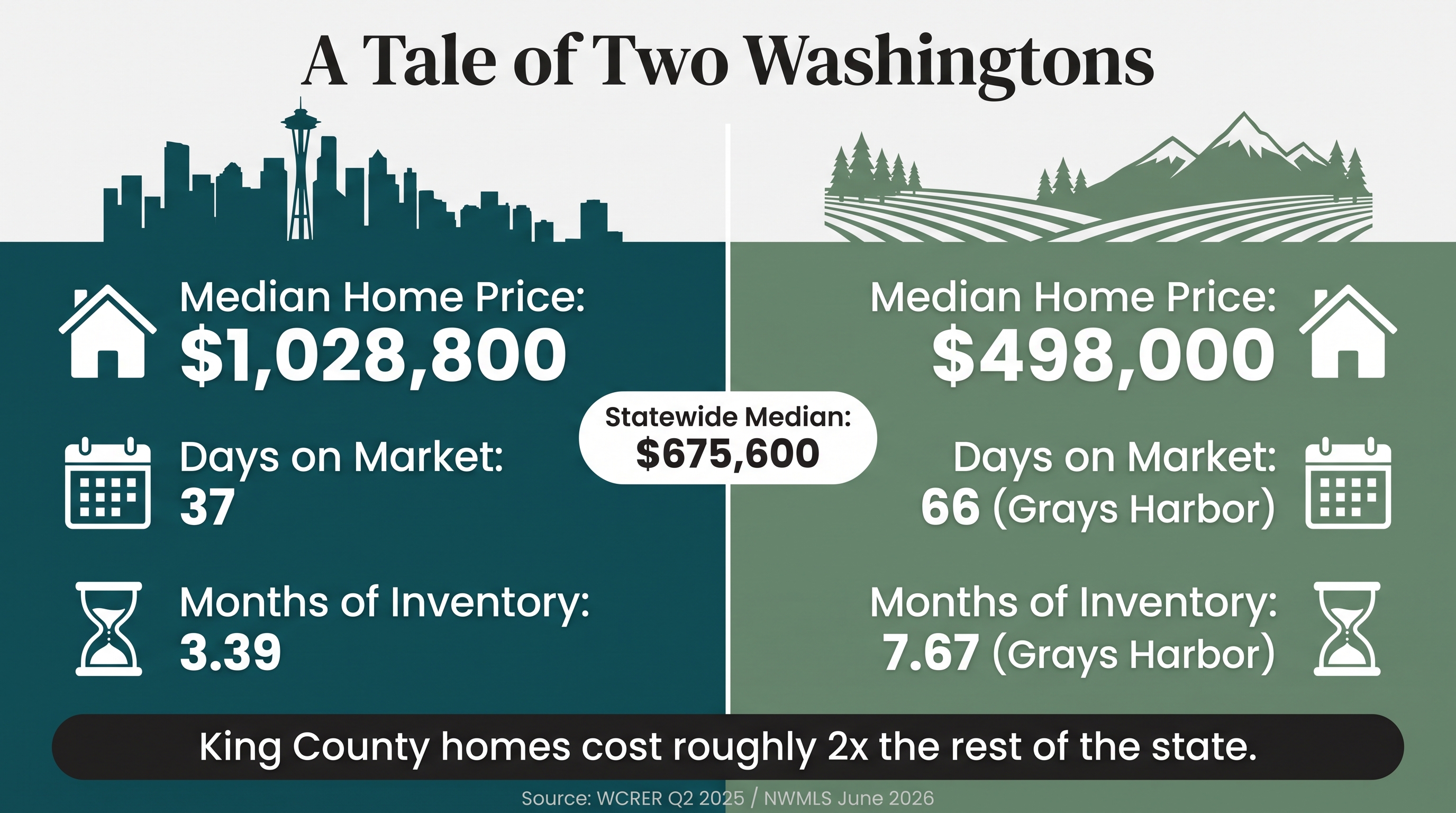
To grasp the magnitude of the state market divergence, look no further than the latest figures from the Washington Center for Real Estate Research. According to Q2 2025 data, the median home price in King County stands at $1,028,800. In stark contrast, the median home price for the rest of the state sits at $498,000, pulling the statewide median to $675,600. A standard single-family home in King County costs roughly double what it does across the remainder of Washington counties.
For a newly licensed broker, these numbers represent entirely different business models, client expectations, and risk profiles. Operating a real estate practice in a million-dollar median market requires vastly different strategies than operating in a half-million-dollar median market. The economic forces driving King County create a unique ecosystem that simply does not exist in most other parts of the state.
Source: WCRER Q2 2025 Housing Market Report; NWMLS June 2026 Market Snapshot
The Numbers: A Deep Dive into Regional Contrasts
While the broad framing of King County versus the rest of the state is a useful starting point, examining specific county comparisons using Northwest Multiple Listing Service data reveals an even more complex picture.
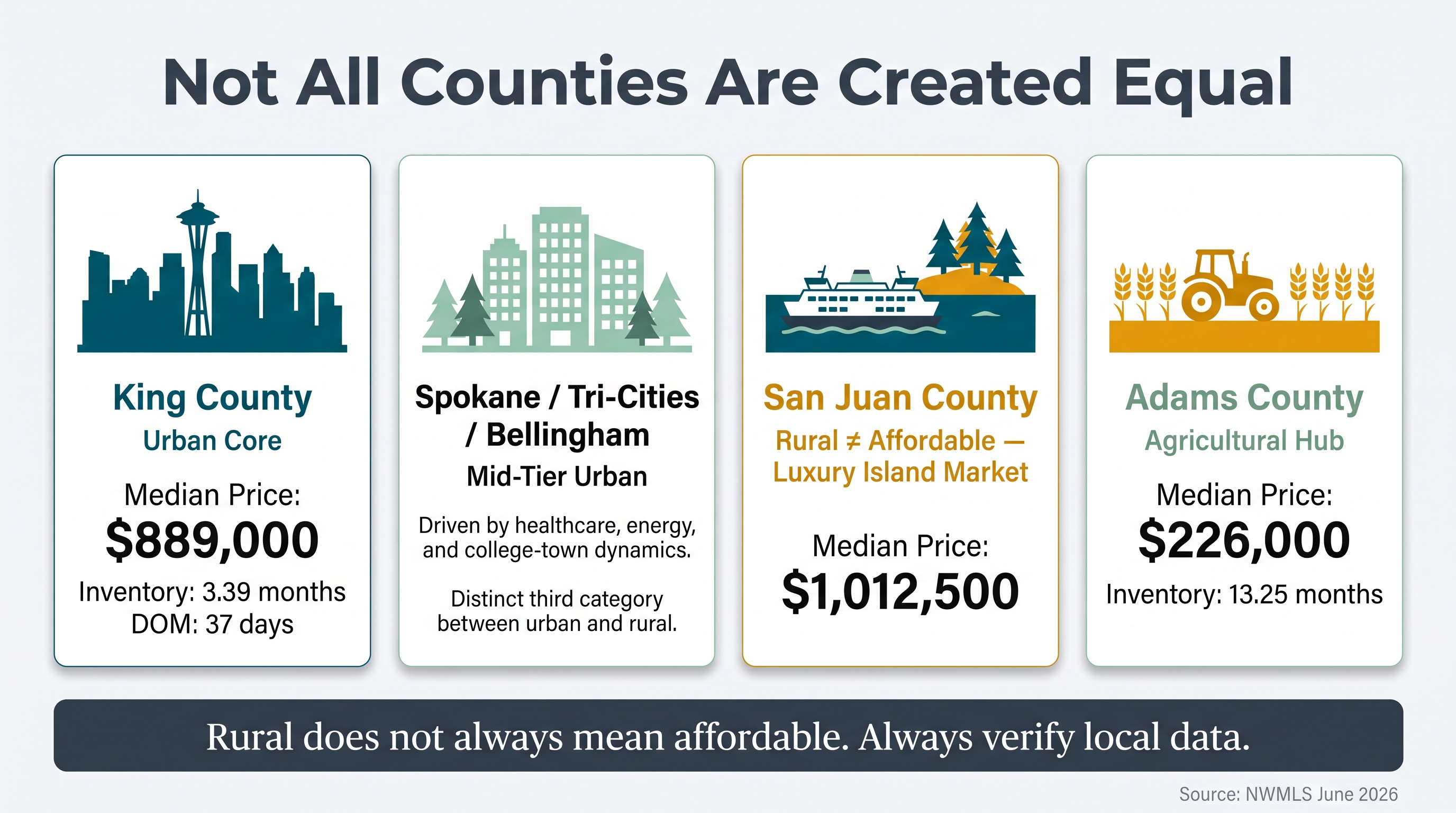
Consider the contrast between King County and Adams County. June 2026 data shows King County reported a median price of $889,000 with a constrained 3.39 months of inventory. In agricultural hubs like Adams County, median prices sit dramatically lower at $226,000, and inventory moves at a much slower pace of 13.25 months. Yet rural does not always equate to affordable. San Juan County offers the perfect counterexample. Accessible only by ferry or plane, this island community supports a luxury real estate market where June 2026 median home prices reached $1,012,500. A broker who assumes all rural Washington counties operate like Adams County would be dangerously unprepared for a transaction in Friday Harbor.
Washington's county-level markets defy simple urban vs. rural assumptions. Source: NWMLS June 2026
Brokers must also account for Washington thriving mid-tier urban markets. Cities like Spokane, the Tri-Cities, and Bellingham represent a distinct third category, each with its own market dynamics. Spokane functions as a major inland economic hub driven by healthcare and higher education. The Tri-Cities market is heavily shaped by the energy sector and agricultural sciences. Bellingham presents a highly constrained coastal and college-town market. Forcing either a Seattle-style high-density strategy or a purely rural approach onto these mid-tier cities will consistently produce misaligned pricing and frustrated clients.
Market pace also varies dramatically by geography. According to June 2026 metrics, properties in King County spend an average of 37 days on the market. In rural coastal areas like Grays Harbor, that figure climbs to 66 days, accompanied by 7.67 months of inventory. King County low inventory keeps competition fierce among buyers, while markets carrying 7 to 13 months of inventory create conditions where purchasers hold considerably more negotiating power.
Why This Matters for Your Practice
The operational implications of these market differences are substantial. Comparative Market Analysis work must be hyper-local above all else. A Seattle pricing methodology does not translate to Othello or Hoquiam. In King County, a broker might draw comparable sales from the past 30 days within a half-mile radius because the market moves rapidly. In a rural market, that same broker might need to pull data from the past six months across a ten-mile radius just to assemble enough comparable sales to establish a reliable baseline.
Buyer counseling differs just as dramatically. An urban buyer in King County must be prepared to act swiftly. Effective counseling means preparing them for potential multiple-offer scenarios, pre-inspections, and rapid decision-making. A buyer in Grays Harbor facing an average of 66 days on the market can afford to view a property multiple times, negotiate traditional inspection contingencies, and request seller concessions.
The mathematical realities of these markets also deserve careful attention. A 5% price reduction on a King County home valued at $1,028,800 represents a drop of more than $51,000. In the rest of the state, that same 5% reduction amounts to roughly $25,000. This disparity ripples through every aspect of a transaction, from the size of earnest money deposits to affordability calculations, debt-to-income thresholds, and your own commission structures.
Legal and Ethical Obligations
Understanding regional differences is directly tied to your legal and ethical obligations as a licensed real estate broker in Washington State.
Under state law, all brokers owe statutory duties to all parties, including the duty to exercise reasonable skill and care. If you primarily practice in Spokane but agree to list a property in Kirkland without understanding local inventory levels, days on market, or neighborhood-specific pricing nuances, you are arguably in violation of that duty. Mispricing a property by $100,000 because you failed to understand the local market is a direct breach.
Fair housing compliance presents another critical consideration. Brokers must be vigilant in avoiding steering, the illegal practice of directing buyers toward or away from certain neighborhoods based on protected characteristics. In a state with such pronounced affordability differences, an uninformed broker can easily fall into the trap of making assumptions about where a buyer should look based on their background, rather than letting objective factors like pre-approval amounts and stated preferences guide the search.
Washington agency law mandates the use of written buyer brokerage services agreements before rendering real estate brokerage services. In markets as varied as Washington, negotiating compensation upfront is more important than ever. A percentage-based commission in King County yields a vastly different gross income than the same percentage applied in a lower-priced rural county, making transparent conversations about compensation essential.
State laws regarding pocket listings also warrant attention to promote transparency and ensure equitable access to housing inventory. In hyper-competitive markets like King County, withholding listings from the open market exacerbates affordability challenges. Strict adherence to clear cooperation rules is non-negotiable.
When to Refer Business to Local Experts
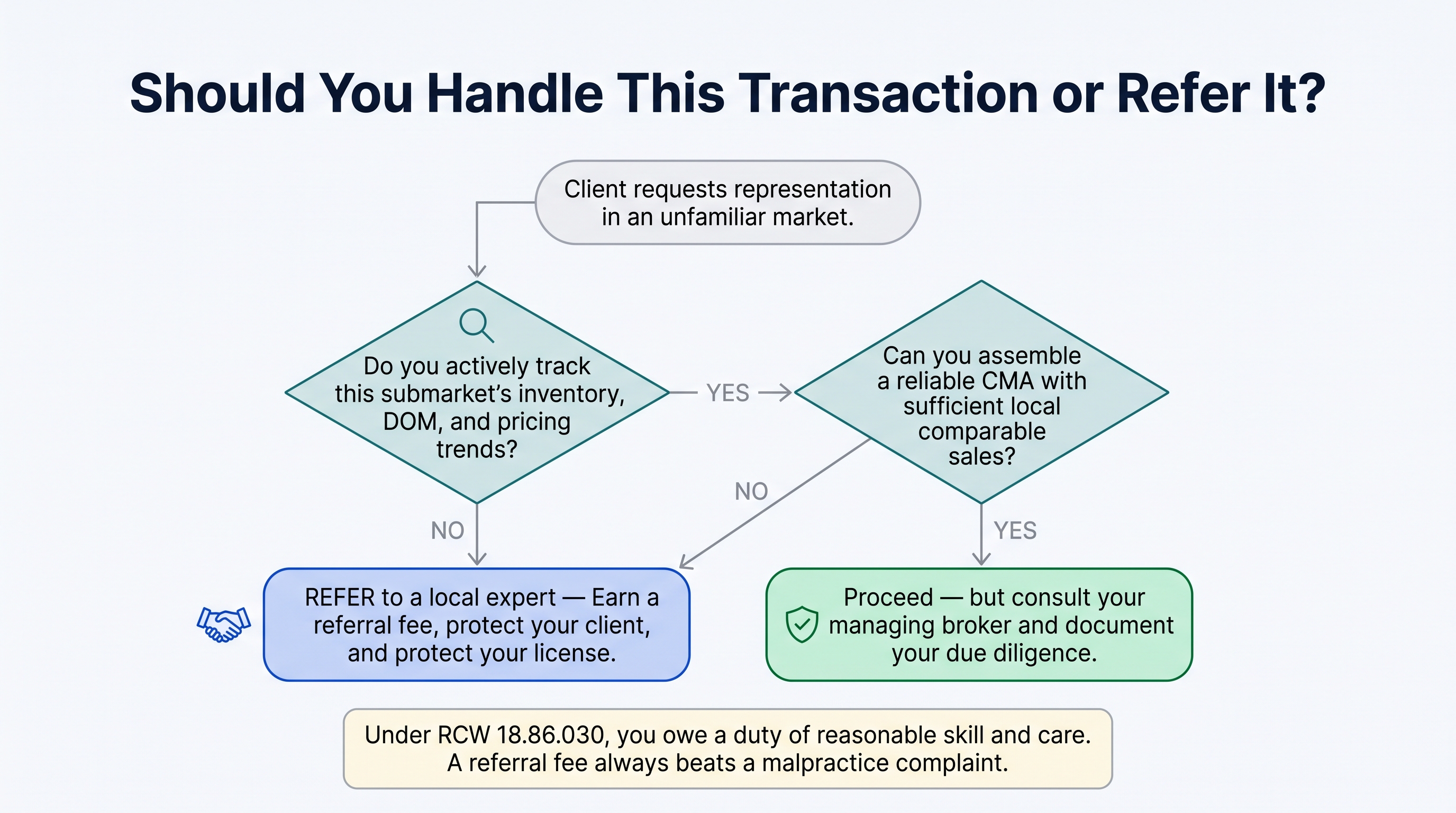
One of the most valuable skills a new broker can develop is knowing when to refer business to a localized professional. When a client asks you to list a property three counties away in a market you do not actively track, the most professional course of action is often a referral.
Establishing a co-broker arrangement or executing a standard referral agreement allows you to earn a customary referral fee without assuming the significant risk of practicing outside your geographic competency. This approach protects the client by ensuring they receive genuinely localized expertise. It also protects your license. Violating the standard of reasonable skill and care because you lacked hyper-local knowledge is a direct path to disciplinary action and civil liability. A referral fee is always preferable to a malpractice complaint.
When in doubt, refer it out — a simple framework for geographic competency decisions
What This Means for Your License
While the Department of Licensing does not issue county-specific licenses, it closely regulates how brokers acquire and demonstrate market knowledge. The mandatory prelicensing curriculum includes extensive education on property valuation and Comparative Market Analysis preparation. Applying those tools effectively at the local level is your responsibility.
State regulations require managing brokers to supervise all affiliated brokers, with heightened oversight required for those in their first two years of licensure. A diligent managing broker must carefully review the pricing analyses prepared by newer brokers to ensure they are not applying urban strategies to rural properties. When a new broker ventures outside their usual geographic territory, the managing broker must confirm that the broker has partnered with a local expert or performed sufficient due diligence.
Washington also mandates ongoing education through its CORE curriculum. CORE courses regularly address legislative updates, market shifts, and risk management. Engaging seriously with this continuing education is how brokers remain legally compliant as the divide between urban, mid-tier, and rural markets evolves.
Practical Takeaways for Washington Brokers
To build a successful and ethical real estate practice in Washington State, brokers should integrate the following principles:
1. Always Use Hyperlocal Data: Never rely on statewide or county-wide medians when pricing a specific property. Drill down to the zip code and neighborhood level.
2. Understand Your Submarket Pace: Do not unnecessarily rush a rural buyer, and do not allow an urban buyer to deliberate too long. Align your counseling with the specific days on market relevant to the neighborhood.
3. Beware of Small Sample Sizes: When working in rural counties, treat statistical medians with caution. In a county with only 15 closed sales in a given month, a single luxury waterfront property can significantly skew the median price. Always examine the raw data before drawing conclusions.
4. Use Referrals Strategically: Protect your clients and your license by using referral networks when a transaction falls outside your geographic competency. Earning a referral fee is smart business. Risking a malpractice complaint is not.
5. Stay Current Through CORE Education: Treat your continuing education as a vital business asset. The legal landscape is constantly evolving, and understanding how those changes intersect with diverse markets is the mark of a true professional.
Washington is a state of remarkable diversity. By recognizing that King County operates on an entirely different economic frequency than the rest of the state, acknowledging the distinct forces shaping mid-tier markets, and applying hyper-local expertise, brokers can deliver the highest level of service while protecting their licenses.
See how Washington's real estate market differences by county impact your practice. Compare King County data and call 425-775-2313 today.