Washington exempts direct real estate sales from its state capital gains excise tax, but that's only part of the story for luxury clients. A 2025 surcharge on gains over $1 million, a newly enacted Tax on Millionaires, and the graduated Real Estate Excise Tax (REET) all still shape what a high-net-worth seller or buyer actually nets — and your team needs to explain the difference correctly, without crossing into tax advice.
For firm leaders, this isn't about becoming a tax expert. It's about making sure every broker on your team can answer a luxury client's first tax question accurately, flag the moments that call for a CPA, and document the referral so the brokerage stays protected.
- Direct real estate sales are exempt from Washington's capital gains excise tax, but entity sales of LLCs holding real estate are only partially exempt.
- A 2.9% surcharge now applies to capital gains over $1 million, layered on top of the 7% base rate.
- REET is calculated in graduated brackets, not a flat rate on the full sale price — a distinction that matters for accurate luxury net sheets.
- The Tax on Millionaires (income-based, effective 2028) is a separate tax from the capital gains excise tax and the two should never be conflated.
- Every broker on your team should know to refer tax questions to a CPA or tax attorney and to document that referral in writing.
What's Changed in Washington's Capital Gains Tax Landscape
Washington's tax framework for high-net-worth clients keeps shifting, and your luxury-market agents feel the effects even when a transaction is a straightforward home sale. In 2024, Initiative 2109 failed at the ballot, leaving the state's capital gains excise tax in place. In 2025, lawmakers layered on a 2.9% surcharge on capital gains above $1 million, and more recently the legislature passed a separate Tax on Millionaires.
Direct real estate sales remain generally exempt from the state capital gains tax. But the ripple effects on the luxury market are real: clients liquidating stock to fund a purchase, relocating out of state, or selling ownership interests in entities that hold real estate are all affected differently. Your team needs to recognize which situation applies before a client conversation goes sideways.
Washington Capital Gains Tax vs. the Tax on Millionaires: What Your Team Needs to Know
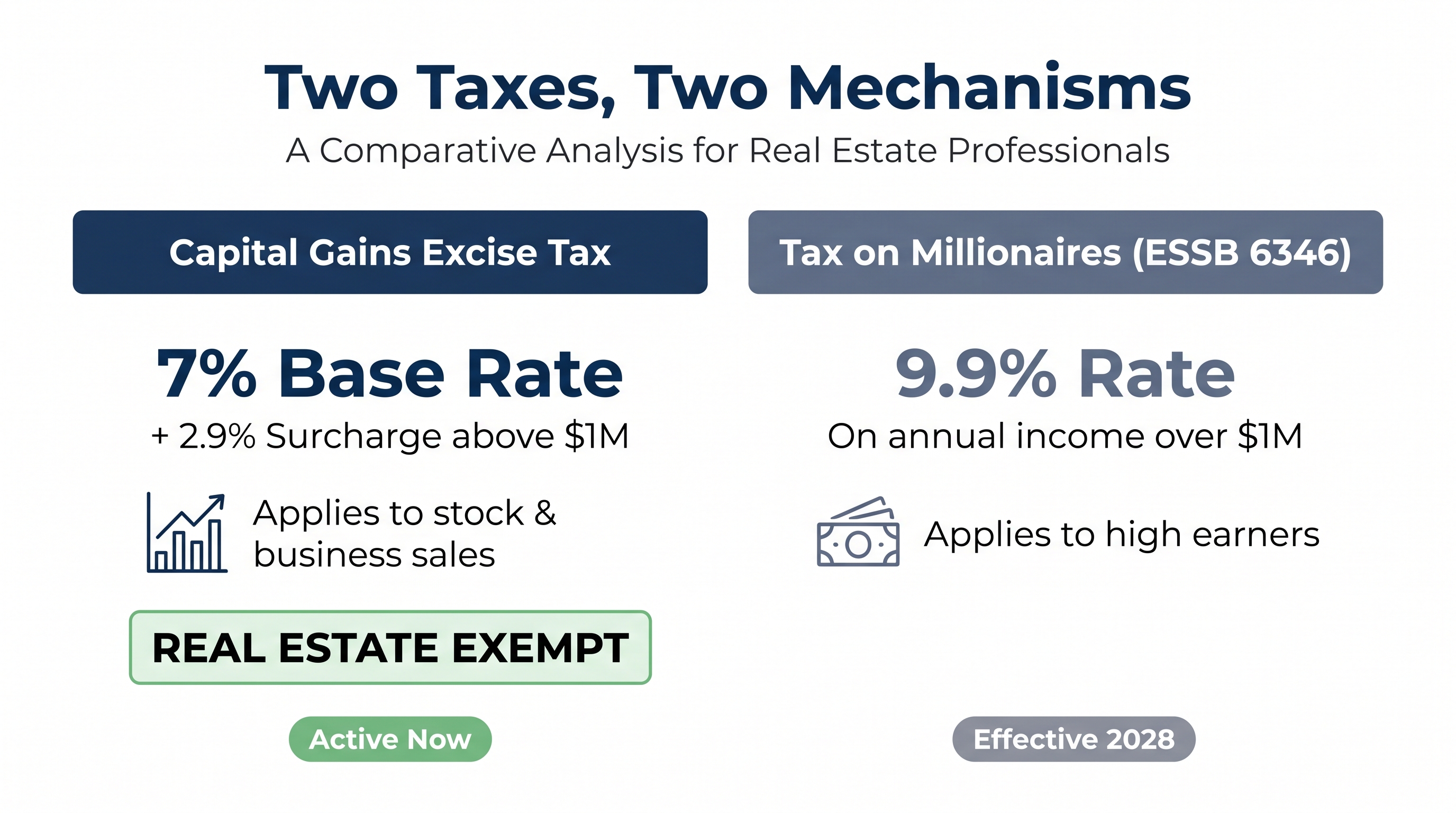
These two taxes get confused constantly, and mixing them up in front of a client is an easy way to lose credibility. Washington imposes a capital gains excise tax on the sale or exchange of long-term capital assets, with a base rate of 7% on gains above the standard deduction — $278,000 for the 2025 tax year. That standard deduction adjusts annually for inflation, so confirm the current figure on the Washington Department of Revenue site before quoting it to a client.
The 2025 surcharge added 2.9% on gains over $1 million, creating a 9.9% marginal rate on top-tier gains. Separately, the newly enacted Tax on Millionaires takes effect in 2028 and applies a 9.9% tax on annual income over $1 million. The distinction matters: one is an excise tax triggered by selling an asset today; the other is an income tax on high earners' ongoing cash flow starting in 2028.
| Feature | Capital Gains Excise Tax | Tax on Millionaires |
|---|---|---|
| What triggers it | Selling a long-term capital asset (stocks, bonds, business interests) | Annual income over $1 million |
| Base rate | 7%, plus 2.9% surcharge over $1M in gains | 9.9% on income above threshold |
| Effective | Now (surcharge added 2025) | 2028 |
| Applies to direct real estate sales? | Generally exempt | Not applicable — income-based |
Why Real Estate Sales Are (Mostly) Exempt from Capital Gains Tax
The single most important point to communicate to a luxury seller: state law categorically exempts the direct sale or transfer of real estate from Washington's capital gains excise tax. A client selling a $15 million waterfront estate they've owned for a decade owes zero state capital gains tax on that transaction.
The nuance your team must catch is entity sales. High-net-worth clients frequently hold real estate inside LLCs or partnerships. When a client sells their ownership interest in an LLC that owns real estate, that sale is only partially exempt — the exemption applies just to the gain directly attributable to the real estate itself. Any gain attributable to other entity assets, like equipment, IP, or a stock portfolio, remains subject to the 7% base tax and the 2.9% surcharge.
This is exactly the kind of nuance worth building into your team's onboarding and ongoing CE. Telling a client "Washington has no capital gains tax" is factually wrong; telling them "Washington taxes all capital gains" needlessly alarms an ordinary home seller. The accurate line is: direct sales are exempt, entity sales and portfolio liquidations need a CPA's eyes.
REET Brackets: The Tax That Hits Luxury Sales Directly
While the capital gains tax mostly steps aside for real estate, Washington's Real Estate Excise Tax hits luxury sales head-on — and it's graduated, not flat. A common misconception your agents will hear at the listing table is that the top REET rate applies to the entire price once a luxury threshold is crossed. Correcting that misconception on the spot is a genuine value-add.
| Portion of sale price | 2025 state REET rate |
|---|---|
| Up to $525,000 | 1.10% |
| $525,000.01 – $1,525,000 | 1.28% |
| $1,525,000.01 – $3,025,000 | 2.75% |
| Over $3,025,000 | 3.00% |
These bracket thresholds adjust periodically with inflation — verify current figures on the Washington DOR site before finalizing a net sheet.
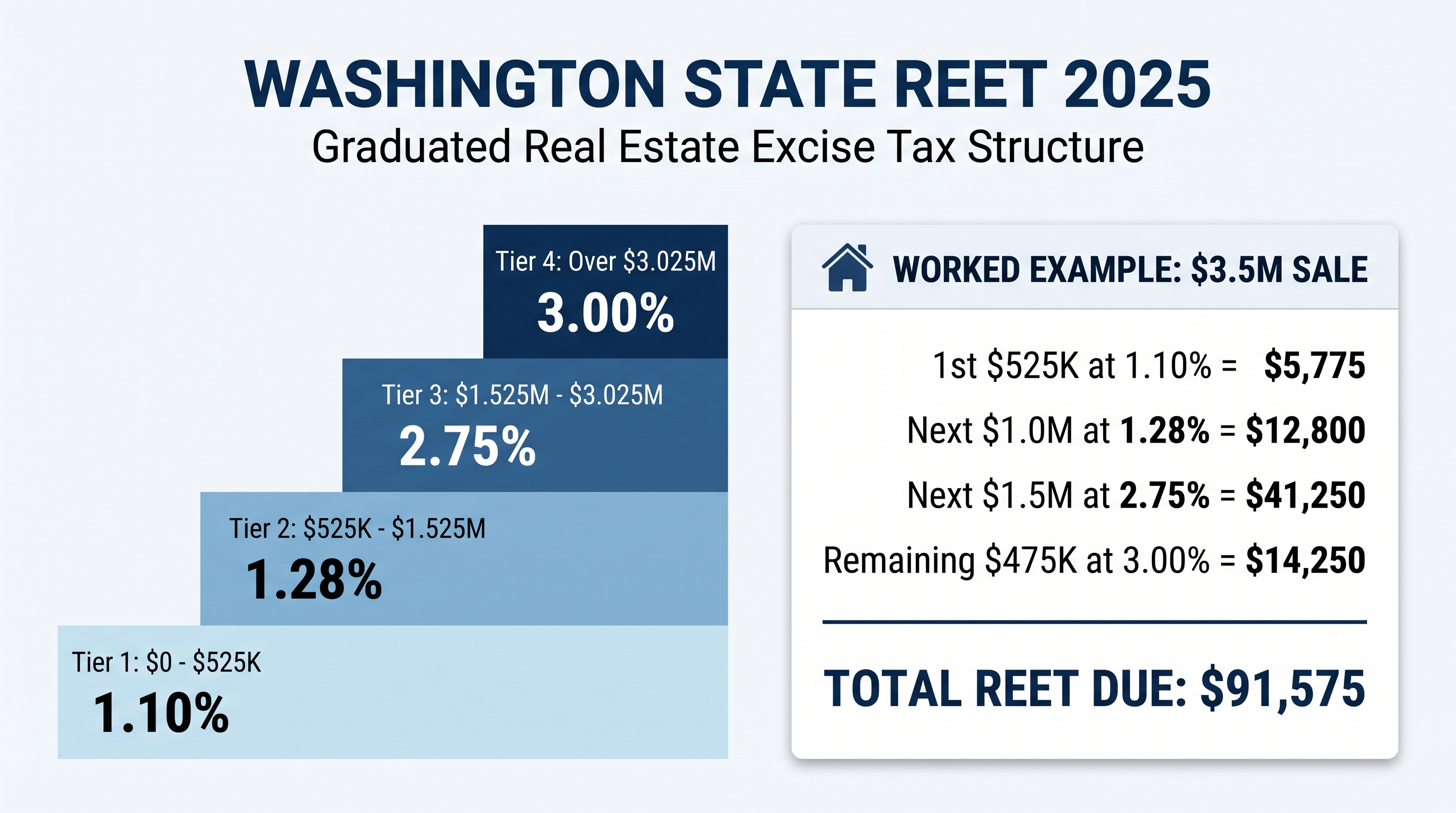
Walk through a $3.5 million Seattle home sale: $525,000 × 1.1% = $5,775; $1,000,000 × 1.28% = $12,800; $1,500,000 × 2.75% = $41,250; $475,000 × 3.0% = $14,250. That's $74,075 in state REET. Seattle's local REET of 0.50% on the full price adds $17,500, bringing total REET to roughly $91,575.
On a $10 million estate, the same progressive brackets apply through $3,025,000 (about $59,825), and the remaining $6,975,000 is taxed at the top 3.0% rate ($209,250) — a state total near $269,075. Add Seattle's 0.50% local REET ($50,000) for an approximate total obligation of $319,075. Equipping your team to walk through this math builds trust with sellers before they ever see a closing statement.
Give your team the specialized course: Sales involving entity structures or timed liquidations come up constantly in the luxury segment. The 1031 Exchanges: Mastering Tax-Deferred Transactions in Washington course gives your agents a working command of deferral strategies and Washington-specific rules — the kind of CE that pays off the first time a luxury client asks about it.
How the Tax Landscape Shapes Luxury Buyer and Seller Behavior
Even though direct real estate is exempt, the capital gains framework still shapes luxury market behavior. A large share of Puget Sound luxury purchases are funded by liquidating tech stock — RSUs from Amazon, Microsoft, or a smaller IPO. When a buyer sells stock to fund a $5 million cash purchase, that stock sale is subject to the state capital gains tax and the 2.9% surcharge. Some buyers time closings around this, or explore portfolio loans to avoid triggering a large gain.
There's ongoing debate about whether the combined weight of the capital gains tax, the surcharge, and the incoming Tax on Millionaires will push affluent residents toward income-tax-free states. Market data so far tells a more balanced story: many high-net-worth Washingtonians stay put for the technology ecosystem, venture capital access, and Pacific Northwest lifestyle.
The luxury segment has stayed resilient through it. 2025 Redfin data put Seattle's median luxury home price near $3 million despite the shifting tax framework, and cash buyers have proven far less rate-sensitive than the broader market. The Puget Sound Business Journal reported the region's top ten most expensive 2025 sales averaged $23.3 million, headlined by Jeff Bezos' $63 million Hunts Point acquisition — a sign that taxes are friction, not a demand-killer, for premier Washington real estate.
Keeping Your Team Inside Its Licensing Scope on Tax Questions
Navigating this environment demands strict adherence to licensing scope. State law defines the duties real estate licensees may perform, and specialized tax advice sits outside that boundary — a distinction worth reviewing with your team, since the Washington Department of Licensing is explicit about where brokerage services end and licensed professional advice begins.
Two federal concepts worth your team's conceptual familiarity, purely for referral purposes:
- 1031 like-kind exchanges: Investors can defer capital gains recognition by reinvesting sale proceeds into a qualifying like-kind property. The 45-day identification window and 180-day closing deadline are strict, so agents should flag this option early enough for a client's tax attorney to act.
- Primary residence exclusion: Homeowners can exclude up to $250,000 (or $500,000 for joint filers) of gain on a primary residence sale, if ownership and use tests are met. In the luxury segment, appreciation frequently exceeds that limit, leaving remaining gains exposed to federal tax.
Framing both strictly as "topics to raise with your CPA" adds value while keeping every agent inside their scope of practice.
Documentation matters as much as the conversation itself. To manage E&O exposure and support your supervisory responsibilities as a managing broker, agents should follow up any tax-related conversation with a brief written note: stating plainly that they don't provide tax advice and summarizing the referral to a CPA. Standard scope-of-practice disclaimers in client communications are a foundational habit worth building into your team's transaction checklist — and reviewing this alongside your own managing broker responsibilities is worth the time if you haven't recently.
Entity sales deserve special vigilance. Transferring 50% or more of the ownership interest in an entity that owns Washington real estate within a 36-month period triggers REET on the underlying property's value, even without a direct property sale. An agent unfamiliar with this aggregation rule can expose a client to an unexpected tax bill while "just" restructuring ownership.
Frequently Asked Questions
Do sellers pay Washington capital gains tax when they sell a home?
No. Direct real estate sales are exempt from Washington's capital gains excise tax. However, sales of ownership interests in entities that hold real estate may still be partially taxable on the portion of gain attributable to non-real-estate assets held by that entity.
What's the difference between Washington's capital gains tax and the Tax on Millionaires?
The capital gains tax is an excise tax triggered when someone sells an asset like stock or a business interest. The Tax on Millionaires is an income-based tax on high earners, taking effect in 2028. One is transaction-triggered today; the other tracks annual income starting later.
How is Washington's Real Estate Excise Tax (REET) calculated on a luxury sale?
REET applies in graduated brackets based on sale price, similar to income tax brackets — not a flat rate on the full price. Only the portion of the price within each bracket is taxed at that bracket's rate, and local jurisdictions like Seattle can add their own REET on top.
Can real estate brokers give clients capital gains tax advice?
No. Washington licensees should refer clients to a CPA or tax attorney for specific guidance, document that referral in writing, and limit their own comments to describing general exemptions rather than personalized tax analysis.
Why should firm leaders train their agents on Washington's tax landscape?
Luxury clients frequently ask about REET, capital gains exemptions, or entity sales during listing conversations. Agents who explain the basics accurately — and know exactly when to refer out — build client trust and reduce E&O risk for the whole brokerage.
Give Your Team the Confidence to Handle Luxury Tax Questions
You've built a team clients trust with their biggest transactions — give them the specialized knowledge to match. Keep their Washington continuing education current with courses like the 1031 Exchanges elective, so every agent on your roster can speak accurately to luxury clients without overstepping into tax advice. Questions about building out your team's CE plan? Call us at 425-775-2313 — a real person picks up.
Washington's 7% capital gains tax exempts direct home sales, but REET and entity sales don't. Learn how to brief your luxury team accurately today.