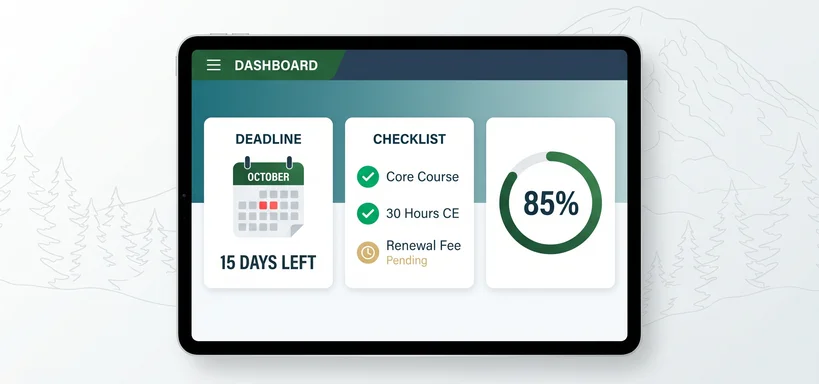
1. The Real Cost of Missing a Renewal Deadline
The real estate industry in Washington State is a demanding profession. Between managing client expectations, conducting open houses, negotiating complex transactions, and overseeing marketing strategies, administrative tasks can easily slip through the cracks. Missing a license renewal deadline, however, is one oversight that can bring an entire business to a halt.
Failing to renew a Washington real estate license on time is a costly mistake. The moment a deadline passes, a license becomes inactive. That means you cannot legally conduct business, represent clients, or collect commissions while your license is expired. Beyond the immediate loss of income, the financial penalties are substantial. The standard renewal fee for a Broker is $233, but a late renewal adds a penalty that brings the total to $273. For a Managing Broker, the standard renewal fee of $330 rises to $370 when the deadline is missed.
The consequences extend beyond late fees. A lapsed license creates a significant reinstatement burden. You may be required to cease all marketing activity and hand off active escrows to your designated broker—the individual responsible for the legal and regulatory compliance of a firm—until the state processes your late paperwork. For professionals whose livelihoods depend on their active license status, tracking continuing education is not merely administrative housekeeping. It is essential risk management.
2. Understanding the Attestation-and-Audit Model
Many real estate professionals who are newly licensed or relocating from other states mistakenly assume that the Washington State Department of Licensing tracks their completed education for them. They may also assume that course certificates must be uploaded at the time of renewal. Washington actually operates on an attestation-and-audit model.
When it is time to renew, you log into SecureAccess Washington, complete the online renewal form, pay your fee, and check a box legally attesting that you have completed the required continuing education hours. You are certifying this under penalty of discipline. You do not upload certificates to the state portal during a standard renewal.
While this streamlined process is convenient on renewal day, it creates a meaningful compliance risk for the disorganized professional. Because the state does not require proof upfront, it enforces compliance through random, rigorous audits. If your license number is selected for an audit, you will receive a notification requiring you to immediately produce valid certificates for every hour of education claimed during your attestation.
If those certificates are buried in an old email account, or if you miscounted your hours and attested to completing requirements you did not actually meet, the consequences are severe. Disciplinary actions for failing an audit can include substantial fines, mandatory completion of additional penalty hours, license suspension, or revocation. In an attestation-and-audit environment, a personal tracking system is a vital professional safeguard.
3. What Makes Washington CE Requirements Complex
Tracking continuing education in Washington is rarely as simple as counting to thirty. The state regulations establish a layered web of requirements based on your license level, the length of time you have been licensed, and specific rolling timeframes. The following rules are the primary sources of compliance complexity.
The 90-Hour First Renewal for Brokers
Newly licensed Brokers approaching their first renewal are not subject to the standard 30-hour rule. Instead, they must complete 90 hours of continuing education. This includes a 30-hour Advanced Real Estate Practices course, a 30-hour Real Estate Law course, and 30 hours of electives. Within those elective hours, a 3-hour CORE course and a 3-hour Washington Real Estate Fair Housing course are mandatory. Managing this volume of requirements while building a new business is a common compliance challenge.
Managing Broker First and Active Renewals
For Managing Brokers, the first renewal and all subsequent active renewals require 30 hours of continuing education. These hours must have been completed after the date of initial licensure as a Managing Broker, ensuring the education is relevant to the advanced license level.
The 30-Hour Standard Renewal for Brokers
For subsequent Broker renewals, the requirement is 30 hours every two years. Licensees are legally required to include specific curriculum within that total.
CORE Curriculum Requirements
Every renewing licensee must complete a 3-hour Current Issues in Washington Residential Real Estate course, commonly known as CORE. The real estate commission regularly updates this curriculum to reflect new legislation and evolving market conditions. It is essential to confirm you are enrolled in the current 2026-2027 CORE cycle course. Completing an outdated class will result in no credit toward the mandatory requirement.
Fair Housing Mandate
Since June 2022, Washington has required all Brokers and Managing Brokers to complete a specific 3-hour Washington Real Estate Fair Housing course each renewal cycle. Many experienced Managing Brokers still inadvertently complete 30 hours of standard electives without satisfying this separate obligation.
Timing Windows and Carry-Forward Rules
Washington provides a carry-forward provision that allows licensees to apply up to 15 hours of unused credit to a future renewal cycle. However, this benefit is governed by a strict 48-month rule. To be eligible for carry-forward, the additional courses must have been completed within 48 months of your current renewal date.
Fingerprint Renewals
Every six years, which is the equivalent of every third renewal cycle, licensees must pass a new background check and submit fresh fingerprints through the state vendor, IdentoGO. Fingerprint processing can take several weeks. Waiting until your expiration date to realize a fingerprint renewal is due can delay your entire renewal.
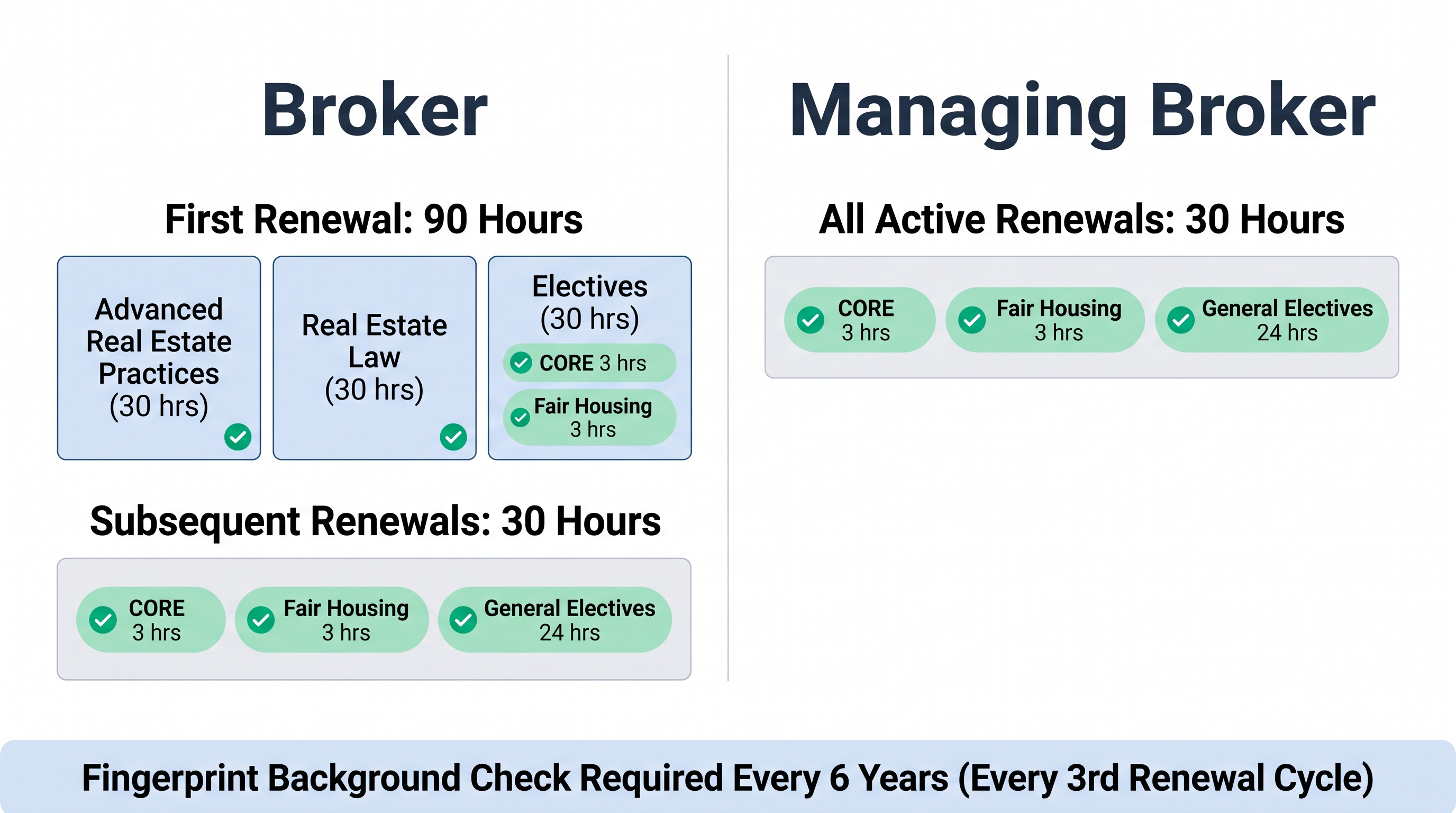
Washington State CE requirements at a glance: Broker vs. Managing Broker renewal obligations.
4. How the WA Pro CE Tracker Works
Attempting to manage the 90-hour first renewal, CORE cycle requirements, the 15-hour carry-forward calculation, and the 6-year fingerprint cycle using a paper folder or an informal spreadsheet invites compliance gaps. A dedicated system like the WA Pro CE Tracker is built specifically around Washington State regulations and offers several automated features designed to eliminate that risk.
Deadline Tracking and Alerts
The foundation of any effective tracker is its notification system. By entering your license expiration date, the tracker initiates a countdown and delivers automated alerts at 90, 60, and 30 days before expiration. A separate 6-year countdown for the fingerprint background check prompts you to schedule your IdentoGO appointment well in advance.
Categorization and Compliance Logic
When you log a completed course, you assign it a category like CORE, Fair Housing, Law, Advanced Practices, or General Elective. The dashboard then visually confirms whether all sub-requirements have been met. This logic immediately surfaces the common scenario in which a licensee has accumulated 30 total hours but overlooked the current 2026-2027 CORE requirement.
Completion Status Dashboard
Visual progress indicators replace manual mental calculations. For a newly licensed Broker, the dashboard divides progress into three mandatory 30-hour blocks. For Managing Brokers, a 30-hour summary chart is segmented by the mandatory Fair Housing and CORE components.
Audit-Ready Certificate Storage
Because Washington operates under the attestation-and-audit model, document retention is your primary line of defense. The tracker provides a secure, cloud-based document vault. Upon completing a course, you can upload the PDF certificate directly to your profile. If the state issues an audit notice, your complete certificate dossier can be exported in seconds.
Automated Carry-Forward Calculation
The most complex calculation is the carry-forward rule, which is handled automatically by the tracker algorithm. If you complete 40 hours of continuing education in a given cycle, the system banks the excess 10 hours. It verifies the completion dates against the 48-month window of your next renewal date, applies valid hours to the upcoming cycle, and expires any hours that fall outside the eligibility window.
5. Practical Example
To illustrate the value of a digital tracking system, consider a scenario involving Sarah, a busy Managing Broker in Spokane.
Sarah has a license set to expire on November 15th. In late August, the tracker sends her a 90-day automated alert. She logs into her dashboard to assess her standing. She knows she needs 30 hours total. The tracker algorithm immediately informs her that she has 12 hours of unused elective credit carried forward from courses completed 36 months ago. This is well within the allowable 48-month window.
Because those 12 hours have been applied, Sarah needs only 18 additional hours to complete her renewal. However, two red indicators on the dashboard flag outstanding requirements. She has not yet completed the current 2026-2027 CORE course, nor has she taken the mandatory 3-hour Fair Housing course.
Armed with this precise information, Sarah avoids spending time or money on unnecessary electives. She registers for a 3-hour CORE class, a 3-hour Fair Housing class, and 12 hours of commercial real estate electives she has been planning to take. As she completes each course, she uploads the PDF certificates to the document vault.
The dashboard turns completely green. In early November, Sarah logs into SecureAccess Washington, pays her $330 Managing Broker renewal fee, and confidently checks the attestation box. She knows that if she is randomly selected for an audit the following day, her compiled certificates are ready to submit within moments.
6. Getting Started
Your real estate license is the foundation of your livelihood. In a profession with as many moving parts as real estate, relying on memory or informal files to manage strict legal compliance is an unnecessary and avoidable risk. Do not wait until you are thirty days from expiration to assess your standing, and do not wait for an audit notice to begin tracking down certificates from past course providers.
Take action today. Set up your tracking profile by entering your license issue date, your next expiration date, and your license type. Gather any certificates you have recently completed and upload them to the secure vault. Investing five minutes to establish this foundation frees you to focus your energy on what matters most. You can get back to serving your clients and growing your real estate business in Washington State.
Never miss a deadline or fail an audit again.
Click Here to Start Tracking with WA Pro CE Tracker Today
Important Note:
Continuing education requirements, fees, and CORE cycle designations are subject to change. Readers should always verify current requirements and regulations directly with the Washington State Department of Licensing.