Getting Licensed in Washington vs. Other States: What is Different
1. Introduction: The Importance of State-by-State Nuances
For aspiring real estate professionals, the journey to licensure requires navigating state-specific rules. Because real estate licensing lacks a single federal standard or universal reciprocity agreement, each state maintains its own regulatory body, educational prerequisites, and exam structures. For students in the Pacific Northwest, understanding the specific requirements enforced by the Washington State Department of Licensing is essential to building a successful career.
Applying out-of-state logic to a Washington real estate license can lead to missed application deadlines, misdirected exam preparation, and costly compliance failures. To provide a clear and practical perspective, this article anchors Washington's licensing process against two of the nation's largest real estate markets: California and Texas. By comparing Washington to the California Department of Real Estate and the Texas Real Estate Commission, we will highlight precisely what makes Washington unique.
2. Terminology Matters: You Are a "Broker" in Washington
One immediate point of confusion for those entering the Washington real estate market is the terminology used to describe an entry-level licensee. In large markets like California and Texas, the hierarchy follows a structure common across much of the country. In California, a newly licensed individual is called a "Salesperson" and is legally required to work under the supervision of a licensed "Broker." In Texas, the entry-level designation is "Sales Agent," and that individual must be sponsored by a "Broker" to practice actively.
Washington departs from this traditional nomenclature entirely. According to Washington state law, the entry-level license is officially designated as "Broker." There is no "Salesperson" or "Sales Agent" status anywhere in the state's legal framework. If you pass your initial exam and obtain a license to represent buyers and sellers, you are a Broker. The supervisory role, the individual who assumes legal responsibility for the firm and its affiliated agents, is known as a "Managing Broker" or "Designated Broker."
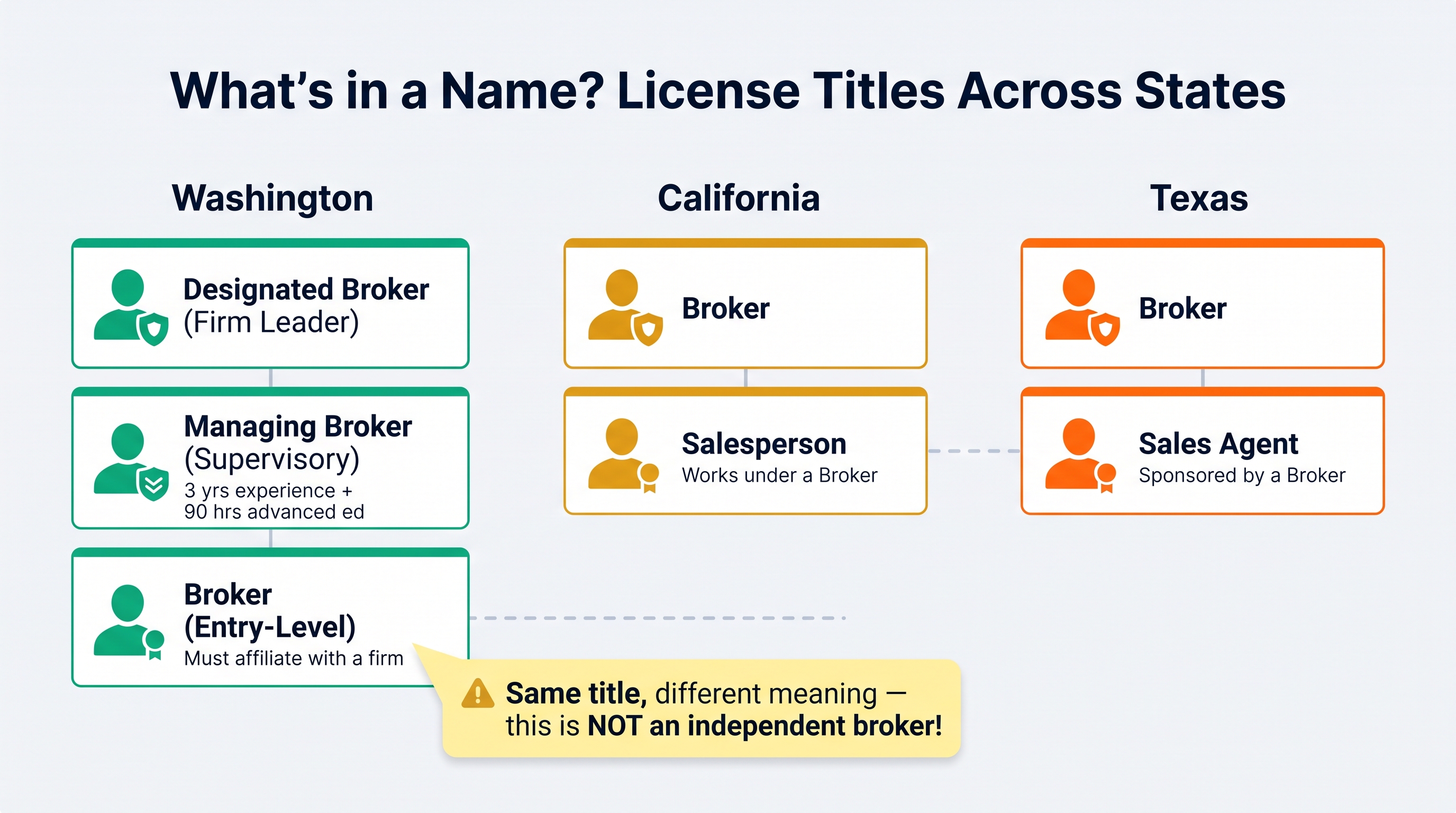
Washington's 'Broker' is entry-level — don't confuse it with the independent 'Broker' title used in other states.
Practical Takeaway for Aspirants: This terminology distinction matters considerably when purchasing study materials, enrolling in exam prep courses, or completing out-of-state reciprocity applications. If you relocate from Dallas to Seattle and search online for "Washington Real Estate Sales Agent exam prep," you will likely encounter outdated or irrelevant materials. Always search for "Washington Broker" resources for entry-level licensure.
Critical Practical Note: While you hold the professional title of "Broker," a newly licensed Washington Broker cannot practice independently. Before your license can be activated and you can legally practice real estate, you must be affiliated with and supervised by a Designated Broker, and your license must be activated with a Washington real estate firm.
3. Prelicense Education Hours: Quality, Specificity, and Timelines
Washington requires fewer prelicense hours than either California or Texas, but it compensates for that lower total with a highly specific, structured curriculum. Understanding exactly what is required and when it must be completed is critical for every applicant.
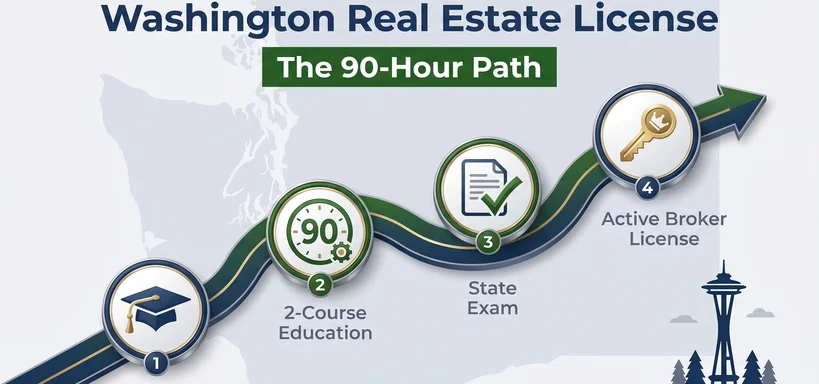
- Washington (90 Hours): The state requires exactly 90 hours of prelicense education completed through an approved education provider. The requirement is divided into two foundational courses: a 60-hour Real Estate Fundamentals course and a 30-hour Real Estate Practices course. The Fundamentals course covers legal concepts, contract law, and property types. The Practices course addresses the day-to-day realities of listing properties, working with buyers, and business planning.
- California (135 Hours): California requires 135 hours of college-level education, typically structured as three 45-hour segments: Real Estate Principles, Real Estate Practice, and one state-approved elective.
- Texas (180 Hours): Texas enforces one of the most demanding prelicense educational structures in the country, requiring 180 hours of qualifying education covering Principles I & II, Law of Agency, Law of Contracts, Promulgated Contract Forms, and Real Estate Finance.
The 2-Year Course Currency Rule: Washington aspirants must pay close attention to the currency of their education. Prelicense coursework is valid for exactly two years from the date of completion. If you finish your 90 hours but wait more than 24 months to pass your licensing exam, your educational certificates expire and you will be required to retake the coursework in full before you may sit for the exam again.
4. The Licensing Exam: Structure, Scoring, and What to Expect
The licensing exam is a universal milestone for real estate professionals, but its administration, structure, and scoring vary significantly by state.
In Washington, the real estate exam is administered by PSI, a third-party testing vendor. The exam is divided into two distinct portions: a National portion covering general real estate concepts applicable across the United States, and a State-specific portion covering Washington's unique agency laws, contract regulations, and licensing rules. To pass the Washington Broker exam, a candidate must achieve a minimum scaled score of 70 on each section.
A scaled score is not a flat percentage. Because PSI uses different versions of the test to prevent cheating, some forms may be marginally more difficult than others. The scaled score adjusts for these variances, ensuring that a 70 represents a consistent level of baseline competency regardless of which test form a candidate receives.
The 6-Month Exam Pairing Rule: Washington imposes a strict timing requirement on the two exam portions. If you pass the National portion but fail the State portion, or vice versa, you are not required to retake the section you passed. However, you have only a six-month window to pass the remaining section. If six months elapse without a passing score on the second portion, your passing score is invalidated and you must begin again, paying for and taking both portions anew.
For comparison:
- California: The state administers a single integrated exam consisting of 150 questions, with no separate State and National sections. Candidates must achieve a raw score of 70 percent, exactly 105 correct answers, to pass.
- Texas: Administered by Pearson VUE, the Texas exam is clearly divided into an 80-question National section and a 40-question State section.
5. Washington's Reciprocity Pathway for Out-of-State Licensees
Given the frequency with which professionals relocate from large markets like California and Texas, understanding Washington's approach to out-of-state license recognition is a practical necessity. Unlike states that offer blanket endorsement agreements, Washington uses a specific license by reciprocity pathway.
To qualify, an applicant must have been actively licensed in another state and in good standing within the preceding six months. Eligible reciprocity applicants are exempt from the National exam and are required to take only the Washington law portion of the licensing exam.
When applying, candidates must submit a formal License History document issued by their previous state's regulatory body. Simple screenshots or photocopies of a paper license are not accepted. Candidates may apply for an equivalent or lesser license level. An out-of-state license title alone does not guarantee equivalency. The state evaluates whether the applicant's license level is genuinely equivalent to Washington's Managing Broker tier, which carries its own experience and education requirements.
Reciprocity does not exempt candidates from all administrative requirements. Applicants must still undergo a fingerprint-based background check. Additionally, as with any newly licensed in-state professional, an out-of-state agent must activate their license with a Washington real estate firm before legally beginning to practice.
6. Post-Licensing: Washington's First Renewal Requirement
Perhaps the most distinctive and frequently surprising aspect of holding a Washington real estate license is the state's first active renewal requirement. Most states require a relatively modest amount of continuing education to renew a license every few years. Washington takes a notably different approach.
A Washington Broker renewing their active license for the first time must complete 90 hours of continuing education, a requirement specifically designed to strengthen new agents' competency during their critical early years in the profession.
This first-renewal curriculum must include:
- 30 hours of Advanced Practices
- 30 hours of Real Estate Law
- A 3-hour Current Issues in Washington Residential Real Estate course
- A mandatory Fair Housing course (typically 3 hours for those who completed it during prelicense, or 6 hours for those who did not)
- Additional elective courses to reach the full 90-hour total
This stands in stark contrast to subsequent Washington renewals, which require only 30 hours of continuing education every two years, and to California, which requires 45 hours for renewals. While Texas has a comparably substantial 90-hour Sales Agent Apprentice Education requirement for its first renewal, Washington's specific emphasis on Advanced Practices and Real Estate Law ensures its licensees receive targeted risk-management training early in their careers.
7. Fair Housing Education Integration
Fair housing laws are a fundamental cornerstone of ethical real estate practice, and Washington State has taken a proactive approach to ensuring its licensees are well-versed in these requirements.
Following recent legislative updates, Washington has embedded mandatory fair housing curriculum directly into both prelicense and continuing education requirements. If fair housing was not completed during a broker's initial prelicense qualification, that licensee must complete an initial 6-hour Washington Real Estate Fair Housing course. A 3-hour fair housing course is subsequently required at every active renewal cycle. This ongoing requirement ensures that Washington Brokers remain current on anti-discrimination laws, locally protected classes, and equitable housing practices. Unique Washington protections include source of income and honorably discharged veteran or military status.
8. The Managing Broker Upgrade Path
For professionals looking to advance their careers, open independent brokerages, or legally supervise other agents, Washington offers the Managing Broker license tier.
To upgrade from Broker to Managing Broker in Washington, a licensee must demonstrate at least three years of full-time experience as an active real estate broker within the past five years. They must also complete an additional 90 hours of advanced education covering Advanced Real Estate Law, Real Estate Brokerage Management, and Business Management.
The Managing Broker exam reflects this elevated standard. While the entry-level Broker exam requires a minimum scaled score of 70, the Managing Broker exam requires a minimum scaled score of 75, acknowledging the greater competency expected of those who will supervise and take legal responsibility for other licensees.
9. Administrative Deadlines and Requirements at a Glance
Success in Washington real estate depends as much on managing administrative details as it does on closing transactions. The following checklist consolidates the critical timing rules and practical requirements every Washington aspirant should track:
- Prelicense Course Currency: Education certificates expire exactly 24 months from the date of course completion.
- The 6-Month Exam Pairing Rule: If you pass one portion of the PSI exam, you have exactly six months to pass the other before your passing score is invalidated.
- The 1-Year Application Deadline: Once you have passed both exam portions, you have a one-year window to submit your formal license application and background check.
- Fingerprinting Cycles: All initial applicants must submit to a fingerprint-based background check, which must be renewed every six years to maintain active license status.
- Errors & Omissions Insurance: This insurance is a mandatory requirement for active licensees. Your license cannot be activated until this coverage is secured, typically through affiliation with your Designated Broker's firm policy.
- License and Exam Fees: Application, examination, and original license fees apply and are updated periodically.
10. Conclusion and Practical Takeaways
Obtaining a real estate license in Washington State requires strategic planning, a firm command of state-specific terminology, and careful attention to deadlines.
State-by-State Comparison at a Glance
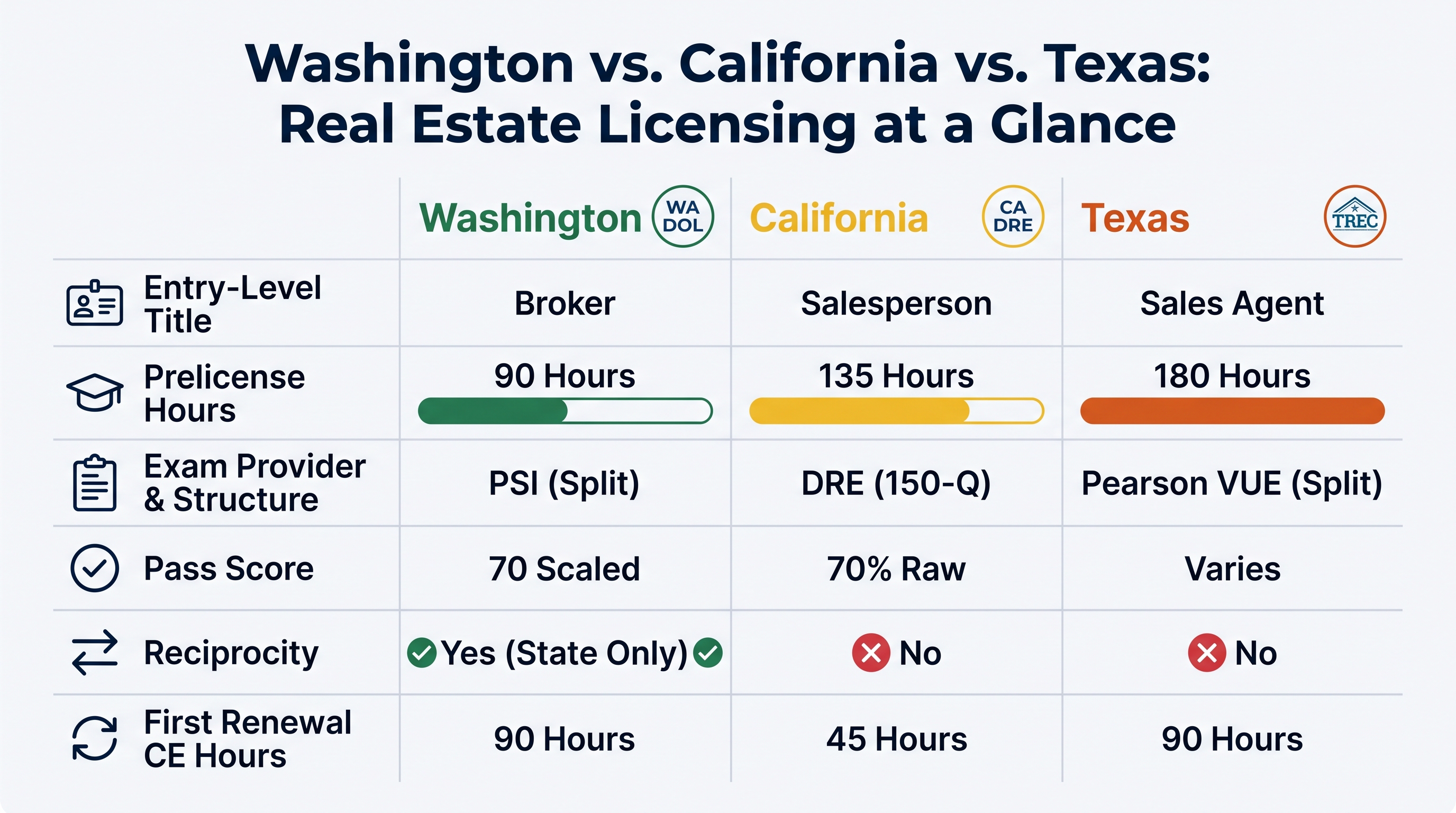
Key licensing differences between Washington, California, and Texas at a glance.
| Feature | Washington | California | Texas |
|---|---|---|---|
| Entry-Level Title | Broker | Salesperson | Sales Agent |
| Prelicense Hours | 90 Hours | 135 Hours | 180 Hours |
| Exam Provider | PSI | DRE | Pearson VUE |
| Exam Structure | State & National Split | Single 150-Q Exam | State & National Split |
| Pass Score | 70 Scaled Score (Both) | 70% Raw Score | Varies by section |
| Reciprocity Available? | Yes (State exam only) | No (No agreements) | No (No agreements) |
| First Renewal CE | 90 Hours | 45 Hours | 90 Hours (SAE) |
Those pursuing a real estate career in Washington should keep one overarching point in mind: you are studying to become a Broker. While only 90 hours of initial education are required to enter the field, the most significant educational commitment arrives two years after licensure, during the rigorous 90-hour first renewal process.
By understanding these structural differences, particularly in comparison to major markets like California and Texas, you can avoid common administrative pitfalls, track your deadlines with confidence, and enter the Washington real estate market prepared to thrive.
Next Steps and Official Resources
Ready to begin? The following official resources will support your next steps:
- WA DOL Real Estate Licensing Page: Current rules, applications, and reciprocity guidelines are available at dol.wa.gov.
- WA DOL-Approved Education Search: Browse the DOL portal to find an approved online or in-person prelicense education provider.
- PSI Exams Scheduling Portal: Download the Washington Candidate Information Bulletin and schedule your exam at psiexams.com.