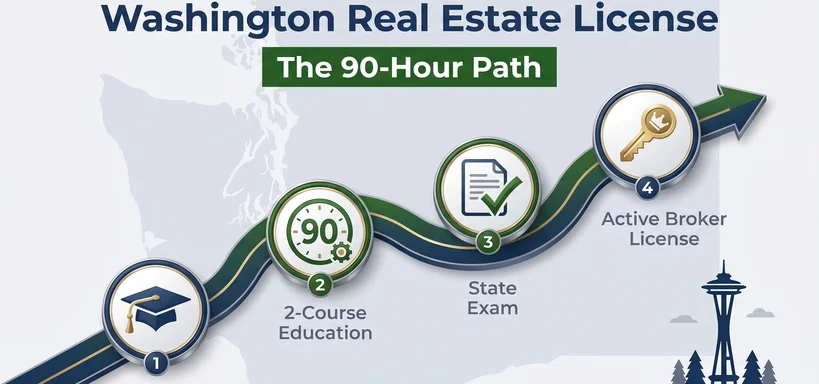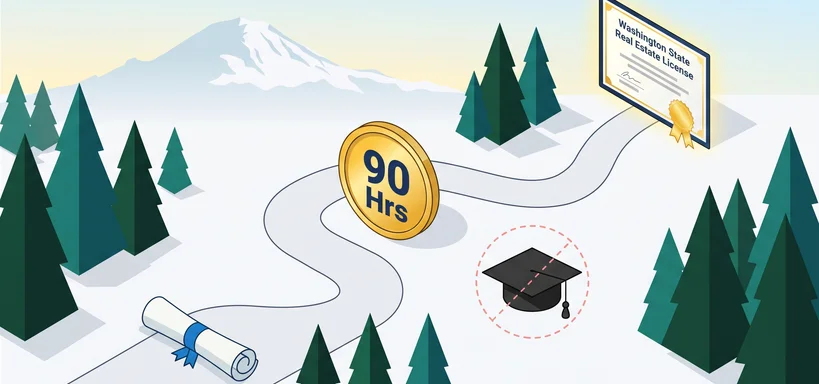
No — Washington does not require a college degree to get a real estate license. The state requires you to be at least 18 years old, hold a high school diploma or GED, complete 90 hours of approved pre-license education, and pass the state licensing exam. Academic background has nothing to do with it.
If you're eyeing the active housing markets of Seattle, Spokane, or Tacoma but assumed a university diploma was standing between you and a new career, this is good news. Success in Washington real estate comes down to work ethic, market knowledge, and negotiation skill — not a transcript.
- A college degree is never required to become a licensed Broker in Washington.
- You must be 18+, hold a high school diploma or GED, and complete 90 hours of pre-license education.
- Washington's entry-level license is called "Broker," not "salesperson" or "agent" — a common point of confusion.
- The PSI state exam and a fingerprint-based background check are required no matter your education level.
- College coursework can occasionally substitute for pre-license hours, but only with rare, discretionary DOL Director approval.
What Washington Actually Requires for a Real Estate License
Rather than a four-year degree, the Washington State Department of Licensing sets baseline criteria that are far more accessible. You must be at least 18 years of age, and you must possess a high school diploma or its equivalent, such as a GED.
If you meet those two prerequisites, you're eligible to begin. The real core of Washington's entry requirement is industry-specific training: 90 hours of approved real estate instruction, passing course exams, and passing the official state licensing exam. Because brokers handle sensitive financial transactions, the state also requires a fingerprint-based background check. For the full step-by-step process, see our guide to how to get a Washington real estate license.
Understanding Washington's License Terminology: Broker vs. Salesperson
Before you go further, it helps to understand Washington's unique licensing terms — this trips up a lot of people relocating from other states.
In most states, the entry-level license is called "Salesperson" or "Real Estate Agent," and "Broker" is reserved for experienced professionals who manage a firm. Washington doesn't use the term "salesperson" at all. Here, the entry-level license is officially a "Broker" from day one.
| Other States | Washington State |
|---|---|
| Salesperson / Real Estate Agent (entry-level) | Broker (entry-level) |
| Broker (experienced, manages a firm) | Managing Broker / Designated Broker |
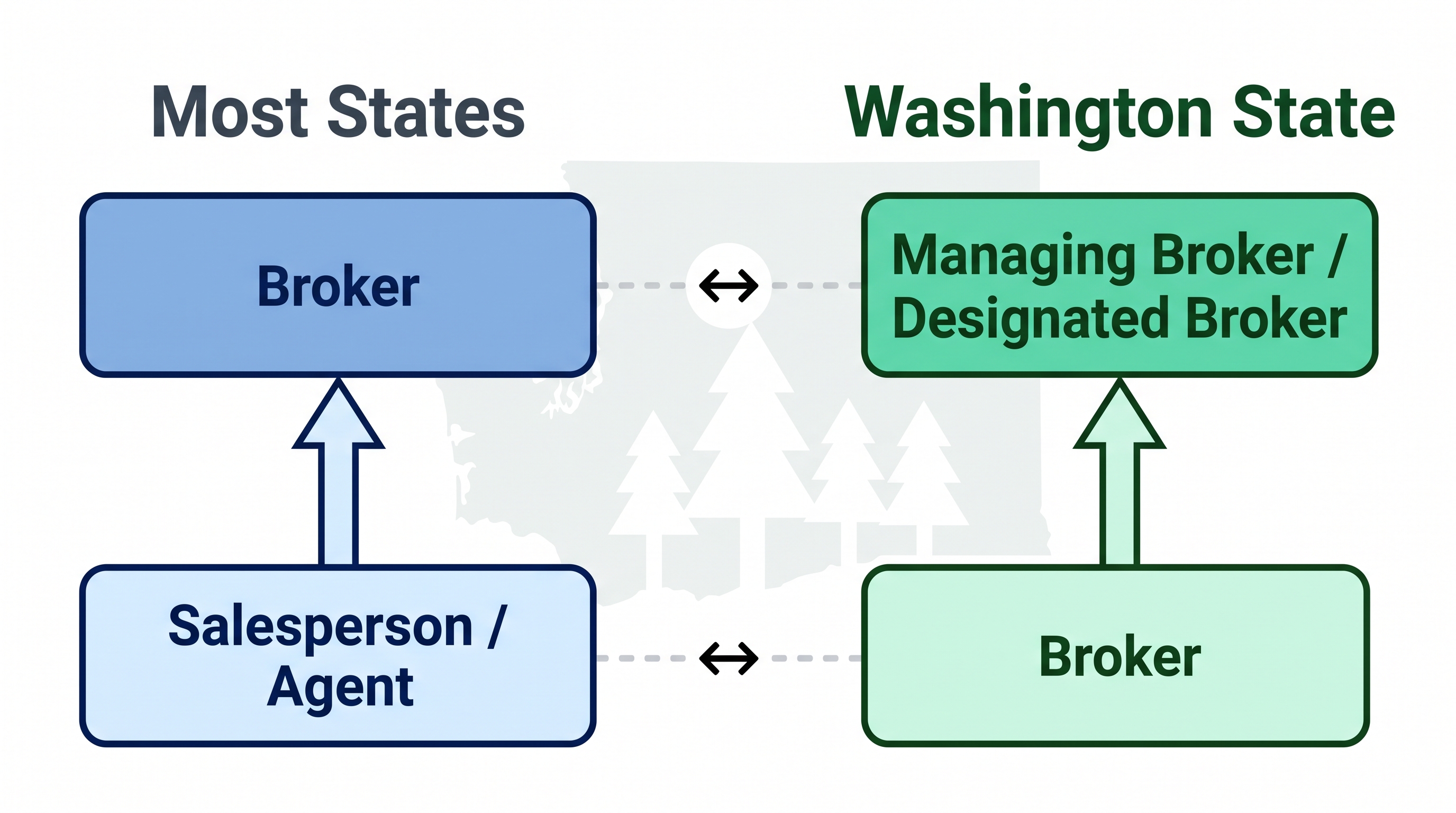
Washington uses different terminology—don't let it confuse you.
Because you hold the title of Broker from day one, the supervisor overseeing your work is called a "Managing Broker" or "Designated Broker." Every newly licensed Broker must affiliate with a licensed firm and work under supervision for the first stretch of their career. For a side-by-side look at how Washington's system compares to other states entirely, read how Washington's licensing terms compare to other states.
The 90-Hour Pre-License Education Requirement
Washington requires targeted, practical education instead of a general degree. You must complete exactly 90 hours of pre-licensing instruction from an approved real estate school, split into two courses:
- A 60-hour Real Estate Fundamentals course: the legal and technical foundation — property rights, estates, contracts, financing, escrow, and agency law, including at least three hours on fair housing and consumer protection.
- A 30-hour Real Estate Practices course: the day-to-day business of being a broker — securing listings, comparative market analyses, marketing homes, and representing buyers in competitive offers.
These courses must be completed within two years prior to applying for your exam. Let them expire past that window, and you'll need to retake the full 90 hours.
Your next step: The Gold Broker Pre-License package bundles the full 90-hour Fundamentals and Practices requirement with exam prep tools, self-paced online, so you can move through it around a current job.
Can College Coursework Count Toward Your Washington License?
What if you already completed college-level courses in real estate, business law, or finance? Could that exempt you from the 90-hour requirement?
Possibly. The Director of the Department of Licensing has authority to allow substitution of the standard clock-hour requirements if an applicant is determined to be similarly qualified through equivalent coursework at a recognized institution. You'd need to formally submit a transcript to the Department of Licensing for review.
In practice, this substitution pathway is rarely used, and approval is entirely discretionary. Most applicants find it far more efficient to simply complete the state-approved 90-hour courses, since they're built directly around Washington law and the state exam.
Important Distinction: Real Estate Brokers vs. Appraisers
A common source of the "you need a degree" myth is confusing real estate brokers with real estate appraisers. These are different professions with different rules.
A Washington Real Estate Broker does not need a college degree. Appraisal is different — it's regulated by federal guidelines, and the highest credential, Certified General Appraiser, does specifically require a bachelor's degree in any field. (The Certified Residential Appraiser credential does not.) If your goal is helping buyers and sellers negotiate transactions, you're pursuing a Broker license, and the degree requirement simply doesn't apply to you.
The Complete Path to Washington Real Estate Licensure
Here's the roadmap from zero to licensed, without a college degree, along with what each step typically costs:
- Confirm eligibility: at least 18 years old, high school diploma or GED.
- Complete the 90 hours: enroll in an approved school and finish your 60-hour Fundamentals and 30-hour Practices courses, then pass the school's final exams. Approximate tuition generally ranges from $200–$400 — see our full breakdown of Washington real estate license costs for every fee along the way.
- Pass the licensing exam: Washington partners with PSI Services; the broker exam fee is approximately $210 and covers both the National and Washington State-specific portions. Pass one section but fail the other, and you get a six-month window to retake it.
- Fingerprinting and background check: submitted through IdentoGO, running roughly $44–$65.
- Apply for your license: once you've passed both exam portions, you have one year to formally apply. The original broker license application fee is approximately $233, including a $20 research fee.
- Affiliate with a firm: your license won't go active until a Designated Broker invites you to join a licensed real estate firm.
For a fuller week-by-week look at how this all fits together, see our full timeline for getting licensed in Washington.
Don't Forget: Post-Licensing Continuing Education
A degree isn't required to get your license — but the education doesn't stop once you pass the exam. Washington requires new brokers to complete 90 hours of approved post-license education within their first two-year licensing cycle in order to renew.
This includes specific courses like Advanced Real Estate Practices, Real Estate Law, and current industry issues, all of which must be started after your original license date. Miss the 90-clock-hour deadline before your first renewal, and your license goes inactive — legally prohibiting you from practicing until you catch up.
What About Upgrading to Managing Broker? Do You Need a Degree Then?
As your career progresses, you may want to open your own brokerage or manage other agents — in Washington, that's a Managing Broker upgrade. Does reaching that level require a college degree?
Still no. The Managing Broker upgrade is based on experience and advanced targeted education, not academic credentials. You need a minimum of three years of practical, full-time broker experience, plus 90 more hours of advanced instruction (30 hours each in Brokerage Management, Business Management, and Advanced Real Estate Law), followed by the Managing Broker exam. For the complete requirements and timeline, read our complete guide to becoming a Washington Managing Broker.
Key Washington Licensing Deadlines to Remember
The path to licensure runs on strict timelines. Keep these three windows in mind — missing any of them is one of the most common ways candidates lose momentum. See our guide to common mistakes that delay licensing for the full list.
- The 2-year education rule: your 90 hours of pre-licensing education are valid for two years; you must apply for your broker exam within this window.
- The 6-month exam rule: pass one exam section but fail the other, and you have exactly six months to pass the remaining section.
- The 1-year application rule: after passing both exam portions, you have up to one year to complete your background check, secure a sponsoring brokerage, and submit your license application.
Frequently Asked Questions
Do I need a college degree to get a Washington real estate license?
No. Washington requires you to be at least 18, hold a high school diploma or GED, complete 90 hours of approved pre-license education, and pass the state exam. A college degree plays no role in eligibility for a Broker license.
What are the minimum requirements to become a Washington real estate broker?
You must be 18 or older, have a high school diploma or GED, complete 90 hours of approved pre-license education (60-hour Fundamentals plus 30-hour Practices), pass the PSI state exam, and pass a fingerprint-based background check before affiliating with a firm.
Can college courses replace the 90-hour pre-license requirement?
Occasionally. The DOL Director can allow equivalent college coursework to substitute for some or all of the 90 hours, but approval is discretionary and rarely granted. Most candidates find it faster to simply complete the standard state-approved courses.
Do real estate appraisers need a college degree in Washington?
Appraisers are regulated differently than brokers. The Certified General Appraiser credential does require a bachelor's degree, while the Certified Residential Appraiser credential does not. Neither requirement applies to real estate Brokers helping buyers and sellers transact.
Do I need a degree to become a Washington Managing Broker?
No. Upgrading from Broker to Managing Broker requires three years of full-time broker experience and 90 additional hours of advanced coursework, plus passing the Managing Broker exam — experience and training, not a college transcript.
Ready to Start Your Washington Real Estate Career?
You don't need a degree to open doors in Washington real estate — you need the right 90 hours, completed the right way. The Gold Broker Pre-License package is self-paced, DOL-approved, and built around the state exam, with pre-license courses starting at $309. Most students finish in two to three months around their current job.
Questions about eligibility, transcripts, or timing? Call us at 425-775-2313 — a real person picks up.
No degree needed for a Washington real estate license—just 90 hours of approved pre-license education. Start your course today.