Is Real Estate Still a Good Career in Washington in 2026? (Data-Backed Answer)
Every year, thousands of aspiring professionals in Washington state ask themselves the same question: Is getting a real estate license actually worth it? As we navigate through 2026, the residential real estate landscape has shifted dramatically. The pandemic-era frenzy is firmly in the rearview mirror, interest rates have established a new baseline, and industry-wide structural changes to compensation have redefined how business is conducted.
For those considering licensure—and for current Brokers evaluating their long-term career trajectory—the industry is too often portrayed in extremes. On one side, reality television and social media project an illusion of effortless luxury and overnight wealth. On the other, skeptics insist the market is hopelessly oversaturated and nearly impossible to break into. The truth, as always, lies somewhere in the middle, and it is best revealed through data.
This article offers an honest, data-driven assessment of whether real estate remains a viable and attractive career in Washington in 2026. Setting aside both the cheerleading and the cynicism, we will focus on the numbers to help you make an informed, realistic business decision.
The Industry Shift: Buyer-Broker Compensation Changes
No assessment of a real estate career in 2026 is complete without acknowledging the most consequential structural change in recent memory: the post-NAR settlement buyer-broker compensation rules. The industry has firmly moved away from the assumption that the seller automatically pays the buyer's agent.
Under the new paradigm, Washington Brokers are strictly required to have a signed, written buyer representation agreement in place before touring any homes. Compensation is now directly negotiated between the broker and the buyer—fully disclosed and explicitly agreed upon upfront. While this shift has required significant adjustment nationally, Washington Brokers carry a distinct advantage: the state's Department of Licensing (DOL) and the Northwest MLS had already implemented many of these requirements through a revision of RCW 18.86 in 2024. As a result, while new Brokers must develop strong skills in articulating their value proposition to buyers, the legal and regulatory framework for doing so compliantly in Washington is already well established.
The Market Reality: What the Numbers Say
To evaluate the career viability of a Washington real estate Broker, you must first understand the market environment in which you will be operating. The Northwest Multiple Listing Service (NWMLS) and the Washington Center for Real Estate Research (WCRER) together provide a clear snapshot of a market in transition.
According to NWMLS 2025 annual data, the region recorded 67,929 closed sales at a median closed price of $644,500 [1]. While those figures represent an enormous volume of transacted wealth, the more telling metric for working Brokers is inventory, which rose 34.4% year-over-year in 2025 [1]. By June 2026, the median price had climbed slightly to $650,000, active listings were up an additional 16.4%, and the market had reached 3.37 months of supply [2].
At the same time, WCRER's Q1 2026 data reveals a more nuanced picture: statewide sales volume increased 8% year-over-year, while median prices declined by 4% [3].
What does this mean for your career? A market with 3.37 months of inventory is transitioning toward balance. Buyers have more choices, and homes are taking longer to sell. For a working Broker, that means you can no longer simply plant a sign in the yard and expect multiple offers within 48 hours. Success now demands robust marketing, strategic pricing, and sharper negotiation skills. The 8% increase in sales volume confirms that transactions are occurring—welcome news for Broker income—but the modest price decline means you will need to build on volume rather than rely on perpetual price appreciation to grow your commission base.
Career Earnings: Washington vs. National
When evaluating real estate as a career, the most common question is straightforward: How much will I actually make?
According to the Bureau of Labor Statistics (BLS), Washington real estate Brokers out-earn their national counterparts by a significant margin. The average income for a Broker in Washington is $79,130, compared to the national average of $52,830 [4].
However, averages in real estate are notoriously misleading. The industry operates on the Pareto principle, in which a small percentage of top producers command the majority of market share. The spread between Washington's 10th and 90th percentile earners is substantial: the bottom 10% of Brokers earn just $48,680, while the top 10% take in $114,090 or more [4]. It is also critical to recognize that BLS and O*NET income figures for "Brokers" in Washington include Managing Brokers, seasoned top producers, and experienced brokerage owners. Industry surveys of first-year broker income suggest a considerably lower entry benchmark, meaning new Brokers should calibrate their expectations accordingly for years one through three.
Equally important is placing these earnings within the broader context of the Washington state economy. The state's average wage across all professions currently stands at $99,810 [6]. That is a sobering benchmark: the average real estate Broker in Washington earns roughly $20,000 less than the average worker statewide. If your primary motivation for entering this field is a quick path to a high-paying position, the data warrants caution. Surpassing the state average requires performing consistently in the upper quartiles of the profession.
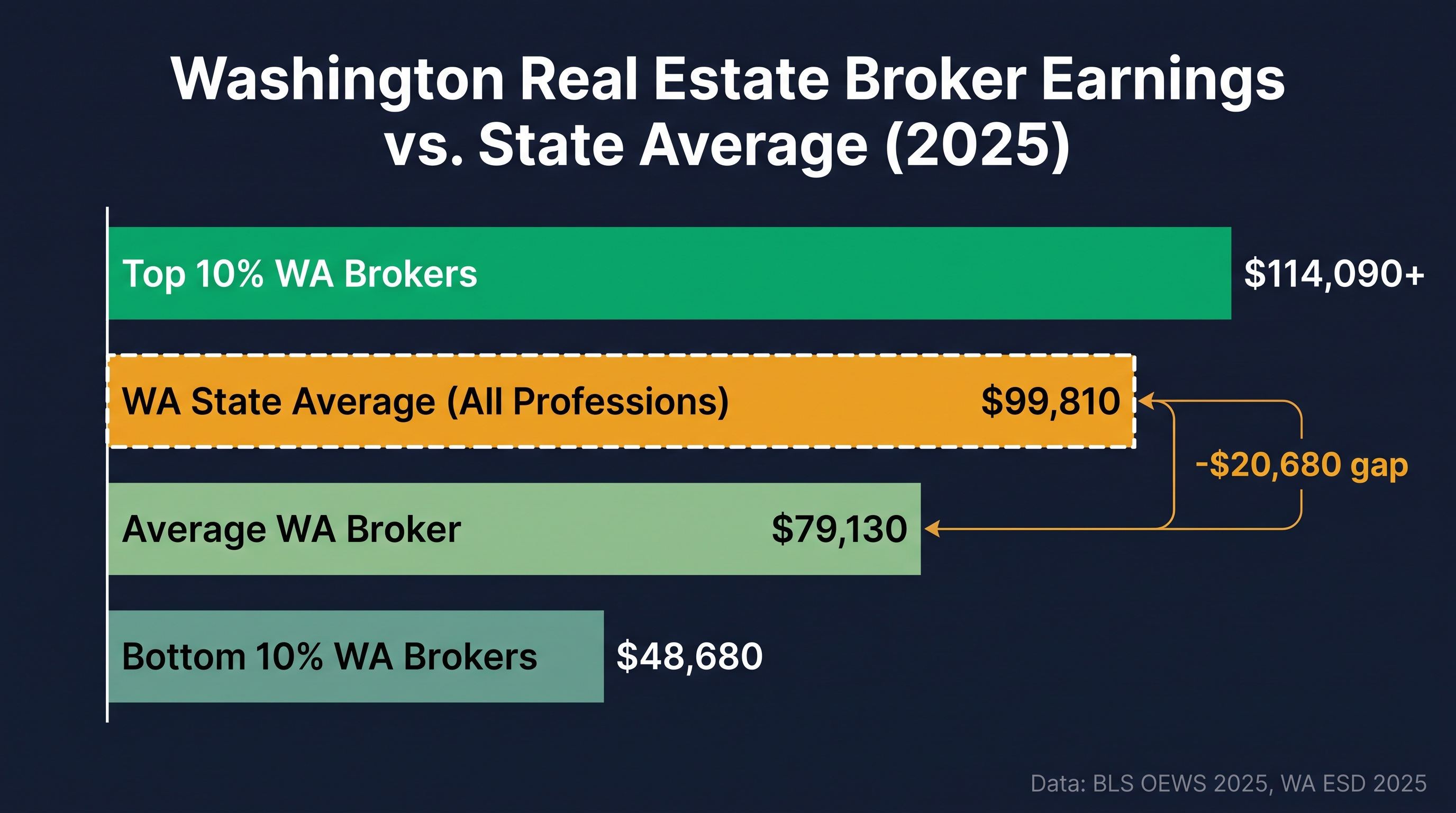
Washington's average real estate Broker earns roughly $20,000 less than the statewide average across all professions. Surpassing that benchmark requires consistent upper-quartile performance. (Data: BLS OEWS 2025, WA ESD 2025)
Job Growth Outlook
Despite the competitive nature of the business, Washington's long-term career outlook for real estate professionals compares favorably with national figures.
Projections indicate an 11% job growth rate for Washington real estate agents between 2022 and 2032, representing an expansion from approximately 22,360 to 24,800 active professionals [5]. That translates to roughly 2,430 annual openings statewide. By comparison, the national growth rate for the profession is a sluggish 3.1% [5].
This strong state-level growth is fueled by Washington's diversified economy, continued migration to the Pacific Northwest, and a robust technology sector that sustains housing demand. That said, Brokers should remain mindful of broader economic headwinds. The Washington State Employment Security Department (ESD) recently noted a deceleration in the state's overall economic expansion, with an annual growth rate hovering around just 0.97% [7]. A slower broader economy can erode buyer purchasing power and dampen consumer confidence, meaning Brokers will need to work harder to generate leads and convert them to closed transactions.
What It Actually Costs to Get Started
One of the most costly misconceptions for new Brokers is approaching real estate as a traditional W-2 job rather than a small-business startup. The relatively low barrier to entry can obscure the true cost of building a sustainable practice.
To become licensed in Washington, you must complete 90 hours of pre-license education—a 60-hour Real Estate Fundamentals course and a 30-hour Real Estate Practices course—pass both the state and national examinations, and pay your initial licensing fees. That, however, is only the beginning.
Once licensed, you will face immediate out-of-pocket expenses: MLS subscription dues, local REALTOR® association fees, lockbox access, business cards, professional photography, digital marketing, mandatory Errors & Omissions (E&O) insurance, and independent healthcare costs. Continuing education requirements add further investment: 90 hours are required for your first license renewal, followed by 30 hours every two years thereafter. For those committed to long-term advancement, earning a Managing Broker license requires three years of full-time experience, an additional 90 hours of education, and passing a secondary state examination.
Tax obligations also demand careful attention. While the 1.5% Business & Occupation (B&O) tax rate on commissions is a long-standing baseline under RCW 82.04.290, the Department of Revenue implemented a specific "Real Estate Commissions" classification effective for reporting periods beginning January 1, 2025 [8]. This classification requires precise reporting by both brokerages and independent brokers.
The Commission Math: A Realistic Example
To understand what a Broker actually takes home, consider the following breakdown for a single transaction. Assume you represent the buyer on a median-priced Washington home of $650,000, with a negotiated gross commission of 2.5%.
- Sale Price: $650,000
- Gross Brokerage Commission (2.5%): $16,250
- Split with Managing Broker (70/30): Your gross share is $11,375
- Washington B&O Tax (1.5% on your gross share): −$170.63
- E&O Insurance (Per-transaction fee): −$50.00
- Subtotal: $11,154.37
- Business Expenses (Marketing, Gas, Gifts, Client Dinners): −$700.00
- Federal Self-Employment Tax (Estimated 15.3%): −$1,740.00
- Federal Income Tax (Estimated 20% effective rate): −$2,240.00
- True Net Take-Home Pay: ~$6,474.37
A $16,250 gross commission sounds substantial on paper. But the true net figure underscores why consistent lead generation and a steady pipeline of closed transactions are not optional—they are existential to a Broker's financial health.
The County-Level Reality: Washington Is Not One Market
A critical mistake new Brokers often make is treating Washington state as a single, uniform housing market. Your experience, your income, and your business strategy will vary considerably depending on your county of operation.
The median home price in tech-heavy King County recently reached $889,000 [9], requiring buyers to demonstrate a qualifying income of approximately $187,000 just to enter the market [10]. In stark contrast, rural Adams County carries a median home price of $226,000 [9]. In Spokane County on the eastern side of the Cascades, the qualifying income drops to a far more accessible $102,000 [10].
Working in King County yields higher commissions per transaction, but you are competing against seasoned Managing Brokers in a dense field, serving buyers who frequently struggle with affordability. Operating in Spokane or Adams County means you will need a higher volume of transactions to achieve comparable gross income, but the barrier to homeownership for your clients is considerably lower. Selecting the right brokerage and market niche requires an honest alignment between your geographic reality and your financial objectives.
What Makes or Breaks New Brokers in This Market
If the data describes a viable but demanding environment, what distinguishes the Brokers who thrive from the many who quietly allow their licenses to lapse?
1. A Financial Runway. Undercapitalization is the leading cause of failure among new Brokers. Real estate is heavily front-loaded with expenses, and transactions typically take 30 to 60 days to close after mutual acceptance. You must have six to twelve months of living expenses in reserve before committing full-time. It is nearly impossible to negotiate effectively on a client's behalf when you are personally dependent on that commission check to cover next month's rent.
2. Mentorship and Leadership. Your choice of Managing Broker is one of the most consequential decisions you will make. Beyond the commission split, you need a Managing Broker who provides hands-on guidance, collaborative business planning, and thorough contract review during your first dozen transactions.
3. Niche Selection. Generalists face an uphill climb in 2026. Brokers who develop a focused specialty—whether serving VA buyers near Joint Base Lewis-McChord, guiding downsizing retirees in the Tri-Cities, or working with first-time homebuyers in the Eastside tech corridor—find it substantially easier to direct their marketing dollars and cultivate a referral-based business.
4. Strict Compliance Readiness. Real estate is a highly regulated and litigious profession. Washington law, specifically RCW 18.86.030, outlines the clear duties of a Broker: exercising reasonable skill and care, dealing honestly and in good faith, presenting all written offers in a timely manner, and properly accounting for all client funds [11]. The Department of Licensing maintains rigorous standards and has little tolerance for sloppy paperwork or ethical lapses. Treating compliance as the foundation of your practice—rather than an afterthought—is not aspirational; it is a condition of long-term survival.
The Bottom Line
So, is real estate still a good career in Washington in 2026?
Yes—but with an important qualification: it is a business-development career, not a job-placement career. When you obtain your license, you are not accepting a position; you are waking up each day responsible for building your own client base from scratch. The market data reflects a normalizing landscape in which homes take somewhat longer to sell and the average Broker earns less than the typical Washington state worker.
Nevertheless, the 11% projected job growth and the significant upside available to top-decile earners demonstrate that, for individuals who are well capitalized, professionally trained, and genuinely entrepreneurial, Washington real estate remains one of the most rewarding small-business opportunities the state has to offer. For those willing to approach their license with the mindset of a CEO rather than an employee, the opportunity is substantial.
References
[1] Northwest Multiple Listing Service (NWMLS). (2026). 2025 Annual Market Report. Published January 2026. Retrieved from https://www.nwmls.com
[2] Northwest Multiple Listing Service (NWMLS). (2026). June 2026 Market Update. Published July 2026. Retrieved from https://www.nwmls.com
[3] Washington Center for Real Estate Research (WCRER). (2026). Washington State Housing Market Report, Q1 2026. University of Washington, Published April 2026. Retrieved from https://wcrer.be.uw.edu
[4] U.S. Bureau of Labor Statistics (BLS). (2025). Occupational Employment and Wage Statistics (OEWS), Survey Year 2025: SOC 41-9022 (Real Estate Brokers). Retrieved from https://www.bls.gov/oes/
[5] ONET OnLine / Projections Central. (2024). Washington State Employment Projections 2022-2032 for Real Estate Sales Agents (SOC 41-9022)*. Dataset Version 28.2. Retrieved from https://www.onetonline.org
[6] Washington State Employment Security Department (ESD). (2026). Occupational Employment and Wage Estimates 2025. Published March 2026. Retrieved from https://esd.wa.gov
[7] Washington State Employment Security Department (ESD). (2026). Washington State Economic and Revenue Forecast, Spring 2026. Published June 2026. Retrieved from https://esd.wa.gov
[8] Washington State Department of Revenue (DOR). (2025). Real Estate Industry Guide: Commissions – brokers (agents). Includes guidance on RCW 82.04.290. Retrieved from https://dor.wa.gov
[9] Northwest Multiple Listing Service (NWMLS). (2026). June 2026 County Market Summaries. Published July 2026. Retrieved from https://www.nwmls.com
[10] Washington REALTORS & National Association of REALTORS (NAR). (2026). Local Market Affordability Forecast Data. Published Q2 2026. Retrieved from https://www.warealtor.org
[11] Washington State Legislature. (2024). RCW 18.86.030: Duties of broker. Revised 2024. Retrieved from https://app.leg.wa.gov/rcw/default.aspx?cite=18.86.030