
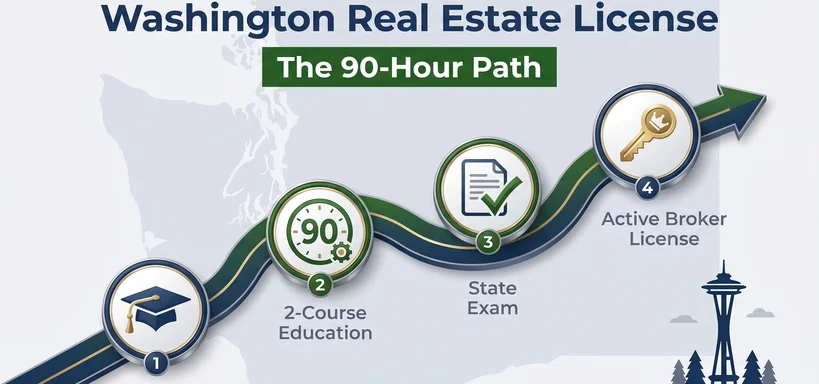
Starting a real estate career in Washington can feel like a vague, intimidating goal until someone writes the steps down for you, and then it turns into a checklist. It's a defined process with a clear finish line: a state broker license and a firm where you can begin working. Here is the entire path, from your first class to an active license, laid out in plain order.
First, a note on titles, because Washington's wording trips people up. In Washington your very first license is called a broker license, not a salesperson license like in some other states. The more advanced role, the one that lets you run an office and supervise others, is called a managing broker, and that's a later step. So when you see "broker," picture the entry point, not years of experience.
First, confirm you qualify
The starting requirements are short. You need to be at least 18 years old, and you need a high school diploma or its equivalent. There's no college degree requirement, and you don't need any prior experience in real estate to begin.
The education: 90 hours in two courses
The core of the process is 90 hours of approved coursework, and those hours come in two specific courses. The first is a 60-hour course called Real Estate Fundamentals, which covers the broad principles of the field: how property is owned and transferred, contracts, financing, fair housing law, and the duties an agent owes a client. The second is a 30-hour course called Real Estate Practices, which is more hands-on and focuses on how the work actually gets done, from listing a home to writing offers and closing a sale. Together they add up to the full 90 hours the state requires.
One detail worth checking before you pay for anything: make sure the school is approved by the Washington State Department of Licensing, the state agency that issues real estate licenses. Only hours from an approved school count, and a reputable provider will state its approval plainly. Most people take these courses online and at their own pace, which makes it realistic to study around a current job. Each course ends with a final, and finishing the coursework is what clears you to schedule the licensing exam.
The exam, and the clock that starts with it
Washington uses a company called PSI to deliver the licensing exam. The exam has two portions: a national portion covering real estate principles used across the country, and a state portion covering Washington's specific laws. There are about 130 questions in total, and you need a scaled score of 70 on each portion to pass.
Two timing rules matter here, and missing them means repeating work. First, you have to pass both portions within six months of each other, or you'll have to retake both. Second, you need to complete the exam within two years of finishing your education, so the coursework doesn't go stale. If you study the way your course prepares you and schedule the exam with momentum, both windows are easy to stay inside.
Fingerprints and your background check
After you pass, the next step is a background check. Washington has you do this in a specific order: you pass the exam first, and then you submit your fingerprints. Inside Washington, fingerprinting is handled through a vendor called IdentoGo, and it's a routine step that lets the state confirm you're eligible to hold a license. Once you've passed, you then have one year to apply for your license, so it's worth moving from exam to application without long delays.
Activating your license with a firm
Passing the exam and clearing the background check still leaves one piece. A newly licensed Washington broker doesn't operate alone. You affiliate with a real estate firm, and a managing broker, the experienced licensee who supervises newer brokers and oversees the office, holds and activates your license within that business.
That makes choosing a brokerage part of getting licensed rather than something you figure out afterward. It's worth talking to a few offices while you finish your coursework, so that when your license is ready, you already know where you want to hang it.
What the path looks like all at once
Step back and the route is just a handful of clear moves: meet the basic requirements, complete the 60-hour Fundamentals and 30-hour Practices courses, pass the national and state exam portions, clear a fingerprint background check, and join a firm under a managing broker. Thousands of Washington brokers have followed exactly these steps, and a single approved 90-hour package can carry you through both required courses and your exam prep in one place. The license is closer than it looks from the first day of class.