Real estate technology is often marketed as a way to generate leads and increase income. For Washington state real estate professionals, however, a strong tech stack is the backbone of your compliance strategy. With the Washington State Department of Licensing maintaining strict oversight, the right tools protect your license and ensure you meet statutory obligations.
This year brings regulatory shifts, most notably the state's new public marketing law. Brokers, Managing Brokers, and Designated Brokers must treat their software as a compliance toolkit. Washington laws establish exacting legal standards that modern platforms are designed to satisfy. Here is a look at the top technology categories every Washington Broker should use in 2026 to remain compliant and organized.
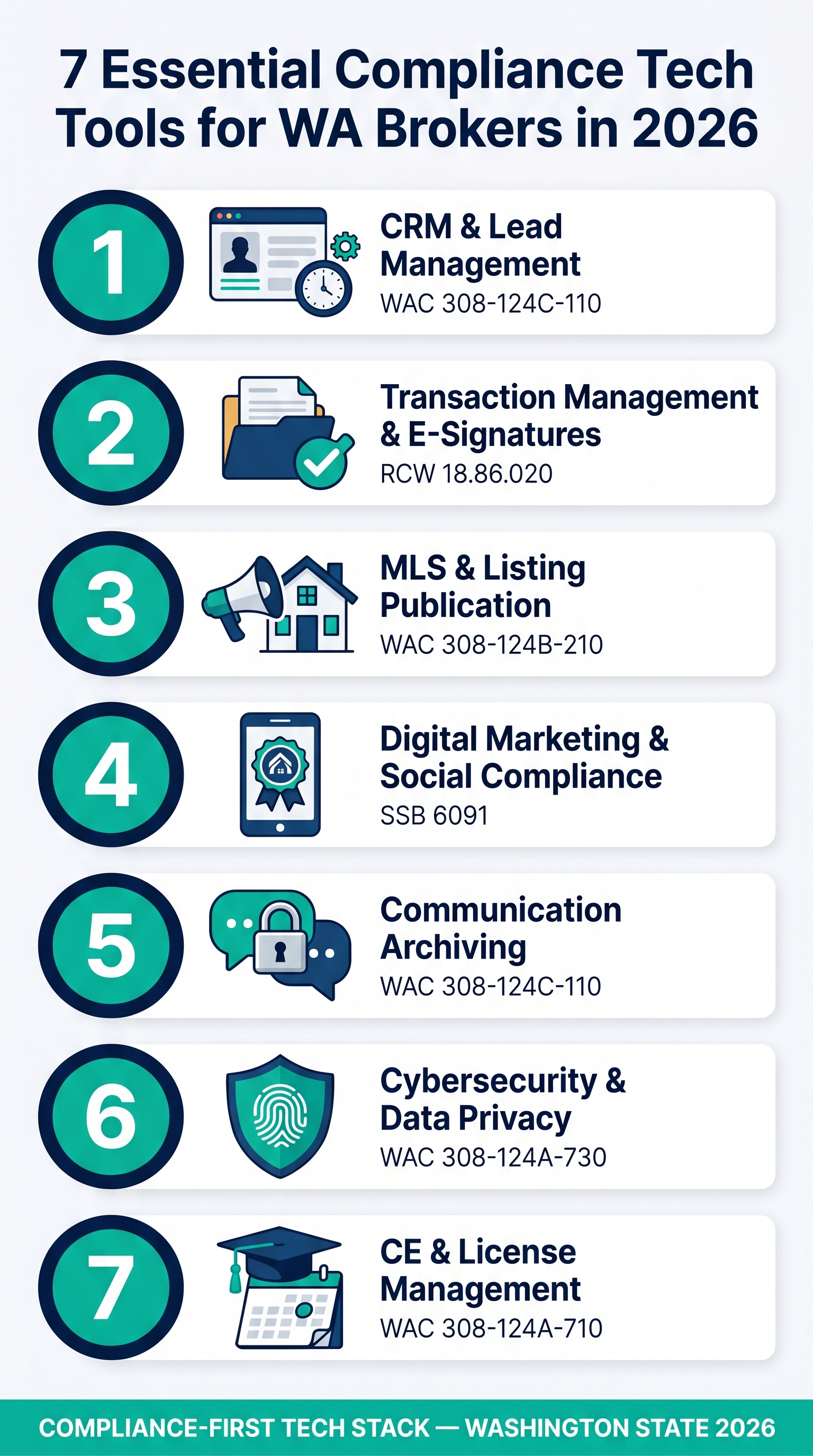
Your 2026 compliance tech stack at a glance — seven tool categories aligned to Washington state statutes and regulations.
1. CRM and Lead Management Systems: Navigating Agency Timelines
Washington state agency law requires brokers to establish a written brokerage services agreement as soon as reasonably practical after commencing real estate brokerage services. This applies equally to sellers and buyers, a standard embedded in Washington law following the 2024 agency updates. The law also mandates timely delivery of the Law of Real Estate Agency pamphlet before any representation agreement is signed, an offer is drafted, or a party consents to dual agency.
A compliant Customer Relationship Management platform is your primary tool for tracking these statutory timelines. Brokers should use CRM automation to deliver the agency pamphlet digitally upon a client's first inquiry and log the read receipt. When meeting a buyer at an open house, a mobile responsive CRM lets you document that first substantive contact immediately.
A CRM with automated workflow triggers ensures no buyer representation agreement is missed before a property tour. By recording the exact date and time a services agreement is executed, your CRM creates an auditable trail. This includes monitoring the state's default 60-day minimum term for buyer representation. State law explicitly provides for this 60-day default term, which must be clearly defined in writing.
Individual Brokers are responsible for executing services agreements. Managing Brokers must use the firm's CRM to supervise Brokers and review files. Designated Brokers bear ultimate statutory responsibility for the firm's agency law compliance. Automated drip campaigns can alert you when a buyer's agreement is expiring, prompting a timely extension and demonstrating to auditors that all tiers fulfilled their obligations.
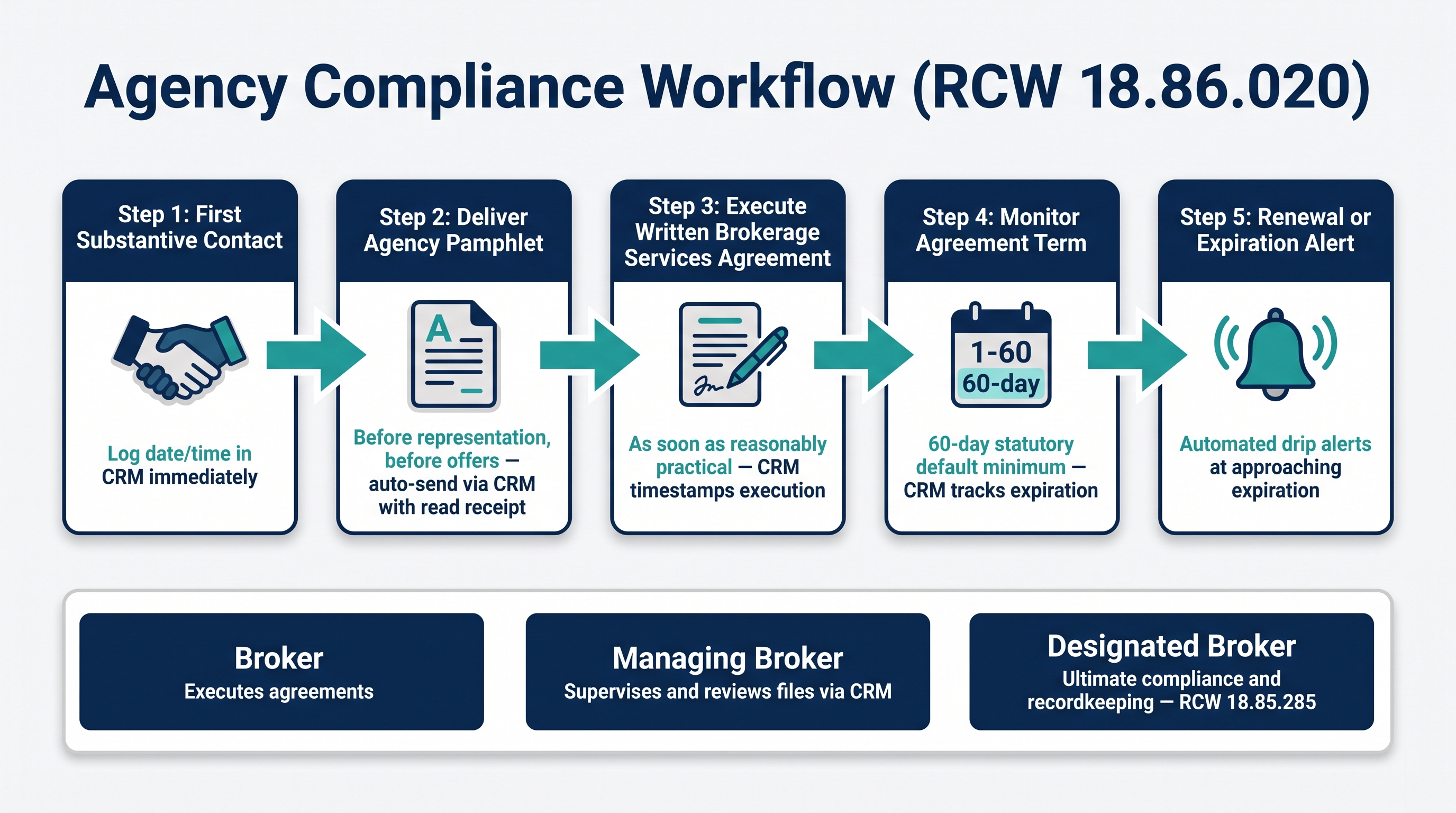
Agency compliance workflow under RCW 18.86.020 — how your CRM should track every critical milestone from first contact to agreement renewal.
2. Transaction Management and E-Signature Platforms: The 3-Year Rule
Washington real estate firms must retain a legible copy of all transaction folders, contracts, receipts, and related documents for a minimum of three years. The Department of Licensing requires these records be accurate, current, and immediately accessible upon request at the firm's licensed office location.
Modern transaction management and electronic signature platforms are essential for meeting these requirements. State rules permit electronic storage, but retrieval must be immediate, and records must be viewable and printable upon request at the licensed location.
A cloud based transaction management system ensures your Designated Broker has firm level access to all active and closed files in real time. If the state conducts an audit, the Designated Broker can retrieve a complete transaction history instantly without searching physical cabinets. Advanced platforms provide comprehensive audit trails, IP address tracking on electronic signatures, and role based permissions that limit liability.
3. MLS and Listing Publication Tools: Complying with New Marketing Laws
The most significant shift for Washington Brokers in 2026 is the state's new public marketing law. Effective June 11, 2026, this legislation expressly prohibits real estate brokers from marketing residential real estate to an exclusive or limited group of prospective buyers or brokers. It requires that any property marketed for sale or lease be concurrently marketed to the general public and all other real estate brokers. The only exception is when privacy is reasonably necessary to protect the health or safety of the owner or occupant.
This mandate makes your Multiple Listing Service and listing publication tools critical. The law promotes fair housing, equal access to inventory, and transparent consumer practices. Using MLS tools, such as Matrix, ShowingTime, and authorized syndication channels, ensures your listings satisfy the statutory definition of public marketing.
Rather than relying on private whisper networks or closed social media groups, Brokers must use MLS technology to distribute listings to the widest audience immediately. Older practices could now trigger severe disciplinary action. Modern platforms provide the digital footprint to demonstrate concurrent public marketing, protecting your seller's interests and safeguarding your license.
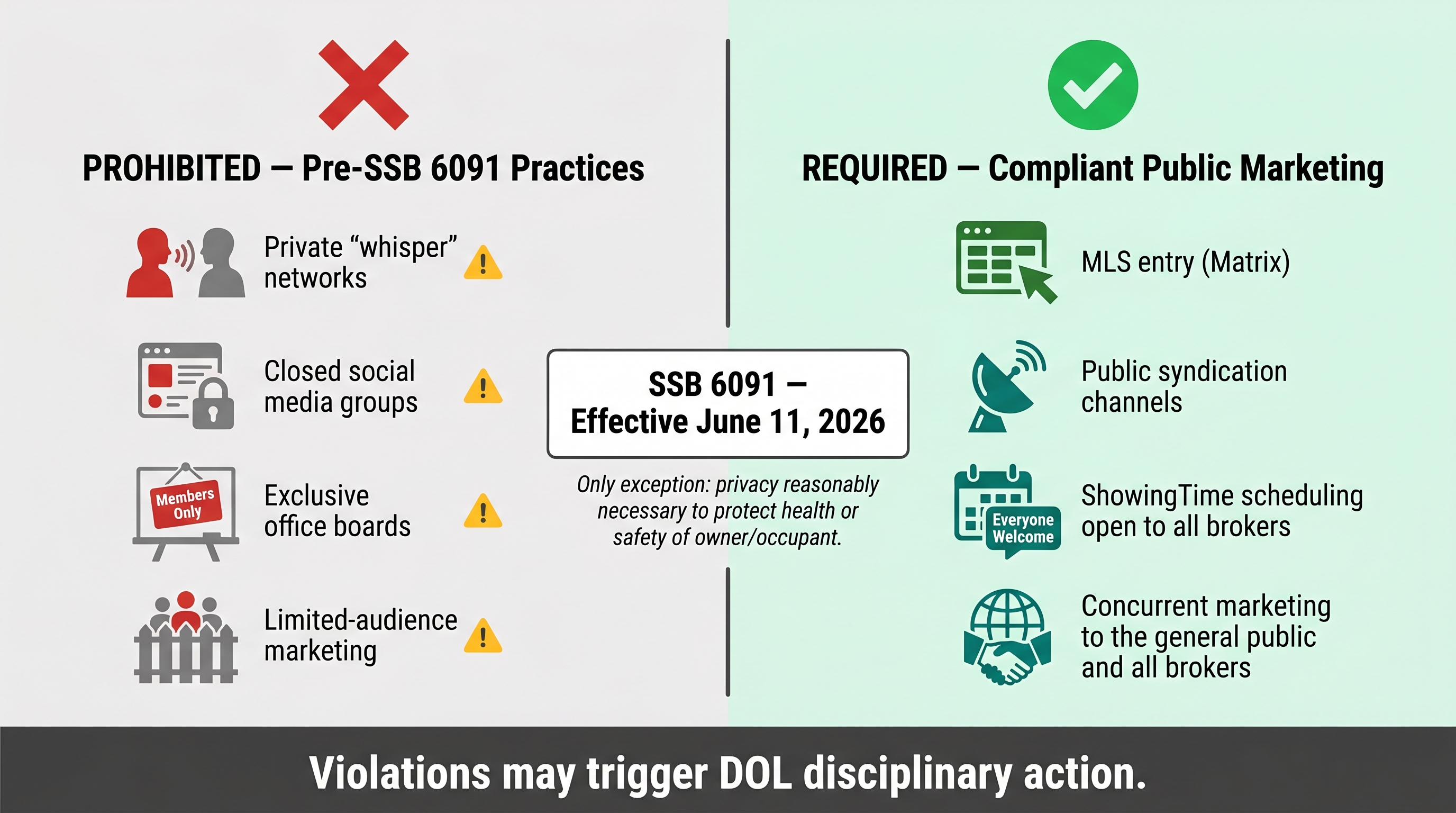
SSB 6091 at a glance — prohibited pocket-listing practices versus compliant public marketing requirements, effective June 11, 2026.
4. Digital Marketing and Social Media Compliance Tools: The Firm Name Mandate
As Brokers turn to platforms like Instagram, TikTok, and artificial intelligence content tools, advertising compliance remains a frequent pitfall. State advertising rules strictly govern Washington licensees, explicitly requiring that all advertising and solicitations include the firm name or an assumed name as licensed. There are no exceptions. This requirement covers internet based advertising, web pages, email signatures, and all visual media.
Digital marketing and social media compliance tools are indispensable here. Limited screen space on a TikTok video doesn't exempt you from state law. Brokers should use marketing platforms and social media schedulers that support pre approved brand templates. These templates must feature the exact licensed firm name in a clear and conspicuous manner.
Advanced team platforms offer approval workflows allowing a Managing Broker to review social posts before publication. If you use a personal brand or team title without a registered assumed name license, your tech tools can automatically append the mandatory brokerage firm name to every post or video watermark. This systematic approach prevents inadvertent violations.
5. Communication Archiving Tools: Capturing Electronic Negotiations
Negotiations no longer occur exclusively on paper. They unfold rapidly via text message, email, and direct messaging applications. According to state recordkeeping mandates, the required transaction folder must contain all material correspondence for each real estate transaction.
If a price reduction was informally agreed upon via a text message thread, or inspection repairs were negotiated through email, those electronic communications are officially part of the transaction record. They are subject to the same three year retention requirement as a formal Purchase and Sale Agreement. If a dispute arises after closing, official audit guidance makes clear that investigators will request all material correspondence.
Communication archiving tools make it straightforward to capture these interactions. Brokers should use dedicated business phone applications that automatically back up text messages and call logs to the cloud or directly into the transaction file. Keeping business texts separate from personal texts makes compliance archiving an automatic background process. Forwarding critical emails to your transaction management platform's unique drop email address is another practical habit that satisfies retention requirements.
6. Cybersecurity and Client Data Privacy: Protecting PII
As technology use expands, so do compliance considerations surrounding cybersecurity and client data privacy. Real estate brokers handle a substantial volume of highly sensitive Personally Identifiable Information daily, ranging from financial data to personal disclosures. The Washington Department of Licensing places a strong emphasis on consumer protection, which extends to the security of client data.
Brokers must implement rigorous data security practices. These include enabling Two Factor Authentication across all CRM and transaction tools, using secure enterprise level cloud storage, and avoiding the transmission of unencrypted sensitive documents over public Wi-Fi networks. Brokers should also be aware of broad state regulations such as the Washington My Health My Data Act. While primarily focused on health data, this legislation established strict privacy standards affecting consumer data collection. Even a casual notation in a CRM regarding a client's health related relocation need requires secure, legally compliant data handling to prevent costly breaches.
7. CE and License Management Dashboards: Tracking Your Renewal
Maintaining an active Washington real estate license requires careful tracking of continuing education requirements. The state mandates that Brokers and Managing Brokers complete 30 hours of approved continuing education every two years to qualify for license renewal. This biennial requirement must include the mandatory CORE course and at least three hours of specialized Fair Housing training.
Relying on handwritten notes or vague calendar reminders is a risky approach to managing your credential. Brokers should proactively use continuing education and license management dashboards to monitor their progress. With the 2026 to 2027 Current Issues in Washington Real Estate curriculum now in effect, featuring training on the new public marketing law and agency updates, a dedicated dashboard ensures you complete required modules on schedule. Automated alerts at the 90 day, 60 day, and 30 day marks before license expiration provide ample time to act, preventing accidental suspension.
Conclusion
In Washington state, real estate technology is a regulatory imperative. The environment for licensed professionals is closely scrutinized, and ignorance of the law is never an acceptable defense during a state audit. By deliberately aligning your CRM, transaction management software, MLS tools, marketing schedulers, and communication archiving applications with the specific demands of state laws and the landmark public marketing legislation, you transform your tech stack into a fortress of compliance.
To take actionable steps today, visit the official Washington Department of Licensing resources and publications page to access updated manuals and compliance guidelines. Second, make regular use of the SecureAccess Washington portal to monitor your continuing education progress and license status well ahead of your renewal deadline. Embrace these technology tools in 2026 to elevate your standard of professionalism, protect consumers, and safeguard your Washington real estate practice.