Transitioning to commercial real estate in Washington doesn’t require a new license — it requires a new playbook. The state issues one universal Broker license for all real property, so the legal door to commercial deals is already open the day you're licensed. What actually changes is the statutory definitions, forms, MLS platforms, and supervision rules you'll need to master before you're ready to represent a client on a warehouse or a five-plex instead of a single-family home.
Whether you're a newly licensed Broker or a seasoned Managing Broker eyeing a new specialty, this guide lays out the legal roadmap and the practical steps for making the move into Washington's commercial market.
- Washington issues no separate commercial real estate license — your existing Broker license already covers commercial property.
- The 1-4 unit rule is the legal line: a four-plex is residential, a five-plex is commercial.
- Commercial buyers and tenants are exempt from the 2024 mandatory written services agreement rule — but written compensation disclosure is still required.
- Brokers licensed under two years face heightened supervision on every LOI, purchase agreement, and lease — regardless of property type.
- Elective CE hours are your fastest, cheapest path to building real commercial competence.
No Separate Commercial License Required in Washington State
A common misconception is that practicing commercial real estate requires a specialized license. In Washington, the Department of Licensing issues a single universal license authorizing the holder to broker any type of real property.
Washington uses a three-tiered licensing structure based on experience, education, and responsibility:
- Broker: The entry-level tier. A Broker performs real estate brokerage services under the supervision of a Managing Broker and the ultimate authority of a Designated Broker.
- Managing Broker: Requires a minimum of three years of full-time experience as a Broker (or equivalent) and 90 hours of advanced education. Managing Brokers may supervise other Brokers and manage branch offices. See our full breakdown of Washington managing broker requirements if this tier is part of your longer-term plan.
- Designated Broker: The individual Managing Broker holding ultimate legal and regulatory responsibility for the firm's activities. Every firm must have one.
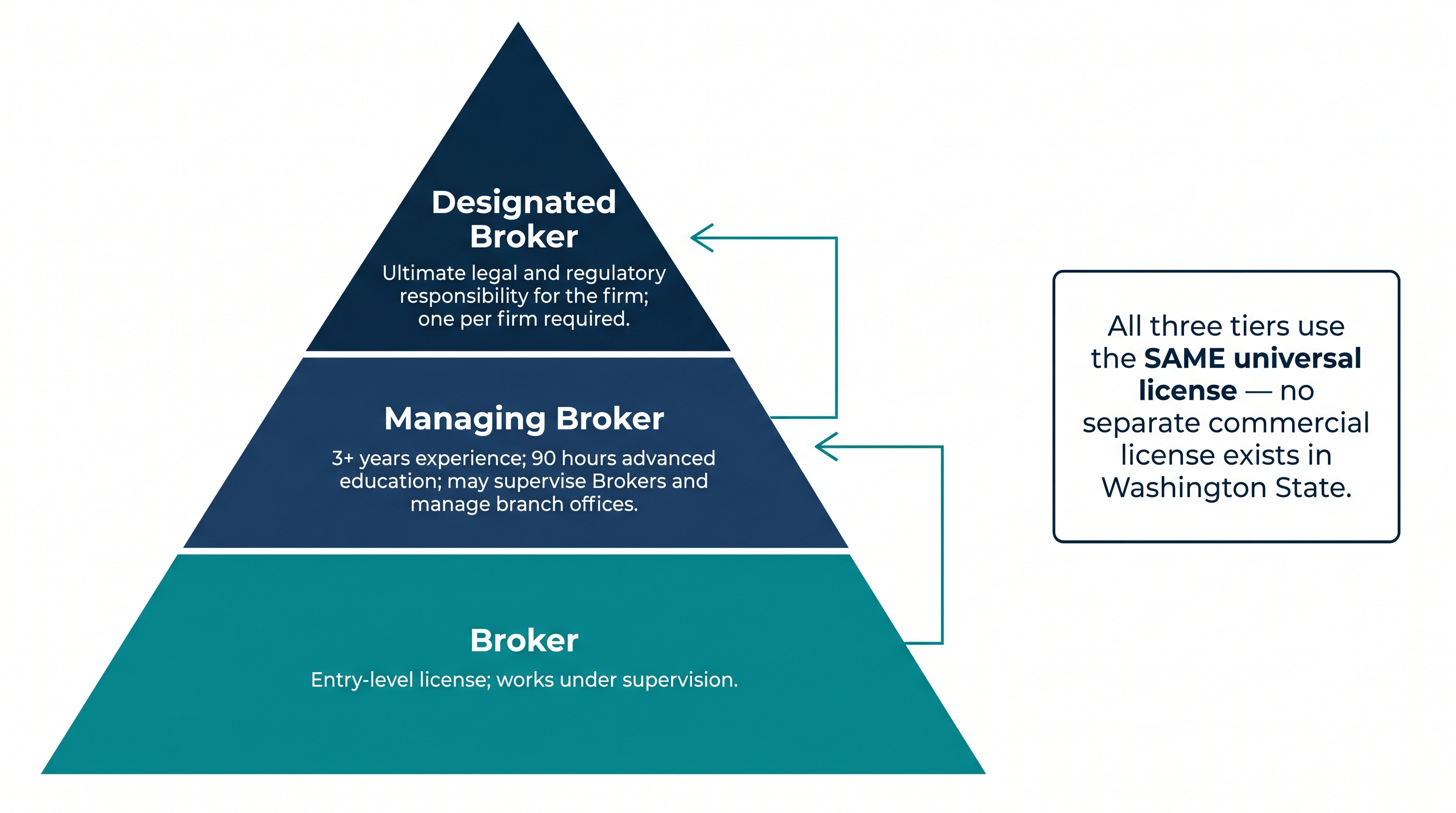
Washington State's tiered Broker licensing structure — a single universal license covers both residential and commercial practice.
Because the state does not issue a specific commercial license, commercial real estate is a practice specialization, not a credential. A newly licensed Broker is legally permitted to broker a large office building on day one, provided they have authorization and adequate supervision from their Designated Broker. Legal permission, however, does not equal professional competence.
What Counts as Commercial Real Estate Under Washington Law?
To practice effectively, you must understand what the state considers commercial. State law provides an overarching definition of real estate brokerage services that applies universally, but uses a narrower definition for specific commercial exemptions.
Under Washington's agency laws, commercial real estate adopts the framework from the state's commercial broker lien statutes. It includes any fee title or leasehold interest in real property, with critical exceptions. Real estate is not commercial if it is:
- Real property containing one to four residential units;
- Real property with no buildings or structures, but zoned for single-family residential use;
- Real property classified as agricultural land.
This 1-4 unit rule is the most crucial distinction for transitioning Brokers. A four-plex is legally residential real estate, subject to standard residential consumer protections. A five-plex is commercial real estate.
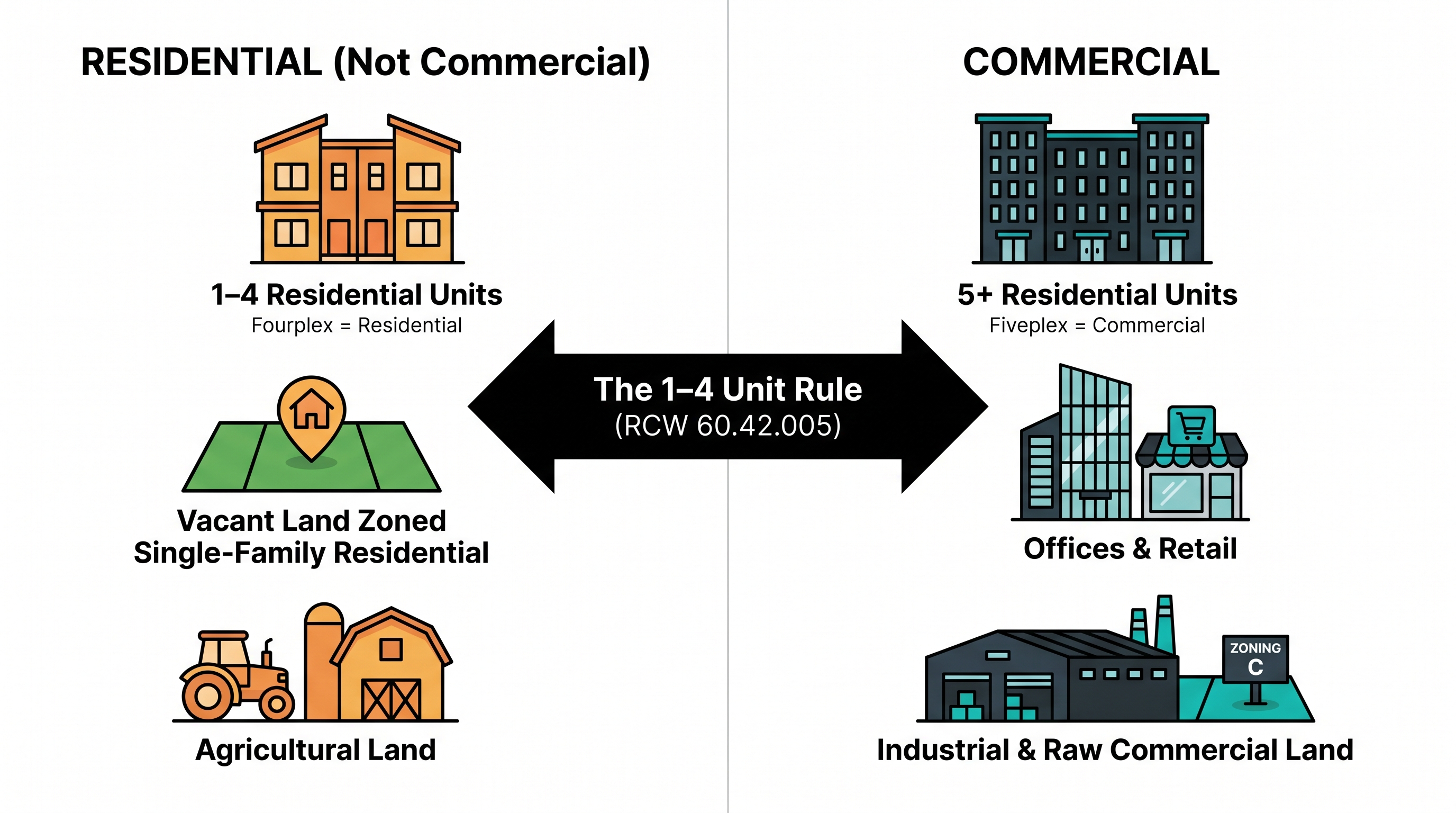
The 1–4 Unit Rule: How Washington law draws the line between residential and commercial real estate (RCW 60.42.005).
Commercial Property Types Washington Brokers Should Know
Commercial real estate is heavily segmented. Transitioning Brokers typically specialize in one of the following property types:
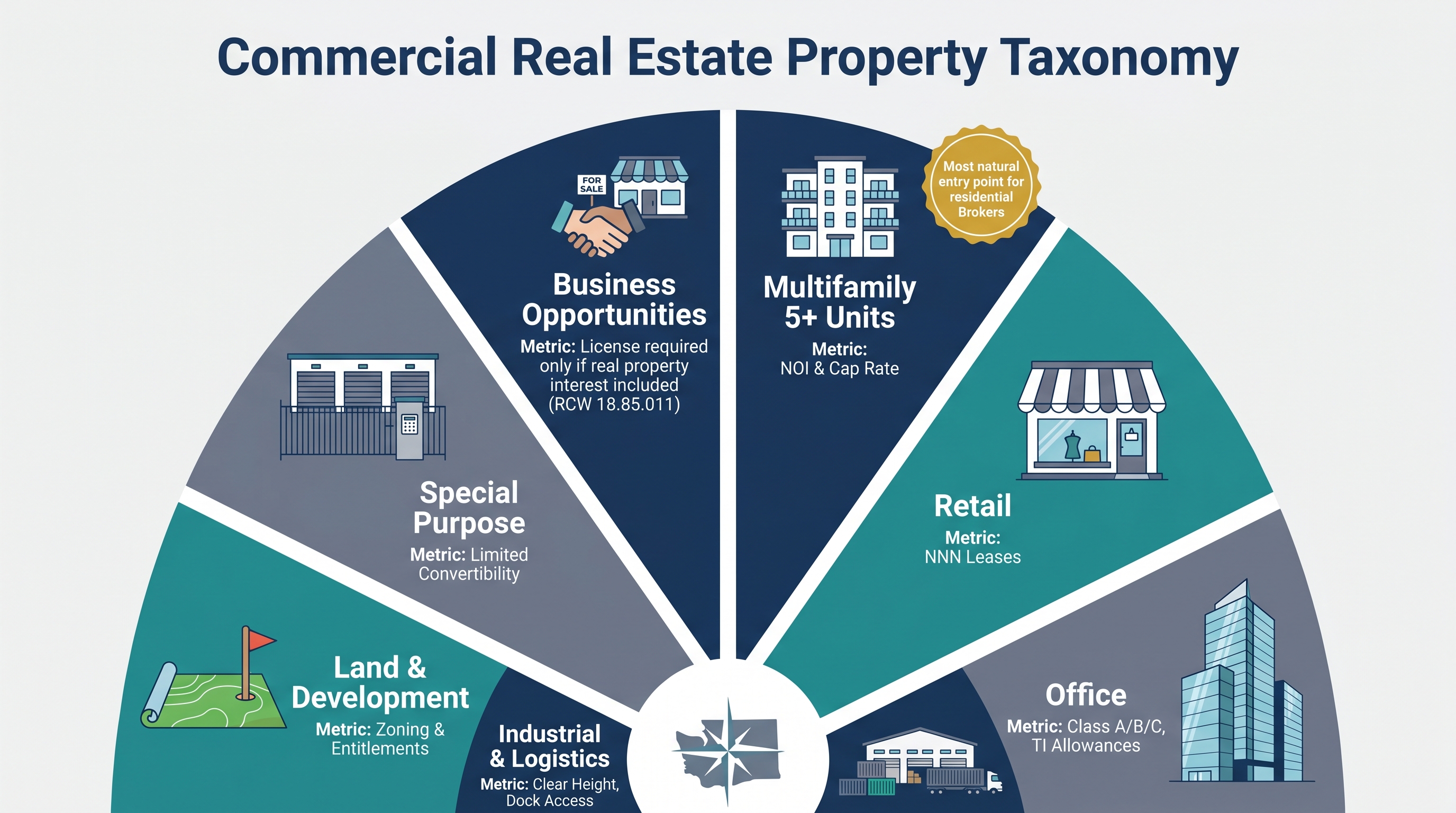
The seven major commercial real estate property types — and the key metrics that drive each sector.
- Multifamily (5+ Units): The most natural stepping stone for residential Brokers. Valuation is driven by Net Operating Income (NOI) and capitalization (cap) rates rather than comparable sales alone.
- Retail: Ranging from single-tenant pad sites to large malls. Transactions heavily involve Triple Net (NNN) leases, where the tenant covers property taxes, insurance, and maintenance.
- Office: Segmented into Class A, B, and C properties. Transactions frequently involve complex negotiations regarding Tenant Improvements (TI) and variable lease structures.
- Industrial and Logistics: Warehouses, manufacturing facilities, and distribution centers. Key metrics include clear height, loading dock access, and floor load capacity.
- Land and Development: Raw land intended for commercial use. Requires deep knowledge of zoning, entitlements, environmental assessments, and local municipal codes.
- Special Purpose: Car washes, self-storage facilities, churches, and schools. Uniquely constructed and difficult to convert to alternative uses.
- Business Opportunities: Selling an existing business entity or goodwill. A real estate license is only required when the transaction includes an interest in real property, such as a lease assignment or building sale. If no real property interest is involved, a Washington real estate license is not required, though a separate business broker registration may be needed.
Ready to build a real foundation before your first commercial deal? The Commercial Property Essentials for the Modern Broker course walks through Washington's statutory definitions, property type fundamentals, and the competency standards DOL expects — a natural next step before you take on your first commercial client.
How the 2024 Agency Law Changes Affect Commercial Brokers
On January 1, 2024, significant revisions to Washington's agency laws took effect. While residential Brokers adapted to mandatory written buyer brokerage services agreements, commercial Brokers operate under different rules — a distinction we cover in more depth in our full guide to Washington's 2024 agency law changes. A Broker is not required to enter into a written services agreement with a buyer or tenant solely interested in commercial real estate.
This exemption carries an important caveat. State law requires brokers to disclose in writing the terms of their compensation before the principal signs a binding legal document. While a formal services agreement is not strictly required, obtaining a written representation and compensation agreement remains industry best practice to ensure payment and define the scope of representation.
Washington explicitly abolished common-law fiduciary duties for the real estate brokerage relationship. Your duties to clients and customers are strictly statutory. However, if you act in another capacity, such as assuming a property management role or acting as a principal, common-law fiduciary duties or other obligations may still apply.
Commercial MLS Access, Listing Platforms, and Compensation in Washington
Unlike the residential sector, which relies heavily on the Northwest Multiple Listing Service (NWMLS), commercial real estate in Washington relies on specialized listing platforms. National databases like CoStar and LoopNet dominate the industry. Locally, the Commercial Brokers Association (CBA) operates the predominant commercial MLS for the Pacific Northwest. Transitioning Brokers must secure access to these platforms to pull accurate commercial comparables and expose listings to investor pools.
Key CBA Forms for Transitioning Brokers
In Washington commercial real estate, you will replace familiar NWMLS forms with CBA standard forms. Key documents include:
- CBA Commercial Purchase and Sale Agreement (CBA PS_1A)
- CBA Commercial Lease Agreement (CBA LE_1)
- CBA Letter of Intent to Purchase/Lease (CBA LOI)
- CBA Exclusive Listing Agreement for Sale or Lease
Familiarity with this document ecosystem is essential before drafting your first commercial offer.
Commercial compensation and co-brokerage practices differ significantly from residential norms. Residential co-op commissions are largely standardized. In commercial real estate, compensation is highly variable and heavily negotiated, and co-brokerage splits are not always 50/50. In commercial tenant representation, commissions are frequently calculated as a percentage of the total gross rent over the lease term. Retainer arrangements and hourly consulting fees are also common.
| Factor | Residential Practice | Commercial Practice |
|---|---|---|
| Listing source | NWMLS | CBA MLS, CoStar, LoopNet |
| Standard forms | NWMLS forms | CBA forms (PS_1A, LE_1, LOI) |
| Written buyer agreement | Mandatory since 2024 | Exempt, though best practice |
| Valuation basis | Comparable sales | NOI and cap rate |
| Compensation structure | Largely standardized | Negotiated, variable |
Supervision, Mentorship, and Continuing Education for Transitioning Brokers
Commercial real estate carries higher risks, greater financial liabilities, and increased complexity. Because Washington permits Brokers to practice commercial real estate immediately upon licensing, the state enforces strict supervision requirements. Any Broker licensed for less than two years is subject to heightened supervision by their Managing Broker or Designated Broker, regardless of whether the transaction is residential or commercial. In the commercial context, your Designated Broker must thoroughly review your Letters of Intent (LOIs), purchase and sale agreements, and lease contracts prior to execution.
Seek out a mentorship opportunity or a junior broker position on an established commercial team. A seasoned commercial Managing Broker — a role we outline step-by-step in our guide on how to become a Washington managing broker — will provide invaluable guidance on underwriting properties, analyzing rent rolls, and navigating standard commercial transaction forms.
Washington also requires ongoing CE, and elective hours are your fastest path to real commercial competence. For a Broker's first active license renewal, the state requires 90 hours of CE, including Advanced Practices, Real Estate Law, a Core Course, and Washington's mandatory Fair Housing CE requirement, plus elective hours. Subsequent renewals require 30 hours, including the Core Course and a 3-hour Fair Housing course. Direct your elective hours toward commercial-specific coursework from the Commercial Brokers Association (CBA), the CCIM Institute, or SIOR that's approved for Washington clock hours.
Practical Steps and Risk Management for Your Commercial Transition
A successful transition requires a strategic approach:
- Firm Authorization & E&O Review: Not all residential brokerages authorize Brokers to conduct commercial transactions. Many residential Errors and Omissions (E&O) insurance policies exclude commercial transactions or impose lower coverage limits. Secure authorization from your Designated Broker and verify E&O coverage before proceeding.
- Build Competence in Investment Metrics: Commercial clients make decisions based on yield, not emotion. Become fluent in Net Operating Income (NOI), Capitalization Rates (Cap Rates), Cash-on-Cash Return, and Internal Rate of Return (IRR).
- Master Commercial Due Diligence: The timeline and scope of commercial due diligence differ substantially from residential inspections. Understand Phase I and Phase II Environmental Site Assessments (ESAs), ALTA surveys, zoning compliance letters, and lease estoppel certificates.
The most important part of transitioning to commercial real estate is recognizing the limits of your current knowledge. Brokers owe a duty to all parties to exercise reasonable skill and care. State law explicitly states, however, that a Broker has no duty to independently investigate matters outside the scope of the Broker's expertise, nor to conduct an independent inspection of the property. Never act as an environmental inspector, an attorney, or a CPA. Build a strong referral network of commercial real estate attorneys, commercial lenders, 1031 exchange accommodators, and environmental consultants, and advise clients in writing to seek expert counsel for all specialized due diligence matters.
Frequently Asked Questions
Do Washington brokers need a separate license to sell commercial property?
No. Washington's Department of Licensing issues one universal Broker license covering all real property types. Commercial real estate is a practice specialization, not a separate credential — though your Designated Broker's authorization and adequate supervision are still required before you take on commercial clients.
What is the 1-4 unit rule in Washington commercial real estate?
It's the statutory line separating residential from commercial property. Real property with one to four residential units, vacant land zoned single-family, or agricultural land is legally residential. A five-plex or larger multifamily property is classified as commercial under Washington law.
Do commercial buyers in Washington need a written services agreement?
No. Washington's 2024 agency law reforms exempt buyers and tenants solely interested in commercial real estate from the mandatory written services agreement required in residential deals. Brokers must still disclose compensation terms in writing before a binding document is signed.
How many CE hours should a transitioning broker put toward commercial coursework?
All elective CE hours beyond the mandatory Core, Law, and Fair Housing courses can go toward commercial topics. First renewal requires 90 total hours; subsequent renewals require 30. Courses from the CBA, CCIM Institute, or SIOR approved for Washington clock hours count toward this requirement.
Your 5-Step Commercial Transition Checklist
Breaking into commercial real estate as a Washington-licensed Broker is a genuine career-growth opportunity for brokers ready to move past the residential grind. Take these concrete steps to begin safely and successfully:
- Verify E&O Coverage: Speak directly with your Designated Broker to confirm your firm's Errors and Omissions policy covers commercial transactions.
- Join the CBA: Subscribe to the Commercial Brokers Association to gain access to commercial MLS listings and essential transaction forms used throughout Washington's commercial market.
- Complete CCIM CI 101: Enroll in a foundational commercial course such as CCIM CI 101 (Financial Analysis for Commercial Investment Real Estate), applying your required elective hours toward completion.
- Identify a Commercial Mentor: Partner with an experienced commercial Managing Broker at your firm or in your network to guide you through underwriting your first transactions.
- Execute Your First LOI Under Supervision: Draft your first commercial Letter of Intent subject to mandatory heightened supervision, ensuring all statutory and financial bases are properly addressed.
Ready to build the foundation for your commercial specialty? Browse Washington's full course catalog — including managing broker and continuing education paths — at realestateschool.org's Washington course hub. Questions about which path fits your goals? Call us at 425-775-2313 — a real person picks up.
WA brokers: no separate commercial license needed. Learn the 1-4 unit rule, CBA forms, and CE steps to transition. Call 425-775-2313.