
AI and Automation in Real Estate: Practical Applications for WA Brokers
Artificial intelligence and automation are driving a massive technological shift in real estate. For Washington state Designated Brokers and Managing Brokers, these tools offer great opportunities to improve operations and client service. However, integrating AI carries significant risk. Washington's regulatory framework sets strict boundaries that Managing Brokers must enforce to protect the public. Ignorance of how an algorithm works is never a valid defense against a compliance violation.
Washington's Regulatory Framework Is Technology-Neutral but Function-Specific
A common misunderstanding is that the lack of a specific AI rule in Washington means AI operates in a gray area. This is false. The Washington State Department of Licensing takes a technology-neutral but function-specific approach. The method of execution doesn't change the underlying legal responsibility, whether a task is done manually or by an AI algorithm.
State law holds the Designated Broker ultimately responsible for all brokerage activities, including supervising affiliated Brokers. This duty covers every AI-generated advertisement, automated CRM email, and algorithmic valuation. Fiduciary duties, like reasonable skill and care, can't be outsourced to a machine. Regulations covering electronic records and advertising apply directly to AI outputs. AI is not a shield against liability; it requires strict, proactive supervision.
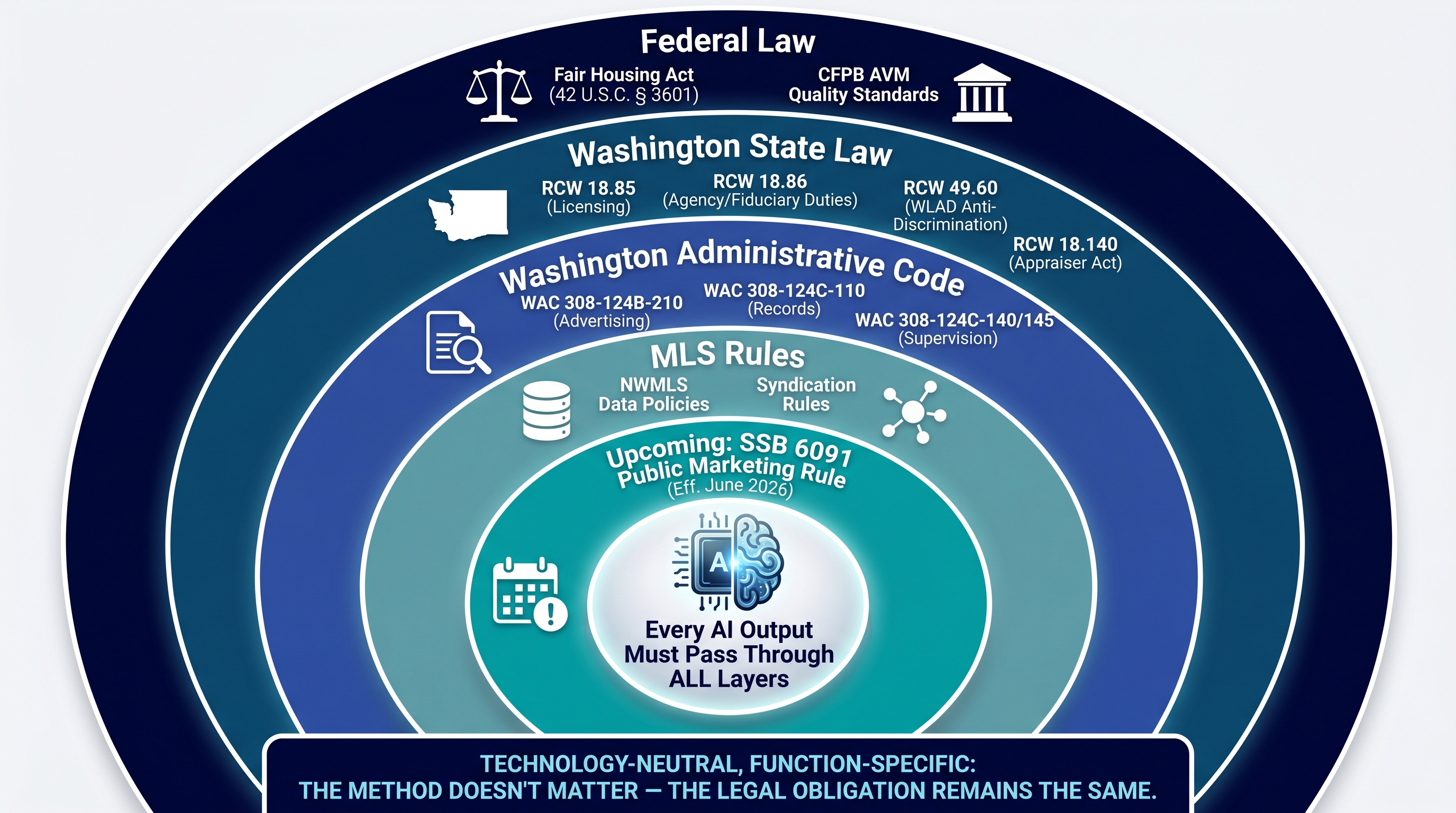
Washington's AI Compliance Layers: Every AI-generated output must satisfy all regulatory layers simultaneously — from federal Fair Housing law to MLS data policies.
Practical AI Applications for Managing Brokers
When properly supervised, AI and automation can greatly improve firm efficiency and strengthen compliance.
Transaction Management Automation
The Department of Licensing strictly enforces document timelines. Brokers must submit all transaction documents to their firm within two business days of mutual acceptance. Automation platforms can track these deadlines and send alerts, preventing administrative violations.
Managing Brokers can also use AI dashboards to meet heightened supervision duties. Designated Brokers and delegated Managing Brokers must provide heightened supervision for Brokers licensed for less than two years, which includes reviewing their transaction documents within five business days of mutual acceptance. Advanced systems can automatically flag documents submitted by newer Brokers, scanning for missing initials or incomplete addendums to ensure Managing Brokers never miss this critical review window.
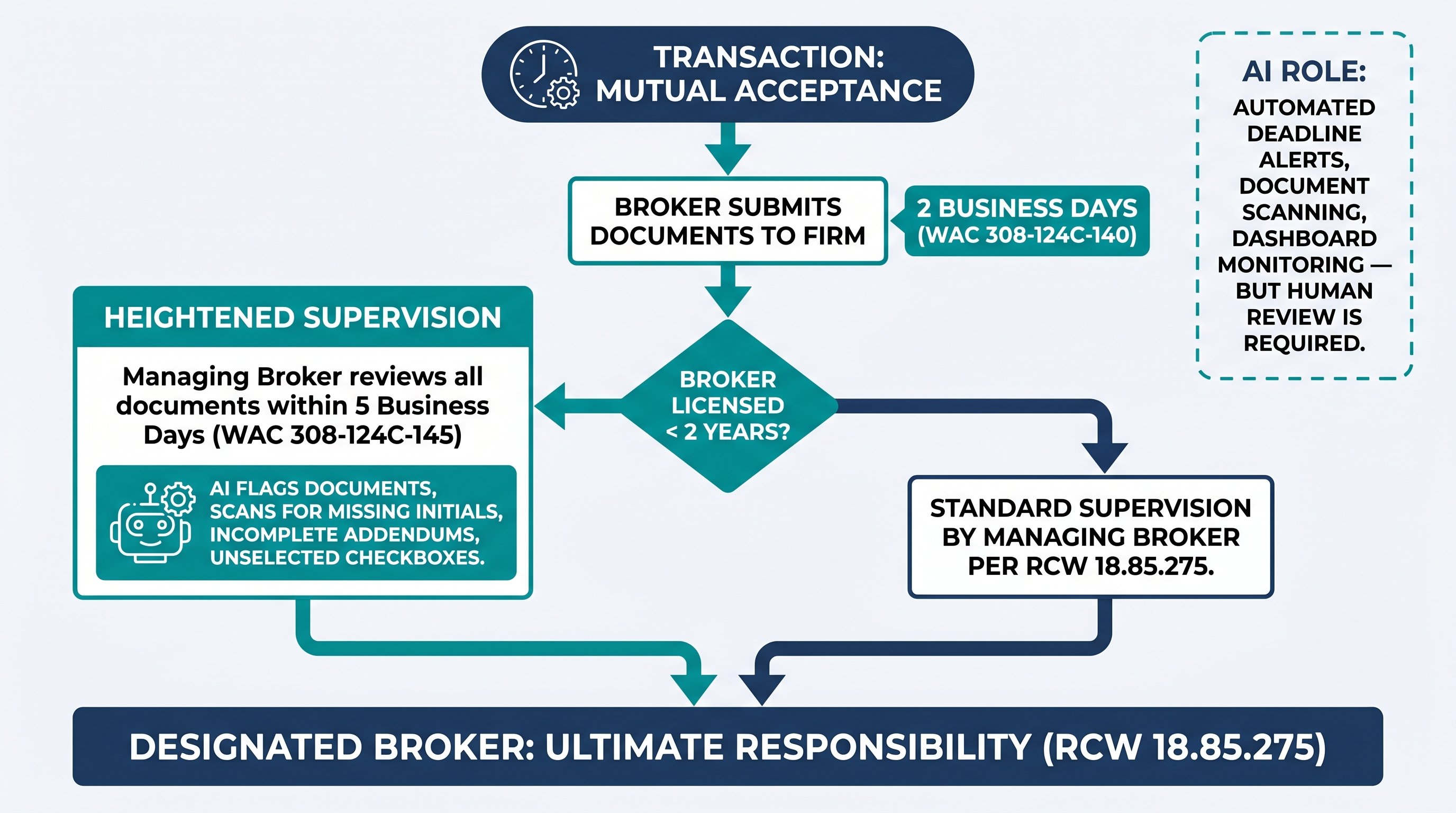
Transaction Supervision Workflow: How AI automation supports — but does not replace — Managing Broker oversight of document review timelines under Washington regulations.
AI-Assisted Listing Descriptions and Chatbots
Generative AI can write listing descriptions in seconds, and chatbots can engage website visitors around the clock. You must configure these tools to comply with Washington's advertising and agency rules. A chatbot must not accidentally create an agency relationship or give wrong property information, as the firm is strictly liable for its statements. Similarly, the responsible Broker must fact-check AI-drafted listing copy to ensure it doesn't hide material defects or misrepresent zoning regulations.
Advertising Automation and Compliance
Advertising is a frequent source of disciplinary action. State regulations cover all forms of advertising regardless of the medium or technology used.
The foundation of Washington real estate advertising law is that the firm's assumed name must appear clearly and conspicuously in all advertising. When a Broker uses AI to generate social media posts or video scripts, the Managing Broker must ensure every output includes the firm name clearly. You can't use AI to create deceptive team names. The Designated Broker must pre-approve any doing business as name. Managing Brokers must audit automated schedulers to verify that AI-generated copy doesn't omit mandatory disclosures, misrepresent property features, or hide the firm's identity.
Managing Brokers must also follow Multiple Listing Service rules. The Northwest Multiple Listing Service enforces strict guidelines governing AI-generated syndication, listing media, and pocket listing practices. Review all AI marketing outputs against these policies before publishing.
Electronic Records and Audit Readiness
Washington Brokers increasingly rely on cloud-based systems and AI communication tools. State rules allow electronic storage, but require that electronic records be indexed and available for immediate retrieval, viewing, and printing at the firm's licensed office location.
If an auditor arrives unannounced, a Managing Broker can't excuse a delay by claiming records are locked in an AI server experiencing downtime. The firm must guarantee immediate access. You must also keep digital records for a minimum of three years. This includes automated correspondence, chatbot transcripts, and text message drip campaigns related to a transaction. Firms must ensure their AI tools properly archive conversations to meet this retention requirement.
Fair Housing Risks with AI
The biggest hidden liability in using AI is algorithmic bias and potential Fair Housing violations. The Washington Law Against Discrimination and the federal Fair Housing Act strictly prohibit discrimination based on race, color, national origin, religion, sex, familial status, disability, sexual orientation, and veteran status.
AI algorithms can accidentally learn and repeat discriminatory patterns. Using AI to automate ad targeting by excluding certain zip codes can act as digital redlining. If a Broker uses generative AI to write a listing description, the AI might insert biased language. Phrases like "perfect for a traditional family" or "walking distance to the local church" violate Fair Housing guidelines. Automated tenant screening software is another high-risk area. If an algorithm unfairly rejects applicants based on discriminatory factors, the firm faces massive liability. Managing Brokers must enforce a strict human in the loop rule. A licensed professional must review all AI-generated content and automated screening decisions before publication or adverse action.
AI Valuation Tools Versus Appraisals
Automated Valuation Models and AI pricing algorithms quickly gather market data, but Managing Brokers must ensure affiliated Brokers understand the legal difference between a formal appraisal and a Broker Price Opinion or Competitive Market Analysis.
Under Washington law, only certified appraisers may perform formal appraisals. Real estate licensees can provide competitive market analyses and broker price opinions in the normal course of business. If a Broker relies entirely on an AI-generated valuation and presents it as an authoritative estimate without independent professional analysis, they risk crossing into unlicensed appraisal practice and violating the duty of reasonable skill and care. The Consumer Financial Protection Bureau highlighted concerns about algorithmic valuations lacking accuracy and harboring bias in a June 24, 2024 rule. AI estimates require rigorous Broker verification. The technology should supplement, not replace, the local market expertise of a licensed Washington Broker.
Upcoming Law: Public Marketing Rule
Managing Brokers must prepare automated systems for new legislative rules. Effective June 11, 2026, Substitute Senate Bill 6091 introduces the Public Marketing Rule, establishing strict rules against the exclusive or limited marketing of residential properties to ensure fair, equal access to housing inventory.
Implementing this rule requires overhauling a firm's automated marketing workflows. Managing Brokers should audit listing launch sequences, automated email campaigns, and coming soon digital practices. Any AI marketing tool programmed to promote exclusive off-market opportunities to a closed network of VIP buyers will trigger serious compliance failures. Violations will be grounds for licensing discipline. Firms must ensure any property marketed to the public is submitted to the Multiple Listing Service within mandated timeframes, eliminating the risk of prohibited pocket listings.
Building a Firm AI Policy
To use AI while lowering regulatory risks, Designated Brokers and Managing Brokers must create a comprehensive Firm AI Policy documented in the firm's manual, addressing these critical components:
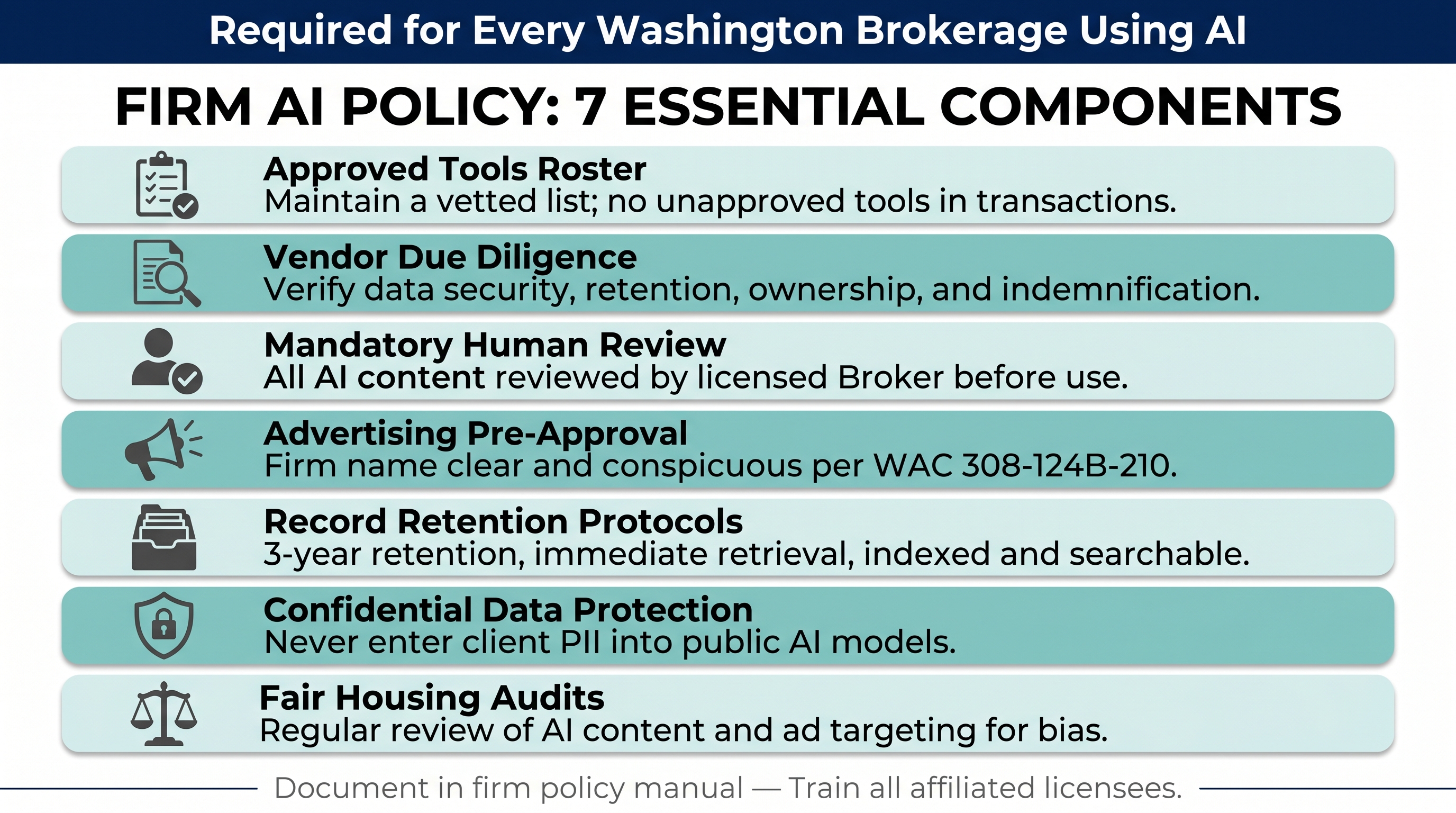
The 7 Pillars of a Firm AI Policy: Every Washington brokerage using AI or automation tools should document and enforce these components to maintain regulatory compliance.
- Approved Tools Roster: Keep a current list of vetted AI tools. Brokers must be prohibited from using unvetted applications without prior Managing Broker approval.
- Vendor Due Diligence: Review AI vendor contracts to verify data security, ownership of outputs, and data retention capabilities. This ensures the firm can meet record retention requirements if a vendor goes offline.
- Mandatory Human Review: Require a human in the loop. The responsible Broker must review all AI-generated advertising, listing copy, valuation estimates, and client correspondence for accuracy and compliance before dissemination.
- Advertising Pre-Approval: Establish that AI-generated team names, logos, or marketing campaigns must get Managing Broker approval to confirm the firm's name is clear and conspicuous.
- Record Retention Protocols: Define how AI outputs and automated communications are captured, indexed, and stored to meet the three-year retention and immediate retrieval requirements.
- Confidential Data Protection: Prohibit Brokers from entering confidential client information into open-source public AI models like ChatGPT. Entering financial details or sensitive negotiation strategies could compromise client confidentiality and violate agency duties.
- Fair Housing Audits: Conduct regular audits of AI-generated marketing content and ad targeting parameters to ensure compliance with the Washington Law Against Discrimination and the Fair Housing Act.
Conclusion
Artificial intelligence and automation are permanently changing the Washington real estate landscape, offering tools that greatly expand a firm's operational capacity. AI is a powerful assistant, but not a replacement for professional Broker judgment and careful oversight. The fundamental legal duties owed to the public and the strict standards enforced by the Department of Licensing remain constant, regardless of the technology used. Managing Brokers should conduct an immediate audit of all deployed AI tools against this framework. For strong compliance, consult the Washington State Department of Licensing resources or a real estate compliance attorney when developing firm AI policies. By proactively building these systems, Washington real estate leaders can navigate the future with confidence, ensuring innovation never comes at the expense of compliance.