

Washington real estate brokers in 2026 know the Department of Licensing (DOL) actively enforces compliance to protect the public. The DOL conducts routine audits of real estate firms and affiliated brokers about every three years. This year is the first full audit cycle since the major 2024 agency law reforms changed real estate practice.
The stakes are high. A missing document or uninitialed disclosure is a direct regulatory violation exposing you and your managing broker to serious disciplinary action. Penalties for missing documents or improper handling of client funds range from mandatory continuing education and large fines to license suspension or revocation.
What Auditors Review
Today, audits are systematic, thorough, and conducted remotely. When an audit starts, the auditor requests a randomized batch of transaction files and firm logs. Your designated broker has a short window to upload these documents to a secure portal.
Auditors carefully review buyer brokerage agreements, agency disclosures, compensation disclosures, earnest money records, multiple-offer logs, trust accounts, and bank records. They want a complete, unbroken chain of compliance from your first client meeting to the final disbursement of funds at closing.
The 2024 Agency Law Changes
When state law overhauled agency relationships on January 1, 2024, it changed how Washington brokers work daily. Misunderstandings about these changes remain the leading cause of audit findings.
If you represent a buyer, you must have a written services agreement in place before providing any real estate brokerage services. Showing a home first and getting signatures later is not allowed. Under state law, if your written services agreement does not specify a duration, it automatically defaults to a 60-day term. Auditors consistently find brokers operating under expired agreements because they failed to track this limit.
Sellers also need written services agreements. A standard listing agreement meets this requirement, but it must clearly outline the scope of services, compensation, and duration.
The agreement must clearly indicate whether the brokerage relationship is exclusive or nonexclusive using a prominent checkbox.
Consenting to limited dual agency requires separate, explicit initials from both the buyer and the seller.
State rules require you to give the Washington Real Estate Agency pamphlet to all parties and get written acknowledgment of receipt.
Written agency disclosure must be given to all parties before anyone signs an offer.
Compensation terms must be explicitly detailed in the services agreement. You must specify exactly how, when, and by whom you will be paid.
Watch for new modifications taking effect on June 11, 2026, updating rules around limited and exclusive marketing and pamphlet updates.
Your 2026 Transaction File Checklist
Treat every transaction file like it could be uploaded to an auditor tomorrow morning.
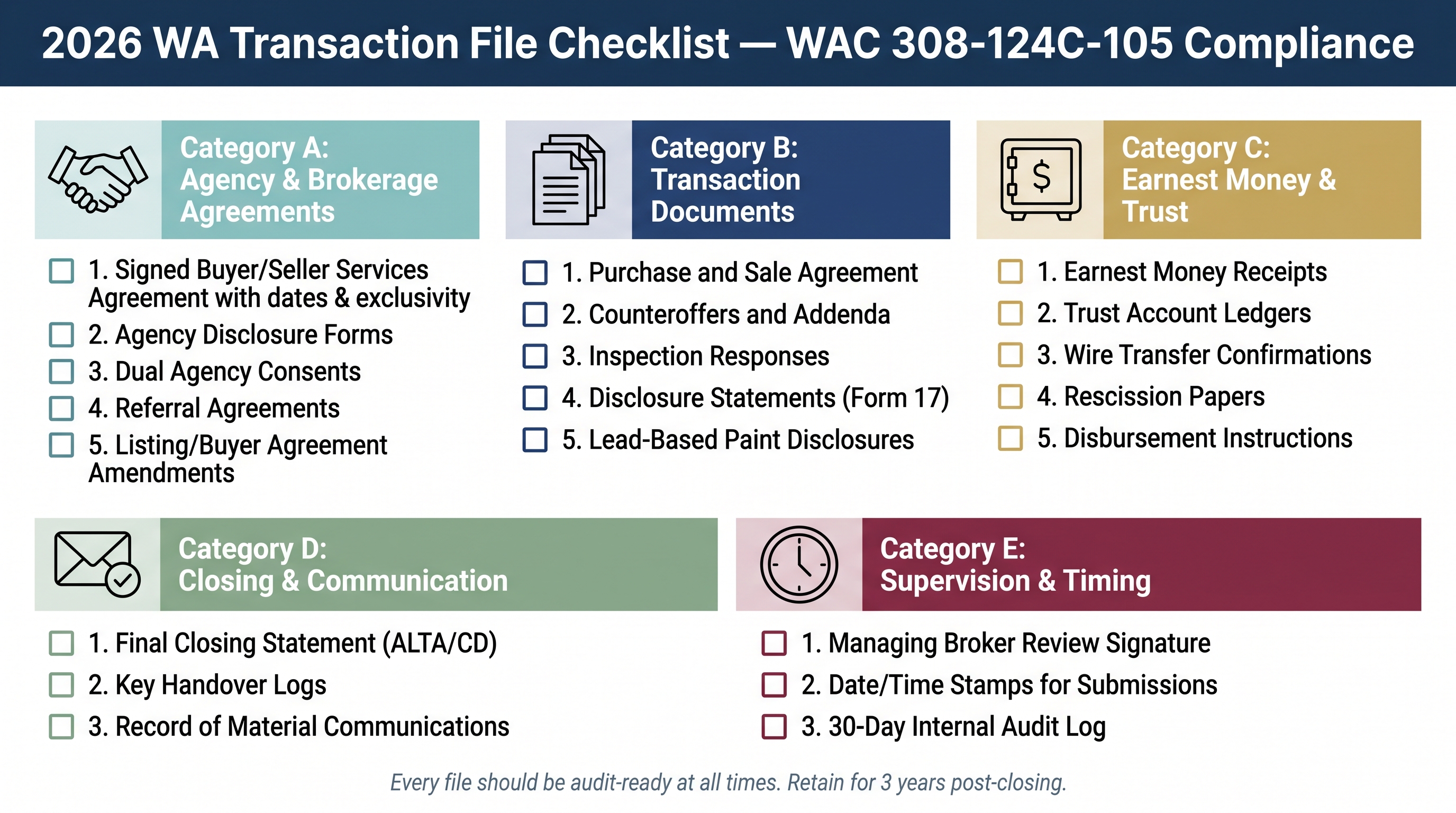
Your 2026 transaction file checklist at a glance — built from WAC 308-124C-105 requirements.
Category A: Agency and Brokerage Agreements
- Signed Buyer or Seller Services Agreement: Fully executed with clear start and end dates, and the exclusive or nonexclusive checkbox marked.
- Pamphlet Acknowledgment: Written proof the client received the Washington Real Estate Agency pamphlet before signing agreements.
- Agency Disclosure: Signed and dated before an offer is drafted or signed.
- Compensation Disclosure: Clear terms of compensation agreed to and signed.
- Limited Dual Agency Consent: Separately initialed by both buyer and seller, if applicable.
Category B: Transaction Documents
- Purchase and Sale Agreement: Complete with every addendum. Use "N/A" for blank lines, and initial all strikethroughs.
- All Written Offers: Includes unaccepted, rejected, and rescinded offers to verify you presented all offers.
- Multiple-Offer Log: A complete log of all offers received.
- Counteroffers: Every version of the negotiation.
- Mutual Acceptance Confirmation: Documents showing the exact date and time of mutual acceptance.
Category C: Earnest Money and Trust
- Earnest Money Receipt: Documents showing exactly when you received the funds.
- Proof of Delivery: Records showing the exact date you delivered the funds to your firm or escrow.
- Dated Receipt from Holder: Written confirmation that the funds were officially deposited.
- Non-Cash Earnest Money Disclosure: Required if the earnest money is not cash or a readily negotiable instrument.
- Interest Election Documentation: Required for all earnest money deposits over $10,000.
Category D: Closing and Communication
- Closing Statement: The final settlement statement confirming the transaction is complete.
- Material Correspondence and Emails: Any communication changing the terms, conditions, pricing, or timeline, including text messages.
- Referral Agreements: Written documentation of any referral fees.
Category E: Supervision and Timing
- Two-Business-Day Document Submission: Time-stamped proof you submitted all transaction documents to your managing broker within two business days of mutual acceptance.
- Five-Business-Day Review: If licensed for less than two years, documentation showing your managing broker reviewed the file within five business days of mutual acceptance.
- Three-Year Retention Compliance: All files must be securely kept for three years after the transaction closes or terminates.
Multiple-Offer Documentation
Auditors are focusing heavily in 2026 on how brokers handle multiple offers. State law requires you to present all written offers and notices to the seller in a timely manner. You cannot act as a gatekeeper. The department also closely monitors transactions for fair housing compliance under the Washington Law Against Discrimination.
To protect your transactions, keep a detailed multiple-offer log. Document the exact date and time you received each offer, presented it to the seller, and the seller's final decision.
Advise sellers to evaluate offers based strictly on lawful, objective criteria like purchase price, contingencies, financing type, and closing timeline. Strongly discourage buyer love letters, which can accidentally trigger fair housing violations.
Earnest Money Timing
Mishandled trust funds lead to fast disciplinary action. Brokers often confuse the internal delivery timeline with the banking deposit timeline.
The First Clock (Internal Delivery): Under state rules, you must deliver the earnest money to your managing broker, designated broker, or escrow agent within two business days of receiving the funds.
The Second Clock (Bank Deposit): The broker or firm holding the funds must deposit them into the firm's trust account or deliver them to escrow no later than the next banking day following receipt of the funds or following mutual acceptance, depending on the agreement.
For example, if you receive an earnest money check on a Thursday afternoon, Friday is Day 1 of your two-business-day clock to deliver the funds. If Monday is a federal holiday, Tuesday becomes Day 2.
However, if the agreement specifies the check must be deposited into the brokerage's trust account, the next-banking-day clock for the actual deposit starts the moment your managing broker receives the funds.
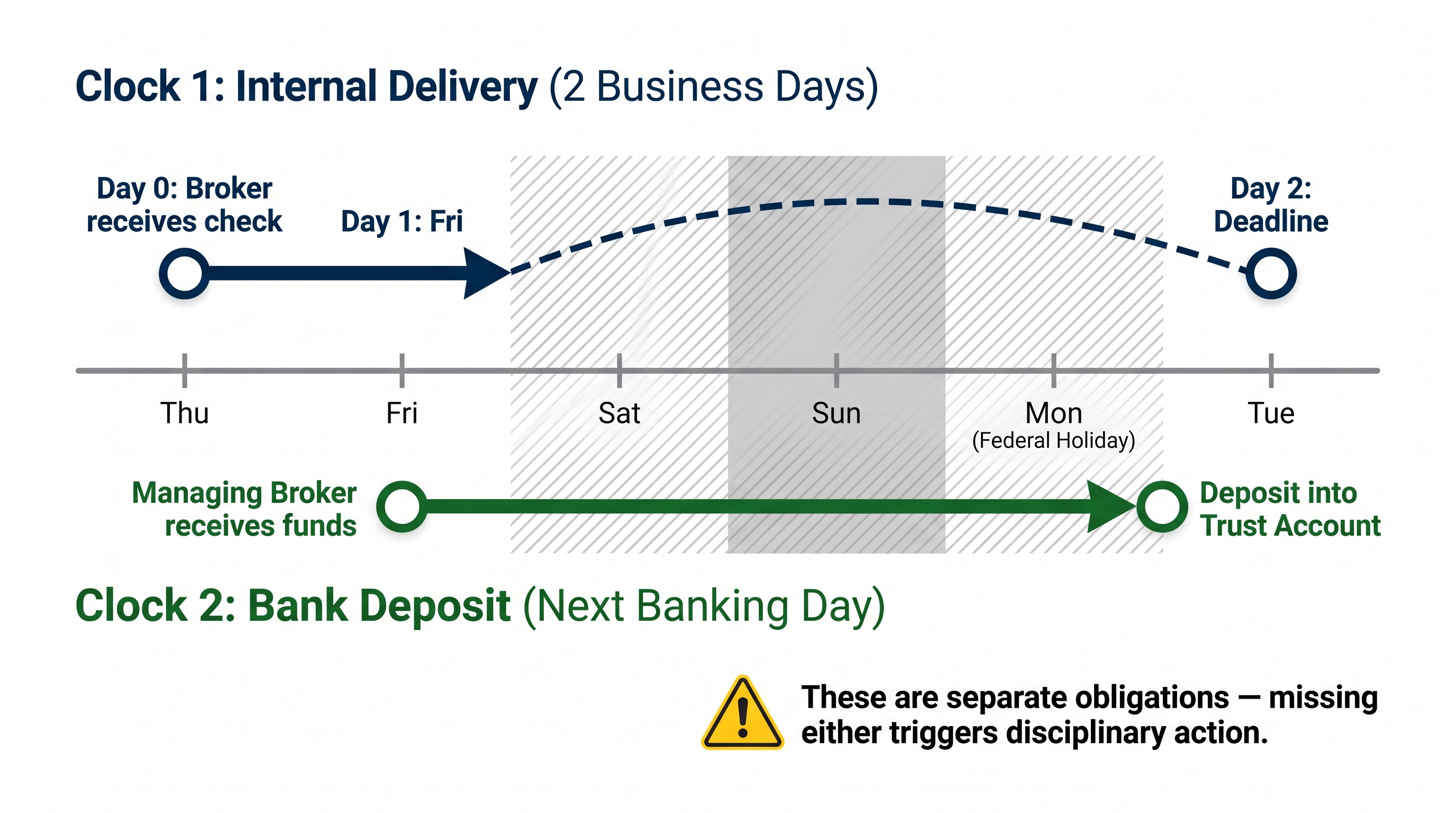
The two earnest money compliance clocks operate independently. Track and document both to avoid disciplinary action.
What to Do If You Receive an Audit Finding
If you receive an audit finding letter, do not panic. Most findings come from correctable administrative mistakes. You have a formal right to respond, and there is a structured appeals process. Consult legal counsel and notify your designated broker immediately to help put together a compliant response.
Invest in Your Compliance Knowledge
Prepare for an audit long before an auditor contacts you.
WA Advanced Real Estate Law ($119):
This curriculum provides a deep look at agency compliance, disclosure requirements, and services agreement best practices, including the 2024 legislative changes and upcoming 2026 updates.
Practical Property Valuation ($59):
Documenting how you decided on a listing price is very important. State rules now require you to keep Broker Price Opinions and Comparative Market Analyses used in a transaction in your files.
Conclusion
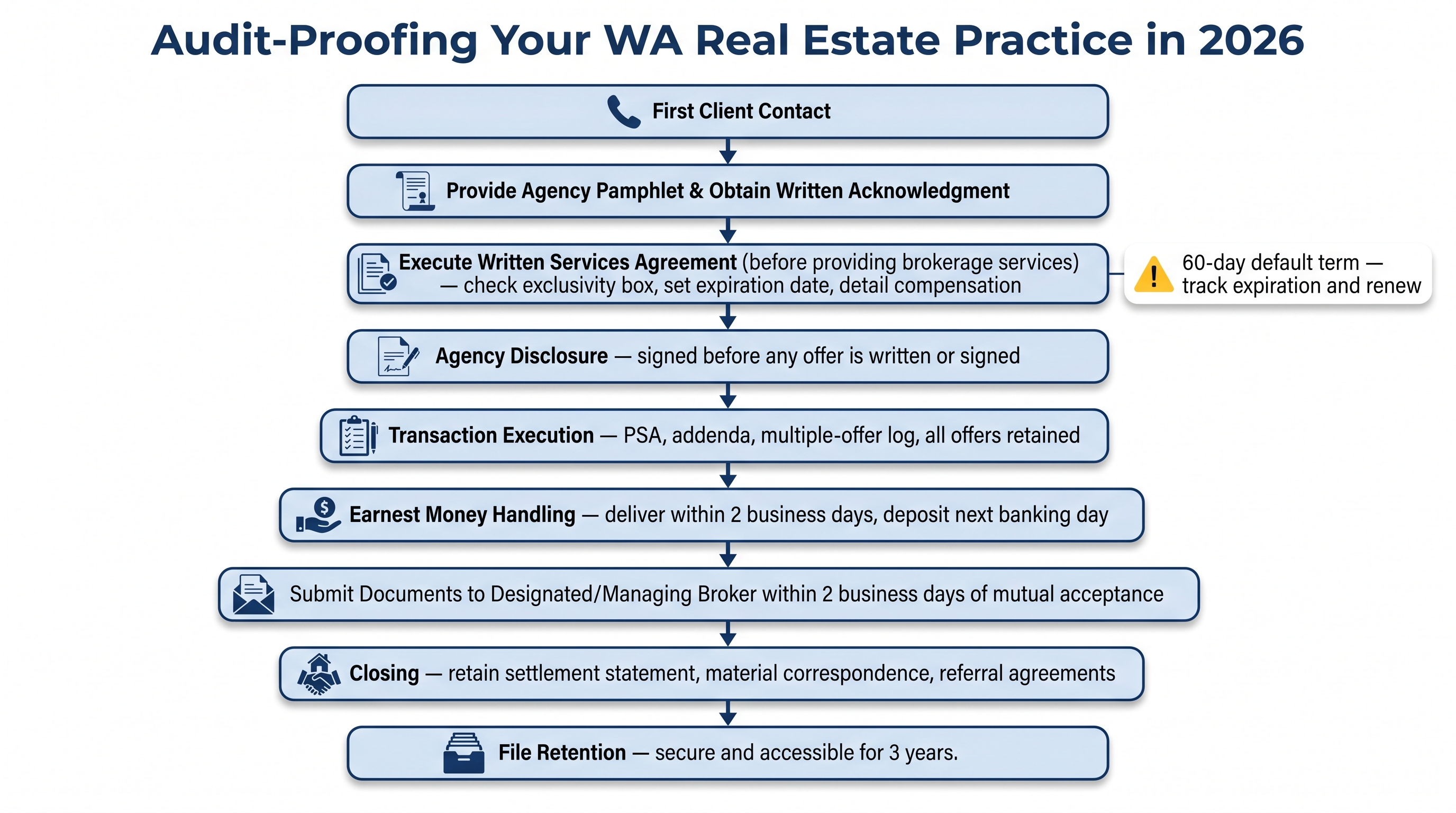
Audit readiness is a daily discipline — follow this compliance workflow from first contact to file retention.
True audit readiness is a daily, disciplined practice. Every email you save and every earnest money receipt you document builds a stronger foundation for your license.
By using this 2026 transaction documentation checklist, respecting the dual timelines for earnest money, and staying current on Washington's changing agency laws, you can run your real estate business with clarity and confidence.