
The agents who master the intricacies of Down Payment Assistance (DPA) programs, seller concessions, and loan limits are the ones who become indispensable advisors to their clients. This guide outlines the essential tools and compliance requirements Washington agents need to navigate the 2026 housing market with confidence.
Washington's DPA Landscape in 2026
Overview
Washington state offers a robust and dynamic ecosystem of Down Payment Assistance programs, primarily administered by the Washington State Housing Finance Commission (WSHFC). Staying current with these programs is critical, as guidelines and funding levels have evolved significantly heading into 2026.
WSHFC Core Programs
The WSHFC remains the central hub for statewide DPA. All WSHFC down payment assistance options are structured as "payment-deferred loans" and must be paired with a Commission first-mortgage program, either Home Advantage or House Key Opportunity.2
The flagship Home Advantage DPA program provides a deferred-payment loan of 3%, 4%, or 5% of the first-mortgage loan amount at 0% interest. Effective September 2025, the maximum borrower income limit for Home Advantage was raised to $215,000, opening the door for many moderate-income buyers who were previously ineligible for assistance.1
For buyers who need additional help on lower-priced homes, the Home Advantage Needs-Based DPA provides up to $10,000 at 1% simple interest. This option is designed for homes priced at or under $250,000, with income caps set at $157,100 for King and Snohomish counties and $122,100 for all other counties.2
For buyers who require more targeted support, the House Key Opportunity DPA offers up to $15,000 at 1% simple interest, optimized for lower-income households and specific target areas. Two additional WSHFC programs round out the core offerings: HomeChoice, which provides up to $15,000 for buyers with a disability or a disabled household member, and the Veterans DPA, which offers up to $10,000 at 3% interest for eligible military families.2
Participation in any WSHFC program requires the buyer to complete a WSHFC-sponsored homebuyer education course. Agents must account for class scheduling and certificate validity when building out transaction timelines. Because classes can fill quickly and certificates carry expiration dates, agents should encourage buyers to fulfill this requirement during the pre-approval phase rather than in the final days before closing.2
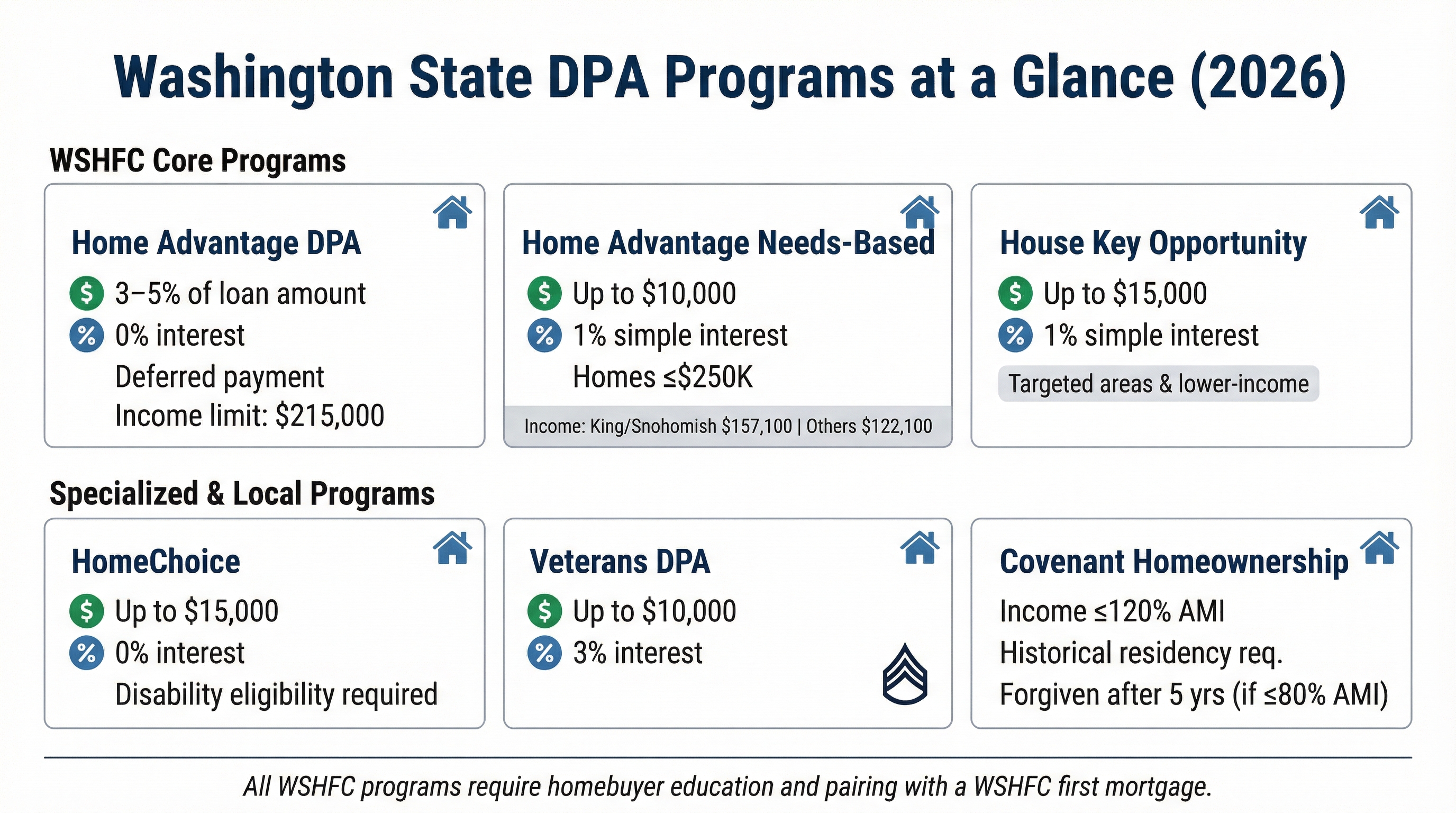
Washington's 2026 DPA landscape offers layered options — but each
program carries distinct eligibility rules, interest rates, and pairing
requirements.
The Covenant Homeownership Program
The state-created Covenant Homeownership Program has demonstrated significant early impact. In its first full fiscal year (July 2024 to June 2025), the program assisted 547 homebuyers across 24 counties.3 Designed to address historical housing discrimination, the program serves first-time homebuyers with household incomes at or below 120% of the Area Median Income (AMI).
A key distinguishing feature is its specific historical eligibility criteria: under RCW 43.181.040, the applicant, or an ancestor, must have been a Washington resident prior to the April 1968 enactment of the federal Fair Housing Act.4 The program also provides a loan forgiveness pathway after five years for households at or below 80% AMI. Under RCW 36.22.185, the program is funded through a $100-per-document recording assessment, establishing a sustainable revenue stream that keeps this resource available in 2026.5
Local and Municipal DPA Programs
Beyond statewide options, local municipalities offer meaningful additional layers of assistance. The Seattle Office of Housing (OH) provides up to $76,000 in DPA for buyers at or below 80% AMI. Agents should note a critical administrative distinction: the Seattle DPA is no longer available directly through the WSHFC and must be accessed through designated OH partner organizations.6 In East King County, the ARCH program offers up to $30,000 at 4% simple interest. In Southwest Washington, Clark County recently relaunched its DPA program, providing up to $60,000 at 2% simple interest.
Agents who are considering combining multiple assistance sources should monitor HB 2153 closely. Introduced in the 2026 regular legislative session, this bill proposes restrictions on homebuyers receiving multiple state-funded DPA loans or grants, commonly referred to as "stacking", which could significantly alter layered financing strategies.7
Seller Concessions: Know Your Loan-Program Limits
When DPA alone is insufficient to cover closing costs, seller concessions become the primary tool for making a transaction work. There is no universal rule governing concessions; limits are determined entirely by the buyer's loan program. Agents should approach concessions using a clear "three buckets" framework.
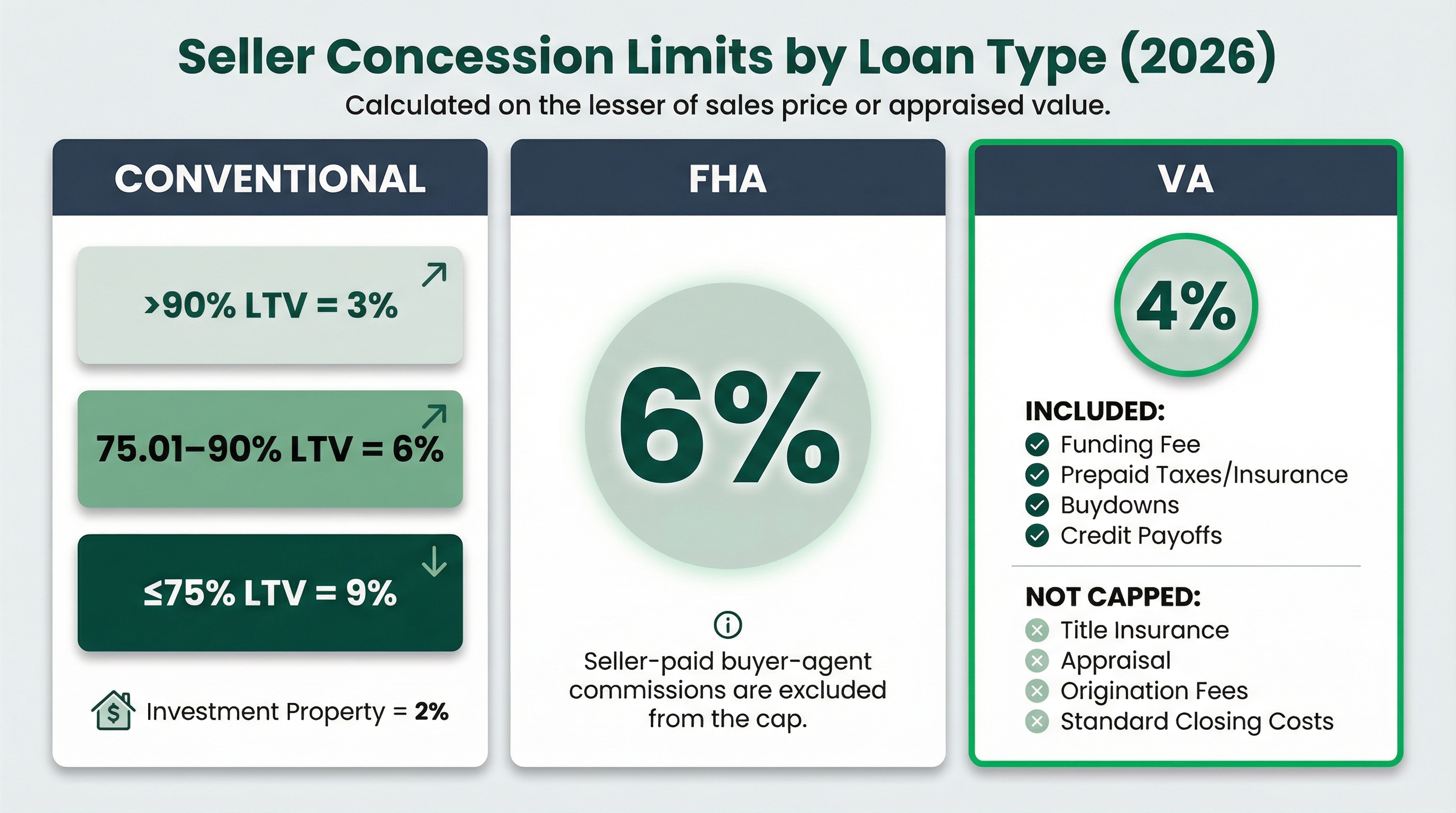
Quick Reference: Seller concession caps vary significantly by loan
type. VA loans are the most commonly misunderstood - standard closing
costs are not subject to the 4% cap.
1. Conventional Loans (Fannie Mae/Freddie Mac)
For conventional loans, Fannie Mae categorizes these credits as Interested Party Contributions (IPCs). The caps are based strictly on the combined loan-to-value (CLTV) ratio and property occupancy type, calculated on the lower of the sales price or appraised value.8 For a primary residence or second home:
3%
Greater than 90% LTV
6%
75.01% to 90% LTV
9%
75% or less LTV
For investment properties, the cap is a firm 2% regardless of LTV.
2. FHA Loans
FHA loans carry an IPC cap of 6% of the lesser of the property's sales price or appraised value. While 6% is the widely accepted industry standard for the FHA IPC limit, agents are strongly advised to verify this figure and its applicable conditions directly in the current live text of HUD Handbook 4000.1 before relying on it for client guidance. In a notable development, HUD clarified that seller-paid buyer-agent commissions, if customary and reasonable, do not count against the IPC cap, preserving the buyer's full 6% allocation for actual closing costs and prepaids.9
3. VA Loans: The Most Misunderstood Category
VA loans are where real estate agents most frequently encounter confusion. The VA allows a seller concession cap of 4%, but this cap applies only to specific items: the VA funding fee, prepaid taxes and insurance, temporary interest rate buydowns, and payoffs of the buyer's outstanding credit balances or judgments.10 A common misconception is that standard closing costs fall under this cap. They do not. Title insurance, appraisal fees, origination fees, and similar charges are not subject to the 4% limit. A seller may pay all of a veteran's traditional closing costs in addition to up to 4% in defined concessions.
Stacking DPA and Seller Concessions: The Precision Play
Combining state-funded DPA with seller concessions requires precise drafting in the purchase and sale agreement. WSHFC programs impose strict constraints: per the WSHFC Home Advantage Program Manual (updated 02/02/2026), no cash back is permitted to the borrower at closing, DPA funds cannot be applied toward appraisal gaps, and DPA funds cannot be used for interest rate buydowns.12
To avoid leaving money on the table, agents should adopt clear contract language conventions. Rather than requesting a flat dollar credit that may exceed allowable costs, agents should structure seller contributions as:
"Seller to contribute up to $X, not to exceed buyer's actual allowable closing costs, prepaids, and allowed broker compensation."
VA Loan Limits in WA: Full vs. Reduced Entitlement
For agents serving Washington's substantial military community, understanding VA loan limits in 2026 starts with a foundational question: does the buyer have full or reduced entitlement?13
Veterans with full entitlement face no maximum loan limit. The VA will guarantee loans of any size with zero down payment, provided the borrower qualifies on income and credit. Veterans with reduced entitlement, typically because they carry an active VA loan on another property or have a prior default, are subject to zero-down purchasing power limits tied to the Federal Housing Finance Agency (FHFA) county conforming loan limits.
$832,750
Baseline conforming limit (most counties)
$1,063,750
King, Pierce, Snohomish (2026)
For 2026, the baseline conforming loan limit for most of the country is $832,750. High-cost counties carry elevated limits. In King, Pierce, and Snohomish counties, the 2026 conforming loan limit is $1,063,750, as officially announced by the FHFA.14 This geographic distinction creates a particularly important scenario for personnel stationed at Joint Base Lewis-McChord (JBLM). A buyer with reduced entitlement shopping in Tacoma (Pierce County) may purchase up to $1,063,750 with zero down. The moment that same buyer crosses into Lacey or Olympia (Thurston County), the zero-down limit drops to the $832,750 baseline. Agents working with military clients must be precise about county boundaries when advising on purchasing power.
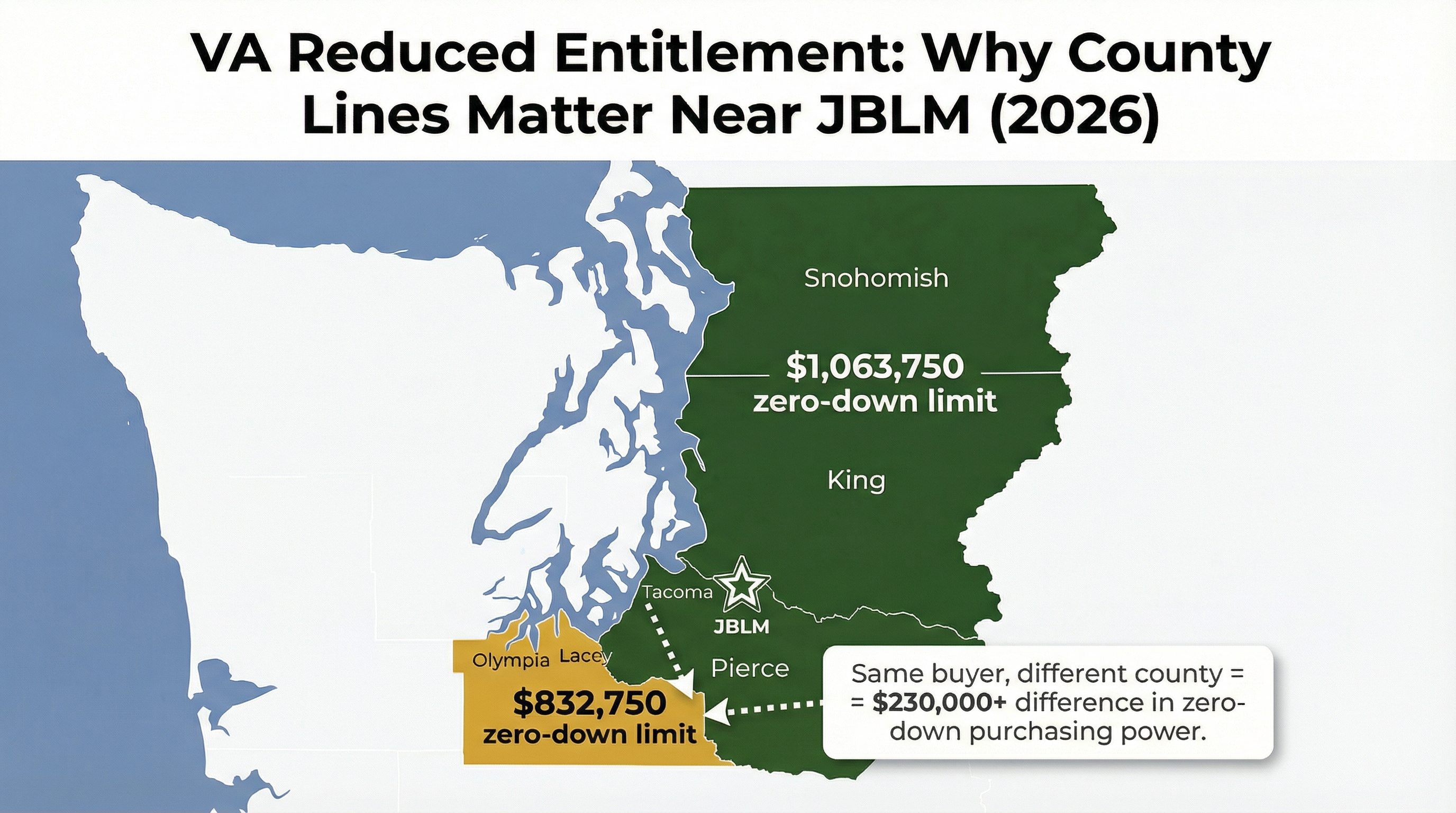
For veterans with reduced entitlement near JBLM, crossing a county line
can mean a six-figure difference in zero-down purchasing power.
WA Compliance Essentials
As financing strategies grow more complex, Washington state licensing law requires agents to maintain rigorous compliance practices.
How to Stay Current in 2026
Program guidelines change frequently, and agents must verify details before writing offers. Bookmark the WSHFC rate sheet and review it regularly for daily program updates.19 Monitor the legislative progress of HB 2153 throughout the 2026 session to determine whether state-funded DPA stacking restrictions are enacted. Above all, consult a WSHFC-trained participating lender before structuring any transaction that involves down payment assistance.
Closing Thoughts
In 2026, down payment assistance and seller concessions are not supplementary financing strategies, they are core tools for addressing Washington's affordability crisis. Real estate agents who thoroughly understand the mechanics of WSHFC programs, the nuances of VA loan limits, and the precise constraints of seller concessions across loan types will be positioned to deliver genuinely transformative outcomes for their clients. As program rules and legislative landscapes continue to shift, the guiding principle remains constant:
Stay educated, draft contracts with precision, and always verify eligibility in collaboration with a qualified lending professional.
For many homebuyers in Washington state, assembling a down payment is only the first major hurdle on the path to homeownership. Record-high home prices and shifting interest rates mean that closing costs, stringent program rules, and loan-type nuances can quickly transform an achievable goal into a formidable challenge. For real estate agents operating in 2026, simply opening doors is no longer sufficient.