Three Separate Functions
Keep these categories distinct: law (statutes and administrative rules), contract (the executed sale agreement), custom (local practice the parties can change), and insurer-specific terms (coverage and pricing that vary by company and transaction). Closing problems can arise when a Broker treats one category as another.
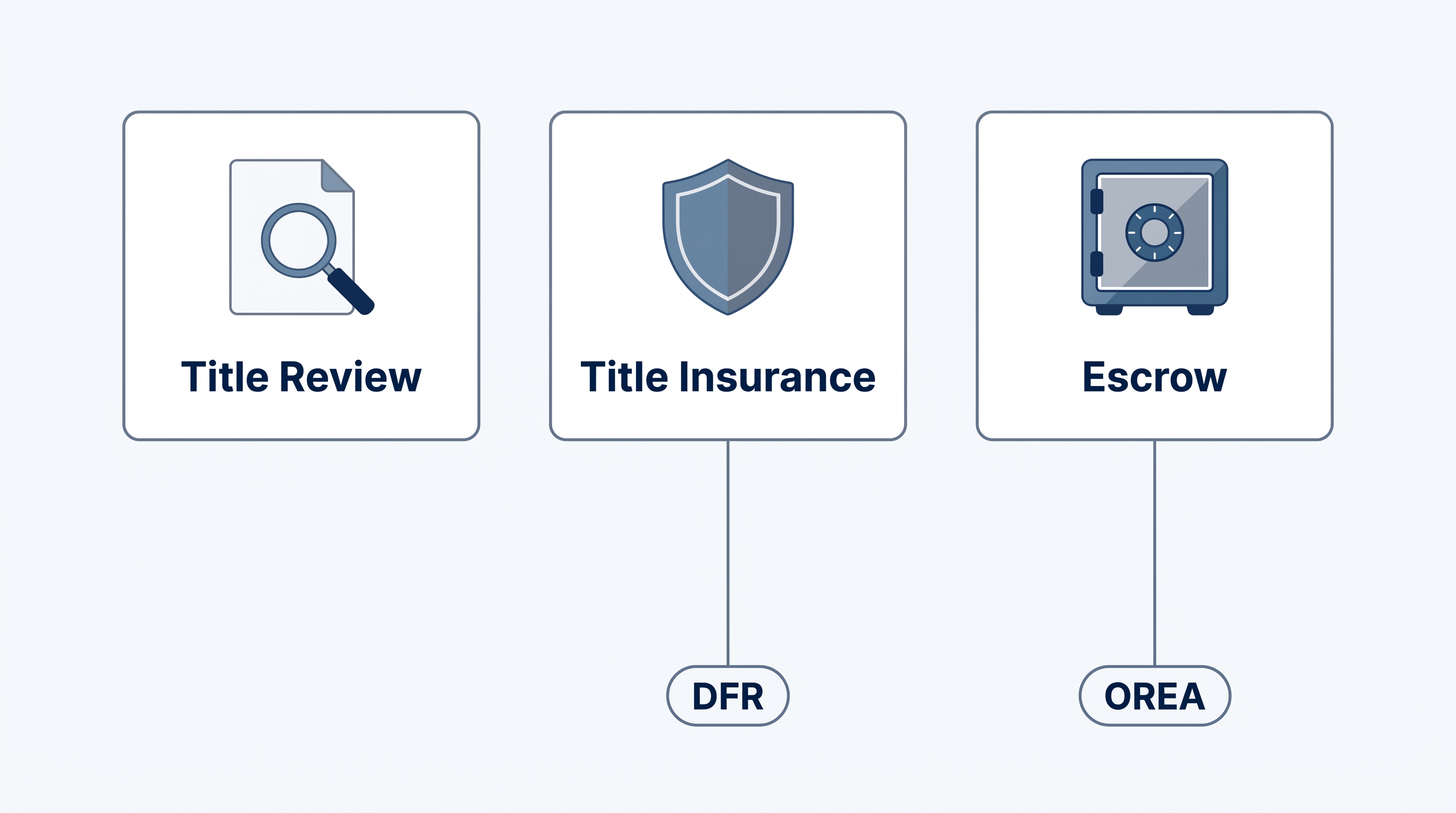
Title review, title insurance, and escrow are separate functions. Title insurers answer to DFR; escrow agents answer to OREA.
Terminology note: This guide uses Oregon’s license terms, Broker and Principal Broker. Beginning January 1, 2026, Oregon rules refer to the authorized principal broker and managing principal broker.
Title Basics
- Owner’s policy: protects the buyer’s ownership interest.
- Lender’s policy: protects the lender’s security interest, or right to use the property as loan collateral.
- Coverage: both policies are limited by their terms, exceptions, and stated amount.
- ALTA policy: a standardized form published by the American Land Title Association. It still includes exceptions.
- Exception: a matter the policy doesn’t cover, such as a recorded easement.
- Deed of trust: a recorded document securing a loan with real property. An existing one is normally paid off at closing.
- Restrictive covenant: a recorded limit on property use, such as a building-height or fence restriction.
Two Regulators
Escrow agents
The Oregon Real Estate Agency (OREA) licenses escrow agents under Oregon’s Escrow Law. Licenses expire annually on June 30; renewal requires annual reports and financial statements.
Title insurers
The Division of Financial Regulation (DFR), within the Department of Consumer and Business Services, regulates title insurers. It also receives escrow rate schedules, but an escrow agent must be OREA-licensed before filing them.
When one company does both
Escrow rules also cover escrow work performed by a title company. Shared letterhead doesn’t combine the functions: title and escrow officers answer to different regulators.
The Preliminary Title Report
The OREF 001 Residential Real Estate Sale Agreement, January 2026 edition, Section 11, sets these default terms:
- Within one business day after the Effective Date, the seller orders the preliminary title report and underlying documents.
- The buyer has five business days to object to items in the report.
- Within five business days, the seller corrects the objected-to items or gives reasonably satisfactory written assurances that they’ll be corrected.
- The seller provides a seller-funded standard owner’s policy for the purchase price within 30 calendar days after closing.
These are contract provisions, not statutory deadlines. The parties can change them, so check the executed agreement and any addenda.
Example: A report lists a recorded driveway easement, an existing deed of trust, and a restrictive covenant. Confirm the underlying documents arrived, deliver them to the client, and calendar the objection deadline. Refer coverage questions to the title company and legal questions to an attorney. Don’t call the easement harmless. Explain that the preliminary report is an offer to insure on stated terms, not the policy itself.
Who Pays, and How Rates Work
By Oregon custom, the seller pays for the owner’s policy and the buyer pays for the lender’s policy, but the parties can negotiate a different allocation. The OREF agreement’s default is an equal split of escrow fees, subject to VA limits on fees a veteran buyer may pay.
The Oregon Title Insurance Rating Organization (OTIRO) is a rating organization under Oregon insurance law, not a government agency. An insurer may adopt OTIRO rates, file deviations, or use an independent rate manual, so premiums can vary by company. Escrow fees are filed with DFR by county. Get a transaction-specific quote rather than relying on memory.
Inducements and Rebates
Oregon insurance rules limit title-related commissions, rebates, and discounts. Calling a payment marketing or a gift doesn’t change what it is. Don’t accept anything of value from a title or escrow company for referrals. Raise questionable offers with your Principal Broker first.
Earnest Money
The licensee’s handling duty
Oregon license rules require a Broker to:
- Deliver promptly: deliver earnest money to the authorized principal broker within three banking days, unless the buyer gave contrary written instructions.
- Hold a check only as agreed in writing: if a check is held undeposited pending acceptance, the sale agreement must state that the Broker is holding it and where and when it will be deposited upon acceptance.
- Place a properly held check after acceptance: within three banking days after acceptance, deposit it into the clients’ trust account, place it with a licensed, neutral Oregon escrow depository and track the deposit, or deliver it to the seller if payable to the seller.
Contract versus rule
The sale agreement sets the buyer’s payment obligations; rules govern licensee handling. After escrow receives checks or cash, it generally must deposit them by the close of the next banking day. Lender checks are an exception.
Timeline example: A Broker properly holds a check, and the offer is accepted on a Friday before a Monday bank holiday. Monday isn’t a banking day, so the three banking days are Tuesday, Wednesday, and Thursday. Confirm the count with your Principal Broker and track the escrow deposit.
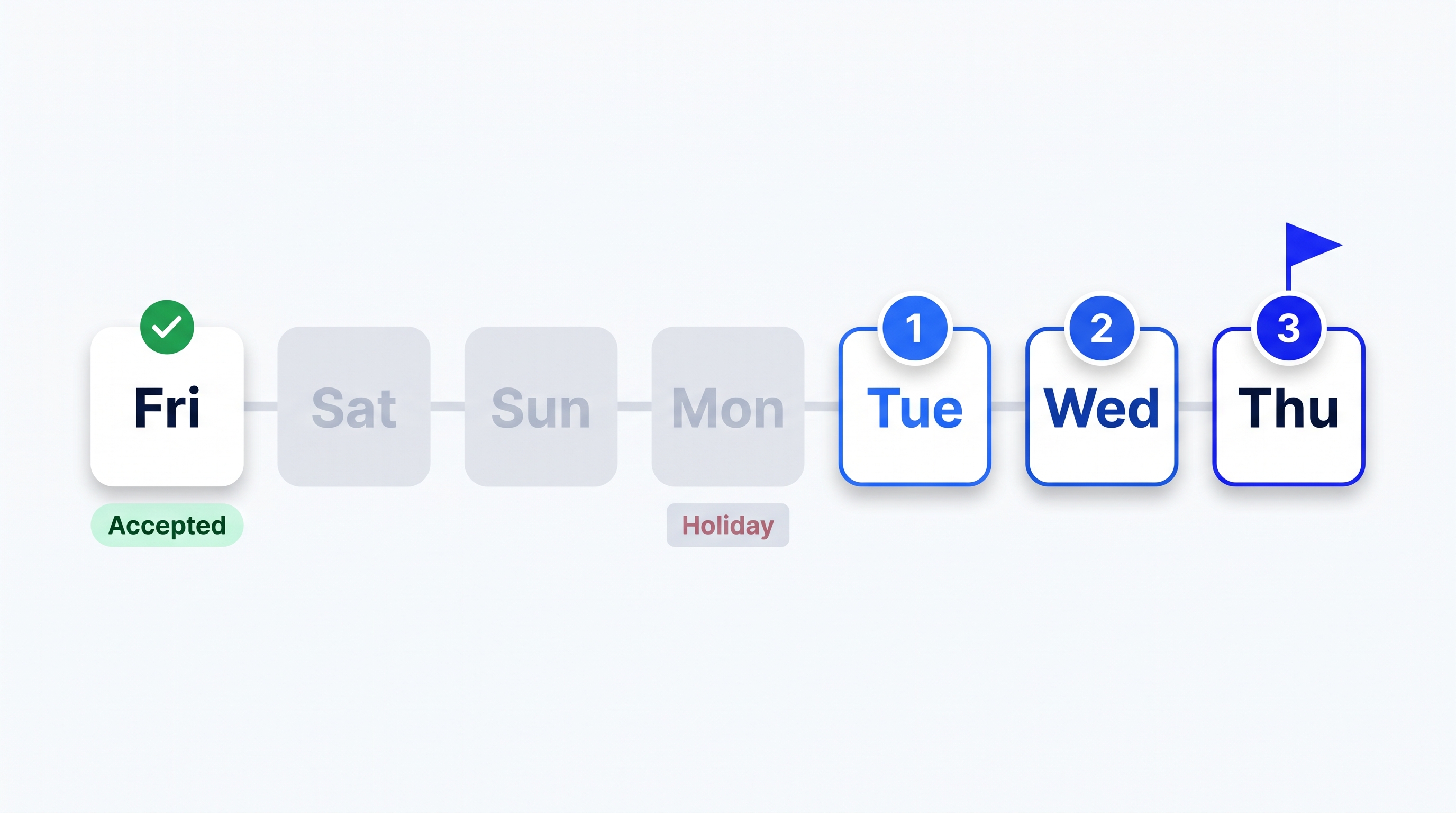
Weekend days and bank holidays are not banking days. Here, acceptance on Friday before a Monday holiday means the three-banking-day deadline falls on Thursday.
Escrow Instructions and Disbursement
An escrow agent can’t accept funds, property, or documents without dated, written instructions from the principals or a dated, executed written agreement between them. Instructions can’t contain blanks to fill in after signing, and alterations must be approved. Separate written instructions from the principals are generally required before closing or disbursement, subject to statutory exceptions. The escrow agent must remain neutral.
Dispute example: A buyer terminates under a contingency, and the seller disputes the termination. A Broker’s opinion about who should receive the earnest money doesn’t authorize its release. Escrow disburses only with consistent instructions from the parties or legal authority. The parties should consult their own attorneys.
Closing
Who may close
The authorized principal broker who is the listing broker must promptly close the transaction. All parties may agree in writing to delegate closing to an Oregon-licensed escrow agent, an attorney, or another authorized principal broker engaged in the transaction. Brokers perform closing functions only with written authorization and direct supervision.
Statements and records
The escrow agent prepares, signs, and dates a statement for each principal. It shows funds received and disbursed, separates third-party expenses, and goes to the principal or the principal’s designee. On request, a Broker receives only the statement for that Broker’s own client.
When an authorized principal broker performs or supervises a closing, the Broker must retain a closing statement showing receipts, disbursements, and adjustments, signed by the seller(s) and buyer(s).
Review the closing statement
Before closing, check that earnest money is credited correctly, title premiums are allocated as the contract requires, and escrow fees follow the contract and any VA requirements. Ask escrow to explain unidentified charges.
Broker Checklist
- Keep law, contract, custom, and insurer-specific terms separate; calendar deadlines from the executed agreement.
- Confirm the title report and underlying documents arrived, then review the documents behind each exception.
- Get transaction-specific quotes and decline referral inducements.
- If holding a check, document where and when it will be deposited, meet the three-banking-day deadline, and track the escrow deposit.
- Confirm written closing delegation and review the client’s closing statement.
Master Oregon title insurance and escrow compliance for closings, plus your 30-hour CE renewal. Call 425-775-2313 today.