Inactive, Expired, or Lapsed?
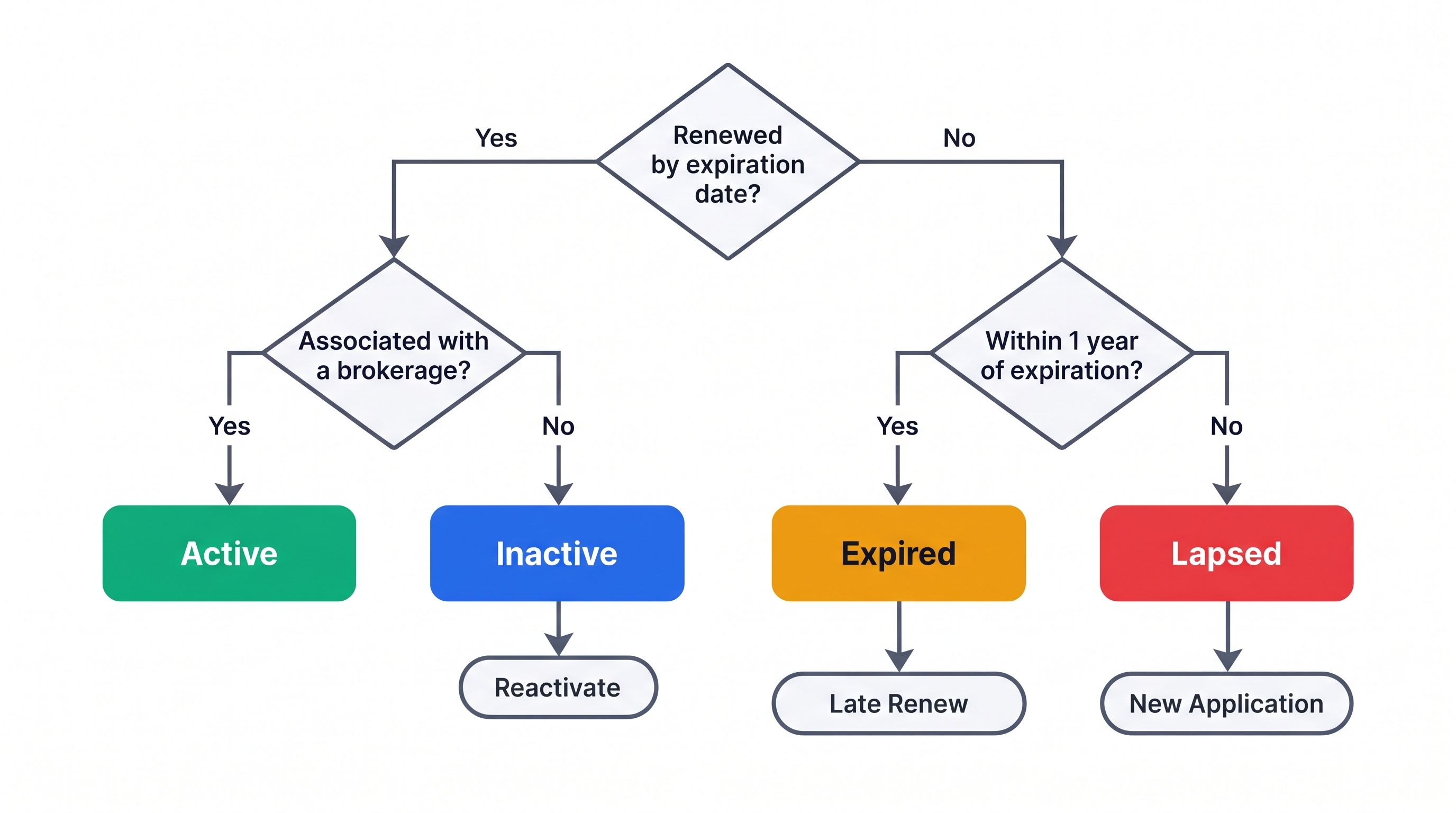
The Oregon Real Estate Agency (OREA) recognizes three non-active statuses. Your status determines the steps to return to work.
| Status | Meaning | What to do |
|---|---|---|
| Inactive | Your license is maintained and renewed, but isn't associated with a registered business. You may not conduct professional activity. | Complete required CE and any required exam, apply and pay, then have your principal broker associate your license. |
| Expired | You missed the renewal date and are within the one-year late-renewal window. | Renew late and pay the late fee. |
| Lapsed | More than one year has passed since expiration. | Submit a new license application under current requirements. |
A registered business is a brokerage registered with OREA. To associate your license, your principal broker adds or transfers it to the brokerage in eLicense.
Licenses expire on the last day of your birth month. Renewal opens in eLicense on the first day of your expiration month. Renewal is your responsibility, even if a reminder doesn't reach you.
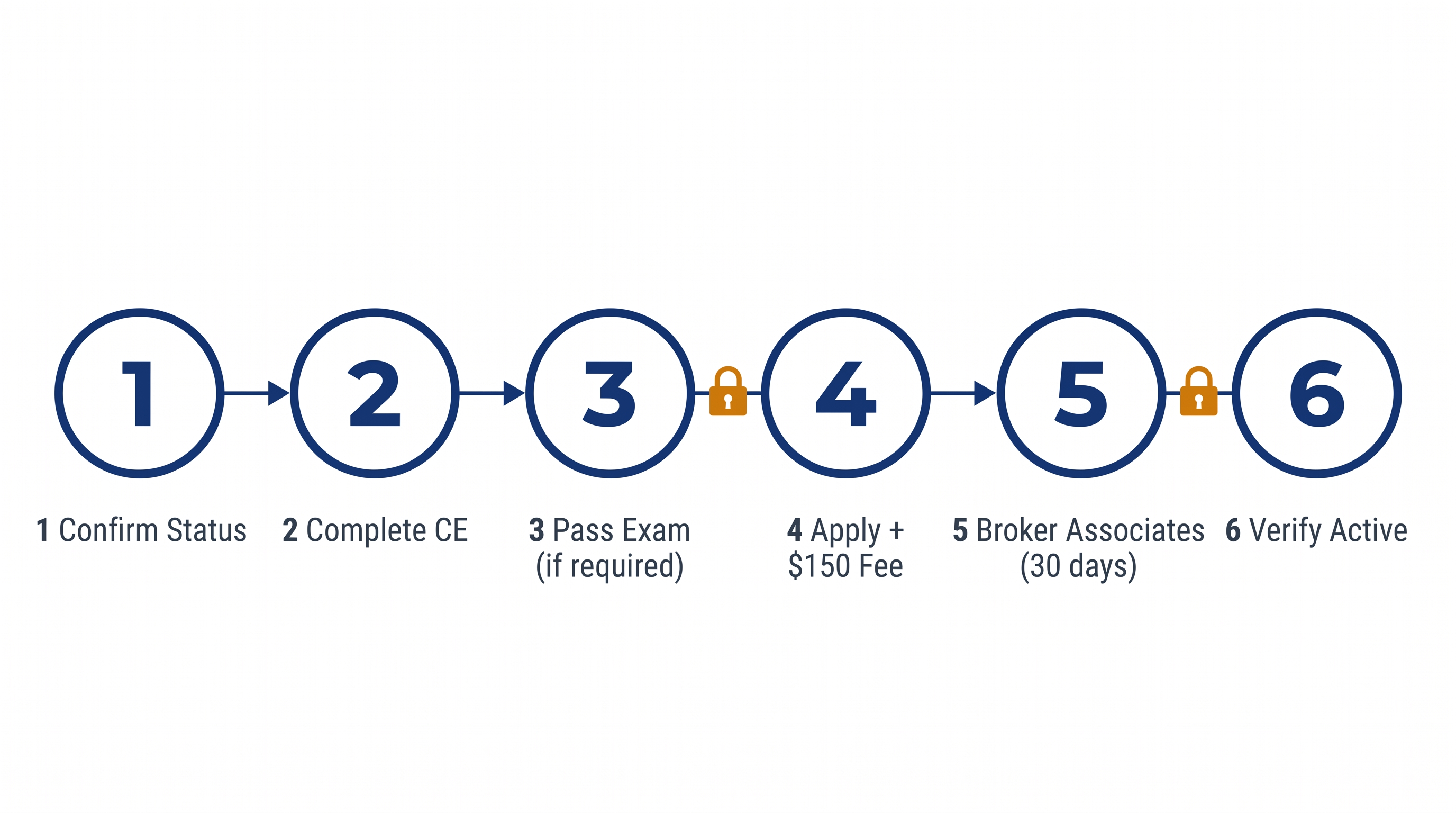
Path A: Reactivating an Inactive License
- Check your status in eLicense. Confirm your expiration date and whether the license is inactive or expired.
Complete the applicable continuing education (CE). The requirements below apply after an inactive renewal. If you went inactive mid-cycle without an intervening inactive renewal, OREA and eLicense will indicate whether CE applies. A separate 30-day change-of-status or transfer route is available after you go inactive. Confirm which requirements apply with OREA before purchasing courses.
The standard 30-hour package includes:
- 2 hours of the Law and Rule Required Course (LARRC);
- 2 hours of Fair Housing; and
- 26 additional hours.
Complete courses within the two years before your renewal or reactivation date.
- Check first-renewal requirements. Your first active renewal, or first reactivation after an inactive first renewal, requires the 26-hour Broker Advanced Practices course, LARRC, and Fair Housing. Advanced Practices ends with a 60-question proficiency assessment. You must score at least 75% to pass. Since July 1, 2026, the assessment includes transaction case studies and scenarios.
- Find out whether you need the reactivation exam. You must pass it if your license hasn't been active for two or more consecutive years. Some OREA pages say more than two years. Follow the rule and confirm with OREA if you are near the threshold. This exam is separate from the Advanced Practices assessment; passing one doesn't satisfy the other.
- Request exam eligibility and pass the exam first. Email orea.info@oregon.gov to become eligible to schedule with PSI. You must pass before submitting your reactivation application and fee.
- Apply for reactivation and pay the $150 fee.
- Have your principal broker associate your license within 30 days. If this doesn't happen, the fee is forfeited. Your license isn't active until association is complete.
- Check eLicense to confirm active status before working.
An inactive license still needs renewal every two years. The inactive renewal fee is $150, and CE isn't required at that time.
Path B: Late Renewal of an Expired License
You may renew late for one year after expiration.
| Renewal type | Fee |
|---|---|
| Active renewal, on time | $300 |
| Inactive renewal, on time | $150 |
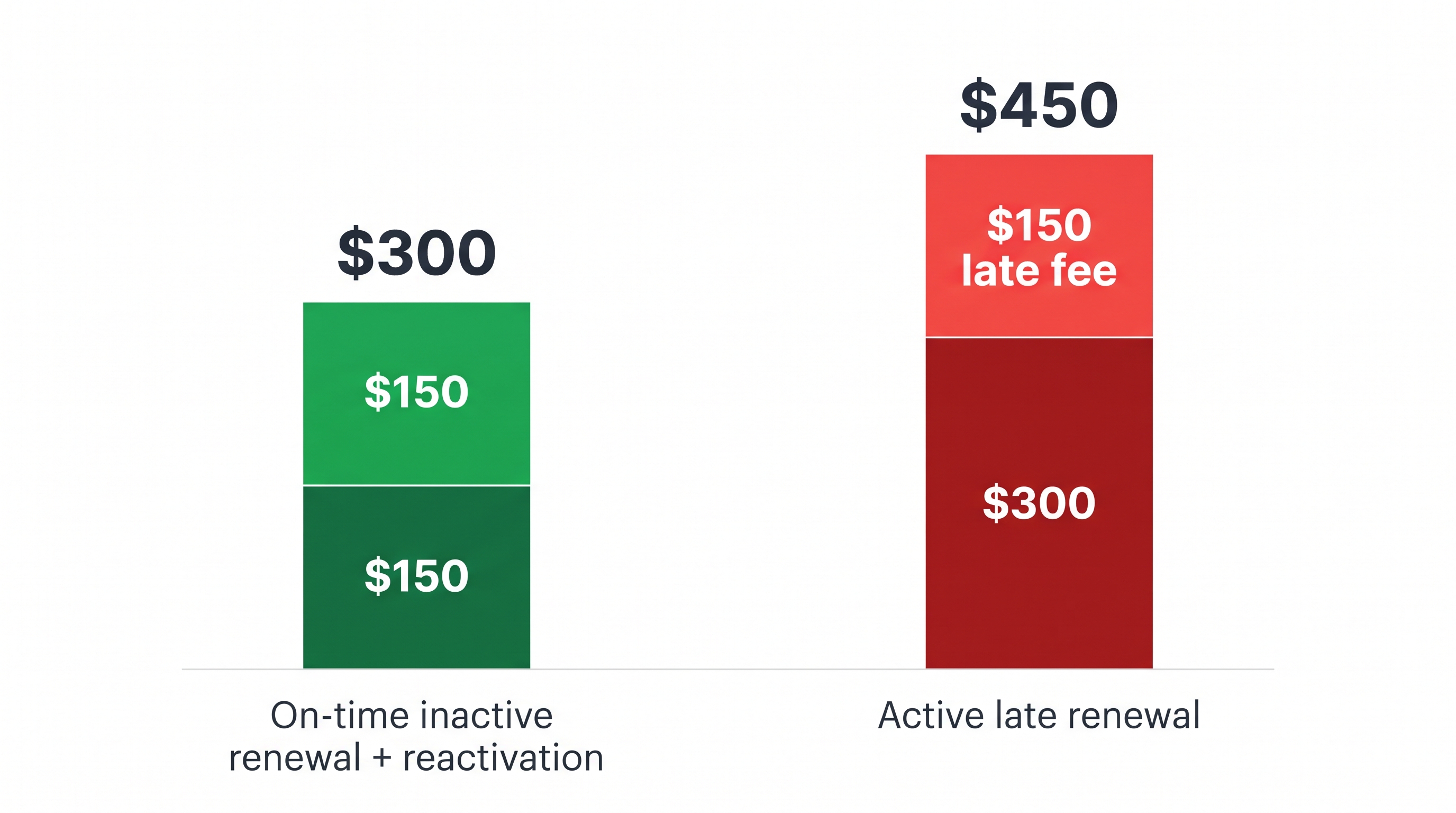
| Active late renewal | $300 + $150 late fee = $450 |
| Inactive late renewal | $150 + $150 late fee = $300 |
| Reactivation | $150 |
These are OREA's currently published fees. Confirm the amount in eLicense before paying. CE tuition and exam-provider fees are separate.
Keep these rules in mind:
- Late renewal doesn't cover the gap. Activity while your license was expired remains unlicensed activity.
- Your expiration date doesn't reset. It stays tied to your birth month.
- You must reassociate. After renewal, your principal broker must associate your license with the registered business before you resume work.
Path C: Lapsed Licenses
After the one-year late-renewal window closes, your license is lapsed. You must apply for a new license and meet current education, exam, and background requirements. OREA says there are no exceptions or waivers based on prior licensure.
Practical Examples
- Missed deadline: A Portland Broker's license expires October 31, 2026. Renewal opens October 1, but she misses the deadline. Starting November 1, she must stop real estate activity. If she renews actively in December, she pays $450, and her next expiration remains October 31, 2028. Transaction work in early November was unlicensed.
- Inactive renewal: A Broker can't complete CE before the deadline. He renews inactive on time for $150, completes CE, then reactivates for $150. The total is $300, compared with $450 for an active late renewal, and he avoids an expired-status gap.
- The two-year mark: A Broker went inactive on March 1, 2024, and seeks reactivation on March 1, 2026. At exactly two years inactive, the reactivation exam is required, and he must pass before applying.
- Too late to renew: A license that expired September 30, 2025, can be renewed late through September 30, 2026. By November 2026, it is lapsed, and the holder must apply for a new license.
CE Recordkeeping Tips
- Enter each course separately in eLicense.
- Excess hours don't carry over to the next renewal period.
- Keep certificates for three years after the renewal date to which the credit applies.
- You don't receive credit for taking the same course twice in one CE period.
- OREA may waive some or all CE only if you provide satisfactory evidence that poor health or circumstances beyond your control prevented you from attending required courses. Don't plan on a waiver.
- Under the 2026 transition, the older 3-hour LARRC or 27-hour Advanced Practices course may count if completed before January 1, 2026. You still need the Fair Housing hours.
Common Mistakes to Avoid
- Working before eLicense shows active status, including while waiting for your principal broker to associate your license.
- Assuming late renewal covers the gap. It doesn't.
- Letting an inactive license expire because no CE was due.
- Miscounting the two-year inactive threshold or applying before passing the exam.
- Confusing a city business license with an OREA license. They don't replace each other.
Disclaimer: This article provides general information, not legal advice. Fees, rules, and CE requirements can change. Confirm your situation with OREA before acting.
Inactive, expired, or lapsed Oregon real estate license? Follow OREA's 2026 renewal and reactivation steps to get back to work. Call 425-775-2313.