All figures, properties, and the neighborhood below are hypothetical and for illustration only. They are not real market data.
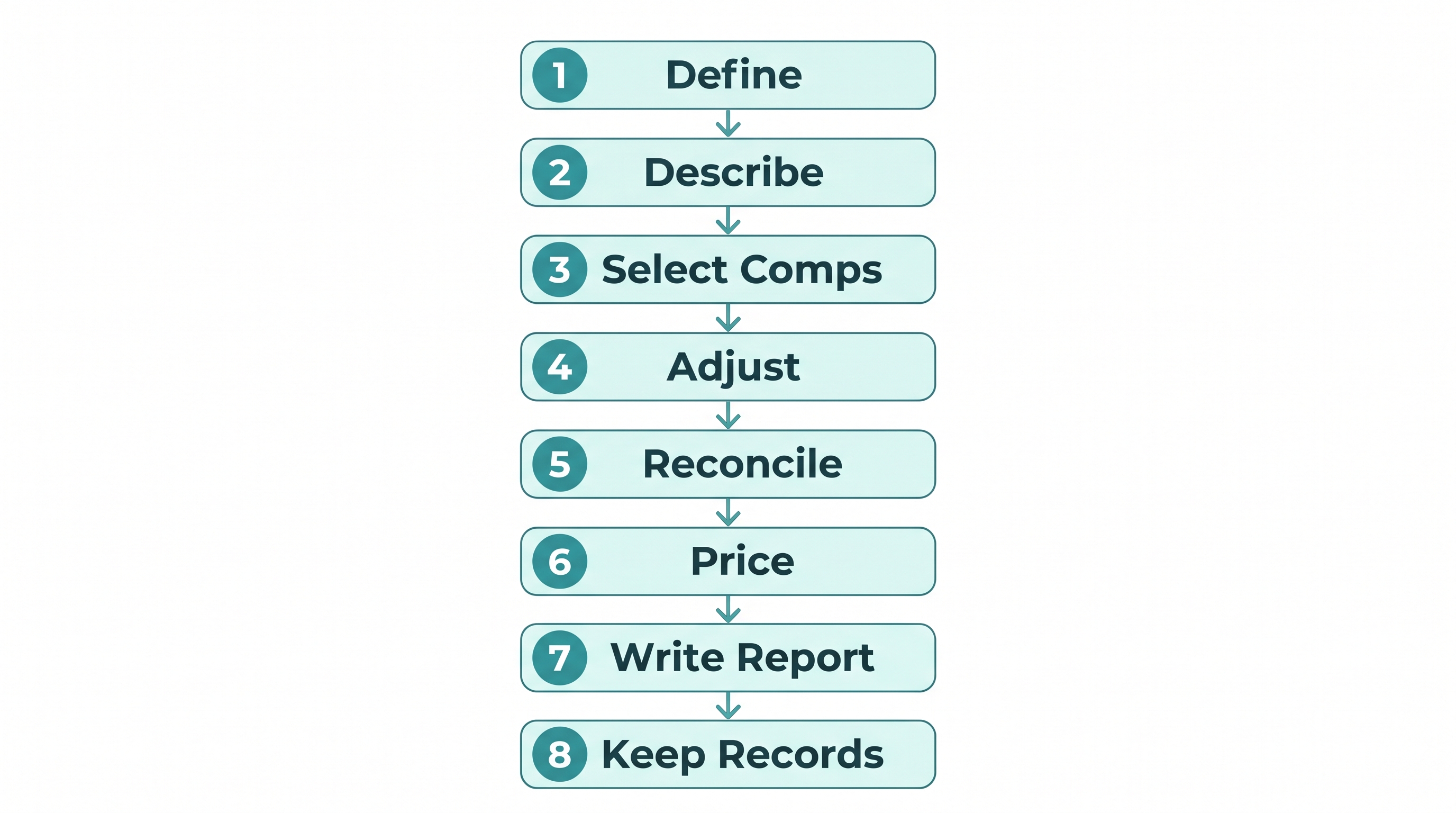
The eight steps of an Oregon CMA, from assignment definition through record retention.
Step 1: Define the Assignment and Purpose
Dana, the hypothetical seller, owns a home in fictional Maple Ridge, an Oregon city, and plans to list it. The CMA recommends a listing price for this contemplated transaction.
OREA guidance issued in June 2026 cautions Brokers against valuations unrelated to an actual or contemplated transaction, including retrospective questions such as, What was it worth in 2019? Refer those requests to a licensed appraiser. Don’t accept an engagement with a predetermined value or a fee tied to reaching a stated result; either can be grounds for discipline.
Step 2: Describe the Subject Property
The subject has 3 bedrooms, 2 bathrooms, about 1,850 sq ft, a 1995 build year, average condition, and an attached 2-car garage. Verify the details:
- Check county assessor records for square footage, year built, and lot size.
- Don’t treat assessed value or real market value (RMV) as a sale price. For example, Multnomah County’s RMV reflects a January 1 assessment date.
- Check permit history. In Portland, search PortlandMaps. Documents for permits issued after December 2023 may require a records request.
- Note discrepancies. If the seller reports 1,900 sq ft but county records show 1,850, use 1,850 unless you have better evidence, and document the difference.
Step 3: Select Comparables
Choose comps that compete for the same buyers. Use closed sales as primary evidence. Present pending and active listings separately: they show competition, not proven value. Oregon sets no minimum number of comps, radius, or time cutoff for a CMA. The familiar three closed comps standard is a Fannie Mae appraisal convention, not an Oregon CMA rule. Use as many comps as the market supports and explain your choices.
Seller concessions are costs or credits the seller pays for the buyer, such as closing-cost contributions. They can inflate the recorded price.
| Feature | Subject | Comp A | Comp B | Comp C |
|---|---|---|---|---|
| Sale price | N/A | $520,000 | $565,000 | $505,000 |
| Closed | N/A | 2 mo. ago | 3 wks. ago | 5 mo. ago |
| Sq ft | 1,850 | 1,800 | 1,950 | 1,850 |
| Baths | 2 | 2 | 2.5 | 2 |
| Condition | Average | Average | Updated | Average + new roof |
| Garage | 2-car | 2-car | 2-car | 1-car |
| Seller concessions | N/A | $0 | $10,000 | $0 |
Competition context (hypothetical): A similar pending home, listed at $534,900, went under contract in 9 days. Active listings include one at $549,000 (45 days on market) and one at $519,000 (12 days, dated kitchen).
Step 4: Make Adjustments
Adjust each comp toward the subject. Subtract for a superior feature; add for an inferior one.
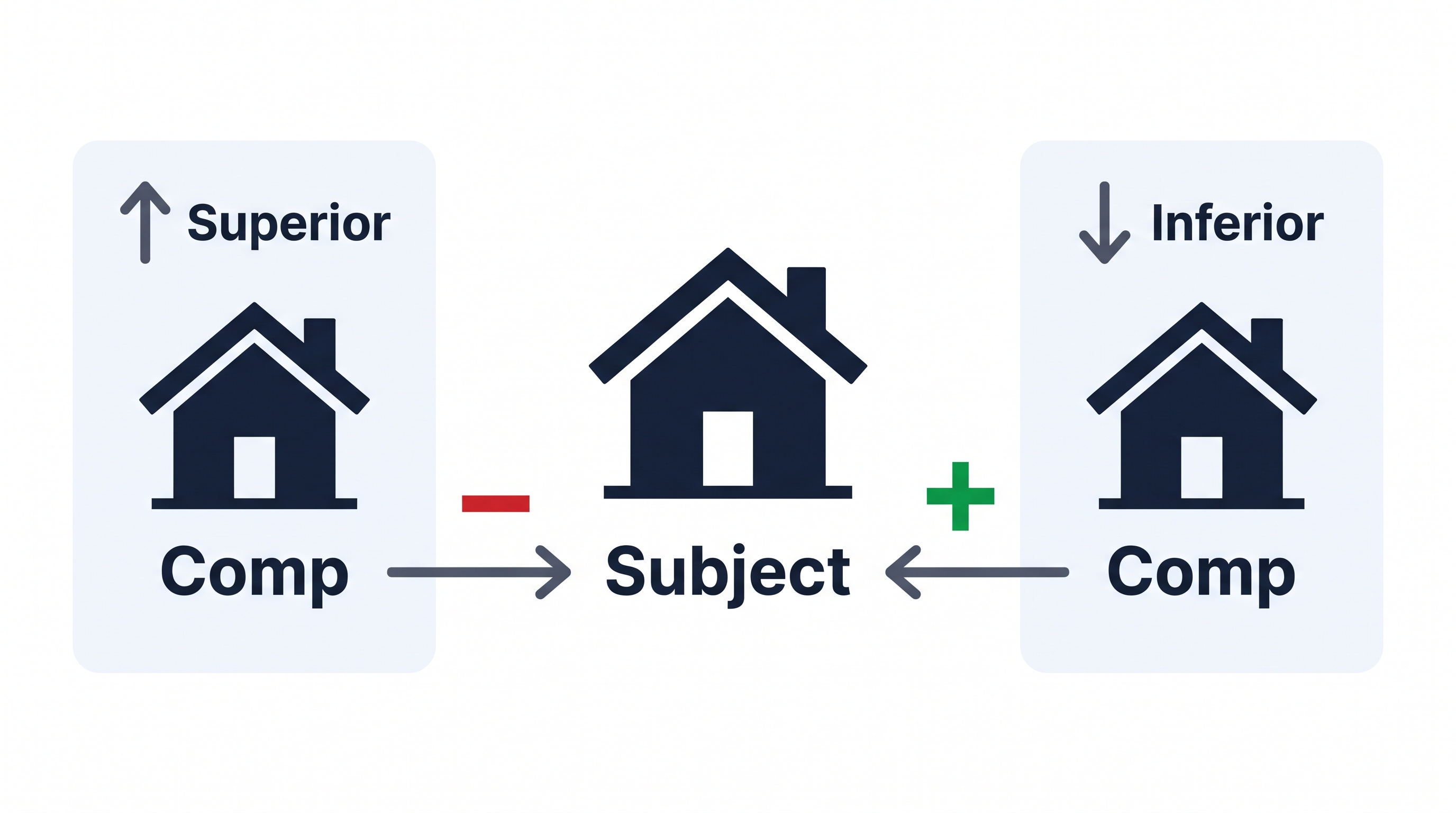
Always adjust the comp toward the subject: subtract for superior features, add for inferior ones.
Support adjustments with market evidence, not rules of thumb. Paired sales compare otherwise similar sales that differ in one feature; the price difference can indicate that feature’s value. Hypothetical support for this example:
- Size: Paired sales indicate about $100 per sq ft.
- Half bath: $8,000.
- Garage stall: $15,000.
- Condition: Paired sales of updated and original-kitchen homes indicate about $10,000 for Comp B’s updated kitchen and baths. Comparisons of recent roof replacements indicate about $5,000 for Comp C’s new roof. Those sales are already time-adjusted to avoid double-counting.
- Time: About 0.5% per full month since closing, rounded to the nearest $1,000. Comp A: $520,000 × 0.5% × 2 = $5,200, rounded to $5,000. Comp C: $505,000 × 0.5% × 5 = $12,625, rounded to $13,000. Comp B closed less than one month ago: $0.
Net adjustment % is the signed total of adjustments divided by the sale price. Gross adjustment % is the total of each adjustment treated as a positive amount, divided by the sale price. A higher gross percentage suggests a less similar comp.
| Adjustment | Comp A | Comp B | Comp C |
|---|---|---|---|
| Sale price | $520,000 | $565,000 | $505,000 |
| Time | +$5,000 | $0 | +$13,000 |
| Size | +$5,000 | −$10,000 | $0 |
| Bathrooms | $0 | −$8,000 | $0 |
| Condition | $0 | −$10,000 | −$5,000 |
| Garage | $0 | $0 | +$15,000 |
| Concessions | $0 | −$10,000 | $0 |
| Net adjustment | +$10,000 | −$38,000 | +$23,000 |
| Adjusted price | $530,000 | $527,000 | $528,000 |
| Net % | +1.9% | −6.7% | +4.6% |
| Gross % | 1.9% | 6.7% | 6.5% |
Arithmetic check: A: +10,000 ÷ 520,000 = +1.9% net and gross. B: −38,000 ÷ 565,000 = −6.7% net; 38,000 gross ÷ 565,000 = 6.7%. C: +23,000 ÷ 505,000 = +4.6% net; 33,000 gross ÷ 505,000 = 6.5%.
Step 5: Reconcile
Adjusted prices range from $527,000 to $530,000. Consider gross adjustment percentage alongside reliability, recency, and similarity. Comp A receives the most weight because it needed the fewest and smallest adjustments and closed recently. Comp B is the most recent, but has the largest gross adjustment, including a concession, so it receives the least weight.
| Comp | Weight | Calculation | Contribution |
|---|---|---|---|
| A | 50% | $530,000 × 0.50 | $265,000 |
| C | 30% | $528,000 × 0.30 | $158,400 |
| B | 20% | $527,000 × 0.20 | $105,400 |
| Total | 100% | $528,800 |
The indicated value is about $529,000, within the supported range.
Step 6: Choose a Pricing Strategy
The $549,000 active listing has been on the market for 45 days, suggesting buyers are rejecting that price level. The $534,900 pending listing went under contract quickly, but its final price won’t be known until closing.
A hypothetical recommendation is to list at $529,000. It’s within the supported range, below the stale active listing, and visible to buyers searching up to $530,000. Agree on a review plan in advance. If showings are weak after 14 to 21 days, assess a reduction using new data. OREA guidance stresses documenting how the price was set and why it changes.
Step 7: Write the Report
A written CMA must include:
- (a) A statement of its purpose and intent.
- (b) A brief description of the property.
- (c) The basis for the price conclusion, including applicable market data and/or a capitalization computation. This computation converts net operating income into a value estimate and is used mainly for income properties. It isn’t needed for an owner-occupied home priced from sales, but explain your basis, such as the adjusted comps above.
- (d) Any limiting conditions.
- (e) Disclosure of any existing or contemplated interest of the licensee in the property.
- (f) The licensee’s signature and preparation date.
- (g) A statement that the CMA isn’t intended to meet the Uniform Standards of Professional Appraisal Practice (USPAP), unless the licensee is also appraiser-licensed.
- (h) A statement that it isn’t an appraisal and that a competent licensed appraiser should be retained if an appraisal is desired.
Brokerage name, client name, and property address are good practice, but aren’t listed as required elements.
Sample disclaimer (educational only, not an official form) for a Broker who isn’t appraiser-licensed: This is a competitive market analysis prepared by [Broker], an Oregon real estate Broker, to recommend a listing price for [address]. It is not an appraisal. I am not licensed or certified by Oregon’s Appraiser Certification and Licensure Board, and this analysis is not intended to meet USPAP requirements. If you need an appraisal, retain a competent, professionally licensed appraiser.
Step 8: Keep Records
Records generally must be kept for at least six years. For transaction records, the period starts at closing or failure of the transaction, whichever is later. For other records, it starts when the record is created or received, whichever is later. Store records securely as required. Keep the report, comp printouts, adjustment support, and dated price-revision notes.
Lending and Default Collateral Analyses
A Broker may prepare a lending collateral analysis for a financial institution’s internal use only when the loan is less than $250,000. A Broker may prepare a default collateral analysis for internal use on a defaulted loan. Neither replaces an appraisal. If you hold the listing or represent a buyer or seller in a pending transaction, disclose your relationship with the lender to both parties. Screen these requests when defining the assignment.
Common Mistakes
- Treating assessed value as a sale price.
- Adjusting the subject instead of the comps.
- Using unsupported per-bedroom rules of thumb.
- Treating active asking prices as closed-sale evidence. Use active listings for pricing strategy, not proof of value.
- Ignoring seller concessions.
- Leaving out the USPAP and non-appraisal statements.
Conclusion
Before delivering Dana’s CMA, confirm elements (a) through (h), use the disclaimer that matches your credentials, and sign and date the report. Record the delivery date and method. File everything under the retention requirements, and consult your Principal Broker about firm templates and current rule text.
A worked Oregon CMA example: pick comps, adjust for size and condition, reconcile values, and set your listing price in 8 clear steps. Read it today.