What "As Is" Does
An as-is provision allocates property-condition risk. The buyer agrees to accept the property in its present condition, usually after an inspection, and generally gives up any expectation that the seller will make repairs. Depending on its wording, the provision may also bar some claims.
In Wilkinson v. Carpenter, 276 Or. 311, 554 P.2d 512 (1976), the Oregon Supreme Court held that an as-is clause in that contract barred rescission (unwinding the contract) based on an innocent misrepresentation—a false statement made without knowledge that it was false.² The result depended on the contract's language and the facts of the case. Do not assume every as-is clause will have the same effect.
What "As Is" Does Not Do
It is not a statutory exclusion. ORS 105.465 generally covers sales of real property with one to four residential dwelling units, certain condominium units and timeshares not subject to other disclosure statutes, and a manufactured dwelling only when the owner also owns the underlying land. Leaseholds are not covered. Unless an exclusion applies, the seller must complete, sign, and deliver the statutory disclosure statement to each buyer who makes a written offer to purchase. The statutes also do not apply if the buyer indicates to the seller that the property will be used for purposes other than a residence for the buyer or the buyer's spouse, parent, or child; that indication is conclusive.³
ORS 105.470 lists narrow exclusions. An as-is sale is not one of them:⁴
| ORS 105.470 exclusion | Example |
|---|---|
| First sale of a never-occupied dwelling, but only if the seller provides the prescribed construction/installation permit statement on or before the date the buyer becomes legally obligated to purchase | New construction with timely permit statement |
| Sale by a financial institution that acquired the property as custodian, agent, or trustee, or by foreclosure or deed in lieu | Bank-owned, or "real estate owned" (REO), sale |
| Sale by a court-appointed receiver, personal representative, trustee, conservator, or guardian | Probate personal representative |
| Sale by a governmental agency | Surplus public property |
It does not waive the revocation right. Under ORS 105.475, the buyer may revoke the offer within five business days after the disclosure statement is delivered by delivering a separate, signed written revocation to the seller. If the required disclosure is never delivered, the revocation right continues until closing. If the buyer revokes, all deposits must be returned. The buyer can waive this right only in writing; accepting the property as is does not count.⁵
It does not shield fraud. ORS 105.490 preserves remedies for fraud, misrepresentation, and negligence, as well as equitable remedies, meaning court-ordered relief such as rescission.⁶ In Bodenhamer v. Patterson, 278 Or. 367 (1977), the court held that a seller who knows of a defect cannot avoid liability simply by professing to have no knowledge of it.⁷ Concealment can defeat an as-is clause.
The statement is not a warranty. ORS 105.464 states that the disclosure form is not a warranty and does not replace inspections.⁸ It records what the seller actually knows, which is why honest answers matter.
The Broker's Independent Duties
The seller's duties are separate from your own. Under ORS 696.805, a seller's agent must disclose material facts the agent knows about that are not apparent or readily ascertainable to the buyer. ORS 696.870 also requires licensees to inform clients of their rights and obligations under the disclosure statutes.⁹ Violations can lead to discipline under ORS 696.301.¹
In Terway v. Real Estate Agency, 223 Or. App. 501 (2008), the court held that the presence of information in public records is not an automatic defense to a disclosure violation.¹⁰ The Oregon Real Estate Agency generally treats disputes over the contents of a disclosure statement as civil matters, but it can still discipline a licensee for misconduct.¹¹
Practical Scenarios (Hypothetical)
Portland fixer. A seller lists a dated Southeast Portland bungalow as is and says, "I'm not filling out forms." The sale involves one dwelling, and no exclusion applies. The disclosure statement is still required. If the broker knows about a failed sewer scope, the broker must disclose it.
Inherited home. An heir sells a parent's house after probate closes. Inheritance and outright ownership alone do not establish an exclusion; coverage and the applicable exclusion categories still must be analyzed. Compare this with a court-appointed personal representative selling during probate, which falls within ORS 105.470.⁴
Living-trust trustee. A successor trustee of a revocable trust sells the residence. The trustee was not appointed by a court, so the exclusion for court-appointed fiduciaries (people a court authorizes to manage property for others) likely does not apply. Treat the sale as covered unless Oregon counsel advises otherwise.
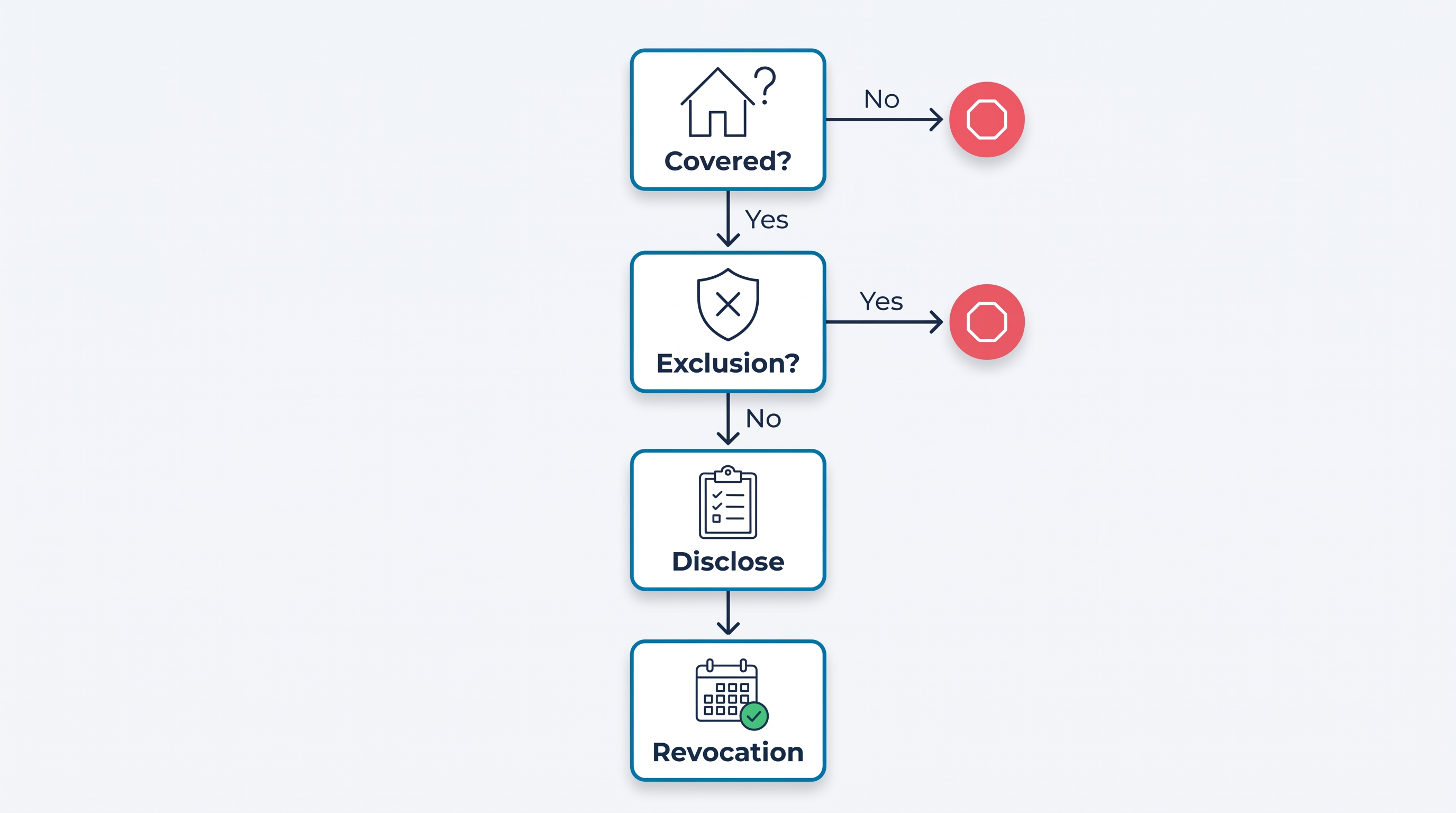
Decision flow: confirm coverage under ORS 105.465, check for an ORS 105.470 exclusion, deliver the disclosure statement, and preserve the buyer's five-business-day revocation right.
Practical Checklist
- Coverage and exclusion: Confirm the property type under ORS 105.465 and match the sale to an ORS 105.470 exclusion, or assume disclosure is required.³⁴
- Current form: ORS 105.464 was amended in 2025, so use the current statutory form and verify current law before relying on it.⁸
- Delivery proof: Under ORS 105.485, the seller bears the burden of proving delivery of the statement and any amendment; the buyer bears the burden of proving delivery of a revocation.¹² Oregon REALTORS guidance indicates that an MLS link alone is not sufficient delivery.¹³ Obtain signed acknowledgments.
- Record keeping: Keep disclosures, waivers, and acknowledgments as required by ORS 696.280 and OAR 863-015-0250.¹⁴
- Escalate: Bring exclusion questions, waiver requests, and suspected concealment to your principal broker, and refer legal questions to Oregon counsel.
This article is for general education and is not legal advice. Consult your principal broker and a licensed Oregon attorney about specific transactions.
An Oregon as-is clause won't waive your ORS 105.465 disclosure duty or the buyer's 5-day revocation right. See what brokers still must disclose.