Many older Oregon homes, especially around Portland, were heated with oil from an underground tank. Many tanks remain; some still contain oil, and some have leaked. The Oregon Department of Environmental Quality (DEQ) generally looks to the current owner to address a leaking tank. Brokers who carelessly describe a tank’s status may face civil claims and license discipline.²
The Legal Minimum vs. the Contract
Under ORS 466.878, a heating oil tank must be emptied when it is replaced or when the building converts to another primary heat source. If the tank is not decommissioned, its vent line must remain in place. At sale, the seller must ensure that a known abandoned tank has been emptied and give the buyer documentation showing it was emptied.¹
Decommissioning goes further and is voluntary under DEQ rules. Buyers and lenders, however, often require decommissioning or soil testing as a contract condition. An active, non-leaking tank need not be removed just because the property is sold.²
Key Vocabulary
| Term | What it means |
|---|---|
| Emptied | Oil removed from the tank; the statutory minimum for a tank taken out of use. |
| Decommissioned | Emptied, cleaned, and removed or filled in place under DEQ standards. |
| Certified and registered | A licensed provider certifies the work and submits a report; DEQ then registers the certification. Provider submission alone is not registration. |
| Release | An oil leak or spill from the tank or its piping. |
| Cleanup complete | A release addressed under DEQ cleanup rules. |
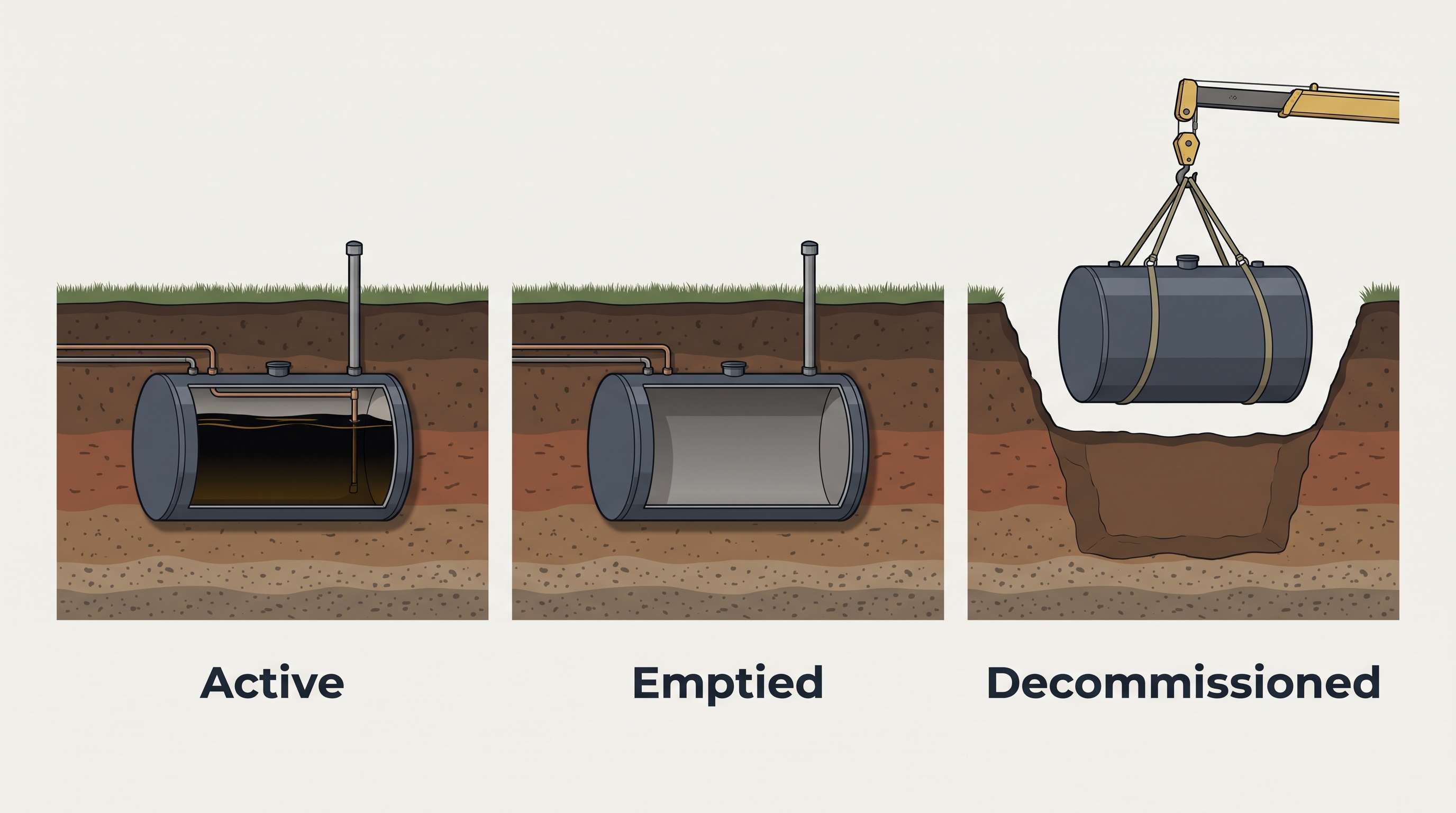
Emptying removes the oil. Decommissioning goes further: the tank is cleaned and then removed or filled in place under DEQ standards.
DEQ is direct: “a tank that has only been emptied of oil has not been ‘decommissioned.’”³ Under the certification program, which has been in place since March 15, 2000, provider certification plus DEQ registration is treated as equivalent to a “No Further Action” letter.⁴
“Cleanup complete” does not always mean clean soil. Under OAR 340-177-0065, a generic remedy allows limited contamination to remain if set requirements are met; it is unavailable where groundwater is present. A risk-based cleanup ends when investigation shows that remaining contamination poses no unacceptable risk.¹⁰
Broker Duties
Seller’s agents (ORS 696.805) and buyer’s agents (ORS 696.810) must disclose known material facts that are not apparent or readily ascertainable (readily discoverable), exercise reasonable care and diligence, and advise clients to seek expert advice beyond the Broker’s expertise.⁷
The seller’s property disclosure statement under ORS 105.464 asks about underground storage tanks; confirm the exact question against the current statute and form.⁶ Encourage sellers to answer accurately and attach records, but do not answer for them.
The practical rule: never describe a tank’s status beyond what the documents show. A pumping receipt shows emptying, not “decommissioned,” “clean,” or “no issue.” Overstatement can be misrepresentation and expose you to discipline under ORS 696.301.⁷
Buyer Due Diligence
- A tank locate (sweep) asks whether a tank is present.
- Soil sampling asks whether oil has leaked into the soil.
A locate that finds no tank says nothing about contamination from a tank removed years ago. Do not assume that permission for a non-invasive locate authorizes soil borings or excavation; confirm that the executed contract or separate written owner authorization permits the proposed invasive work.⁹
Search Your DEQ Online for records, but keep in mind that they may be incomplete; no record does not mean no tank.⁵ DEQ guidance indicates that active-tank sampling data should be relied on for no more than 90 days.²
Buyers should hire a provider licensed under OAR chapter 340, division 163, and verify an HOT-specific license, not just a general contractor license.⁴
If a Release Is Found
A confirmed release generally must be reported to DEQ within 72 hours under OAR 340-177-0055. Notification must be immediate if groundwater is encountered during investigation or cleanup, or if specified vapor or free-product hazards exist (free product is accumulated liquid oil, as opposed to oil dissolved in water or attached to soil).¹⁰ Cleanup obligations then apply.
Refer clients to licensed providers and attorneys; do not estimate scope, cost, or liability. A price credit or private cost allocation does not eliminate the buyer’s potential cleanup responsibility as the future owner.² DEQ filing fees range from $104 for a clean decommissioning to $468 for a risk-based cleanup;⁸ contractor costs are separate and often far higher.
Example: The Pumping Receipt
A seller hands you a 2015 pumping receipt and says the tank was “taken care of.”
- Describe it accurately: “emptied per receipt dated 2015.”
- Search DEQ records and share the results, including any gaps.
- Encourage the seller to disclose the tank.
- Tell the buyer’s Broker you found no decommissioning certification.
- Recommend licensed providers and, where appropriate, counsel.
- Document each step and loop in your Principal Broker.
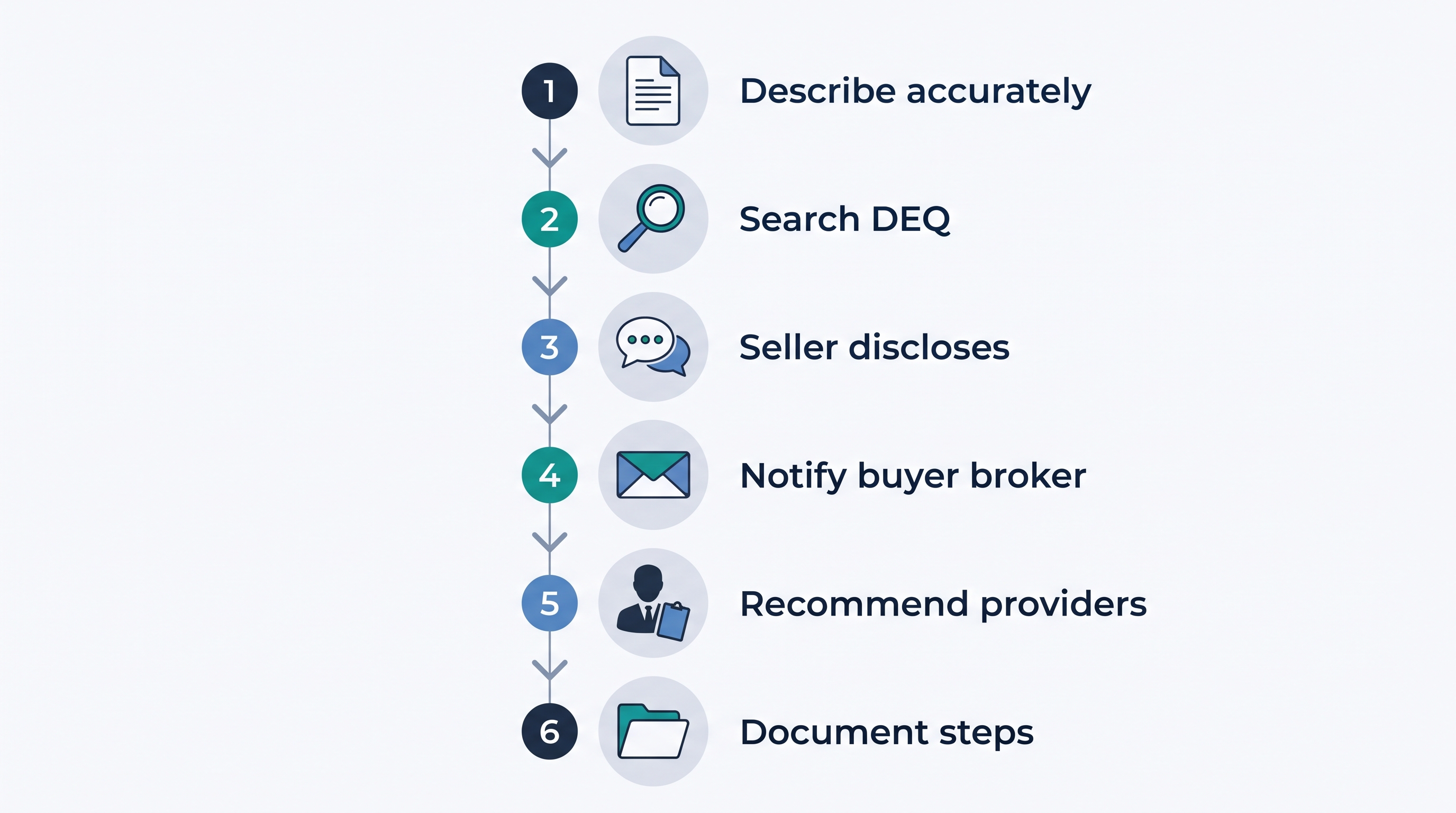
Follow every step and loop in your Principal Broker. A pumping receipt shows emptying — nothing more.
Before Closing: Documents and Contract Terms
Document packet: disclosure statement; pumping receipts; DEQ registration, if any; dated provider reports and sampling results; DEQ search results; cleanup reports.
Contract terms:
- who selects and pays the provider
- deliverables: locate results, soil samples, decommissioning, and DEQ registration (not just provider submission)
- whether invasive testing is permitted and what restoration follows
- remedies if contamination is found: cleanup, credit, or termination
- deadlines and extensions tied to sampling, fieldwork, and DEQ processing
Before closing, confirm that each promised deliverable is in the file. Use current forms from your brokerage library and have your Principal Broker review any tank-specific terms.
Oregon heating oil tank disclosure rules under ORS 466.878 trip up new brokers every year. Learn the difference before your next 30-hour CE renewal.