Introduction
As the Oregon Real Estate Agency (OREA) tightens its digital oversight through the eLicense portal, real estate education providers face a critical compliance challenge: adequately documenting and demonstrating instructor availability and student support. With the January 1, 2026, rule changes now in effect, OREA compliance reviewers are scrutinizing provider applications, course renewals, and instructor qualifications more rigorously than ever before. For Oregon education providers—whether offering pre-license training or continuing education (CE)—a robust Instructor Availability and Student Support Statement is no longer simply a best practice; it is a critical compliance document required for eLicense portal submissions under specific Oregon Administrative Rules, including OAR 863-022-0030 [1].
This guide is designed for school administrators, compliance officers, and curriculum developers navigating the intersection of Oregon Administrative Rules (OAR), Oregon Revised Statutes (ORS), and the Association of Real Estate License Law Officials (ARELLO) distance education standards. By understanding how to properly structure your support statements and map them to specific regulatory mandates, your institution can ensure seamless eLicense portal submissions, avoid costly delays, and deliver superior educational experiences to real estate professionals across the state.
The Regulatory Framework
To draft a compliant Instructor Availability and Student Support Statement, providers must first understand the regulatory architecture governing Oregon real estate education. Unlike traditional classroom settings where instructor presence is inherent and easily verifiable, distance education requires explicit, documented frameworks to ensure meaningful student-instructor interaction.
In Oregon, the governing mandates are organized under two primary administrative chapters: OAR 863 Division 20, which governs continuing education providers [2][3][4], and OAR 863 Division 22, which establishes requirements for pre-license and applicant course providers [1]. Rather than developing a separate online learning standard, Oregon effectively delegates its distance education baseline for pre-license private career schools to ARELLO [5].
Under ARELLO's framework, your student support statement must satisfy several specific standards [6]. Standard 2.3 mandates "Interactive Engagement Techniques," explicitly requiring integrated learner-to-instructor engagement throughout the coursework. Standards 4 and 7 address the operational realities of course delivery, requiring that instructors remain consistently contactable and stipulating a maximum response time of 48 hours for learner inquiries. It is worth clarifying that the Certified Distance Education Instructor (CDEI) credential is an ARELLO-specific requirement for instructors associated with ARELLO-certified courses, rather than a standalone Oregon OAR mandate. However, this credential becomes operationally relevant—and effectively mandatory—when Oregon schools seek ARELLO certification for their distance learning programs.
All designated instructors must also meet the statutory qualification requirements outlined in ORS 696.186 [7], which establishes the baseline for educational, experiential, and professional credentialing. As a point of multi-state comparison, neighboring jurisdictions such as Washington explicitly outline distance education delivery requirements—including interactive events, remediation mechanisms, and instructor availability standards—directly within their state administrative codes, such as WAC 308-124H-840 [8]. Oregon, by contrast, relies on a bifurcated approach: statutory qualifications via ORS combined with ARELLO certification enforcement for distance pre-license education. The OREA eLicense portal serves as the digital backbone where these compliance threads converge, requiring providers to upload definitive proof of these frameworks during new applications, instructor additions, and annual renewals.
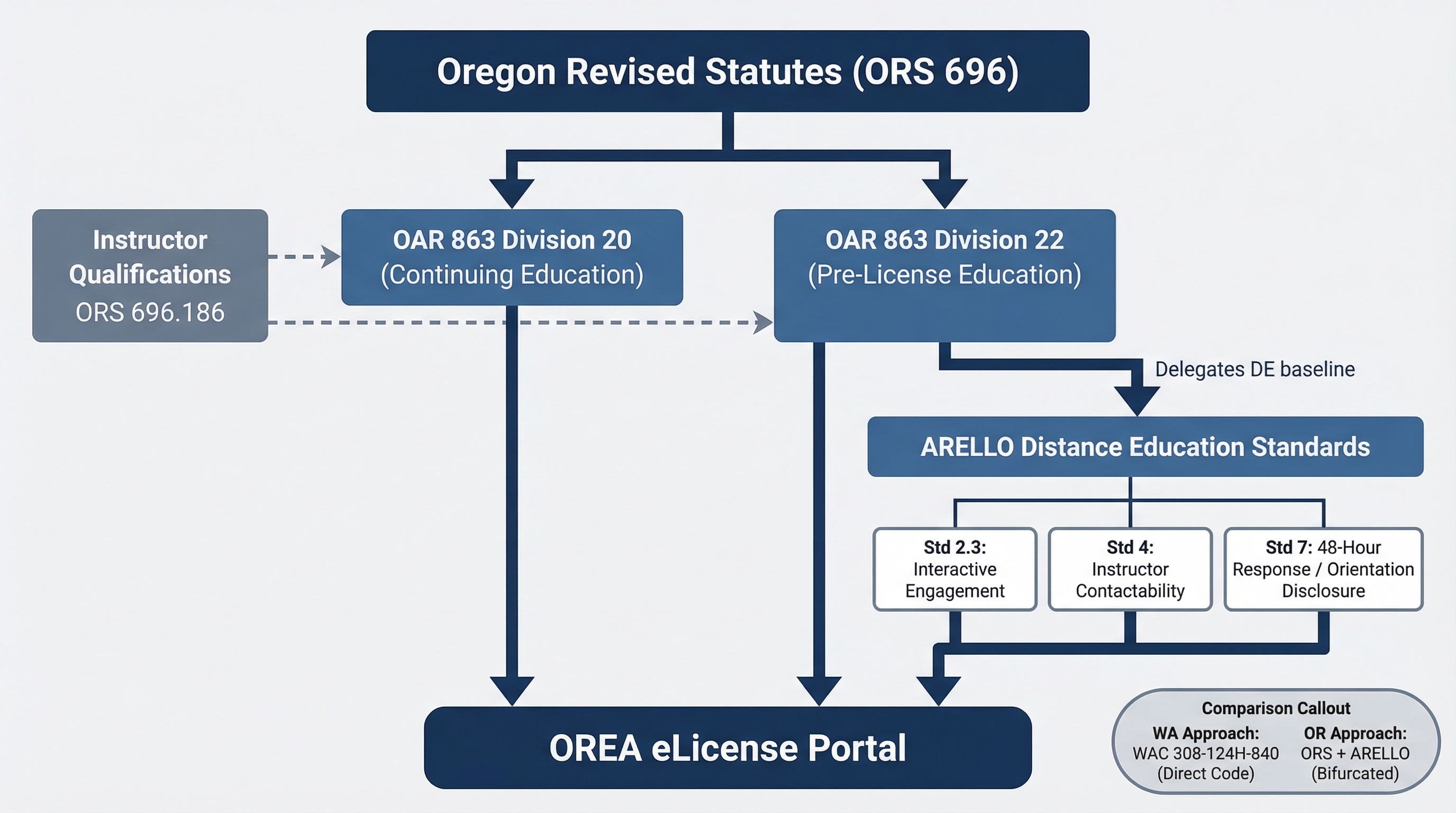
Figure 1: Oregon Real Estate Education Regulatory Hierarchy — How ORS, OAR, and ARELLO standards converge at the eLicense portal.
What Your Instructor Availability Statement Must Include
When an OREA compliance reviewer opens your provider application in the eLicense portal, your Instructor Availability and Student Support Statement should immediately demonstrate operational readiness. A compliant statement functions as a practical contract among the school, the instructor, and the student. To meet both OREA and ARELLO expectations, your statement must explicitly address the following components:
- Comprehensive Instructor Contact Information: Provide exact channels of communication—such as direct email, internal Learning Management System (LMS) messaging, or a dedicated ticketing portal. Phone numbers should include explicit availability windows, ensuring learners know precisely when and how they can reach their assigned instructor.
- Strict Response Time Commitments: Your policy must explicitly state a Service Level Agreement (SLA) that aligns with ARELLO's requirement. Use definitive language such as: "Instructors will respond to all content-related inquiries within 48 hours or less." [6] Administrators should also document their policy for handling exceptions when an inquiry cannot be resolved within the 48-hour window.
- Defined Office Hours or Synchronous Windows: While asynchronous learning offers flexibility, providing scheduled windows during which an instructor is guaranteed to be available demonstrates proactive compliance with learner-to-instructor engagement mandates.
- Content Questions vs. Technical Support Distinction: ARELLO standards emphasize that credentialed instructors should not be diverted by password resets or browser issues. Your statement must clearly delineate how students seek assistance for curriculum concepts—routed to the ORS 696.186-qualified instructor—versus platform issues, which are routed to technical support staff.
- Orientation Disclosure Requirements: ARELLO Standard 7 requires that instructor availability, contact methods, and response SLAs be explicitly disclosed during the student orientation phase, before substantive coursework begins [6]. Your portal submission should include screenshots or transcripts of this orientation disclosure as verifiable evidence for compliance reviewers.
Student Support Requirements by Provider Type
Oregon law does not treat all education providers identically. Your eLicense portal compliance strategy must be carefully tailored to your specific organizational classification.
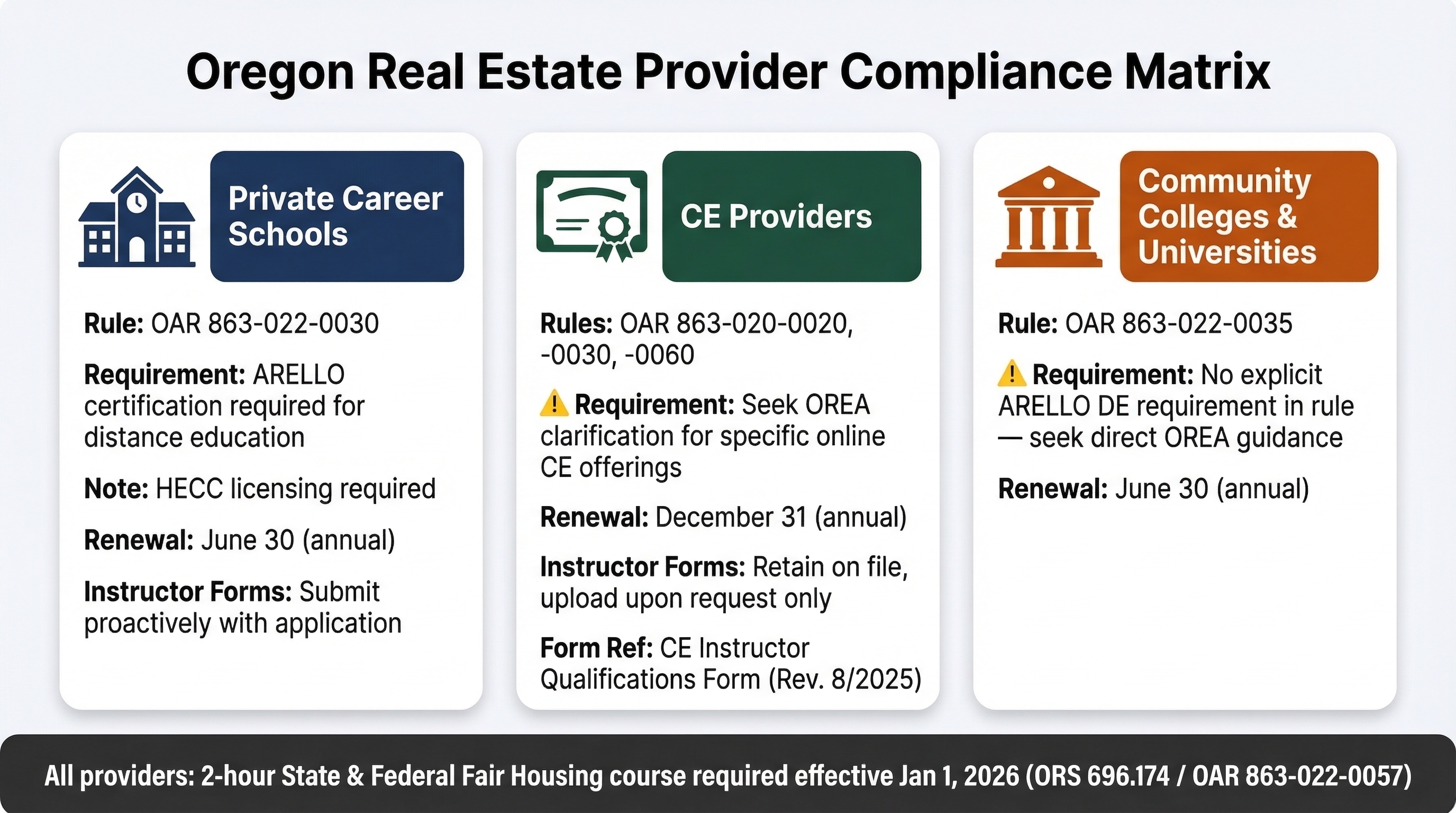
Figure 2: Provider Type Comparison — Key compliance requirements, governing rules, and annual renewal deadlines by provider classification.
Private Career Schools
For private career schools offering the 150-hour broker pre-license program or the 60-hour property manager course via distance education, OAR 863-022-0030 is the governing rule [1]. This rule explicitly requires providers to submit documentation proving the course has been certified by ARELLO. Because ARELLO certification mandates strict instructor interaction standards, your Student Support Statement must be thorough and detailed. One regulatory artifact worth noting: while Division 22 definitions reference licensing by the "Oregon Department of Education" (ODE), the actual approval rules require proof of licensing from the Higher Education Coordinating Commission (HECC). Reviewers are generally aware of this naming inconsistency, but your documentation should align with current HECC credentials to avoid unnecessary administrative friction.
Continuing Education (CE) Providers
CE providers operate under a distinct set of rules, primarily OAR 863-020-0020 (definitions, including the distance learning provider definition) [2], OAR 863-020-0030 (CE provider certification) [3], and OAR 863-020-0060 (instructor qualification form requirements) [4]. While OREA defines an approved "distance learning provider" for CE purposes as one with at least one course certified by ARELLO, the current regulatory text presents some ambiguity regarding whether all online CE courses—regardless of provider type—require ARELLO certification [9]. The rules specifically mandate ARELLO certification for pre-license distance education and recognize it for qualifying as a "distance learning provider," but the universal application to all online CE formats is less explicitly defined. Administrators are strongly advised to contact OREA directly for formal clarification on whether ARELLO certification is required for their specific online CE offerings.
Community Colleges and Universities
Public institutions governed by OAR 863-022-0035 follow slightly different statutory pathways [10]. Unlike the rules applicable to private career schools, OAR 863-022-0035 does not contain the same explicit ARELLO distance education requirement found in OAR 863-022-0030. Because this presents a genuine regulatory ambiguity, administrators at community colleges and universities should seek direct OREA guidance on whether ARELLO certification is expected for their distance offerings. Recognizing and navigating these ambiguities—including drafting anomalies such as OAR 863-022-0050's erroneous cross-reference to OAR 863-022-0015 (rather than 0025) for the 40-hour Brokerage Administration and Sales Supervision (BASS) course [11]—reflects the kind of thorough compliance awareness that serves institutions well during regulatory review.
eLicense Portal Compliance Workflow
Maintaining compliance is an ongoing operational workflow, not a one-time event. The OREA eLicense portal is designed to track compliance dynamically throughout the academic year.
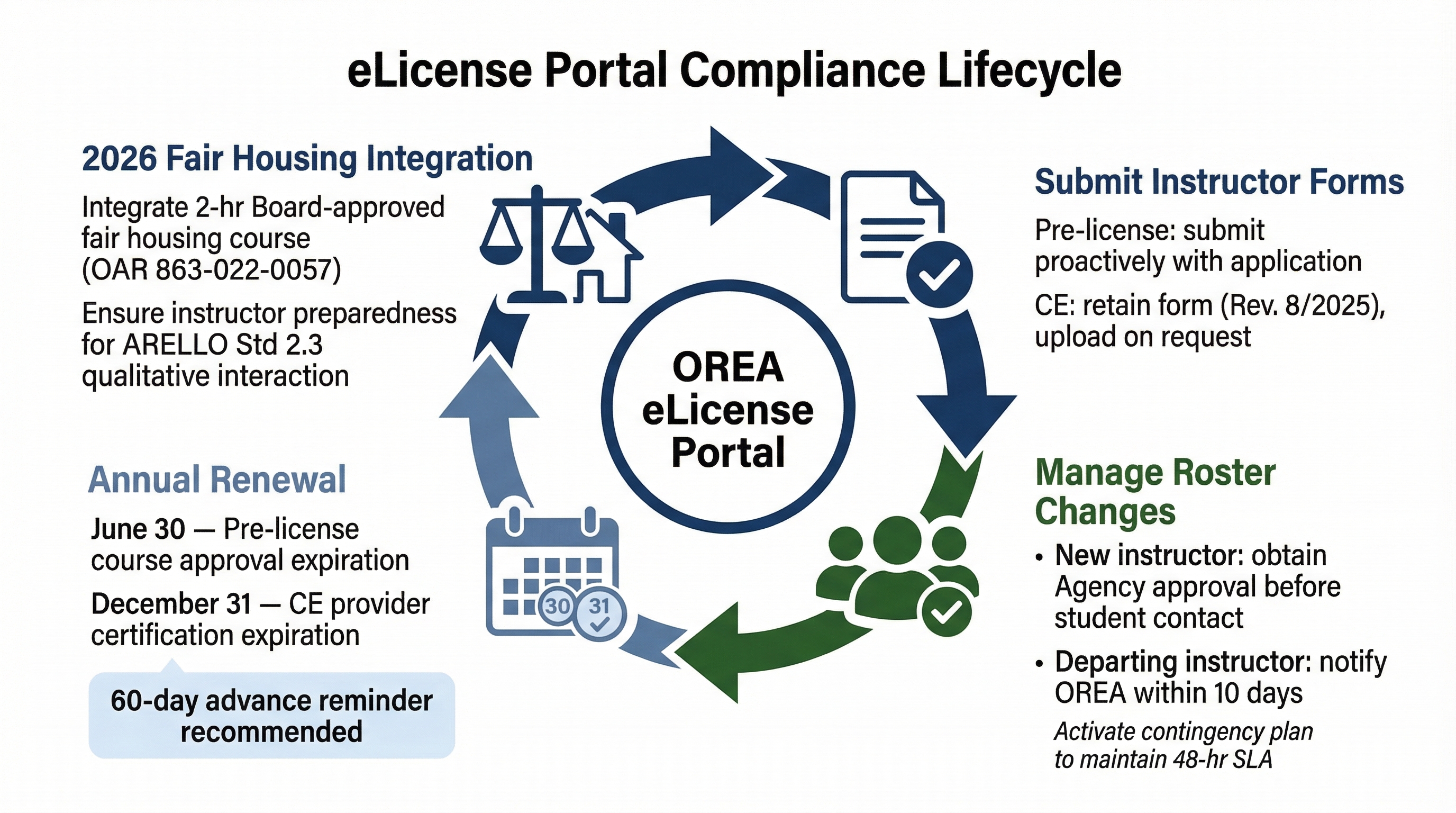
Figure 3: eLicense Portal Compliance Lifecycle — A continuous workflow for maintaining provider compliance throughout the academic year.
1. Submitting Instructor Forms: Under OAR 863-022-0030, pre-license applications must include "Agency-approved instructor forms" [1]. For CE courses, providers must ensure that instructors complete and sign the contents required by OAR 863-020-0060, using the updated OREA CE Instructor Qualifications Form (Rev. 8/2025) [12]. Importantly, OREA instructions specify that this CE form should be retained by the provider and uploaded to the agency only upon request—unlike pre-license forms, which must be submitted proactively.
2. Managing Instructor Roster Changes: The portal requires vigilant maintenance of your instructor roster. Adding a new instructor requires a formal application for Agency approval before that instructor may interact with students. If an instructor departs, the school must notify OREA within 10 days [1]. Your Student Support Statement should include an internal contingency plan detailing how student inquiries will be handled during these transition windows to ensure the 48-hour response SLA remains uninterrupted.
3. Annual Renewal Deadlines: Missing a renewal deadline in the eLicense portal automatically invalidates your courses. Pre-license course approvals expire annually on June 30 [1], while CE provider certifications expire annually on December 31 [3]. Your portal management calendar should include 60-day advance reminders for both dates to allow sufficient time for document preparation and internal review.
4. The 2026 Fair Housing Requirement Transition: A major focus for compliance reviewers in the current cycle is the integration of the newly mandated State and Federal Fair Housing course. Effective January 1, 2026, ORS 696.174 [13] and OAR 863-022-0057 [14] require a minimum of two hours of Board-approved fair housing instruction. Your instructor support statement for this course should highlight how instructors are prepared to engage learners on complex, sensitive legal scenarios, fulfilling the qualitative interaction expectations of ARELLO Standard 2.3.
Building an Audit-Ready Student Support Framework
Drafting a compliant statement is only the first step; consistent execution ensures your institution remains in good standing during an OREA audit. Reviewers look for objective evidence that written policies translate into actual student support.
Implement Ticketing and LMS Logging: Avoid relying on personal instructor email accounts. Implement a centralized ticketing system or LMS messaging module that automatically timestamps every student inquiry and instructor response. If OREA audits your 48-hour response SLA, you must be able to export a report demonstrating compliance across all interactions without requiring manual data compilation.
Establish Coverage Plans for Weekends and Holidays: The 48-hour response expectation does not pause for weekends or holidays. Your internal framework must designate named backup instructors or support staff to monitor the inquiry queue during these periods, ensuring SLAs are not breached when the primary instructor is unavailable.
Proactive Monitoring and Outreach: ARELLO standards expect instructors to be proactive, not merely reactive. Configure your LMS to generate alerts for non-progress—for example, a student inactive for seven days—and require instructors to initiate outreach and log those interactions. This approach transforms your support model from a passive help desk into active academic supervision, demonstrating genuine and sustained learner-to-instructor engagement.
Strict Record Retention: OAR 863-020-0055 requires CE providers to maintain all records of attendance, course materials, and instructor qualifications for a minimum of three years [15]. Ensure your LMS archives all student-instructor communications for this same 36-month period, keeping them readily accessible for prompt upload to the eLicense portal if requested by an auditor. Systematic record organization signals operational maturity to compliance reviewers.
Conclusion
Crafting a compliant Instructor Availability and Student Support Statement is a foundational requirement for operating a real estate school in Oregon. By aligning your operational workflows with ARELLO's ≤48-hour response standards, consistently utilizing the OREA CE Instructor Qualifications Form (Rev. 8/2025), and mapping your programs to the 2026 fair housing mandates, you establish a strong compliance foundation for your eLicense portal submissions. Proactive compliance not only satisfies OREA reviewers—it ultimately elevates the standard of real estate education, ensuring that Oregon brokers and property managers enter the field thoroughly supported and well prepared.
References
- OAR 863-022-0030 (Pre-license Course Approval Requirements): https://secure.sos.state.or.us/oard/viewSingleRule.action?ruleVrsnRsn=328551
- OAR 863-020-0020 (CE Definitions and Distance Learning Provider): https://secure.sos.state.or.us/oard/viewSingleRule.action?ruleVrsnRsn=236070
- OAR 863-020-0030 (CE Provider Certification and Renewal): https://secure.sos.state.or.us/oard/viewSingleRule.action?ruleVrsnRsn=251075
- OAR 863-020-0060 (Instructor Qualification Form Requirements): https://secure.sos.state.or.us/oard/viewSingleRule.action?ruleVrsnRsn=322112
- ARELLO Distance Education Program: https://www.arello.org/public/programs/distance-education/
- ARELLO Distance Education Standards, Policies & Procedures (2024-12-12 PDF): https://www.arello.org/assets/DE/ARELLO%20Distance%20Education%20Standards%2C%20Policies%20%26%20Procedures%202024-12-12.pdf
- ORS 696.186 (Qualifications of Continuing Education Instructors): https://www.oregonlegislature.gov/bills_laws/ors/ors696.html
- WAC 308-124H-840 (Washington Distance Education Standards): https://app.leg.wa.gov/documents/laws/WACArchive/2020/pdf/WAC%20308%20%20TITLE/WAC%20308%20-124H%20CHAPTER/WAC%20308%20-124H-840.pdf
- OREA Continuing Education Page: https://www.oregon.gov/rea/Educators/Pages/Continuing-Ed.aspx
- OAR 863-022-0035 (Community Colleges and Universities): https://secure.sos.state.or.us/oard/viewSingleRule.action?ruleVrsnRsn=328552
- OAR 863-022-0050 (Drafting Error / Advanced Practices Cross-Reference Note): Referenced within text for regulatory awareness context.
- OREA CE Instructor Qualifications Form: https://www.oregon.gov/rea/educators/Documents/ce-instructor-qualifications-form.pdf
- ORS 696.174 (Continuing Education Statutory Requirements): https://www.oregonlegislature.gov/bills_laws/ors/ors696.html
- OAR 863-022-0057 (State and Federal Fair Housing Course): https://secure.sos.state.or.us/oard/viewSingleRule.action?ruleVrsnRsn=328555
- OAR 863-020-0055 (Record Retention Requirements): https://secure.sos.state.or.us/oard/viewSingleRule.action?ruleVrsnRsn=251079
As the Oregon Real Estate Agency (OREA) tightens its digital oversight through the eLicense portal, real estate education providers face a critical compliance challenge: adequately documenting and demonstrating instructor availability and student support. With the January 1, 2026, rule changes now in effect, OREA compliance reviewers are scrutinizing provider applications, course renewals, and instructor qualifications more rigorously than ever before. For Oregon education providers, whethe...