
Oregon CMA Mastery: Sales Comparison, Reporting and Ethics
Price it right. Defend it legally. Build CMAs that win listings and withstand scrutiny in Oregon's evolving market.
Course Description
This 4.5-hour continuing education course takes Oregon real estate brokers step by step through the sales comparison approach and a complete Comparative Market Analysis, then through reporting, client presentation and the ethics that govern a broker's opinion of value.
You will select and adjust comparable sales, reconcile them into a defensible price range, present the result clearly to clients, and document your work to the standard Oregon licensing law expects, including the limits of a broker's role and the disclosures a CMA requires.
Modules Include:
- Sales Comparison Approach (CMA Execution)
- Practical Reporting, Presentation & Ethics
Course Preview
The Principle of Substitution in Valuation
You’ve established agency. You’ve analyzed market conditions. You understand your legal boundaries. Now, you are ready to execute the pricing analysis itself. The Sales Comparison Approach (SCA) is the industry-standard methodology for residential valuation. It serves as the foundation of every Competitive Market Analysis you perform under Oregon real estate law¹.
The Sales Comparison Approach relies entirely on the Principle of Substitution. This means a rational buyer will not pay more for a property than the cost of acquiring a similar substitute with equal utility². Therefore, the value of your subject property is not determined by its features in isolation, but by the prices of alternative properties currently available or recently sold.
Unlike the Cost Approach, which adds land value to the depreciated cost of improvements, or the Income Approach, which capitalizes a revenue stream, the SCA analyzes past market behavior to predict a future transaction price. It is the only method that directly reflects the emotional and financial trade-offs made by residential buyers. Builders use cost. Investors use income. We use sales.
To apply this principle of substitution, we must use a structured mathematical formula.
How does the Sales Comparison Approach differ from the Cost Approach and the Income Approach?
The Operational Formula and Adjustment Logic
At its core, the sales comparison approach solves for an unknown value using known variables. Your subject property is the unknown, while recent comparable sales are the knowns. Because no two properties are identical, particularly within Oregon’s diverse housing stock, you must mathematically normalize the data. We use a constant formula for this:
Price of Comparable ± Adjustments = Indicated Value of Subject
This process requires strict discipline. You must never adjust the subject property. Instead, you always adjust the comparable sales to match the subject property. If a comparable has a superior feature, such as an extra garage bay, you subtract that feature’s value from the comparable’s sales price. If the comparable is inferior, perhaps lacking a scenic view, you add that value to the comparable’s price. This normalization shows what the comparable would have sold for if it had the exact same characteristics as your subject property.
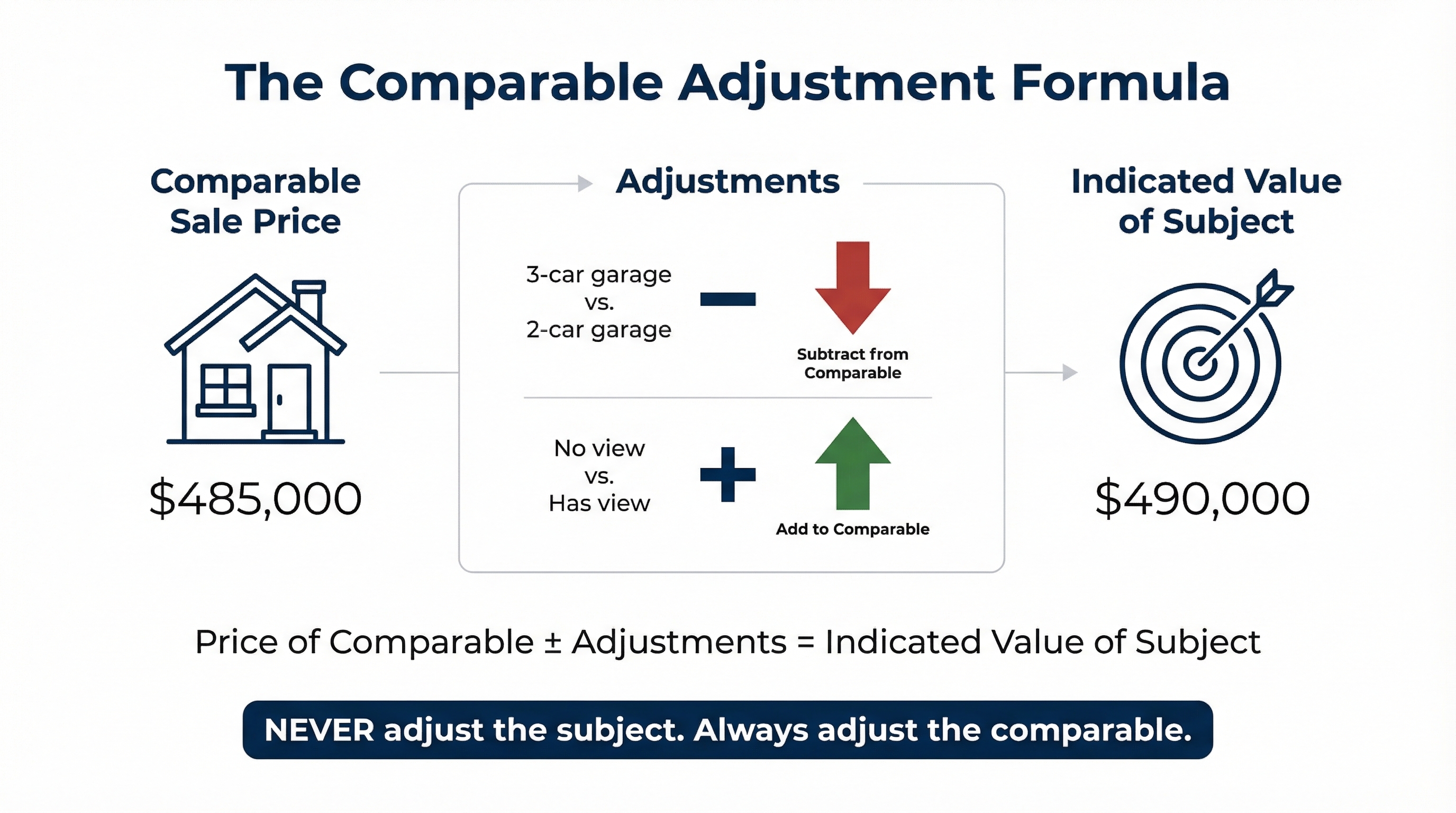
Figure 1: Directional logic of the comparable adjustment process. Superior comparable features reduce price; inferior features increase it.
In the sales comparison approach described on the slide, which property is adjusted?
In the sales comparison approach, which property is adjusted, and why?
Oregon’s Legal Utility and Boundary Challenges
In standard markets, finding substitutes depends on geography and square footage. In Oregon, however, the Urban Growth Boundary (UGB) and House Bill 2001 upzoning make our selection process more complex. A house one mile away is not comparable if it sits across the UGB line in a different legal jurisdiction. A property with a deed restriction preventing an Accessory Dwelling Unit (ADU) is not a direct substitute for a neighbor that can legally accommodate a dual-living structure.
You must filter for these legal utility differences before applying physical adjustments. Treating a rural residential property as a comp for a suburban subdivision home is a fundamental error in your methodology, regardless of how similar the structures appear.
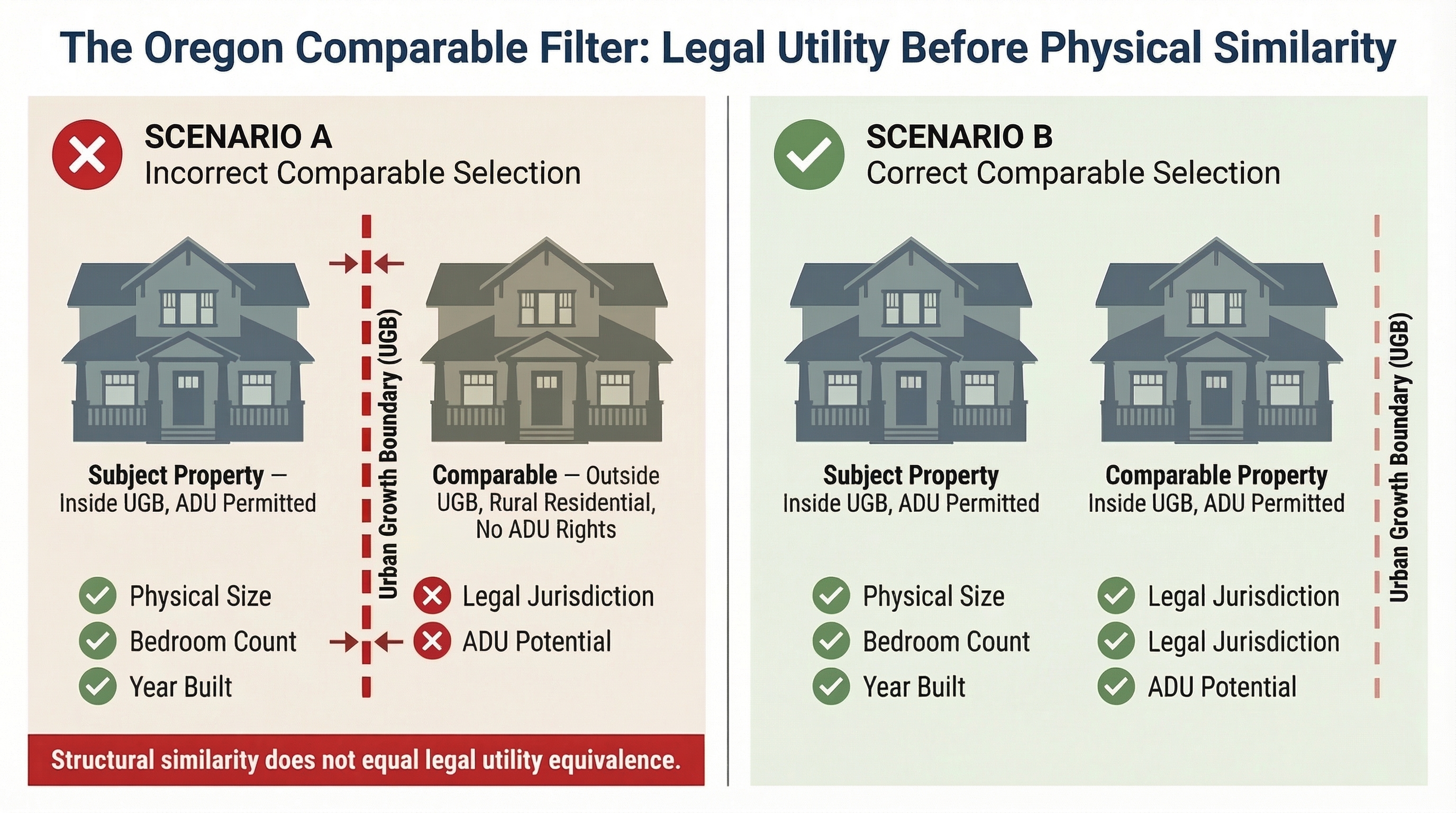
Figure 2: In Oregon markets, you must apply legal utility filters, like UGB jurisdiction and ADU rights, before making physical adjustments.
Navigating these regional boundaries leads directly into our next focus: the structured four-phase workflow of CMA execution.
According to the slide, what must a broker do before applying physical adjustments to Oregon comparables?
The Four-Phase CMA Execution Workflow
A strong Competitive Market Analysis (CMA) relies on four distinct phases. Each phase builds directly on the previous one, meaning any error early in the process will negatively impact your final valuation.
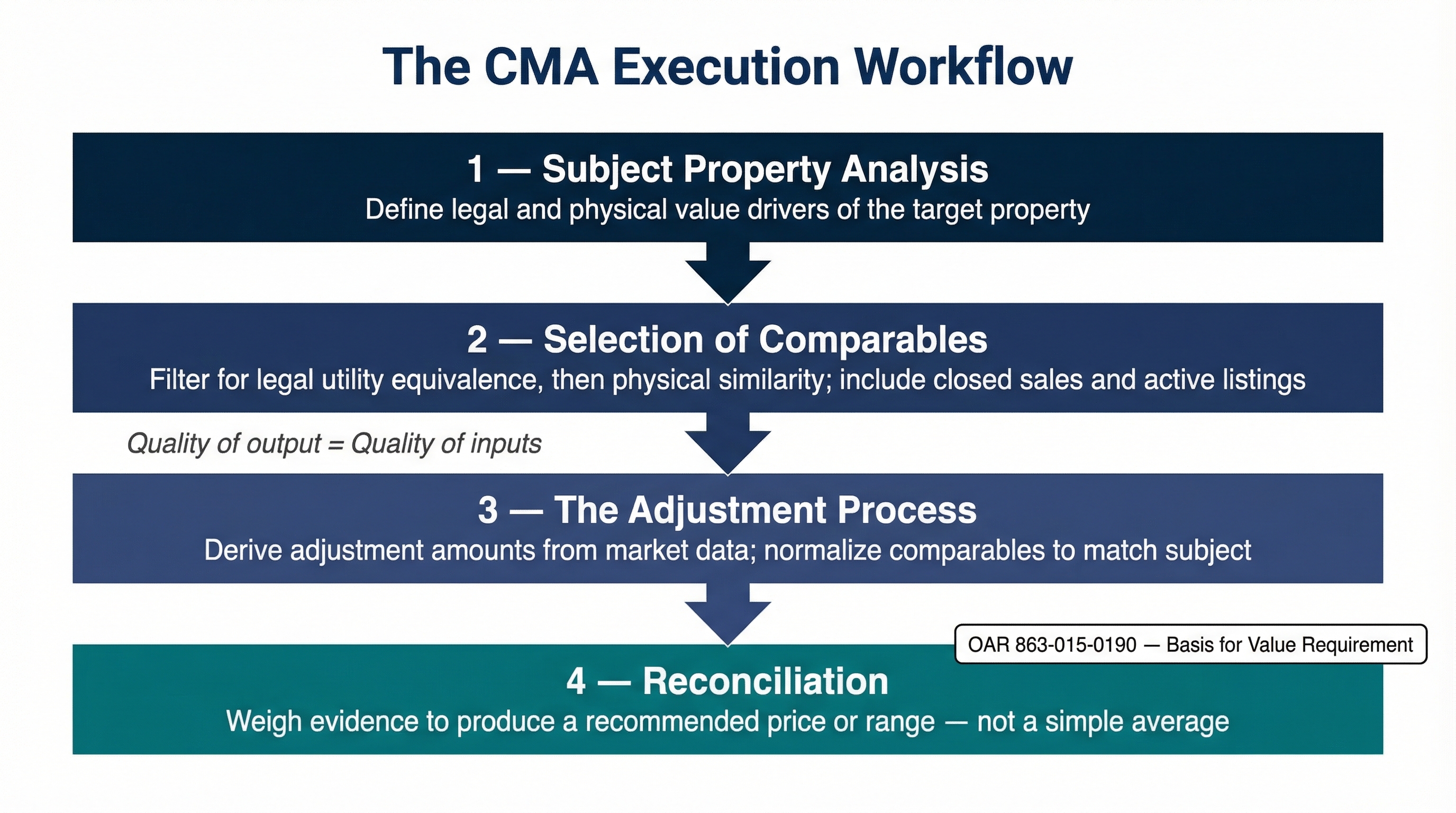
Figure 3: The four-phase CMA workflow. Each phase builds on the last. Errors in comparable selection will compound through the adjustment and reconciliation stages.
- Subject Property Analysis: You must define your target property first. This step goes beyond counting bedrooms; you must identify the specific physical and legal characteristics that establish its market value.
- Selection of Comparables: The accuracy of your final price depends on the quality of your comparable properties. In Oregon, a CMA must analyze both past transactions (closed sales) and current listings (active listings). State rules do not require you to prioritize one over the other when determining a recommended listing, selling, or purchase price.
- The Adjustment Process: This phase uses the math of differences. You will learn to calculate adjustment values using actual market data instead of guessing.
- Reconciliation: This is the final evaluation. You must weigh all your evidence to recommend a final price or price range, rather than just calculating a simple average.
This structured process helps you meet Oregon administrative rules [1], which require you to provide a clear basis for the value in your final report. We will begin this process with a detailed examination of the subject property.
We must begin our property analysis with a precise definition. If you miss an easement, misidentify the zoning, or accept incorrect square footage, every future adjustment you make will compound that error. The subject property is your control variable. Flawed inputs always produce flawed outputs.
You are not just counting bedrooms and bathrooms. You are defining the complete legal and physical asset. Often, a property’s value resides in its invisible ‘bundle of rights’ rather than its physical structure. For example, a three-bedroom home inside an Urban Growth Boundary (UGB) with middle housing development rights¹ is legally distinct from an identical structure on Exclusive Farm Use (EFU) land. Under state housing laws, properties in large cities (population over 25,000 or within the Portland Metro area) hold potential for a quadplex. Properties in medium cities (population 10,000 to 25,000 outside Metro) are generally allowed a duplex. Conversely, EFU properties are usually limited to one primary dwelling, though county approval may permit additional dwellings for farm help, assisting relatives, or temporary medical hardships.
To conduct an effective analysis, we must assess the property across three dimensions:
- Legal Characteristics: Zoning, UGB status, deed restrictions, easements, and encroachments. In Oregon, you must also verify if the property is subject to specific overlay zones or hazard designations.
- Physical Characteristics: Gross Living Area (GLA), lot size, condition, and construction quality. To maintain accuracy and meet standards of professional competence², you should separate above-grade living space from below-grade space. Note that state administrative rules³ do not explicitly mandate this separation for licensee-prepared valuation reports, but doing so remains a best practice.
- Economic Characteristics: Tax burden, special assessments, and operating costs.
To analyze these dimensions accurately, we must distinguish between mere observation and authoritative verification.
Verification vs. Observation
Relying only on a homeowner’s word or old MLS listings to describe a property creates major liability. Sellers often overlook unpermitted additions, misstate property lines, or miss zoning changes that happened while they owned the home.
Your primary sources must be authoritative, but you must also know their limits. County tax assessor records are useful for preliminary lot size and tax data, but they are administrative records, not legal authorities. To find precise lot boundaries, check the recorded deed or a professional survey. Similarly, city or county building departments hold the permit histories you need to verify whether a bonus room is legally habitable square footage or just finished storage.
The Seller’s Property Disclosure Statement
In Oregon, our property analysis begins before we even visit the home. You will use the Seller’s Property Disclosure Statement (SPDS), which state law requires the seller to deliver.¹ This state-mandated form helps you understand the property’s true value. When a seller discloses issues like a history of soil sliding, a leaking oil tank, or a shared well agreement, these are material facts that define the property. You must account for the cost to fix these issues, or the buyer resistance they cause, before you choose comparable properties.
While verifying these details, we must also remain strictly within our professional scope of expertise.
A broker needs the precise lot boundaries of a subject property. According to the slide, which source should be used?
Scope of Expertise and Reasonable Care
When analyzing a property, you must identify physical issues that affect its value while working strictly within the limits of your license. Under Oregon law, you are obligated to exercise reasonable care and diligence on behalf of your client, whether representing the buyer or the seller.[1] You do not owe this specific duty to other parties in the transaction; instead, your obligation to non-clients is to provide honesty, good faith, and the disclosure of material facts.[2] This duty of reasonable care means you should only observe and report the visible signs, or material facts, of a property’s condition, rather than trying to diagnose the technical cause.
For example, you might note that a roof has curling shingles and lost granules to adjust for its remaining economic life, but you must not certify that it will leak. Similarly, if you see cracks in a foundation, note how this might affect value and recommend a professional inspection. Crossing into technical diagnosis puts you at risk of liability for acting outside your professional expertise.
Now that we have defined the scope of your analysis, we turn next to the specific physical data points you must collect to ensure an accurate comparison.
Property Identification and Legal Entitlement
In the previous section, we established that you must analyze both the legal and physical aspects of an asset. Now, you must collect the specific data points required to define it accurately, starting with the legal identifier.
A mailing address is useful for delivering mail, but it does not legally define the property you are valuing. When preparing a Competitive Market Analysis (CMA), you must identify the property using its formal legal description from a recorded deed or preliminary title report, not just the house number. Administrative rules require every CMA to include a brief property description. While county tax records are a convenient starting point, they are meant for tax assessment, not for certifying boundaries.
Boundaries and Legal Entitlement
Tax maps only show approximate boundaries. The Oregon Property Buyer Advisory warns that these administrative estimates often differ from physical reality. In Oregon, land value depends directly on legal entitlement. The state’s Urban Growth Boundary (UGB) creates a strict divide in land values. Identical acres can have completely different prices based solely on which side of the boundary line they fall.
Within cities, middle housing laws have removed exclusive single-family zoning in many areas. These rules grant development rights that increase a lot’s potential use. A lot approved for a quadplex has a very different value than one limited to a single home. You must verify these legal entitlements to determine highest and best use. Skip this step, and your entire valuation rests on a false premise.
Accurate physical measurement is essential in real estate. Copying square footage from a previous MLS listing can lead to disciplinary action. If you misstate a property’s size, you risk discipline for material misrepresentation. Negligent measurement also violates your statutory duty of reasonable care.
Appraisers use industry standards like ANSI Z765-2021 to separate Gross Living Area (GLA) from below-grade space. While not legally required to adopt this standard, failing to distinguish between above-grade and below-grade areas can cause major discrepancies between your pricing and the eventual appraisal.
A “daylight basement” with even one subterranean wall is considered below-grade space. The market values this space differently than the main floor, and your analysis must reflect that. If you treat 1,000 square feet of basement as equal to main-floor living space, your pricing becomes untenable once an appraiser applies ANSI standards.
Beyond overall square footage, individual room classifications and specialized improvements carry their own regulatory requirements.
A broker copies a home's square footage from an old MLS listing, and the figure turns out to be wrong. What does the slide say the broker risks?
A broker copies the square footage for a new listing directly from the property's previous MLS listing, and the figure turns out to be wrong. What is the broker's exposure?
Room Counts and Specialized Improvements
Room counts carry legal weight in real estate. A room does not count as a bedroom just because it has a bed. To qualify, it must meet Oregon Residential Specialty Code (ORSC) standards for size, heating, and egress. Without a proper egress window, you must classify the room as an office or den. Because local jurisdictions often amend these codes, check specific city requirements before labeling a borderline room. Mislabeling these rooms will distort your property comparisons.
Specialized Improvements
Always confirm the legal status of specialized improvements before analyzing their value. For example, appraisers value an unpermitted Accessory Dwelling Unit (ADU) as storage or non-living space for financing. Cash buyers might see it differently, but Oregon law still requires you to disclose its unpermitted status.
Solar panels also need careful review. You must determine if they are owned fixtures or leased liabilities, which affects property value and the transaction. Verify this status using the OREF 105 Solar Panel System Addendum and checking for recorded UCC-1 filings.
With the physical asset defined, we turn next to the functional and external factors that influence how these characteristics translate into market value.
How should a broker verify whether a property's solar panels are owned fixtures or leased liabilities?
3.1.2. Functional Factors and Obsolescence
Measuring a property’s size and legal boundaries only provides a starting point. Value depends on how well it functions and where it sits. In the Sales Comparison Approach, we split these qualities into two categories: functional factors (internal utility) and external factors (location forces).
Functional Factors: Utility and Obsolescence
Functional factors show how well a property delivers utility against current market standards. If it falls short, it suffers from functional obsolescence. This is a loss in value caused by poor design, outdated equipment, or structural issues inside the property lines.
1. Deficiencies (Curable vs. Incurable)
- Curable: The cost to fix the issue adds at least that much value. Examples include worn carpet, outdated lighting, or missing appliances. You can recover this cost in the sale price.
- Incurable: The cost to correct the defect exceeds the value added. For example, a “walk-through” bedroom is an Oregon bungalow layout defect where you must pass through one bedroom to reach another. Redesigning this costs more than the market will pay.
2. Superadequacy (Over-Improvement)
Sometimes functional issues stem from excess. Superadequacy occurs when an upgrade costs more than the value it contributes. For example, installing a premium slate roof on a starter home in a standard composition-shingle neighborhood is a superadequacy. The market will not pay extra for this high-end material, so the excess cost becomes functional obsolescence. The Principle of Contribution governs here: value is based on what the market pays, not what the owner spent.
While functional factors govern internal utility, external forces outside the property lines bring a different set of valuation challenges.
3.1.2. External Factors and Valuation Dynamics
External factors, often called external obsolescence, are influences outside property boundaries that reduce value. These are almost always incurable because the property owner has no control over them; third parties or environmental forces dictate the impact.
1. Proximity and Nuisance
Common external issues include traffic noise or commercial venting. We cannot directly compare a home backing up to a busy arterial like Barbur Boulevard to a house on a quiet cul-de-sac without making a significant negative adjustment.
2. The UGB Interface
Oregon’s Urban Growth Boundary (UGB) creates unique valuation dynamics. A home on the UGB edge often has a “protected view” of Exclusive Farm Use (EFU) land. Verify if that view is stable. If the adjacent land is designated as an urban reserve under state rules, that pastoral view is legally slated for future development. This anticipated construction and density functions as a negative external factor.
3. Density and Zoning Shifts
Oregon’s middle housing laws introduced a new external factor: density potential. A single-family home next to a lot being redeveloped into a quadplex may suffer from an anticipated loss of privacy or street parking. This regulatory shift creates external pressure a homeowner cannot control.
4. Environmental Stigma
The hazards you identify during physical property analysis translate directly into financial penalties here. A home located within a state-designated landslide susceptibility zone faces external obsolescence due to risk and insurance challenges. Even if the property has never slid, its location within the hazard zone limits the buyer pool. Lenders may refuse financing, and insurance becomes expensive.
Understanding how these external pressures impact value is a key skill that links directly to your professional duties.
Agency Obligations in Property Valuation
Ignoring functional and external factors violates your duty of reasonable care. Under Oregon law, a buyer’s agent must exercise reasonable care and disclose known material facts that are not obvious or easily discovered by the parties.
Oregon law does not require you to investigate issues outside your expertise, such as geologic stability or structural engineering, unless you agree to do so in writing. However, you cannot ignore clear warning signs. If you discover a false marketing description, or if public records and disclosure statements reveal an obvious error, you must account for these issues in your valuation adjustments.
A professional valuation adjusts for these hidden costs before you recommend an offer price. Now that we have defined these internal and external variables, we will focus next on the specific due diligence steps required for Oregon properties.
Oregon Due Diligence: Disclosures and Permits
As we perform due diligence, we must follow up a physical inspection with a careful legal audit of the property’s improvements. In Oregon, a property’s value depends heavily on what the local building department has officially approved, not just what you see. For example, a finished basement might look like 800 square feet of living space. However, if it was built without permits, appraisers and buyers may value it only as expensive storage.
The Disclosure Baseline
Your review starts with the Oregon Seller’s Property Disclosure Statement¹ which is a legally required form where sellers disclose known defects. However, a seller’s lack of knowledge does not excuse you from your own duty of reasonable care. If you notice a fill pipe in the yard but fail to ask about an underground heating oil tank simply because the seller checked “no” on the disclosure form, you can face disciplinary action for negligence under state licensing law².
Shadow Inventory and the Permit Gap
Oregon markets like Portland and Bend are full of “shadow inventory,” which refers to property improvements made without required permits. Common examples include unpermitted Accessory Dwelling Units (ADUs) or garage conversions. Even though these spaces are physically functional, their lack of legal approval harms the property’s value. You cannot value unpermitted space the same way you value permitted square footage. Always verify the permit history directly through local building department records instead of relying on old MLS listings.
Beyond permits, specific physical infrastructure systems in Oregon present unique regulatory liabilities.
Oregon Infrastructure: Sewers and Heating Oil Tanks
Three Oregon-specific systems frequently complicate transactions or affect property values. You must verify the status of each to ensure a property is truly marketable.
1. Private and Party Sewers
In older Portland neighborhoods, multiple homes often share a single sewer line to the public main. These “party sewers” are non-conforming connections. Local city code assigns maintenance responsibility for these private systems to the property owners they serve, meaning shared liability for repairs.
Selling a property does not legally trigger a mandatory disconnection. However, Portland requires the abandonment of non-conforming connections within 180 days of receiving notice that a public sewer is available. Lenders also frequently require party sewers to be separated before approving financing, which forces a resolution during the transaction. Always verify sewer maps in older urban neighborhoods, or you may seriously underestimate infrastructure costs.
2. Heating Oil Tanks (HOTs)
Homes built before 1965 often used underground heating oil tanks. While this date is not written into law, the Oregon Department of Environmental Quality (DEQ) and real estate brokers use it as a screening threshold. Oregon property disclosure law requires sellers to disclose any known heating oil tanks regardless of the home’s age.
An “empty” underground tank is not considered decommissioned and remains an environmental liability under state regulations. To maintain property value, a tank must be certified as decommissioned (cleaned and filled) or completely removed.
You can check a tank’s status using the DEQ online portal. Because government records are not exhaustive, we also recommend a physical oil tank sweep to find unregistered tanks. Without verification, the property carries risk of soil contamination and costly cleanup.
Finally, Oregon’s environmental regulations also target air quality through strict woodstove certification rules, which we will examine next.
In Portland, how long after receiving notice that a public sewer is available must a non-conforming party sewer connection be abandoned, according to the slide?
Oregon Woodstove Certification Requirements
Woodstove Certification
Oregon air quality laws strictly regulate particulate emissions. State law requires the removal and destruction of uncertified solid fuel burning devices, such as woodstoves or fireplace inserts, in connection with the sale of a residential structure [1]. This device must be removed before closing unless the buyer accepts written responsibility to destroy it within 30 days after the closing date.
Although failing to comply does not invalidate the sale, if you ignore this requirement, you create a compliance breach that can delay closing. State administrative rules offer a workaround for this process [2]. The seller and buyer can agree in writing, typically within the sales contract or an addendum, that the buyer will accept responsibility for destroying the device. The buyer must then remove and destroy the device within this 30-day window and submit an Uncertified Woodstove Removal Notification form to the Department of Environmental Quality (DEQ).
With these legal and physical attributes verified, the subject property is fully defined. The next phase: selecting comparables that function as true substitutes.
According to the slide, what is the effect on the sale if the parties fail to comply with Oregon's uncertified woodstove removal requirement?
An Oregon residential sale closes with an uncertified woodstove still in place and no written agreement assigning responsibility for it. What is the consequence of that failure to comply?
3.2. Selecting Comparables (Comps)
With the subject property fully defined and legal constraints verified, you turn to the market. This is the Selection Phase, the most critical step in the valuation process. Select properties that are not true substitutes, and your analysis collapses. No amount of mathematical adjustment can fix a valuation built on flawed data. Garbage in, garbage out.
The Mandate: Evidence Over Intuition
Selecting comparables is not a subjective exercise. It is a regulatory requirement of proof. In Oregon, every written Comparative Market Analysis (CMA) or Letter of Opinion must include the basis for the value, including applicable market data or capitalization computations.¹ You cannot simply state a value. You must provide the data that leads to your conclusion. If a complaint is filed against you, the Oregon Real Estate Agency examines whether your data selection meets the statutory standard of care.²
To ground this selection process in economic reality, we must apply the fundamental principle of substitution.
The Substitution Test
Your selection logic flows directly from the Principle of Substitution we discussed earlier. That economic law dictates that a rational buyer will not pay more for a property than the cost of acquiring an equally desirable substitute without a long delay. A valid comparable must meet a simple test: Would a buyer for the subject property also consider buying this property?
If the answer is no, it is not a comparable. For example, a rural property on five acres is not a substitute for a suburban property on a 5,000-square-foot lot, even if they share the same price.
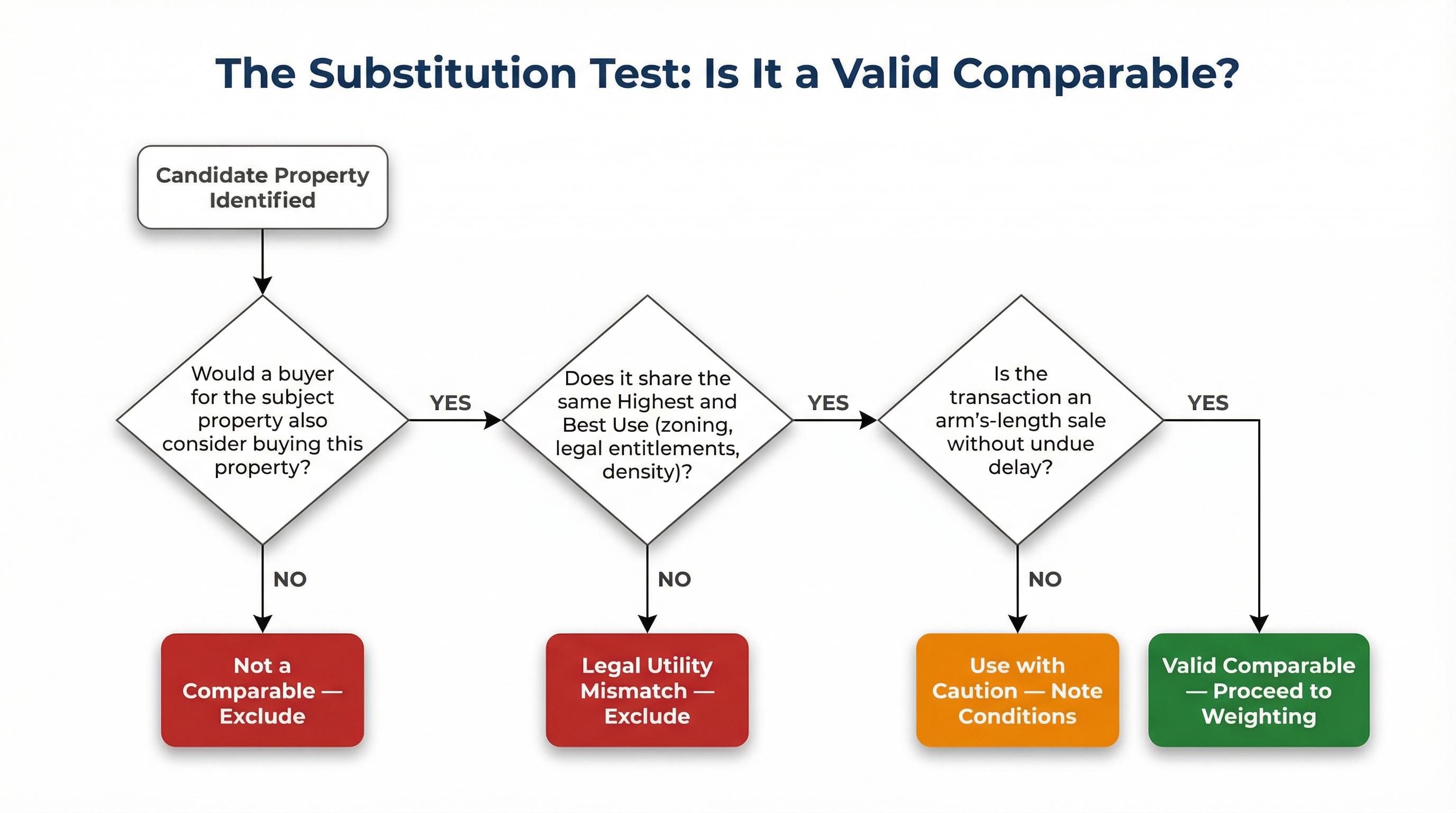
Apply this three-gate test sequentially. A property that fails any gate is not a valid comparable, regardless of price similarity.
The Oregon Filter: Legal Utility
In Oregon, substitution requires matching Highest and Best Use first. Verify that the comparable operates under the same zoning, density allowances, and legal rules as your subject property.
- UGB vs. EFU: A home inside the Urban Growth Boundary with subdivision potential is not a substitute for a home outside the UGB on Exclusive Farm Use land.
- Middle Housing: A lot eligible for a quadplex under House Bill 2001 has a different value utility than a lot restricted by private covenants, conditions, and restrictions (CC&Rs) to only a single home.
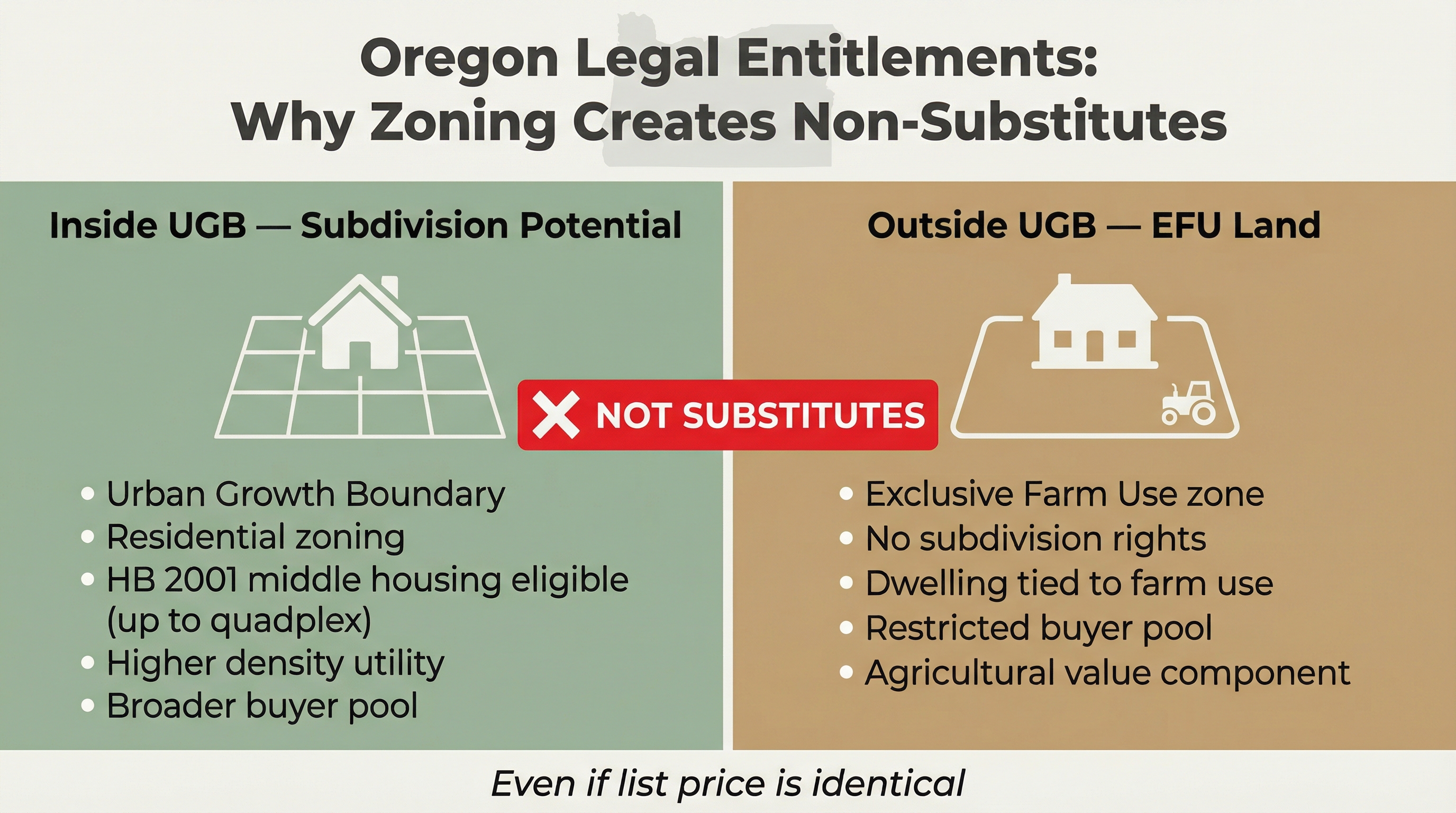
Oregon’s land-use framework creates legally distinct property classes. Matching price without matching legal utility is a methodological error.
Comparing properties with different legal rules is a methodological error.
While understanding legal utility is critical, we must also guard against subjective biases that distort these market comparisons.
The Competence Trap: Bias and Predetermined Value
The most common ethical issue in valuation is confirmation bias. This occurs when you select only high-priced comparable sales to justify an inflated listing price and win a client’s business. This practice, known as “buying the listing,” is illegal.
Oregon law strictly prohibits accepting work or pay for a CMA that depends on reporting a pre-set value. If you filter data just to hit a specific number, you are manipulating the market, not analyzing it.
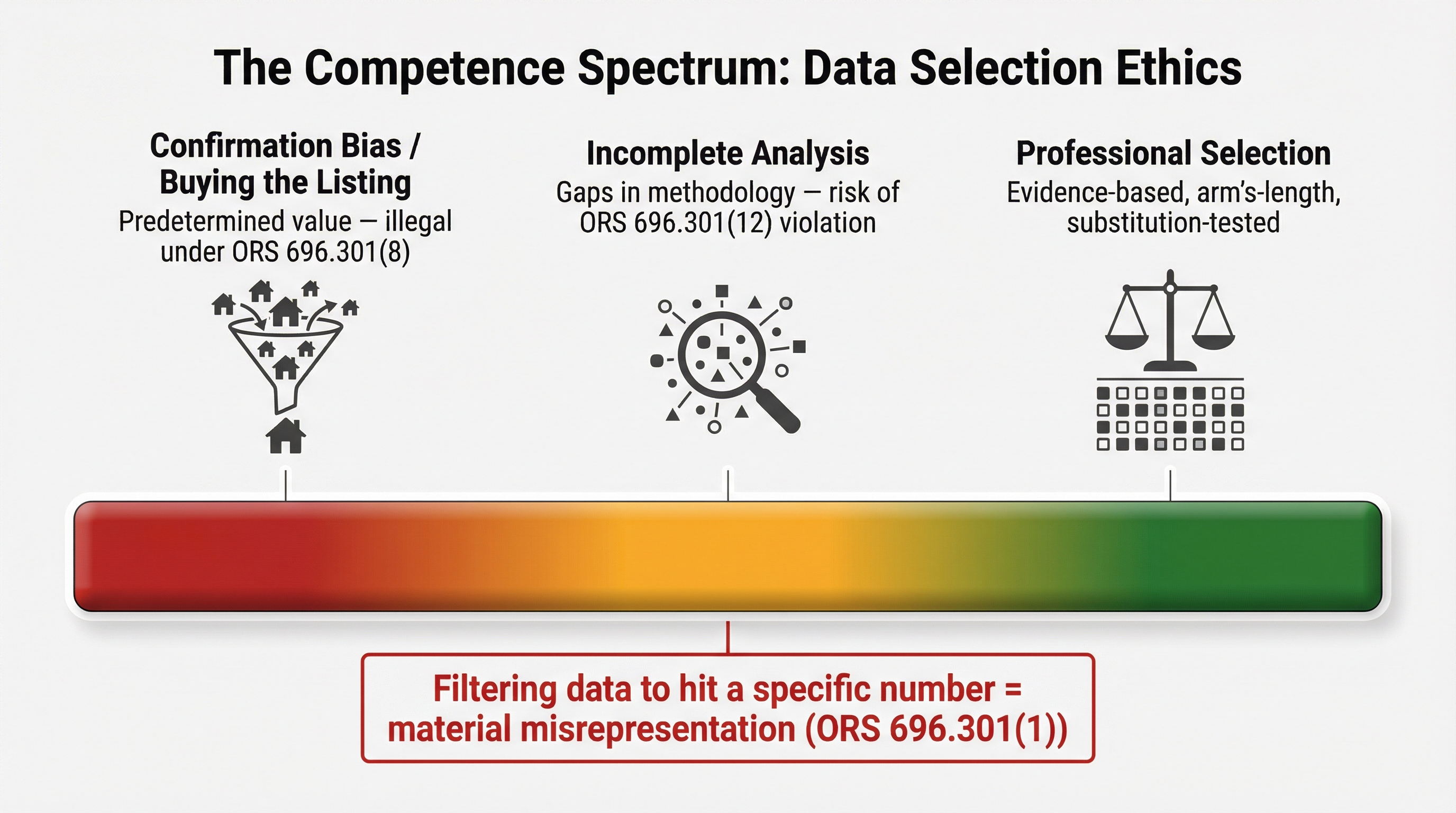
Confirmation bias is not a minor error in judgment; it is a statutory violation with serious license consequences. Professional selection sits at the far right of this spectrum.
This constitutes material misrepresentation and can lead directly to license revocation.
Automated vs. Professional Selection
Sellers often ask why they need your analysis when online Automated Valuation Models (AVMs) provide instant estimates. Algorithms match basic statistics like square footage and zip codes, but they cannot evaluate unique features. For example, an algorithm does not know if a home backs up to a busy highway or enjoys a mountain view.
Your role is to filter data through the lens of utility and marketability, removing statistical matches that are not true competitors.
With this standard of competence established, we will next categorize this evidence by transaction status to determine the specific weight each category carries in your final analysis.
According to the slide, why can an Automated Valuation Model (AVM) not replace a broker's comparable selection?
A seller asks a broker why a professional pricing analysis is needed when an online Automated Valuation Model returns an instant estimate. What is the AVM's limitation?
3.2.1. Listing Status Categories
To establish a clear basis for value under Oregon administrative rules, you must understand what each transaction status reveals and how to combine them. This evidence falls into four distinct categories, each playing a different role in your analysis.
Active Listings (The Ceiling)
Active listings represent your current competition, not your comparable sales. Under the Principle of Substitution, they show the upper limit of value. For example, if a comparable home on the same street is listed for $550,000, that price sets the ceiling. If you price a property above $550,000 without offering better features or utility, you simply make the competing home look like a better deal to buyers.
Pending Listings (The Direction)
Pending sales act as the market’s speedometer, showing the price points that are currently attracting offers. Although the final sales price remains confidential until the transaction closes, the list price at the time of contract indicates immediate buyer acceptance. If active listings are sitting unsold at $550,000 while homes listed at $525,000 go pending within days, the market is moving downward. Paying attention to this signal helps you avoid pricing a home too high in a declining market.
Sold Listings (The Proof)
Sold listings provide the only factual evidence of market value. They show what buyers actually paid, instead of what sellers hoped to receive. Oregon law does not mandate a specific timeframe for using comparable sales data. However, state licensing statutes subject licensees to discipline for incompetence or untrustworthiness. To meet the professional standard of care, industry best practices prioritize sales closed within the last three to six months.
This timeframe is especially important in Oregon’s seasonal market. Local real estate activity and pricing peak in late spring and summer, then soften from November through February. A home sold in December often reflects a discount due to having fewer active buyers. If you use that winter sale to price a July listing without making an adjustment, you ignore the seasonal difference and risk undervaluing your client’s property.
Expired and Withdrawn (The Rejection)
Expired and withdrawn listings reveal prices that the market rejected. They establish the upper boundary of overpricing. You should view these as pricing errors instead of simple marketing failures, as they provide critical signals about what buyers will not pay.
The Defensible Data Mix: Triangulation
A competent competitive market analysis (CMA) combines these categories to find a supported value. While appraisal standards suggest using at least three sold comparables, Oregon law does not require a specific number. State rules require you to provide the basis for your value, including applicable market data, and to clearly state that your analysis is not an appraisal. You build your analytical foundation on recent sold properties, then layer in active and pending listings to place that sales history in the context of current competition.
Consider this example of how to combine the data:
- Solds (Past): Average $500,000 (The market foundation)
- Actives (Present): Average $525,000 (Current competition)
- Pendings (Future): Average $515,000 (Where buyers are acting right now)
- Conclusion: The market is appreciating. A listing price between $515,000 and $520,000 is supported by this upward path.
With your data categories defined and the mix established, we next refine the search using specific selection criteria to ensure true comparability.
A broker uses a comparable that sold in December to price a July listing and makes no adjustment. What risk does this create?

Instructor
or1 instructor1
Details
- Clock Hours: 4.5
- Format: Slides - includes video, text & images