
2026-2027 Law and Rule Required Course (LARRC)
Oregon's required LARRC, stay current on the law changes that directly affect your license and your practice.
Course Description
This is not optional. Oregon requires every broker to complete the Law and Rule Required Course (LARRC) during each renewal cycle, and the 2026–2027 edition reflects the latest legislative changes, agency directives, and regulatory updates you need to know.
Module 1 covers required agency and legislative updates, new statutes, amended rules, and OREA enforcement priorities that took effect during this cycle. Module 2 addresses practice standards and regulatory compliance, translating rule changes into the day-to-day adjustments your brokerage operations require.
Concise, current, and mandatory, complete your LARRC requirement online at your own pace and stay in good standing with the Oregon Real Estate Agency.
Course Preview
Team Regulation and Broker Oversight
Oregon law sets strict transparency and disclosure rules for real estate teams. Effective January 1, 2026, state legislation formalizes the role of the managing principal broker, who is the principal broker responsible for the registered business name.
Under these rules, all team activities require direct approval from your managing principal broker.
To ensure proper oversight, your office must maintain comprehensive written policies covering brokerage operations and detailed succession planning. These guidelines must clearly outline how teams operate, market themselves, and handle client communications.
Furthermore, team disclosure timing is strictly regulated. State rules require you to disclose your team association at first contact, rather than waiting until a written agreement is signed.
Additionally, teams must adjust their branding to meet state standards. The state has extended the deadline to remove the words “real estate” or “realty” from team names to July 1, 2027.
The state real estate licensing system is growing. Starting January 1, 2026, new legislation establishes a distinct timeshare sales agent license. This limited license strictly prohibits the holder from employing, engaging, or supervising the professional real estate activities of any other licensee.
You must disclose both your professional license status and your wholesale intentions to consumers.
We will examine the exact wording required for these wholesale forms shortly.
Additionally, the state has restructured continuing education requirements. Effective January 1, 2026, active license renewals require you to complete an approved State and Federal Fair Housing course.
Because of this new requirement, the mandatory Law and Rule Required Course drops from three hours to two hours. Other renewal and reactivation requirements vary by license type, with unique advanced practice courses required for brokers, principal brokers, and property managers.
With this legislative landscape mapped out, we will next examine exactly how state law redefines the managing principal broker role and its day-to-day impact on brokerage operations.
Oregon real estate regulations underwent a significant update with the passage of House Bill 3137, effective January 1, 2026. This legislation establishes exactly what the managing principal broker designation represents under our state’s regulatory system.
This is not a separate category of license. Instead, it functions as a specific statutory designation layered onto an existing principal broker license to identify exactly who is accountable for a registered business name. Because of this, holding the title of managing principal broker brings distinct supervisory and regulatory responsibilities under Oregon law.
To qualify for this designation, you must hold a principal real estate broker license. This requires you to successfully complete an approved course on brokerage administration and sales supervision. There are no extra licensing fees associated with the title. Instead, it serves as a regulatory tool to ensure that every registered business name has a clearly identified person who is answerable for the activities of the firm.
The practical chain of command for sales-side brokerage operations now flows directly from the broker, to the principal broker, and finally to the managing principal broker. Under these rules, a broker may practice professional real estate activity only if they are associated with and supervised by the same managing principal broker.
Previously, a single broker working in a large office could be loosely supervised by several different principal brokers within the firm. This lack of structure made it difficult for state regulators to pinpoint exactly who was responsible when a transaction failed. By introducing this new hierarchical framework, state regulators resolved a major accountability problem, ensuring there is always one clear line of supervision.
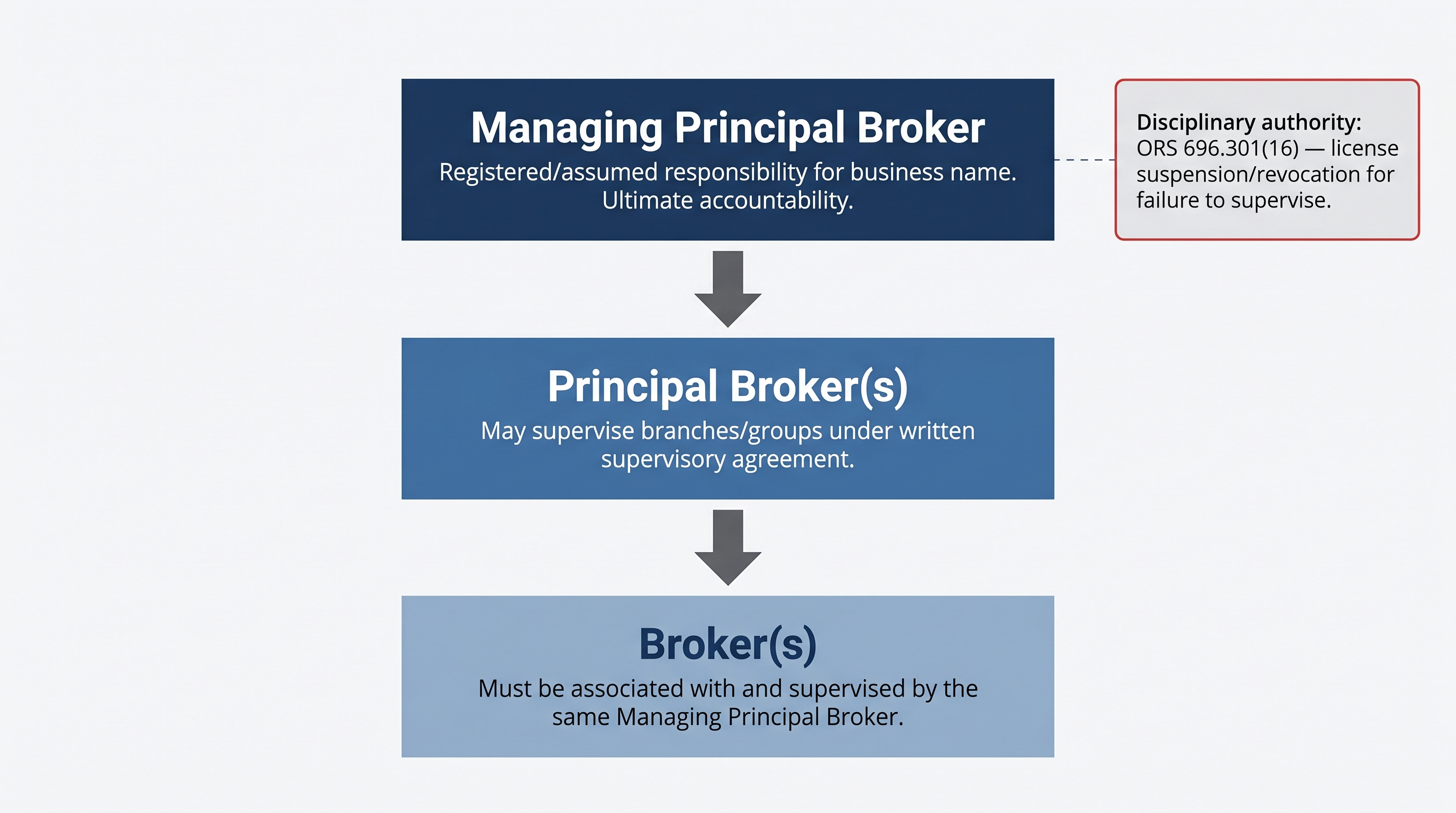
HB 3137 Chain of Command: The new supervisory hierarchy for sales-side brokerage operations effective January 1, 2026.
The other two principal brokers can supervise branches or manage specific groups of brokers only if they operate under a compliant, written supervisory agreement with the managing principal broker. Under permanent administrative rules, the managing principal broker can designate an authorized principal broker to help carry out these day-to-day supervisory duties. Even when these duties are delegated, ultimate responsibility and legal accountability always remain with the managing principal broker at the top of the organization.
This centralization of authority comes with expanded oversight duties that are clearly defined under Oregon law. Specifically, the law requires the managing principal broker to exercise reasonable supervision and control over all associated brokers and principal brokers connected to the firm. This legal mandate means you must actively maintain comprehensive written policies and procedures for your office.
These internal policies must govern:
- how professional real estate activities are reviewed,
- how disclosure forms and contracts are used,
- how transaction documents are stored, and
- how client trust funds are handled.
Additionally, you must actively verify that every licensee associated with your business holds an active real estate license before they engage in any real estate activity on behalf of the brokerage.
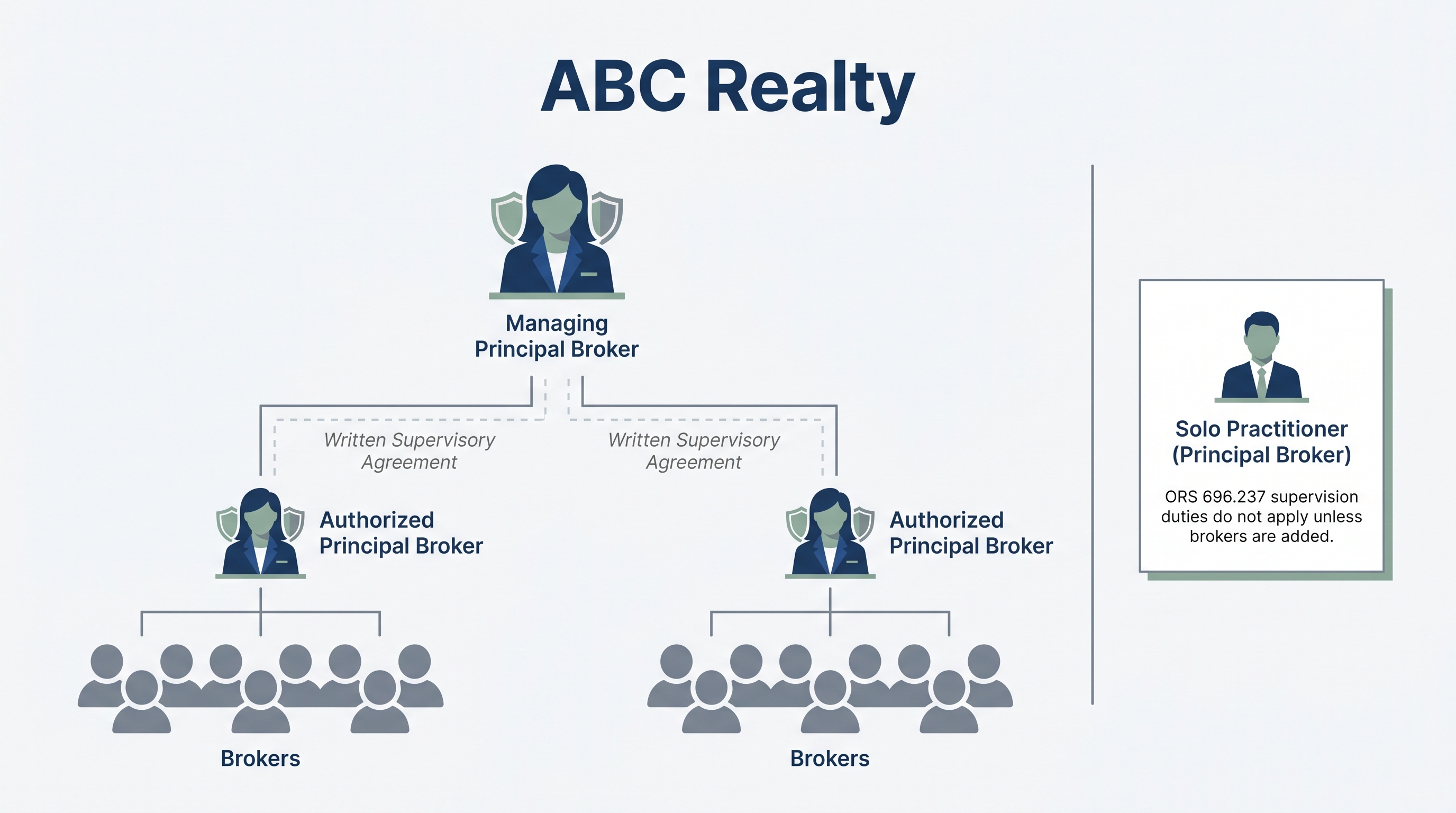
Example: How a multi-broker office and a solo practitioner operate under the managing principal broker framework.
When you choose to delegate authority within a multi-broker office, you must use a formal written supervisory agreement. This agreement must explicitly divide and allocate supervisory control among the participating principal brokers. In addition to dividing daily duties, the supervisory agreement must establish a formal succession plan. This plan must address what will happen to the brokerage operations if the managing principal broker passes away, becomes incapacitated, or loses their active real estate license.
Having a clear succession plan ensures that the business can continue to operate smoothly and that clients are protected during unexpected leadership transitions. This agreement must explicitly state that the managing principal broker’s ultimate responsibility cannot be limited, restricted, or contracted away to someone else.
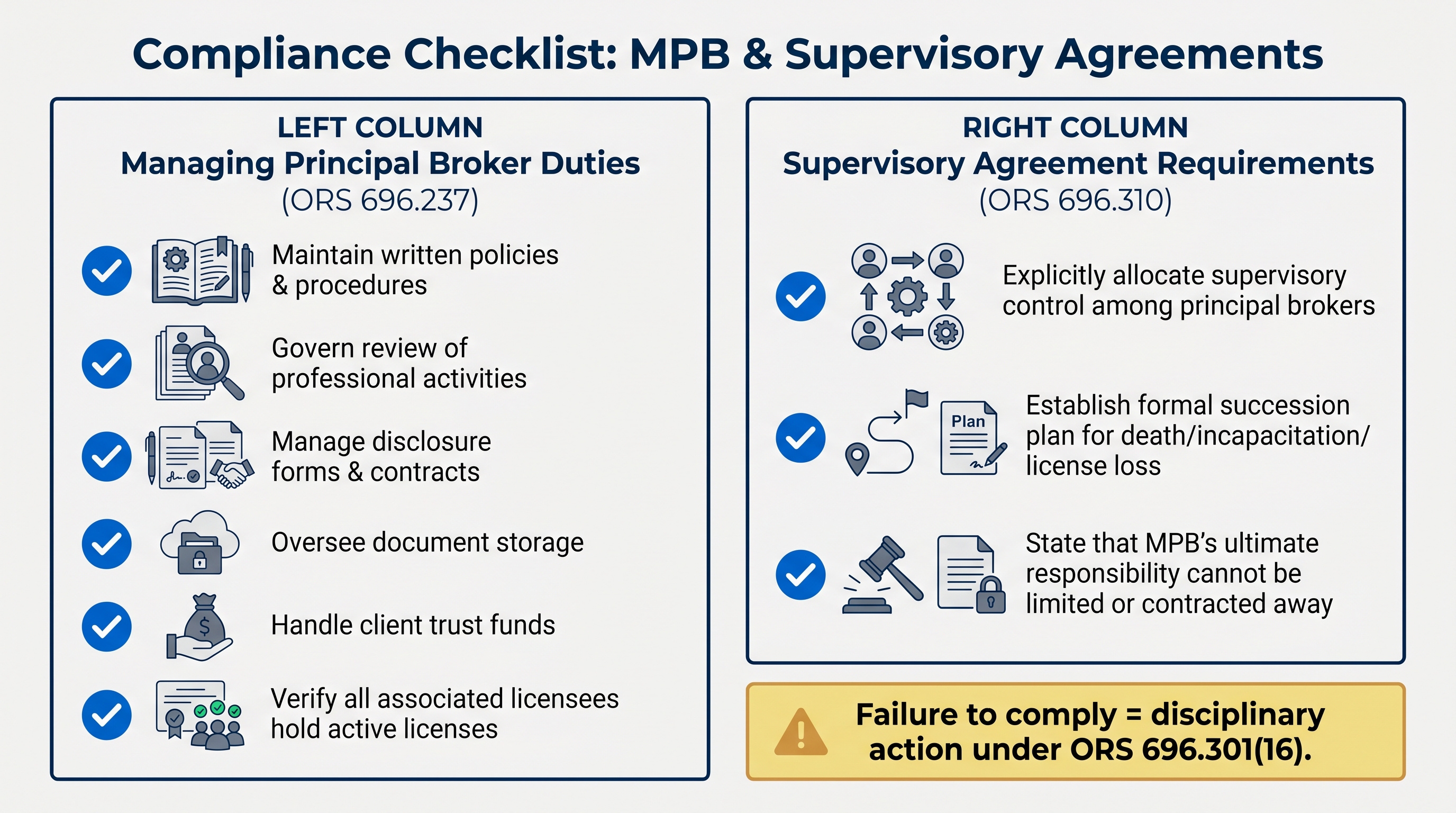
Key compliance requirements: MPB duties and supervisory agreement essentials under Oregon’s updated framework.
We will next examine the specific duties under state supervision laws and outline the exact compliance timelines for existing brokerages transitioning to this model.
Defining the Managing Principal Broker
Before we explore specific compliance timelines, we must establish exactly who carries this legal burden. State law requires written supervisory policies and systems to ensure oversight across an entire brokerage. But Oregon real estate law does not view all principal brokers equally. Under state rules taking effect on January 1, 2026, a precise legal distinction exists based entirely on responsibility for a registered business name.
A principal broker becomes a managing principal broker by registering or assuming responsibility for a business name with the Oregon Real Estate Agency. The distinction turns on responsibility for the registered name, rather than a separate category of real estate license.
The Licensing Hierarchy and Delegated Oversight
Oregon’s real estate licensing system follows a clear structural hierarchy. To perform professional real estate activities while supervising others, you must either register as a managing principal broker or formally associate with one.
As a principal broker, you cannot operate in an independent supervisory role on your own. Instead, you must work under a managing principal broker as an authorized principal broker, backed by a formal written supervisory agreement.
The managing principal broker sits at the top of this hierarchy, holding ultimate legal responsibility for the registered business name and every licensee associated with it.
Company size does not change these legal definitions. Even if you are a solo principal broker working alone from home with no other licensees, you are still technically a managing principal broker. Because you registered a business name, you meet the exact legal definition. Although you are exempt from the complex rules designed for larger firms, your legal identity remains that of a managing principal broker.
Beyond general firm operations, this defined role also dictates how we structure specialized teams and handle in-house transactions.
Teams, Disclosed Limited Agency, and Ultimate Liability
The role of the managing principal broker also shapes how we form and structure real estate teams within a brokerage. Teams can only exist with the clear approval of the managing principal broker. A team can’t act as an independent business or register its own overriding business name.
Also, if a team member supervises other agents, that supervisor must hold an active principal broker license and work under the managing principal broker’s direct oversight. No matter how many sub-teams operate in your firm, the managing principal broker is always the final authority in the supervisory chain.
This responsibility connects directly to the specific supervisory duties required under state licensing statutes, which we will examine in the next section.
Core Supervisory Mandates and Policy Manuals
Under Oregon real estate regulations, a managing principal broker is much more than a figurehead. State law holds this individual completely responsible for the professional real estate activities of all associated brokers during their time with the firm.
This is an active responsibility. You must establish, enforce, and continuously monitor clear written policies and systems. There is a narrow exception: these written compliance requirements do not apply to managing principal brokers who run a single office with no associated licensees.
Your brokerage cannot rely on verbal instructions or informal industry customs. As a managing principal broker, you must create and distribute a formal policy manual that governs daily operations.
These written procedures must explain how your firm uses required disclosure forms, drafts representation contracts, and manages unlicensed assistants. The policy must also cover secure filing and storage of transaction records, as well as strict rules for handling client trust funds. Your written policies must also educate associated brokers about the federal, state, and local laws that apply to the practice of real estate.
Delegation of Authority and Document Review
To grow a brokerage, a managing principal broker needs to delegate daily supervisory tasks to authorized principal brokers. Under Oregon law, an authorized principal broker is either the managing principal broker or a principal broker who has been given supervisory control through a written agreement.
This delegation requires a detailed, written supervisory agreement that maps out exactly who reviews documents, who oversees branch offices, and who manages specific groups of agents.
However, the law strictly forbids any agreement from limiting the managing principal broker’s ultimate legal responsibility. You can delegate the daily work, but you cannot delegate the liability.
This written agreement must also establish a clear succession plan because real estate businesses do not stop for emergencies. The agreement must detail the exact chain of command and operational handover if the managing principal broker dies, becomes incapacitated, or unexpectedly loses their active real estate license. Having this plan in place prevents transaction delays and protects client funds during sudden leadership transitions.
Delegated supervision also involves strict operational deadlines. An authorized principal broker must review every transaction document of agreement within seven banking days after it is accepted, rejected, or withdrawn.
A “document of agreement” refers to listing contracts, buyer representation agreements, purchase offers, counteroffers, and addenda.
For example,
if a buyer’s agent submits an offer on a Friday evening and the seller rejects it on Saturday, you have seven banking days from that Saturday to review the rejected offer. The reviewing broker must date and sign or initial the document to create a permanent audit trail. Missing this seven-day window can lead to disciplinary action for the entire supervisory chain. This review process prevents files from sitting unchecked and lets you catch and correct contract errors while the transaction is still active.
Agency Roles, Recordkeeping, and Financial Oversight
The managing principal broker also assumes a unique agency role during in-house transactions. When different licensees under the same managing principal broker represent opposing parties, the managing principal broker acts as the sole disclosed limited agent for both sides [1].
This statutory requirement ensures impartial oversight when a single firm handles both sides of a deal.
Your oversight of document review ties directly into strict recordkeeping rules. Brokerages must maintain complete, adequate records of all professional real estate activity for at least six years [2].
These records must remain readily available for Oregon Real Estate Agency inspection. You cannot store them off-site unless you have rapid retrieval capabilities.
Financial oversight requires an even stricter schedule. Authorized principal brokers must reconcile each client trust account at least once a month [3].
As the broker, you must physically verify, sign, and date the reconciliation report. Missing a monthly reconciliation immediately flags your brokerage during a state audit. The managing principal broker must set up systems to ensure these reconciliations happen on time, regardless of vacations or staff turnover.
In addition to financial and recordkeeping oversight, the managing principal broker holds absolute authority over team structures and branding.
Team Operations and Regulatory Enforcement
Your authority as a managing principal broker extends heavily into brokerage branding and team formation. Real estate teams can only exist if you give them explicit approval. You have absolute discretion to allow, restrict, or completely ban team structures within your company policy.
If you choose to allow teams, you must make sure they comply with advertising rules. Their advertising cannot state or imply that any licensee other than you is responsible for operating the business. The registered business name of the brokerage must remain clearly visible and immediately noticeable in all marketing materials. A team cannot hide the brokerage name in tiny print at the bottom of a flyer while displaying their team logo prominently at the top.
Team operations also trigger strict disclosure timelines. State administrative rules require team members to provide a formal real estate team disclosure at first contact. They cannot wait until they draft a written representation agreement. This disclosure must clearly identify team member roles, license statuses, direct supervisors, and you as the managing principal broker. It must also include a clear warning about disclosed limited agency scenarios.
The Oregon Real Estate Agency actively audits brokerages to enforce these supervisory standards. If an audit reveals systemic failures, you face direct consequences. State law grants the Oregon Real Estate Commissioner explicit authority to reprimand you or suspend or revoke your license for failing to carry out these oversight duties.
During a routine compliance review, the Agency may grant a 30-day cure period for minor administrative mistakes, giving you time to correct procedural errors. However, regulators offer no such leniency for financial issues. The Agency will immediately start an investigation if client trust funds appear missing, misappropriated, or at risk.
If an audit uncovers systemic oversight failures, you face direct disciplinary action, which can include the immediate suspension of your license. Managing a brokerage carries substantial regulatory weight and operational liability. It requires constant supervision of your licensees and careful attention to compliance. Next, we will examine the exact licensing requirements and qualifications you must meet before assuming this critical position.
Statutory Status and Baseline Qualifications
Oregon does not issue a specific “managing principal broker license” document. Instead, this status is a statutory designation layered onto a standard principal broker license once you assume responsibility for a registered business name. You must first qualify for, apply for, and obtain your standard principal broker license before assuming this heightened regulatory role.
The Oregon Real Estate Agency maintains strict requirements for the principal broker license. You must be at least 18 years old, hold a high school diploma or equivalent, and prove three years of active licensed real estate experience.
Oregon offers a narrow exemption pathway for highly qualified individuals who lack this exact three-year active timeline. If you possess a relevant real estate degree, such as a bachelor’s in real estate finance, or equivalent professional real estate experience, you may petition the Oregon Real Estate Board for an experience waiver.
You must submit this formal petition on an Agency-approved form no later than 21 days before a scheduled board meeting. The Board reviews these petitions strictly on a case-by-case basis.
Once you meet the baseline qualifications, if you are an active Oregon broker, you must complete a specialized 40-hour Brokerage Administration and Sales Supervision course from a certified provider. This mandatory coursework shifts your focus from individual sales tactics to operational liability and office management. The curriculum heavily emphasizes client trust account reconciliation, document review systems, advertising compliance, and creating the written policy manuals required by state law.
Under Oregon state laws [1], managing principal brokers must establish and enforce comprehensive written policies governing all professional real estate activity. In this role, you carry strict compliance monitoring obligations to ensure your associated licensees follow these documented procedures and fair housing laws.
After completing the coursework, you must pass both the state and national portions of the principal broker license exam. Your exam scores remain valid for one year. This timeline creates a specific, non-negotiable window to finalize the licensing process before you must retake the exam.
If you are an out-of-state licensee, you may qualify for an Oregon license by completing the required course of study and passing the corresponding exam. If your license has been expired for more than one year, you must reapply and meet all current licensing qualifications required of new applicants.
If you are unlicensed or lack an active Oregon license, you must also clear a criminal background check. This requires fingerprinting through the state’s approved vendor, which typically delays your licensing by three to four weeks.
Activating Managing Principal Broker Status
Earning your principal broker license does not automatically grant you managing principal broker status. To achieve this status, a newly licensed principal broker must take one of two paths. You can either register a business name using the state’s online eLicense system, or you can transfer to an existing managing principal broker’s active registered business name.
To register a new business name, you must submit the Registered Business Name Application, designate a main office location, and either set up a client trust account or file an exemption notice.
If you are taking over an established firm instead, an authorized principal broker must transfer you to their active registered business name. The Oregon Real Estate Agency charges a $300 business name application fee and a $10 license transfer fee for these transactions. You officially become a managing principal broker the exact moment the Agency approves your registered business name.
Consider this practical example.
A top-producing broker decides to open a boutique firm in Salem. After three years of active practice, they pass the licensing exam and earn their principal broker license. If they stop there, they are only a principal broker and cannot legally supervise other licensees.
To run their firm, they must log into eLicense, submit the required office location and trust account documents, pay the registration fees, and formally register the firm’s business name. Once that registration is approved, they instantly assume all managing principal broker liabilities and supervisory duties over associated licensees.
To maintain your license, you must strictly follow continuing education schedules. Oregon principal broker licenses renew based on your birth month [1]. Your initial license term lasts between 13 and 24 months, while all subsequent renewal cycles operate on a strict 24-month timeline. To renew an active license, we must complete 30 total hours of continuing education.
Recent administrative rules restructured these 30 hours to prioritize consumer protection. You and all other brokers, principal brokers, and property managers must complete an approved State and Federal Fair Housing course before you can renew an active license [2].
This mandatory course focuses heavily on anti-discrimination laws, implicit bias, and equitable service delivery. Additionally, you must complete the Law and Rule Required Course, known as LARRC, for license renewal [3]. The revised LARRC specifically covers recent legislative updates, our agency duties, and changes to client trust account management.
Your specific course hours depend on your renewal date. For renewals through December 31, 2025, a first-time renewing principal broker must complete a 27-hour approved Principal Broker Advanced Practices course and a 3-hour LARRC.
For renewals on or after January 1, 2026, the requirements change to a 26-hour Principal Broker Advanced Practices course, a 2-hour LARRC, and a 2-hour Fair Housing course.
Besides continuing education, Oregon mandates proficiency requirements and strict adherence to renewal deadlines.
Proficiency Testing and Expiration Consequences
Oregon requires a mandatory proficiency benchmark for certain renewals. Under state law, any licensee renewing an active license for the first time, or reactivating a license for the first time after being inactive, must pass an agency-approved assessment of licensee proficiency. This requirement ensures that managing principal brokers retain their crucial administrative and legal knowledge before continuing their supervisory work.
If you are a managing principal broker and fail to renew on or before your expiration date, your license immediately expires. Once expired, you cannot legally conduct any real estate activity or supervise associated licensees.
However, you can renew an expired license to inactive status if the Oregon Real Estate Agency receives your application and fees within one year of expiration. This inactive renewal is never retroactive. Operating a brokerage with an expired license leads to severe disciplinary actions, including heavy fines and permanent license revocation.
Now that we have covered the structural and licensing requirements for traditional brokerage management, we will next look at how licensees may share compensation with a qualifying charitable organization. After that, we will turn to how the state regulates specific transactional models, starting with the updated legal definitions of wholesaling in Oregon.
Sharing Compensation with a Qualified Charity
House Bill 3137 also changes a practical compensation rule. An Oregon real estate licensee may share compensation arising from a real estate transaction with a charitable organization that is tax exempt under section 501(c)(3) of the Internal Revenue Code. The permission applies to a qualifying organization, so the tax status of the recipient matters.
For example, you might want to donate part of your compensation from a closing to a local housing charity. Before you promise the payment, confirm that the organization is a qualifying 501(c)(3) charity, and coordinate the transaction with your managing principal broker. Keep the recipient, the amount, and the payment instructions clear in the transaction record.
Do not treat every community group as interchangeable. A group’s worthwhile purpose or its general description as a nonprofit does not establish the tax status this provision requires. Verify the organization that will actually receive the money instead of relying on a familiar name or an informal description.
The practical takeaway is straightforward. Oregon permits this form of commission sharing, and the statutory condition is the charity’s 501(c)(3) tax exemption. Use that condition as your starting point whenever you evaluate a proposed charitable payment.
With that compensation rule in place, we turn next to a transactional model that recently received its own regulatory overhaul: residential property wholesaling.
The Evolution of Wholesaling Regulations
Having established the structural and licensing requirements for traditional brokerage management, we now turn to a transactional model that recently received a major regulatory overhaul. Residential property wholesaling operations now face strict oversight under a new framework established by the 2024 Oregon Legislative Assembly [1].
This legislation, enacted during the 2024 session, fundamentally shifts wholesaling from an unregulated investment strategy into a formally governed professional activity. The administrative rules implementing this framework became operative on July 1, 2025 [2].
Historically, wholesaling operated in a legal gray area. An investor would secure a purchase agreement with a property owner and then assign that equitable interest (a contractual right to purchase the property without yet holding legal title) to an end buyer for a profit before closing. Because the wholesaler never actually took legal title, unlicensed individuals frequently engaged in these transactions without facing traditional real estate licensing requirements.
This lack of oversight led to significant consumer protection concerns. Sellers often signed contracts unaware that the prospective buyer lacked the actual funds to close and intended only to market the contract to third parties. If the wholesaler failed to find another buyer, the transaction would collapse, leaving the seller stranded with a vacant property and lost market time.
The Oregon legislature responded by implementing strict transparency requirements rather than banning the practice outright. The new laws require mandatory registration for individuals marketing equitable interests in residential property [3].
The Oregon Real Estate Agency now holds direct regulatory authority over these actors. The state instituted a comprehensive disclosure system designed to ensure property owners fully understand the nature of the transaction and the wholesaler’s exact legal limitations before signing any binding agreements.
Next, we’ll examine how these new regulations specifically impact licensed real estate professionals who engage in wholesaling.
If you are a licensed broker or principal broker who does personal wholesaling, a major regulatory shift affects your work.
Under an Oregon law that took effect January 1, 2026, licensees remain bound by state licensing requirements even when acting on their own behalf in purchase and sale transactions. Because of this, the state views wholesaling by a licensee as a regulated personal transaction.
This triggers a dual compliance burden. You must follow standard real estate agency laws while also fulfilling new statutory obligations specific to residential property wholesalers.
For brokers, these personal wholesale transactions must be supervised by your managing principal broker. All transaction documents and earnest money funds must flow through your principal broker’s registered office. This prevents you from treating these deals as transactions conducted outside of required supervision.
Beyond licensee compliance, the state has established strict enforcement mechanisms to ensure industry-wide adherence to these rules.
Enforcement, Penalties, and Compliance Boundaries
Oregon enforces its wholesaling requirements with serious penalties. The Real Estate Commissioner can investigate complaints, seek court injunctions, and issue cease and desist orders against illegal operations. A cease and desist order becomes effective 30 days after its date unless the person named in the order requests a hearing.
If you knowingly violate these registration and disclosure rules, you commit a Class A misdemeanor under Oregon law. Regulators can also issue civil fines. These range from $1,000 to $2,500 for your first offense of unregistered wholesaling, and $2,500 to $5,000 for later violations. A single illegal act is enough to trigger these penalties. For registration violations, the Commissioner may also impose a separate discretionary penalty capped at the amount you profited in the transaction. That profit-based penalty is discretionary rather than automatic, it applies to registration violations rather than every form of noncompliance, and it does not apply when the violation results only from failing to renew a registration on time.
Because the risks are high, you must understand exactly when these rules apply. Even a single text message or social media post can trigger full compliance requirements. To protect yourself, you need to know the lines separating a standard real estate investment from a regulated wholesale transaction. We will next examine the specific statutory criteria and legal definitions that trigger these wholesaling regulations in Oregon.
The Statutory Definition of Wholesaling
Oregon’s regulatory framework for wholesaling relies on a specific two-part legal trigger. Under state license law, “residential property wholesaling” occurs when you market a residential property where you hold only an equitable interest or an option to purchase. To meet this definition, you must have held that interest for fewer than 90 days and invested less than $10,000 in improvements. You must meet both of these conditions to trigger regulatory oversight by the Oregon Real Estate Agency.
This law completely eliminates any loopholes based on the volume of your business. Under state regulations, you are considered to be wholesaling even if you only execute a single transaction. You cannot claim an exemption by arguing that you only wholesale properties occasionally or as a side business. A single, isolated act of marketing an equitable interest under these conditions immediately requires you to fully comply with the regulations.
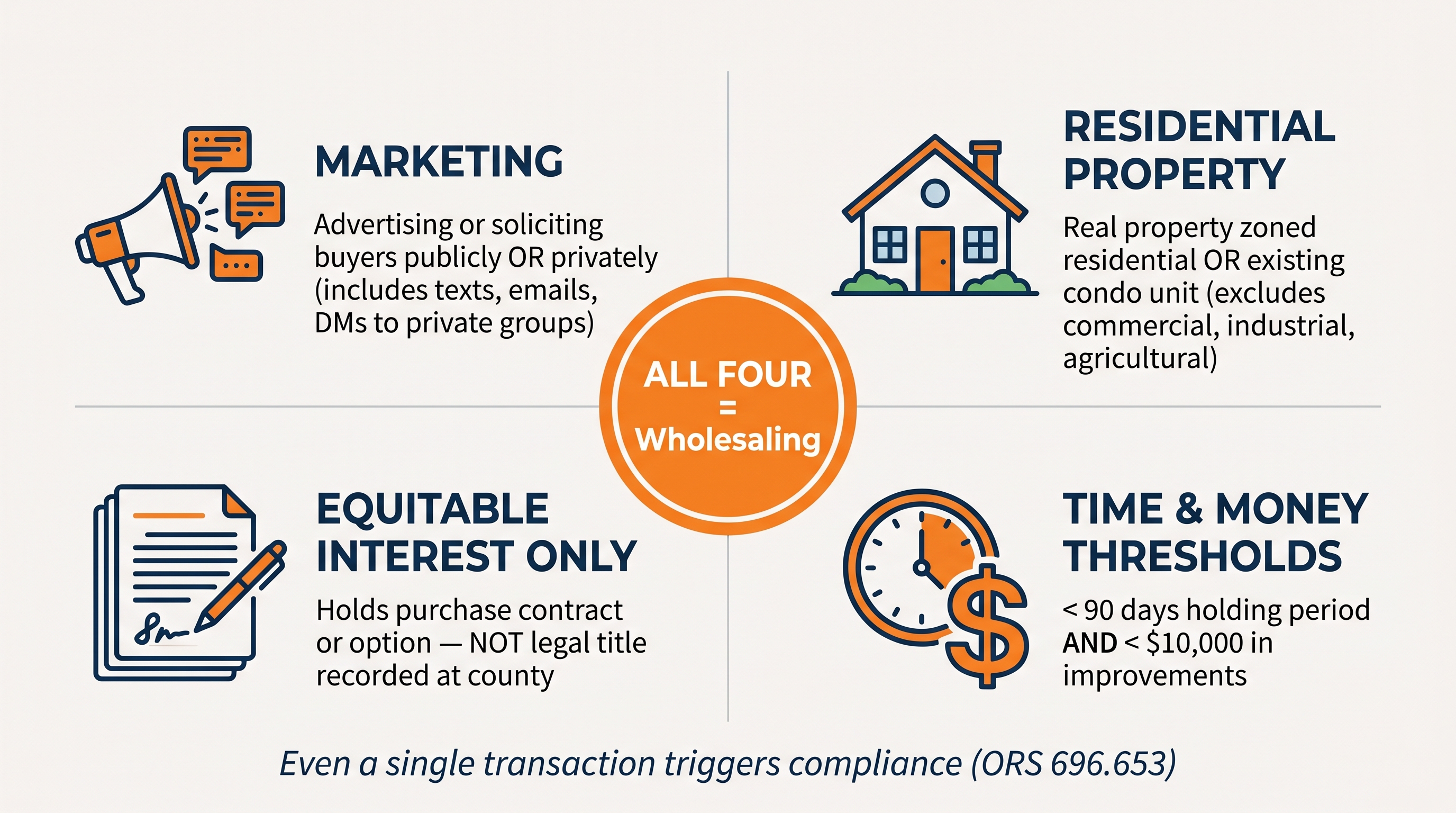
The Four Components of Oregon’s Statutory Wholesaling Definition: All four conditions must be present to trigger regulatory oversight.
Next, we will examine each of these four components in detail.
Marketing and Property Type Components
The first part of Oregon’s legal definition of wholesaling relies on a broad interpretation of “marketing.” State law defines marketing as advertising or soliciting buyers to purchase property, whether you do so publicly or privately [1]. Including private solicitation creates a strict compliance requirement for both investors and real estate licensees. You do not have to list a property on a multiple listing service (MLS), put up a yard sign, or post a public advertisement to trigger the law. Sending a text message blast to a private list of cash buyers, emailing an off-market deal to an investor group, or sending direct messages in a closed real estate investment forum all count as marketing. Oregon designed this broad definition to cover the off-market nature of traditional wholesaling operations.
The second part of the law limits these regulations specifically to “residential property,” which the statute defines as real property zoned for residential use or an existing condominium unit [2]. Commercial properties, industrial sites, agricultural land, and bare land zoned exclusively for commercial development fall outside the scope of these wholesaling rules. You must verify the precise zoning designation of a parcel before determining if these wholesaling laws apply to a specific transaction.
With the marketing and property type defined, we must next analyze the legal interest and timing thresholds.
Equitable Interest and Numerical Thresholds
To understand wholesaling in Oregon, you must understand the legal concept of equitable interest. When you sign a purchase and sale agreement with a property owner, you do not immediately get the legal title. Instead, you gain an equitable interest. This means you have a contractual right to buy the property and force the seller to complete the transaction under the agreed terms.
Oregon law allows you to sell or transfer this contract right before the sale closes. Under state administrative rules, we call this assigning your equitable interest, and you can do this for a profit. However, if your name is already recorded on the legal title at the county level, you hold more than just an equitable interest. In that case, your marketing efforts are not considered wholesaling.
Oregon law also sets clear numerical limits to distinguish wholesalers from traditional property flippers or long-term investors. To be classified as a wholesaler, you must meet two main rules.
First, you must hold the equitable interest or purchase option for fewer than 90 days.
Second, you must spend less than $10,000 on land development or property improvements. This $10,000 limit applies strictly to development and physical improvements, not to normal transaction costs like earnest money deposits or marketing expenses.
Although state rules do not list every single cost that counts toward this limit, we know that expenditures on plans or permits can push you over the line.
Let’s look at how these rules work in practice.
Suppose you put a property under contract and spend $15,000 on architectural plans and initial permitting over a 45-day period. If you then assign that contract to a builder, you have gone over the financial limit.
Even though you held the contract for less than 90 days, you are no longer legally wholesaling because of the $15,000 expenditure.
Similarly, if you hold a lease option on a property for six months before marketing your option rights to a buyer, you have gone past the 90-day time limit.
These components clarify how the state evaluates different transactional structures.
Analyzing Transactional Structures
Let’s look at how Oregon evaluates different transactional structures. The classic contract assignment fits the state’s legal definition of wholesaling perfectly. In this model, you secure a distressed house under contract, holding only an equitable interest for 10 days. You spend nothing on physical improvements and quickly market the contract to an end buyer for a $15,000 assignment fee. Under Oregon law, this series of events is undeniably classified as residential property wholesaling.
The boundaries become less clear when we look at double-close or simultaneous-close transactions. Oregon statutes do not explicitly define a double-close transaction. Instead, state regulators evaluate these deals by looking closely at timing. They ask two main questions: when did the marketing happen, and what specific legal interest did you hold at that exact moment?
If you secure a purchase contract and immediately begin looking for end buyers while holding only an equitable interest, your activity counts as wholesaling. Under Oregon rules, if you market a property while holding only equitable rights, the transaction is residential property wholesaling if you have held that interest for fewer than 90 days and spent less than $10,000 on development or improvements. This applies even if you fully intend to close the initial purchase. Because you marketed the property while holding only equitable rights, the deal falls under the regulatory definition of wholesaling.
On the other hand, consider what happens if you close the initial transaction before marketing. If you use funds to buy the property, take legal title, and record the deed in your name before you begin looking for buyers, the subsequent resale is not considered wholesaling. At the time of marketing, you hold full legal title instead of just an equitable interest, meaning you have taken on the full risk of ownership.
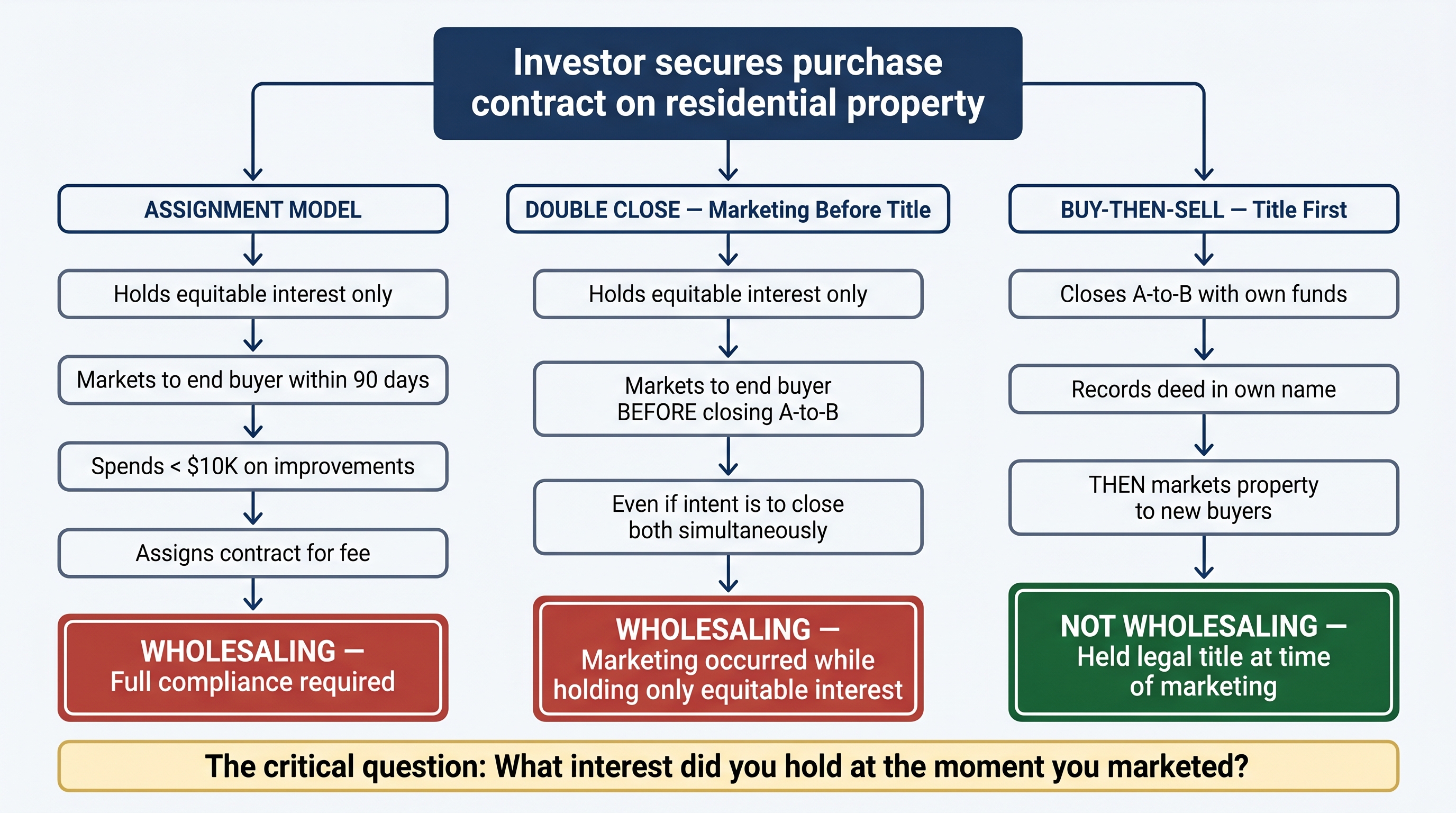
Transaction Structure Analysis: The timing of marketing relative to your legal interest determines whether Oregon wholesaling regulations apply.
Along with these structural rules, Oregon law also includes specific consumer protections and licensee standards.

Instructor
instructor or
Details
- Clock Hours: 2
- Format: Slides - includes video, text & images