
The days of handing a new real estate broker a desk, business cards, and a quick "good luck" are over. Oregon's compliance landscape shifted dramatically on January 1, 2026, driven by new state laws. Managing principal brokers face unprecedented regulatory scrutiny, stringent supervision duties, detailed transfer requirements, and a first-renewal assessment that reinvents how new agents demonstrate competence. Your onboarding system is no longer just an administrative process. It is a core compliance obligation standing between your firm's success and serious disciplinary action. Without a structured, legally sound onboarding workflow, brokers risk pulling your brokerage's compliance record down.
The Managing Principal Broker Supervision Mandate
Under the revised regulatory framework, supervision is an active, documented, and continuous obligation. State law dictates that managing principal brokers hold ultimate statutory responsibility for the professional real estate activities of every broker registered under their firm. This responsibility begins on day one.
Regulations require managing principal brokers to establish, maintain, and enforce written policies across eight specific operational domains. These cover client trust funds, transaction records, agency relationships, advertising compliance, property management, independent contractor versus employee classification, unlicensed personal assistants, and broker supervision. A verbal policy is no longer defensible. If it is not written and integrated into your onboarding process, it does not legally exist.
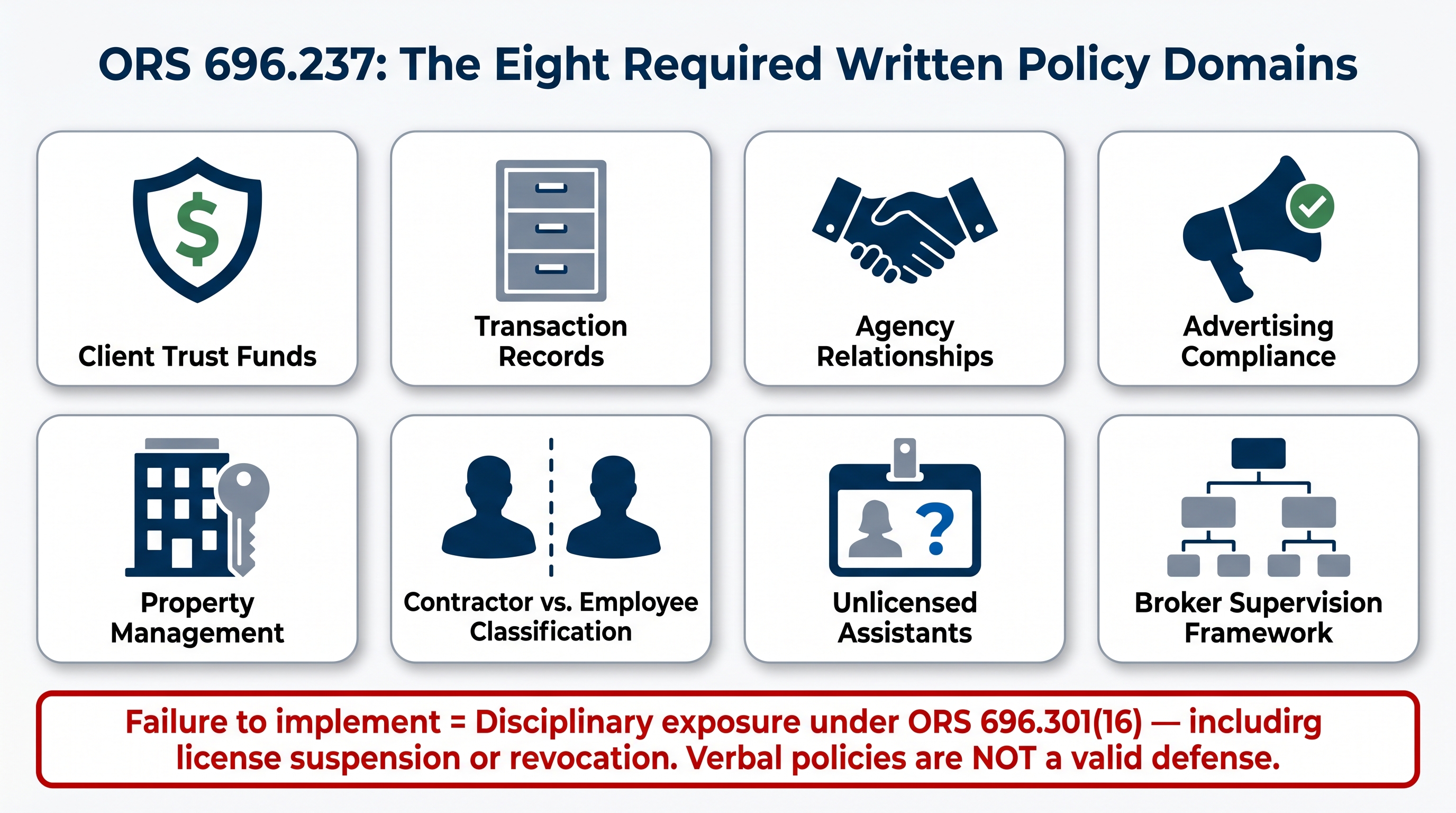
Managing principal brokers must maintain written policies across all eight domains. If it's not written, it doesn't legally exist.
Failing to implement these systems carries significant consequences. A managing principal broker faces direct disciplinary exposure, including potential license suspension or revocation, for failing to exercise adequate supervision. Ignorance of a broker's actions is explicitly rejected as a valid defense if you failed to implement required written policies. Where multiple principal brokers share supervisory responsibilities, state law requires explicit, written supervisory agreements delineating the delegation of authority.
Navigating OREA Audits and Enforcement
Firm owners must pay close attention to Oregon Real Estate Agency (OREA) investigations. Consumer complaints, escrow anomalies, or routine compliance checks typically trigger enforcement actions and audits. When an OREA investigator initiates an inquiry, they evaluate your documented paper trail to verify active supervision.
Official OREA guidance emphasizes that investigators require tangible proof of compliance. Without a documented onboarding system verifying policy acknowledgment, tracking continuing education, and recording transaction reviews, a managing principal broker has little defense against a failure-to-supervise charge. A written system serves as your primary legal shield.
Adding and Transferring Licensees: The Compliance Mechanics
Adding a new broker or transferring an experienced one is a strict compliance process. State administrative rules detail exact procedures required through the OREA eLicense system. Beyond the mandatory $10 transfer fee, managing principal brokers routinely overlook a critical regulatory nuance. The sending managing principal broker remains fully responsible for a licensee's professional real estate activities until OREA receives the transfer or inactivation request.
Consider a practical example. A broker leaves your firm on a Friday afternoon, but you delay processing the inactivation in eLicense until Monday. If that broker engages in unlawful real estate activity over the weekend, you remain legally liable for their actions. Timely execution of the eLicense process must be the first step in your workflows.
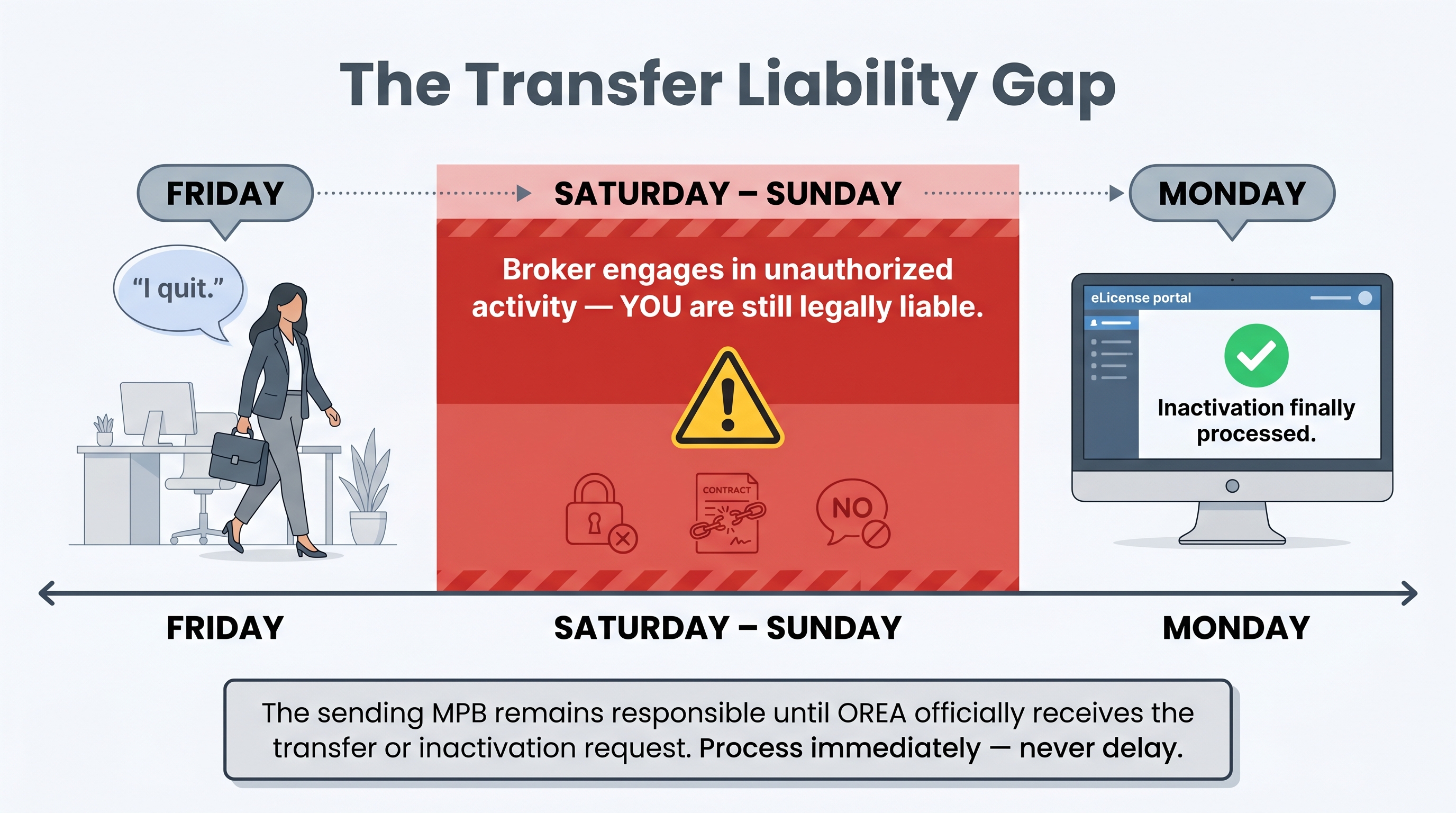
The Transfer Liability Gap: Under OAR 863-014-0063, your legal responsibility doesn't end when a broker walks out - it ends when OREA receives the request.
This rule imposes strict requirements for continuing-transaction written agreements. If a transferring broker carries an active transaction to their new firm or leaves one behind, a definitive written agreement must govern how that transaction will be managed. It is equally important to understand Registered Business Name (RBN) requirements. Brokers must conduct all professional real estate activity under your firm's officially registered name. Your onboarding system must include a mandatory verification step ensuring every new broker uses the correct RBN from day one.
The 2026 Advanced Practices Assessment Changes Everything
While the January 1 structural changes are substantial, the July 1, 2026, shift in educational assessment represents a deeper transformation. Historically, new agents completed continuing education, passed a multiple-choice quiz, and renewed their license. New state statutes permanently change this dynamic by establishing rigorous first-renewal requirements.
A newly licensed broker must complete 30 hours of continuing education, including a 26-hour Advanced Practices (AP) course. To pass, they must complete a 60-question assessment and achieve a minimum score of 75%. The assessment format shifts to a purely scenario-based structure. New brokers will be tested on their practical ability to identify risks in complex transactions, draft precise contract terms, and navigate challenging communication situations. For principal brokers completing their own specialized exams, regulations prescribe scenario-based testing focused on mitigating consumer harm and managing conflict resolution.
Managing principal brokers must actively invest in practical, high-level mentoring. If newly onboarded brokers cannot pass a scenario-based assessment at their first renewal, it signals a meaningful gap in your firm's training approach. Your onboarding program must teach brokers how to handle real-world scenarios they will encounter in practice and on the assessment.
A Practical Onboarding System Framework
To address these interconnected mandates, managing principal brokers should deploy a concrete, repeatable onboarding framework. The following four-phase system is designed to support full compliance.
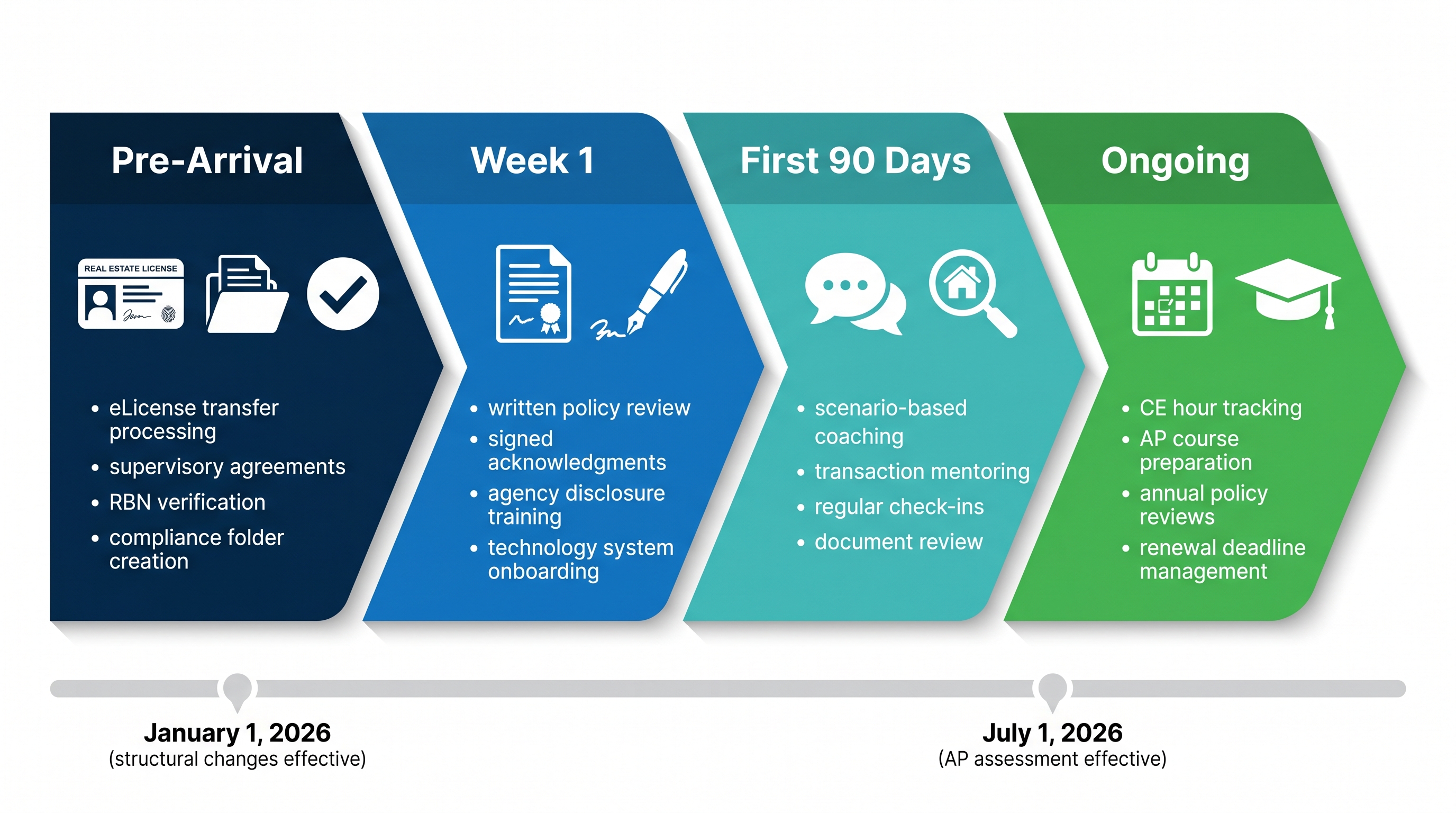
The Four-Phase Onboarding Compliance Framework: A structured system aligned with HB 3137 supervision mandates effective January 1, 2026.
- Phase 1: Pre-Arrival (The Compliance Foundation): Address administrative mechanics before the broker begins work. Immediately process the license transfer or activation in the OREA eLicense system. Draft and execute required written supervisory agreements. Verify all RBN alignments to prevent advertising violations. Establish a secure compliance folder to house signed policies and CE tracking records.
- Phase 2: Week 1 (Policy and System Immersion): Dedicate the first week to reviewing mandated written policies. Require signed acknowledgment confirming the broker understands procedures for agency disclosure and trust account handling. Provide thorough training on your firm's technology systems.
- Phase 3: The First 90 Days (Scenario-Based Mentoring): Transition to active transaction mentoring. Institute regular check-ins featuring scenario-based coaching exercises aligned with new required competencies. Have new brokers practice identifying risks in sample transactions, and review all documents they generate.
- Phase 4: Ongoing (Education and Renewal Tracking): Implement a reliable tracking system for mandatory CE hours. Prepare brokers for the 26-hour AP course well in advance of their first renewal deadline. Establish an annual review schedule to keep them current on policy changes.
Streamline Continuing Education with a Partner Program
Managing intensive onboarding and continuous supervision is a substantial undertaking. Your bandwidth is already stretched across overseeing transactions, resolving client issues, and running your business. You cannot reasonably deliver every hour of required instruction yourself.
This is where realestateschool.org's partner program offers real value. By using bulk enrollment and automated tracking features, managing principal brokers can efficiently enroll their team in required continuing education courses, including the rigorous 26-hour AP course. Our platform allows you to monitor CE completion in real time, confirming compliance without the administrative burden. We handle the delivery of high-quality, scenario-driven instruction, freeing you to focus on hands-on mentoring and high-level transaction supervision.
Conclusion
Recent regulatory changes have fundamentally redefined the role of an Oregon managing principal broker. Systematic, documented, and proactive onboarding is no longer optional. It is a legal requirement. By implementing a comprehensive framework that addresses OREA transfer mechanics, enforces written operational policies, and prioritizes scenario-based mentoring, you protect your license from disciplinary exposure. You develop competent brokers equipped to succeed in a complex market, and build a resilient, compliant brokerage positioned for long-term growth. The time to overhaul your onboarding process is today.
Disclaimer: This article is provided for informational purposes only and does not constitute legal advice. Regulatory requirements are subject to change. Readers should consult directly with the Oregon Real Estate Agency (OREA) at oregon.gov/rea or a licensed Oregon real estate attorney for compliance guidance specific to their situation.
Like this? Become a Marketing Partner.
Marketing Partners co-brand and syndicate this content to their team, get discounted courses for their agents, and earn commissions on referrals.
Sign up →