
Why Your Best Oregon Brokers Leave (And How to Keep Them With Strategic Education)
The retention crisis in real estate is keeping Oregon firm owners and principal brokers up at night—and for good reason. The shifting market, tightening margins, and heightened regulatory demands have created an environment where your top-producing associated brokers are constantly evaluating whether their current firm provides the support they need to thrive. According to the National Association of Realtors (NAR) 2024 Member Profile, while 73% of REALTORS are "very certain" they will remain active in the industry, that leaves 27% uncertain about their future.¹ For an Oregon principal broker, however, the real question is not simply whether top producers will stay in the industry—it is whether they will choose to stay at your firm.
This challenge is most acute among early-career professionals. The same NAR data highlights that 18% of real estate professionals have two years or less of experience. Within this vulnerable segment, the median tenure is just one year and the median gross income is only $8,100.¹ When an associated broker is struggling to build a pipeline and close transactions, the looming pressure of their first renewal can feel overwhelming.
The industry default is to blame commission splits for broker churn, but the reality is far more nuanced. When associated brokers leave, they are often seeking an environment that actively invests in their professional development, mitigates their compliance risks, and simplifies day-to-day operations. In Oregon, where the continuing education (CE) landscape is uniquely regulated and constrained, your brokerage's approach to education can either be your greatest retention vulnerability or your most powerful recruitment tool.
What follows is an examination of why your best brokers are leaving, how Oregon's complex regulatory environment accelerates this turnover, and why establishing a formal CE partnership is the most cost-effective retention strategy a principal broker can deploy today.
Why Oregon Brokers Leave: The Support vs. Split Paradox
It is a common misconception that associated brokers care only about their commission splits. While compensation is undeniably critical, it is rarely the sole driver of a departure. Industry surveys consistently demonstrate that training and support matter deeply to brokers when evaluating a firm—but only when the value is clearly aligned with their commission economics.
What does this paradox mean for a principal broker? It means that training and support must be undeniably high-value, practically useful, and seamlessly included as a core brokerage benefit—not positioned as an expensive optional upsell. When education feels like a hidden fee or an administrative burden, associated brokers naturally focus on their split. When education feels like a competitive advantage that directly increases their gross commission income and keeps their license secure, they stay.
LinkedIn Learning's 2024 Workplace Learning Report reinforces this point: 90% of organizations are actively concerned about retention, and providing clear learning opportunities is currently ranked as the number one retention strategy across industries.² A newly licensed broker who feels unsupported in navigating Oregon's complex continuing education requirements will inevitably look elsewhere—often to a competing firm that advertises robust, hands-on compliance support.
Oregon's Uniquely Constrained CE Landscape
To understand why CE support is such a vital retention tool in Oregon, principal brokers must first understand how the state's education landscape differs from the rest of the country. In many states, continuing education is largely deregulated, allowing any online provider to quickly establish a platform and offer inexpensive, unverified courses. Oregon takes a decidedly different approach.
Under Oregon Revised Statutes (ORS) 696.182, the Oregon Real Estate Agency (OREA) strictly limits who may provide certified continuing education.³ To qualify as an approved provider in Oregon, an entity must fall into one of a narrow set of highly regulated categories: community colleges, public universities, private independent institutions, private career schools licensed by the Higher Education Coordinating Commission (HECC)—Oregon's postsecondary education oversight body—approved brokerages, or recognized trade associations.
This constraint protects Oregon consumers and ensures high educational standards, but it creates a meaningful bottleneck for associated brokers. The provider market is limited, course quality varies, and locating approved, relevant content can be a frustrating process.
The landscape is becoming significantly more complex with the passage of House Bill 3137, which introduces sweeping changes effective January 1, 2026.⁴ To fully appreciate this shift, principal brokers should recall that Oregon currently requires 30 total hours of continuing education per two-year renewal cycle. Under the new HB 3137 requirements, that 30-hour cycle will mandatorily include:
- A newly mandated 2-hour fair housing requirement for all renewals.
- A required 2-hour Law and Rule Required Course (LARRC), updated from its previous 3-hour length.
- The remaining 26 hours consisting of electives—or an adjusted 26-hour Advanced Practices requirement specifically targeted at first-time renewals.
- The introduction of rigorous proficiency assessments utilizing practical, scenario-based case studies, rolling out by July 2026.
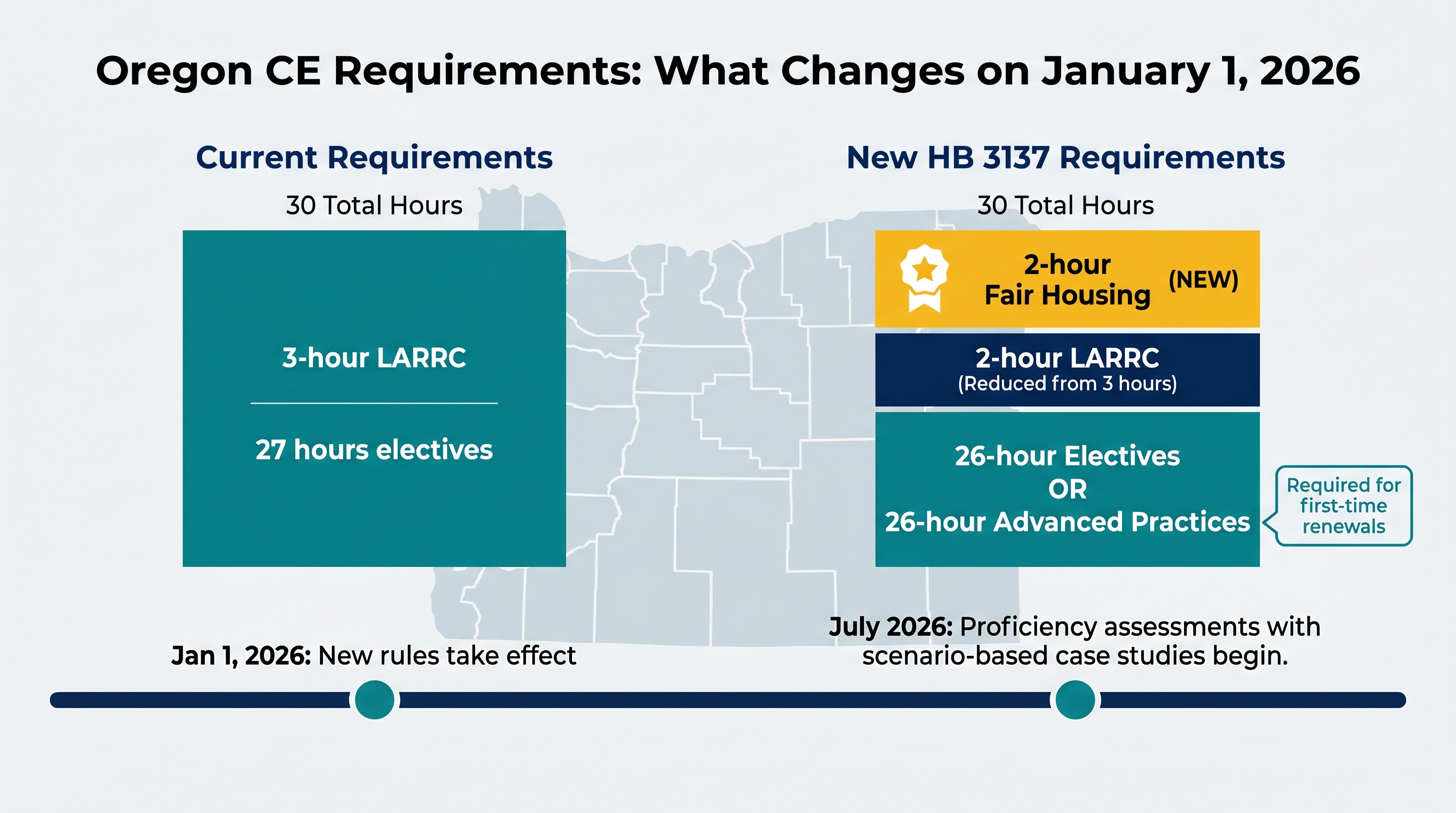
Oregon's CE landscape is changing significantly in 2026. Principal brokers must understand these new requirements to keep their teams compliant.
Crucially, because Oregon operates on a birthday-month renewal cycle, this transition requires careful tracking. Any associated broker whose license expires on or after January 1, 2026, will be subject to these new requirements—making proactive preparation essential for those renewing in early 2026.
Education Is Not Optional: It Is a Supervision Duty
Beyond retention, active involvement in your associated brokers' education is a regulatory mandate. Framing CE support as merely a "cultural perk" ignores the legal realities of operating a real estate firm in Oregon.
Under ORS 696.237, principal brokers have a statutory duty to exercise reasonable supervision, which explicitly includes establishing systems to educate and guide associated brokers on federal, state, and local laws related to the practice of real estate.⁵ Furthermore, ORS 696.174 strictly governs license renewal processes and continuing education requirements, placing a significant burden of compliant practice on firm leadership.⁶
When you leave associated brokers to independently source their CE from an increasingly constrained pool of providers, you are not simply risking their departure—you are introducing meaningful risk management liabilities into your firm. A broker who fails to fully understand the new fair housing mandates or the nuances of the updated LARRC is a liability to the principal broker's license. By proactively partnering with an approved CE provider, you transform a compliance mandate into a standardized, high-quality educational pipeline that protects the entire firm.
What a Formal CE Partnership Solves
Positioning your firm for sustainable growth requires removing friction from your brokers' daily lives. This is precisely where partnering with a HECC-licensed and OREA-approved CE provider becomes a strategic advantage. As noted earlier, providing learning opportunities is the top retention strategy across industries—serving both compliance and career development needs simultaneously.²
A formalized CE partnership directly addresses the core pain points of Oregon real estate practice by delivering the following benefits:
- Removal of Administrative Burden: A partnership provides a centralized platform for your brokers, eliminating the anxiety of tracking evolving OREA requirements, searching for approved courses, and verifying HECC licensure.
- Preferred Pricing and Subsidy Options: A partnership allows your firm to secure discounted rates on premium education, which you can pass directly to your brokers or subsidize as a recruitment incentive.
- Signaling Investment: Offering a dedicated CE portal communicates clearly to associated brokers that the firm is genuinely invested in their long-term career trajectory—fulfilling their desire for high-value support without compromising their commission split.
- Seamless HB 3137 Compliance: A knowledgeable CE partner will have already updated their curriculum to include the new 2-hour fair housing requirement, the updated 2-hour LARRC, and the 26-hour Advanced Practices course, ensuring your roster remains fully compliant without requiring your firm to build these resources from scratch.
The Retention Math: An Investment That Pays for Itself
When evaluating the cost of implementing a CE partnership, principal brokers should weigh the comparative economics of training against the true cost of turnover.
The Training Magazine 2024 Industry Report notes that the average organizational training spend is $774 per learner annually.⁷ In the real estate industry, the hidden costs of losing a producing broker—including lost commission revenue, recruitment marketing, onboarding downtime, and disruption to firm culture—can easily exceed $10,000 per departure.
Contrast those figures with the cost of a premier Oregon CE partnership. Through a strategic partner discount program, an Oregon Elective Package can be secured for as little as $139, while a Complete Renewal Package runs just $109.
For less than $150 per broker, a firm owner can fully satisfy a state-mandated 30-hour compliance requirement (covering the 2-hour LARRC, 2-hour fair housing, and elective hours), deliver a highly valued support benefit, and proactively align the firm with the new HB 3137 regulations. Whether the brokerage absorbs this cost entirely, shares it with the broker, or simply passes along the preferred pricing, the return on investment is clear. This is a fraction of the national average training spend—yet it delivers outsized value because it solves a mandatory, high-stress problem for the broker at a moment when that support matters most.
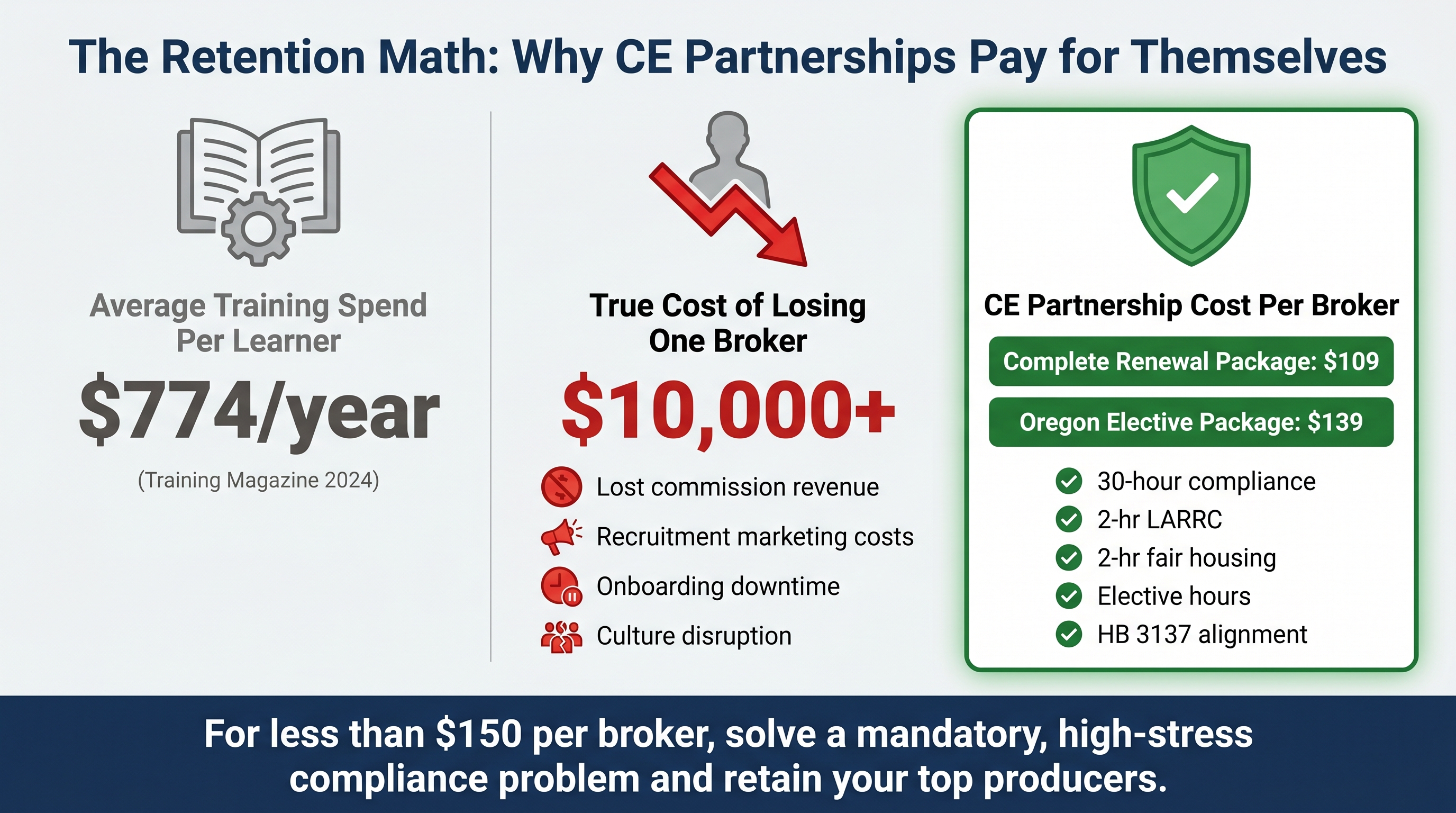
The economics are clear: a strategic CE partnership costs a fraction of broker turnover and delivers compliance, support, and retention in one investment.
Building a Learning Culture That Retains
Securing a CE partnership provides the foundation, but retaining top talent requires building a robust learning culture around that education. Oregon principal brokers should consider the following practical strategies to maximize the value of their CE initiatives.
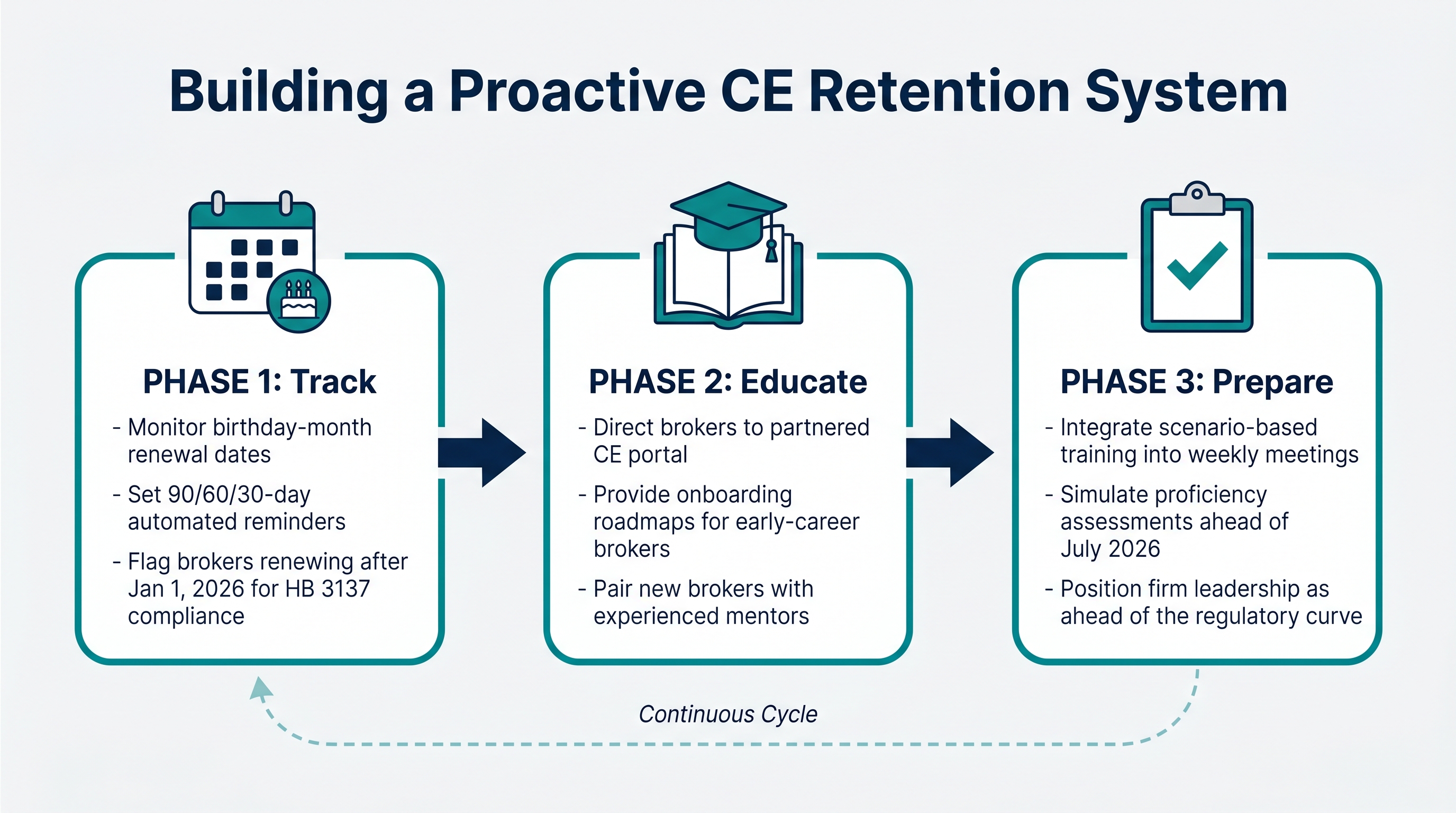
A structured, three-phase approach transforms continuing education from an administrative burden into a powerful retention engine.
1. Track the Birthday-Month Renewal Cycle
Unlike states with a universal renewal date, Oregon brokers renew their licenses on the last day of their birth month. Principal brokers should use their CRM or firm management software to track these dates systematically. Because HB 3137's requirements take effect on January 1, 2026, any associated broker renewing on or after that date will face the new mandates. Set automated reminders at 90, 60, and 30 days prior to the renewal deadline, directing each broker to your partnered CE portal. This proactive outreach demonstrates attentive leadership and prevents last-minute compliance emergencies.
2. Elevate Onboarding for Early-Career Brokers
Given that brokers with fewer than two years of experience are the most vulnerable to leaving, restructure your onboarding process to include a clear educational roadmap for their first 26-hour Advanced Practices renewal. Pair this roadmap with a mentorship program that connects early-career brokers with experienced veterans—significantly increasing their chances of successfully navigating the critical first year.
3. Prepare for Proficiency Assessments
With HB 3137 mandating practical, scenario-based case studies by July 2026, firms should begin transitioning their weekly sales meetings away from passive presentations and toward interactive scenario training. Using real-world local transactions to simulate upcoming proficiency assessments aligns your firm's culture directly with emerging regulatory standards—and signals to your brokers that your leadership is ahead of the curve.
The Bottom Line for Oregon Firm Owners
Your associated brokers are operating in a demanding market governed by an increasingly complex regulatory framework. If your brokerage does not actively help them navigate the requirements of ORS 696.182 and the upcoming HB 3137 changes, another firm will.
Do not allow manageable compliance requirements to become the reason your best producers walk out the door. By recognizing education as both a supervisory duty and a premier retention tool, you can transform a statutory obligation into a core pillar of your firm's value proposition.
Take time to explore a formal partner discount program with your leadership team. With an Oregon Elective Package available at $139 and a Complete Renewal Package at $109, providing your associated brokers with affordable, OREA-approved, and deeply relevant continuing education has never been more accessible. Invest in their compliance, invest in their growth, and your retention numbers will follow.
References
- National Association of Realtors (NAR). (2024). 2024 Member Profile. Retrieved from https://www.nar.realtor/sites/default/files/documents/2024-nar-member-profile-highlights-07-10-2024.pdf
- LinkedIn Learning. (2024). 2024 Workplace Learning Report. Retrieved from https://learning.linkedin.com/resources/workplace-learning-report-2024
- Oregon State Legislature. (2025). ORS 696.182. Retrieved from https://www.oregonlegislature.gov/bills_laws/ors/ors696.html
- Oregon Real Estate Agency (OREA). (2025). New Continuing Education Requirements Begin January 1, 2026. Retrieved from https://www.oregon.gov/rea/newsroom/pages/2025-oren-j/new-continuing-education-requirements-begin-january-1-2026.aspx
- Oregon State Legislature. (2025). ORS 696.237. Retrieved from https://www.oregonlegislature.gov/bills_laws/ors/ors696.html
- Oregon State Legislature. (2025). ORS 696.174. Retrieved from https://www.oregonlegislature.gov/bills_laws/ors/ors696.html
- Training Magazine. (2024). 2024 Training Industry Report. Retrieved from https://trainingmag.com/2024-training-industry-report/
Like this? Become a Marketing Partner.
Marketing Partners co-brand and syndicate this content to their team, get discounted courses for their agents, and earn commissions on referrals.
Sign up →