Introduction
Recent legislation overhauled the foundational educational requirements for new brokers, effective January 1, 2026. The modernized curriculum emphasizes fair housing and practical competency. If your first active renewal falls in 2026, you must understand these new requirements. Navigating this transition means paying attention to two critical dates: January 1, 2026, when new course structures took effect, and July 1, 2026, when the new scenario-based proficiency assessment becomes mandatory. This guide will walk you through every detail to ensure you maintain your active status.
What Changed: The 2026 Updates at a Glance
Recent updates to Oregon laws modernized continuing education with a focused emphasis on consumer protection, ethical practice, and practical transaction management.
The total continuing education required for a broker's first active renewal remains 30 hours, but the allocation has been restructured. The new framework requires exactly 2 hours of a Law and Rule Required Course, 2 hours of a dedicated State and Federal Fair Housing course, and 26 hours of the Broker Advanced Practices course. Furthermore, completing the Broker Advanced Practices course is no longer sufficient on its own. The rules now mandate passing a rigorous proficiency assessment to demonstrate practical competence.
Your First Renewal Checklist: The Three Required Courses
When preparing for your first renewal, you must complete exactly 30 hours of continuing education through a certified provider. Unlike subsequent renewals, your first active renewal curriculum is strictly governed by state rules. Here is your mandatory checklist:
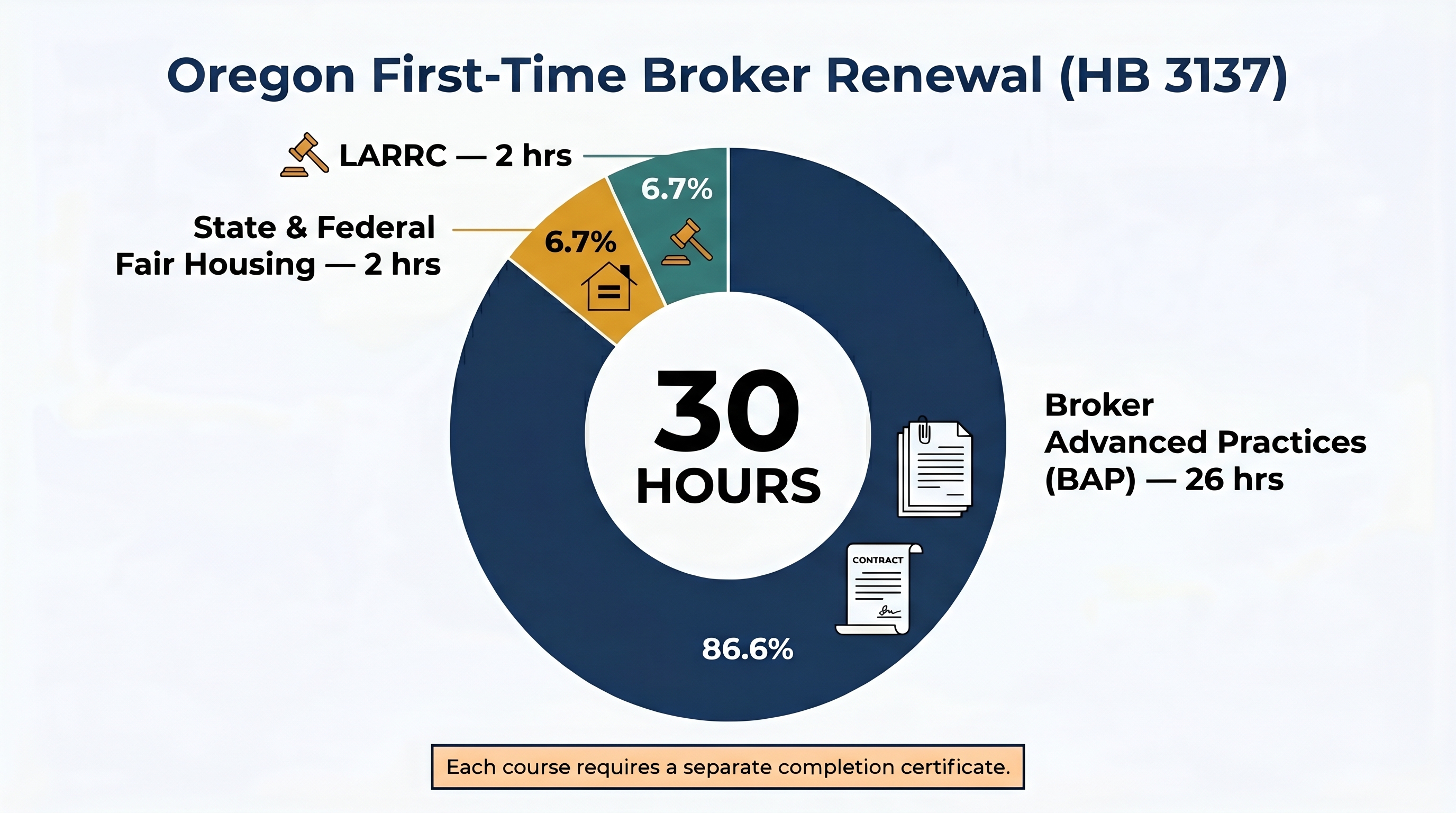
2026 First Renewal CE Breakdown: 30 hours across three mandatory courses under HB 3137
- 26-Hour Broker Advanced Practices Course: This intensive course bridges the gap between theoretical knowledge and the practical realities of managing a transaction. It covers critical topics like agency relationships, proper utilization of Oregon Real Estate Forms, managing escrow and title processes, and advanced negotiation strategies.
- 2-Hour Law and Rule Required Course: Every Oregon licensee must complete this course during every two-year renewal cycle. For your first renewal, the newly shortened 2-hour course focuses exclusively on recent legislative changes, administrative rule updates, and current disciplinary trends.
- 2-Hour State and Federal Fair Housing Course: This is the newest mandatory addition. This dedicated 2-hour module provides a thorough examination of the federal Fair Housing Act and Oregon's specific fair housing statutes. It covers protected classes, discriminatory practices, implicit bias, and the broker's duty to promote equitable housing opportunities.
Crucial Note on Course Structure: Each component is a separate, board-developed course. They must be taken as standalone offerings from a certified continuing education provider. The Fair Housing course cannot be embedded within the Broker Advanced Practices course; they are distinct requirements yielding separate completion certificates.
The Transition Year: What Counts If You Started Early
Because a renewal cycle spans two years, many brokers whose licenses expire in 2026 began taking their continuing education courses in late 2024 or 2025. If you are one of those proactive individuals, grandfathering provisions protect your earlier work.
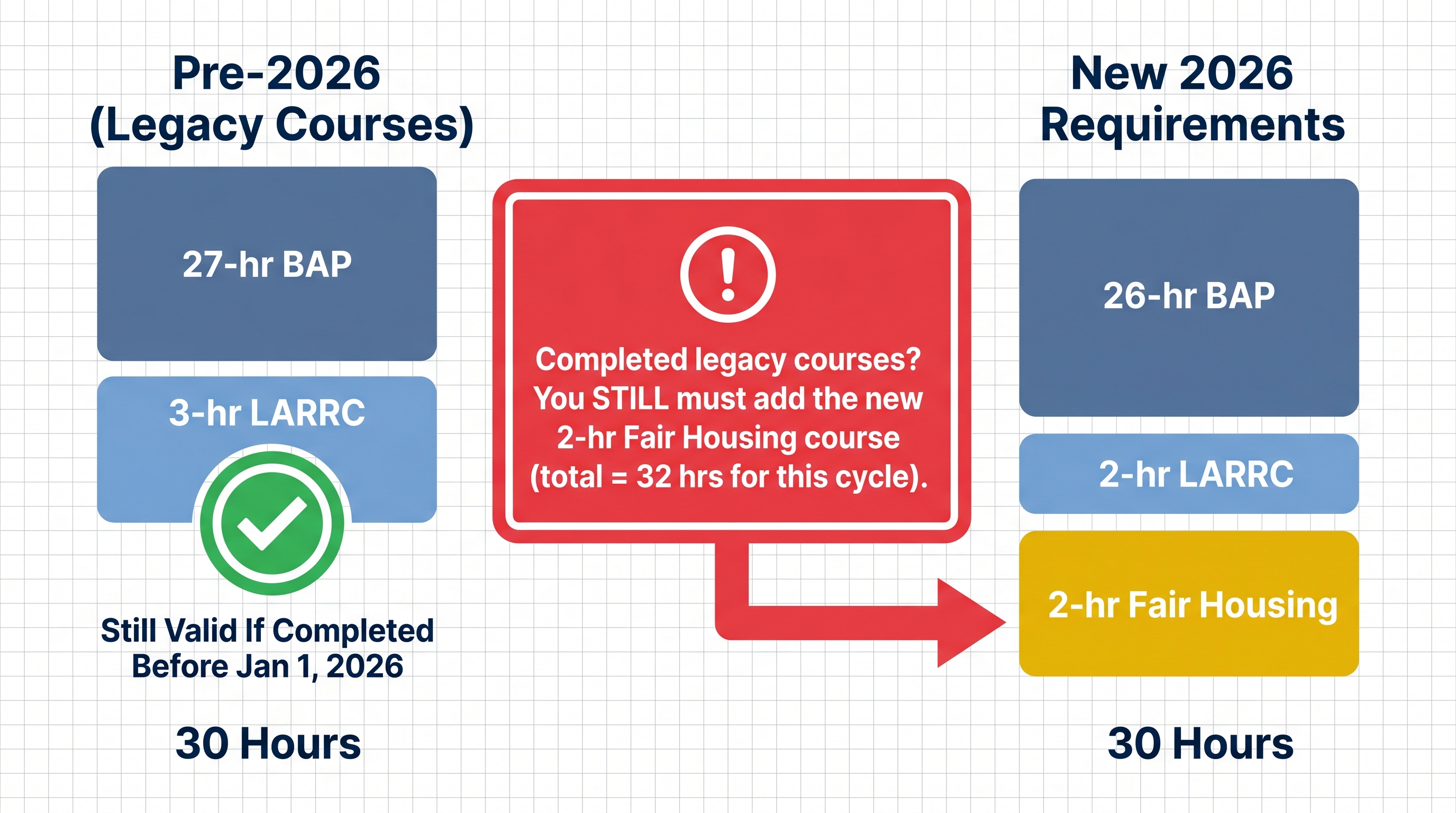
Transition Year Alert: Legacy courses are valid, but you must still complete the new 2-hour Fair Housing course
Prior to January 1, 2026, the requirement consisted of a 27-hour Broker Advanced Practices course and a 3-hour Law and Rule Required Course. According to official transition guidance, if you fully completed the legacy 27-hour course or the legacy 3-hour course before January 1, 2026, those certificates remain entirely valid for your upcoming 2026 renewal.
There is a critical caveat: grandfathering older courses does not exempt you from the new mandates. If you completed the 27-hour and 3-hour courses, you have 30 hours of credit, but you are still missing the new 2-hour State and Federal Fair Housing course. You must complete this requirement even if doing so brings your total continuing education hours for this cycle to 32. When you submit your renewal, the Agency will verify the presence of the Fair Housing certificate regardless of whether your other certificates total 30 hours.
The New Scenario-Based Proficiency Assessment
The most significant change introduced for 2026 is the overhaul of the proficiency assessment. Beginning July 1, 2026, the assessment must utilize complex case studies and hypothetical real-world scenarios, ending the era of simple multiple-choice questions.
The assessment consists of 60 questions, and brokers must achieve a minimum passing score of 75%. The examination tests three core competencies critical to modern real estate practice:
- 1. Client-Risk Identification: Scenarios will present property disclosures, preliminary title reports, or inspection summaries and require you to identify potential liabilities. For example, you might review a scenario where a seller discloses unpermitted structural work and determine the appropriate risk-mitigation steps for your buyer.
- 2. Contract-Term Selection: You will be tested on your ability to select the correct forms, addenda, and specific contractual terms based on a client's unique circumstances. Expect hypotheticals requiring you to navigate complex financing contingencies, repair addenda, or escalation clauses using standard state forms.
- 3. Communication Protocols: These questions evaluate your understanding of legally sound communication practices. Scenarios will test your knowledge of when written notice is statutorily required versus when verbal communication is acceptable, how to properly deliver adverse news, and how to document your advisory role.
Assessment Retake Policy
The administrative rules do not specify a maximum number of retake attempts, but passing is an absolute requirement for renewal. Currently, there are no mandatory waiting periods between attempts or additional state fees specifically for retesting, though individual continuing education providers may maintain their own policies. The most critical factor is time. If you approach your expiration date without a passing score, your renewal will be blocked. Failing the assessment just days before expiration will not afford you the opportunity to address weak areas and retest.
If your renewal requires you to take this assessment on or after July 1, 2026, deliberate preparation is vital. Effective strategies include forming study groups, thoroughly reviewing blank forms, and role-playing complex transactional scenarios with your principal broker.
Key Compliance Details Brokers Often Miss
Administrative missteps can derail a renewal. First, Oregon does not permit continuing education carryover. If you complete 40 hours of continuing education during your first two years, the extra 10 hours do not carry forward to your next cycle; they are forfeited. Similarly, you cannot receive repeat credit for taking the same course content twice within a single renewal cycle.
Another frequently overlooked detail is the strict record-keeping requirement. The responsibility for retaining completion certificates rests with you, not your provider or principal broker. You must retain those certificates for a minimum of three years following your renewal date. The state conducts randomized, post-renewal audits, and failing to produce documentation will result in disciplinary action.
Additionally, your license expiration date is tied to the last day of your birth month. While real estate licenses generally carry a 24-month renewal term, your initial license issue date determined the exact length of your very first cycle to permanently align your expiration with your birth month. Your coursework and renewal application must be fully submitted before midnight on that specific date.
Finally, ensure every course you take is offered by an officially certified Oregon continuing education provider. Use the course search tool on the official state broker page to verify provider certification. Falsely certifying on your renewal application that you have completed the required education constitutes misrepresentation.
The Inactive Renewal Trap
A common pitfall for newer licensees involves the inactive status option. Some brokers, overwhelmed by the 30-hour requirement or temporarily stepping away from the business, choose to renew on an inactive status. While renewing inactive defers the immediate continuing education requirement, it does not eliminate it.
The moment you decide to reactivate your license, the same first-renewal requirements discussed throughout this guide will be triggered immediately. Inactive status does not allow you to bypass the 26-hour course, the new Fair Housing course, or the scenario-based assessment. Waiting out multiple renewal cycles in an inactive state will not relieve you of those obligations. The requirement is permanently attached to your first active renewal. Plan accordingly, and do not allow inactive status to create a false sense of compliance.
Practical Steps: A Month-by-Month Action Plan
To avoid a last-minute scramble, a structured timeline is essential, particularly given the July 1, 2026 transition to the scenario-based assessment. If your renewal falls later in 2026, the following month-by-month action plan will keep you on track:
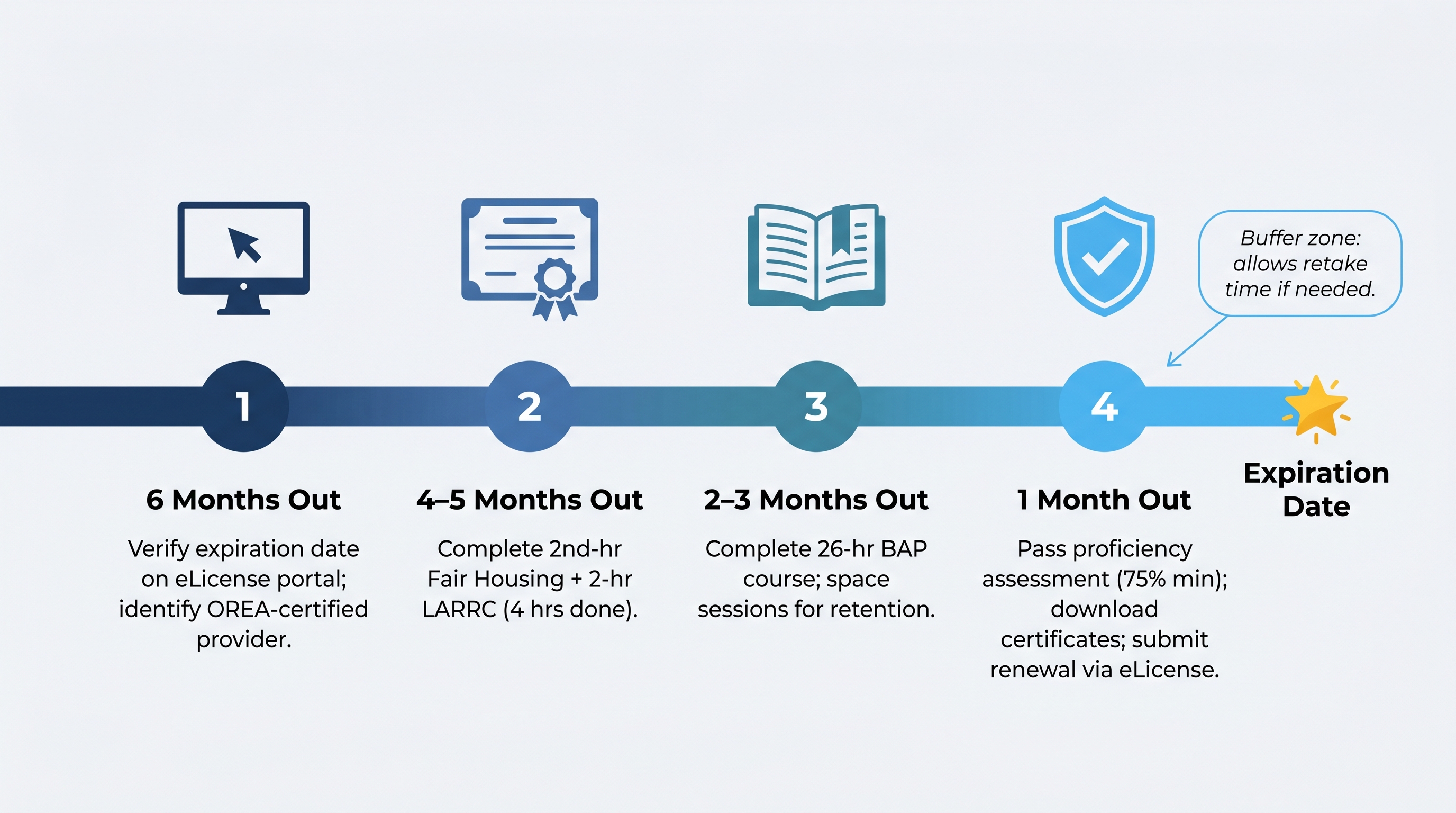
Your Renewal Roadmap: A month-by-month action plan to stay ahead of your 2026 expiration date
- Six Months Out: Log into the eLicense portal to confirm your exact expiration date and review any education you have already completed. Identify a certified provider offering the new 2026-compliant package.
- Four to Five Months Out: Enroll in and complete the 2-hour State and Federal Fair Housing course and the 2-hour Law and Rule Required Course. Completing these early builds momentum and secures 4 of your required 30 hours.
- Two to Three Months Out: Dedicate this block of time to the 26-hour Broker Advanced Practices course. Because the course is dense and practice-oriented, spacing it out over several weeks promotes better retention.
- One Month Out: Sit for the proficiency assessment. Completing it a full month before your deadline provides an essential buffer. If you do not achieve the required 75% passing score on your first attempt, you will have sufficient time to review your weak areas and retake the assessment without your license expiring. Once you have passed, download your certificates to a secure personal location to begin the required 3-year retention period, then submit your renewal application.
Conclusion
Your first license renewal marks a meaningful professional transition from a new entrant to an established Oregon real estate professional. While the changes introduced for 2026 require careful attention, they are designed to elevate the profession and better protect consumers. By understanding the 30-hour course breakdown, navigating the grandfathering provisions, and preparing thoughtfully for the new scenario-based assessment beginning July 1, you can approach your renewal with confidence.
Do not wait until the final weeks of your renewal period. Use this guide to structure your educational timeline, maintain your documentation diligently, and embrace the advanced practices that will define your professional future. For the most current information, the state's official broker page remains your definitive resource.