
Mastering Oregon Real Estate Compliance: DPA, CE, Disclosures, and Rules
Operating as a real estate broker in Oregon requires strict adherence to state laws, administrative rules, and professional standards established by the Oregon Real Estate Agency. Mastering Oregon-specific regulations separates an average agent from a top professional. Whether navigating down payment assistance, aligning continuing education with 2026 changes, managing property disclosure timelines, or bringing marketing into compliance, understanding state rules is non-negotiable. This guide serves as a resource for Oregon brokers. By examining four critical areas of practice, this article provides actionable guidance to help protect your clients, safeguard your license, and elevate your practice.
1. Navigating DPA and Seller Concessions in Oregon
Accumulating a sufficient down payment remains a major barrier to homeownership. Real estate brokers must understand Down Payment Assistance programs and seller concessions.
State and Local Assistance Programs
The Oregon Housing and Community Services department administers grants to expand homeownership. These state programs offer assistance capped at up to $60,000 or 20% of the purchase price, whichever is less. Buyers must strictly meet a 100% Area Median Income limit.
Brokers should also know localized options like the Portland Down Payment Assistance Loan. This program provides $80,000 to $100,000 at 0% interest, structured as a 30-year deferred loan for eligible first-time homebuyers within Portland city limits.
A critical compliance issue arises when combining these programs. Both the Portland loan and state programs require a second lien position on the title. Because they conflict over lien priority, they generally cannot be stacked together.
Navigating Seller Concessions
Oregon has no statewide statutory seller concession cap. Maximum allowable concessions are dictated entirely by the buyer's loan product:
- FHA Loans: Capped at 6% of the lesser of the property sales price or appraised value.
- VA Loans: Capped at 4% of the sales price, applying specifically to closing costs and funding fees.
- Conventional Loans: Dependent on the Combined Loan-to-Value ratio. For a ratio above 90%, the cap is 3%. For a ratio between 75.01% and 90%, the cap is 6%. For a ratio at 75% or below, the cap is 9%. Investment properties are capped at 2%.
- USDA Loans: Capped at 6% of the sales price.
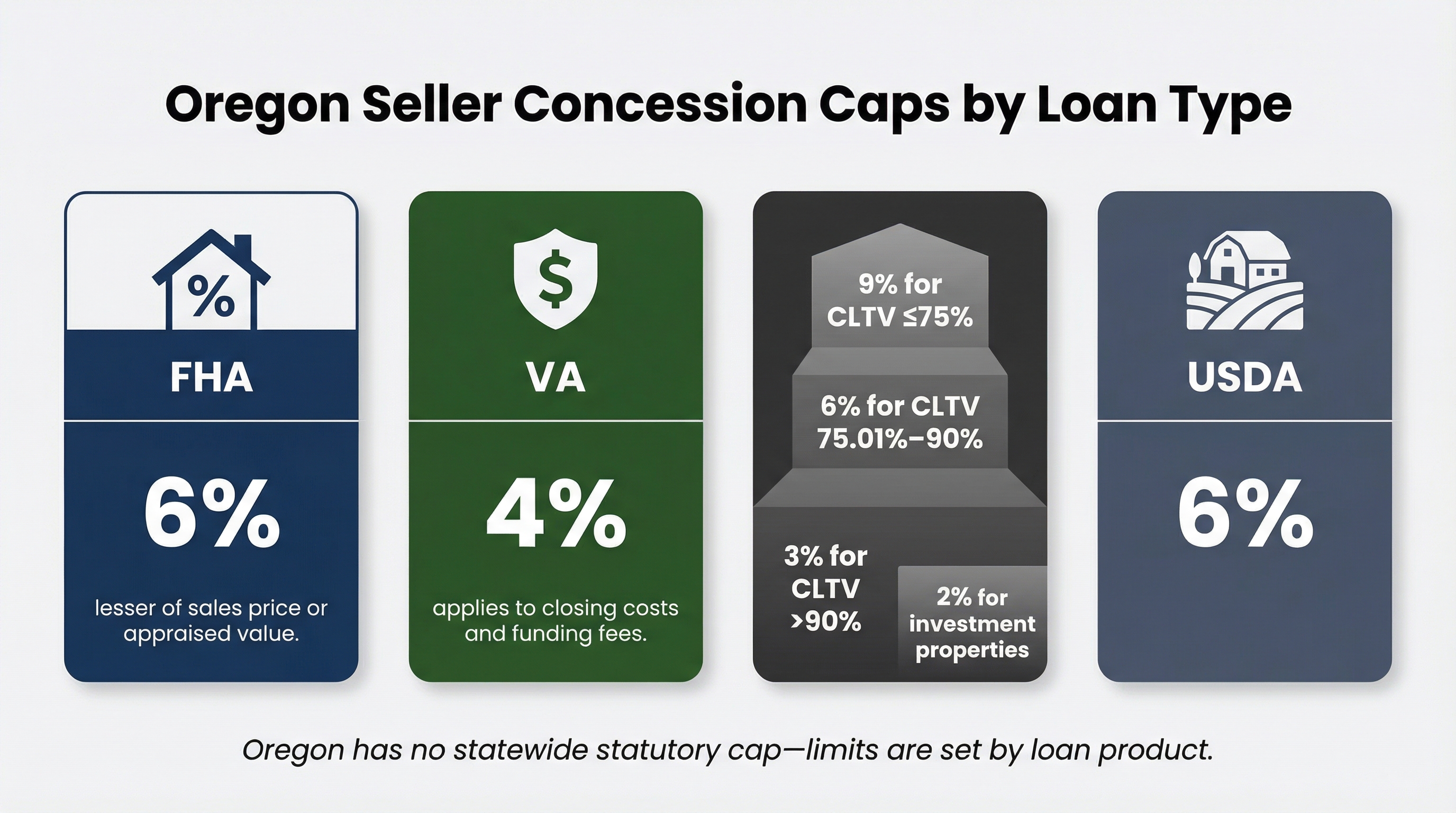
Oregon seller concession caps are determined entirely by loan product, not state law. Always verify the buyer's specific loan terms before writing concessions into an offer.
Key Takeaway: Verify exact loan product caps before writing seller concessions into an offer. Recognize that local and state assistance programs generally cannot be combined due to second lien position conflicts.
2. Instructor Qualifications and CE Compliance
Continuing Education is fundamental to maintaining an active real estate license in Oregon.
The 30-Hour CE Requirement (Effective January 1, 2026)
The total continuing education requirement for license renewal remains at 30 hours, but the internal allocation changes effective January 1, 2026. The Law and Rule Required Course decreases from 3 hours to exactly 2 hours. A new mandatory 2-hour Fair Housing course is introduced. The remaining 26 hours consist of general education or the Advanced Practices course for brokers completing their first active renewal.
Additionally, effective July 1, 2026, brokers entering their first active renewal must achieve a passing score of 75% on a comprehensive 60-question proficiency assessment.
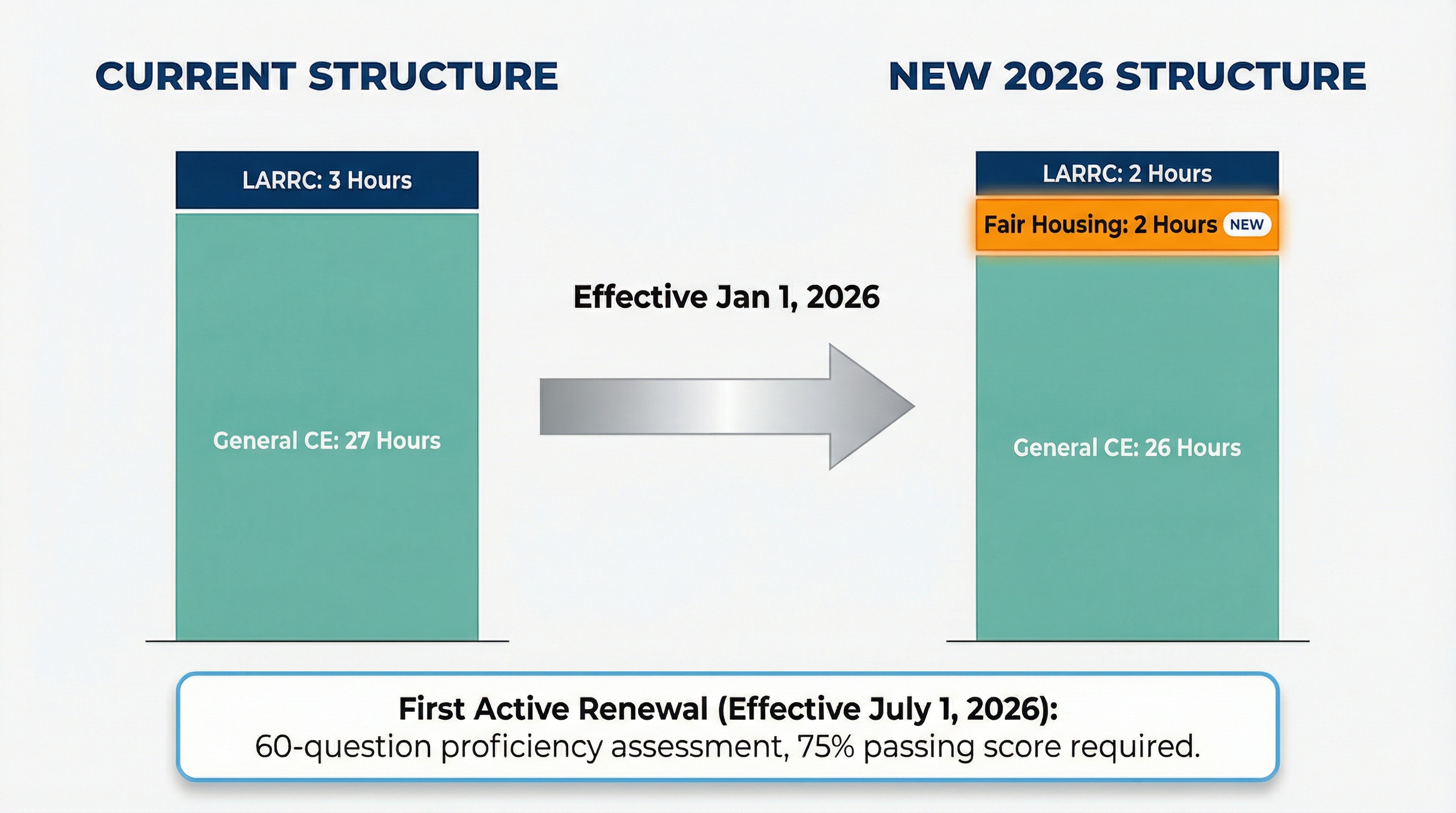
Oregon's 30-hour CE requirement stays the same, but the internal allocation shifts significantly in 2026. Plan your coursework accordingly.
Instructor Qualifications and Provider Responsibilities
The state real estate agency does not certify instructors directly. Education providers bear responsibility for ensuring instructors meet strict statutory qualifications. For online education, Oregon incorporates standards established by the Association of Real Estate License Law Officials.
Recordkeeping Requirements
Licensees must retain completion certificates for three years. If audited, you have exactly 15 business days to produce those records.
Key Takeaway: Audit your education timeline to accommodate the 2026 internal allocation changes, including the 2-hour law course and new 2-hour Fair Housing course. Prepare for the 60-question proficiency assessment for first-time renewals.
3. Mastering Property Disclosure Requirements
A seller's obligations regarding property condition are defined by civil laws. While the real estate agency does not administer these statutes, a broker's handling of disclosures remains heavily regulated.
Offer-Triggered Delivery and Revocation Rights
Sellers must deliver the completed statutory disclosure statement to a buyer making a written offer. Upon receipt, the buyer has a statutory right to revoke their offer within five business days. During this window, the buyer may walk away for any reason related to the disclosure and receive a full refund of their earnest money.
Statutory Exemptions and the 2025 Update
Exemptions to providing a disclosure include new construction that has never been occupied, bank-owned properties, and properties sold by a court-appointed receiver. Additionally, a 2025 legislative update removed the wildland-urban interface question from the statutory disclosure form. Brokers must ensure they use the updated forms.
Broker Duties and Document Transmission
Real estate licensees have an affirmative duty to inform clients about disclosure laws. An agent must never complete the form on the seller's behalf. Once completed, any document generated in a real estate transaction must be transmitted to the authorized principal broker within three banking days. All files must be retained for six years.
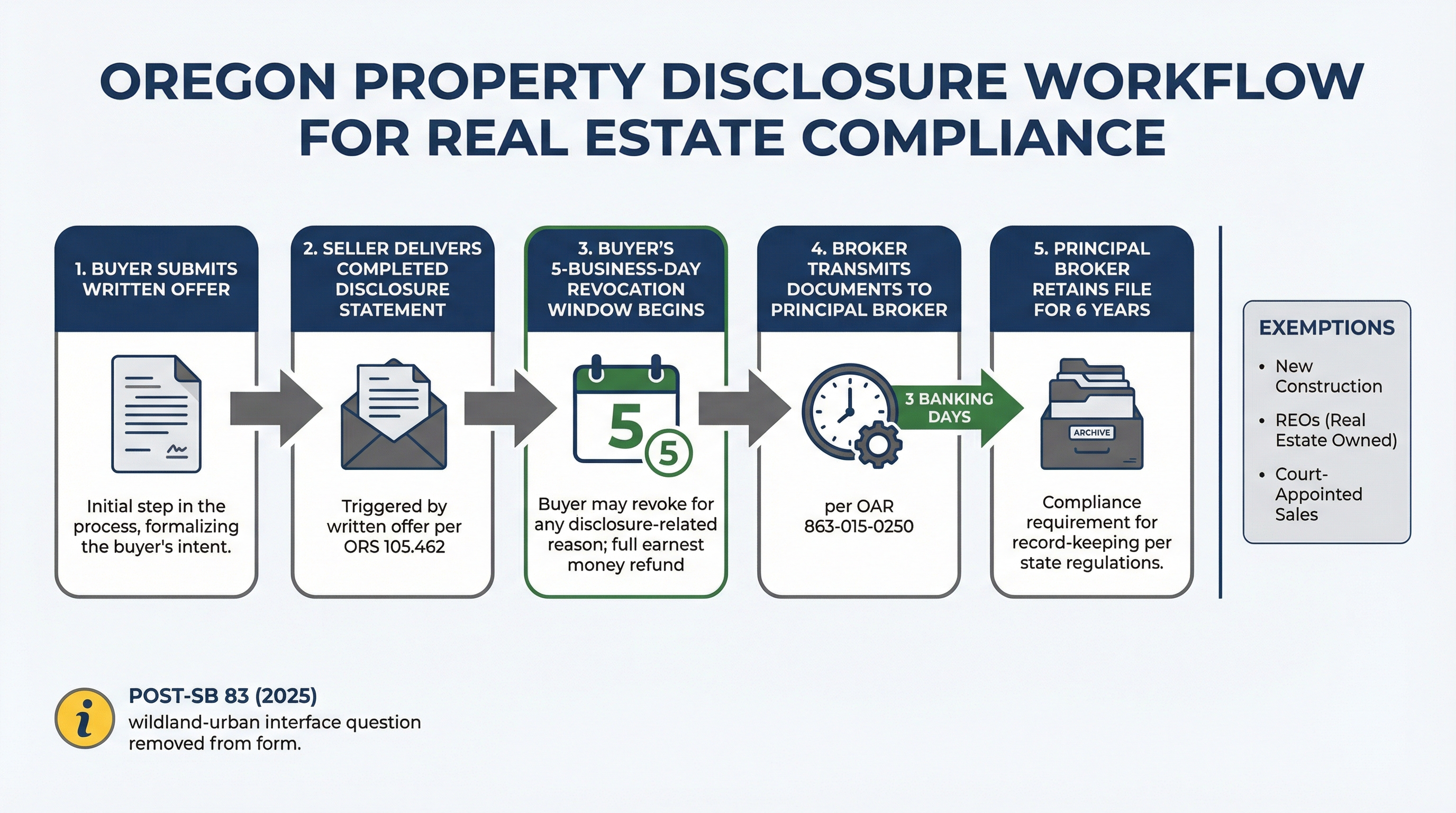
Oregon's property disclosure process involves strict deadlines measured in business and banking days. Missing any step can expose brokers to compliance violations.
Key Takeaway: Use the updated disclosure forms. Accurately calculate the five-business-day revocation window, and strictly adhere to the three-banking-day transmission rule to your principal broker.
4. Licensing Compliance
Engaging in professional real estate activity without a valid, active license directly violates state statutes. This can result in civil penalties ranging from $1,000 to $5,000 per violation and potential Class A misdemeanor charges.
Initial Licensing and Principal Broker Upgrades
Obtaining an initial broker's license requires 150 hours of pre-license education, passing required examinations, and a background check. Upgrading to a Principal Broker license requires three years of active experience and completion of the 40-hour Brokerage Administration and Sales Supervision course.
Advertising and Business Name Compliance
All advertising must prominently display the brokerage's Registered Business Name. The business name must be immediately noticeable, truthful, and never deceptive.
Supervision and Team Name Restrictions
Managing principal brokers carry a statutory duty to supervise all brokers operating under their registered business name. A critical compliance concern involves team naming conventions. State law prohibits team names from including the words "realty" or "real estate." However, recent legislation suspended enforcement, granting a grace period that permits teams to use these terms until July 1, 2027. Brokers should plan for the potential resumption of enforcement after that date.
Furthermore, beginning January 1, 2026, team members must provide clients with a Real Estate Team Disclosure form before entering into any agreement to reduce consumer confusion.
Key Takeaway: Verify that your registered business name is prominently displayed on all marketing. Plan for the enforcement of the restriction on "realty" or "real estate" in team names after July 1, 2027.
Conclusion
Navigating the Oregon real estate landscape requires diligence and a proactive approach to regulatory change. Whether addressing lien conflicts between assistance programs, adapting to 2026 continuing education updates, managing property disclosures within proper transmission timelines, or preparing team names for future enforcement, mastery of these topics is essential. By familiarizing yourself with state statutes and legislative updates, you safeguard your license and deliver a superior standard of care to every client.