
What Is Oregon's Seller's Property Disclosure Statement (SPDS)?
Oregon's Seller's Property Disclosure Statement (SPDS) changed under 2025's Senate Bill 83, and using last year's form is now treated the same as not disclosing at all. The update, effective July 24, 2025, removed the wildland-urban interface question from the statutory form and reshaped how brokers verify compliance heading into 2026.
Below is the current framework under ORS 105.462–105.490, the federal lead-paint rules that run alongside it, and a practical checklist you can run on every listing this year.
- SB 83 (effective July 24, 2025) removed the wildland-urban interface question from the SPDS and voided the statewide wildfire hazard map.
- An outdated SPDS form is legally treated the same as failing to disclose at all — it doesn't satisfy the statute.
- Buyers get five business days (not calendar days) to revoke an offer after receiving a valid SPDS.
- New construction, foreclosure sales, court-appointed transfers, and government transfers are exempt under ORS 105.470.
- Federal lead-based paint disclosure for pre-1978 homes runs on its own timeline, separate from the SPDS.
The SPDS, codified in ORS 105.462 through 105.490, spells out exactly what an Oregon seller must tell a buyer about a property's condition — title, water systems, sewage, insulation, structural integrity, systems and fixtures, and community interests. Disclosures are based on the seller's actual knowledge at the time the form is completed, not an exhaustive inspection. Sellers aren't expected to be engineers; they're expected to tell the truth about what they know.
Which Oregon Properties Require an SPDS?
Under ORS 105.465(1), the SPDS requirement is broad but specific. Delivery is mandatory when selling:
- Residential properties with one to four dwelling units
- Condominiums
- Timeshares
- Manufactured dwellings
The delivery requirement. Under ORS 105.465(2), the seller must deliver the SPDS to each buyer who makes a written offer. Delivery is what starts the buyer's review clock — not the listing, not the MLS file.
Practical scenario: A property gets four competing written offers on a Monday. The listing agent needs to make sure the seller gets a completed SPDS into all four buyers' hands. Keeping the document in an MLS file doesn't count as delivery until the buyer or their agent actually has it.
What Are the Statutory Exemptions to Oregon's Disclosure Law?
ORS 105.470(1) carves out several exemptions. Requiring a disclosure where an exemption applies can needlessly expose a seller to liability; missing a valid exemption can stall a transaction. The exemptions are:
- First sale, never occupied: New construction that has never been lived in.
- Financial institution sales: Sales by a lender, or through foreclosure or a deed-in-lieu of foreclosure.
- Court-appointed fiduciaries: Transfers by receivers, personal representatives, trustees, conservators, or guardians.
- Government transfers: Sales or transfers by any government agency.
Practical scenario: A buyer is purchasing a home a flipper fully gutted and remodeled. The flipper claims the "first sale never occupied" exemption. That's wrong — the original structure was occupied before the renovation, so the exemption doesn't apply. An SPDS is still required.
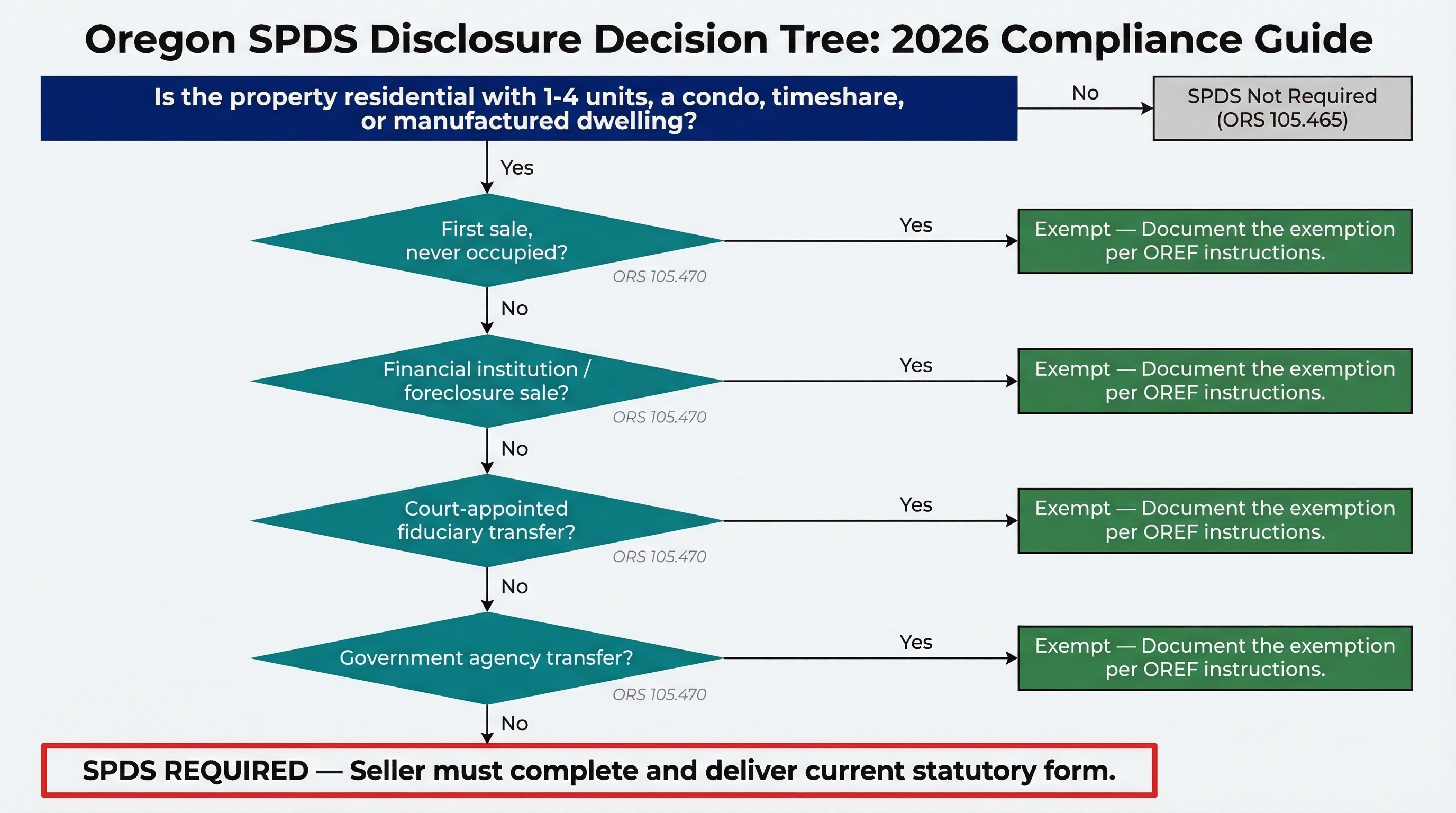
Does this transaction require an SPDS? Check property type under ORS 105.465, then check exemptions under ORS 105.470.
Staying current matters here: legislative updates like SB 83 are exactly the kind of thing your Oregon continuing education requirements are designed to keep you on top of. If you want your renewal hours to double as a compliance refresher, the Oregon Pro CE Bundle pairs your required Law & Rule and Fair Housing hours with bonus courses on valuation, marketing compliance, and deal psychology.
How Does Federal Lead-Based Paint Disclosure Fit In?
Oregon's SPDS covers a lot of ground, but pre-1978 homes bring a second, entirely separate obligation: the federal Residential Lead-Based Paint Hazard Reduction Act (42 U.S.C. § 4852d) and its HUD/EPA rules at 24 CFR Part 35. This runs alongside the SPDS, not instead of it — skipping it leaves both agent and seller exposed.
Compliance means providing the EPA-approved lead hazard pamphlet (updated January 2026), giving buyers a 10-day inspection opportunity, including a Lead Warning Statement in the contract, and keeping records for three years. Under 24 CFR § 35.94, agents carry an affirmative duty to make sure this happens.
The timing difference that trips people up: Oregon's SPDS delivery is triggered by a written offer (ORS 105.465(2)). Federal lead-paint disclosure has to happen before the buyer is obligated under any contract — a different clock entirely.
Practical scenario: A buyer views a 1974-built home Saturday and writes an offer Sunday. The listing agent must have already delivered the EPA pamphlet, lead disclosure form, and warning statement before that offer is signed. Waiting until Monday to hand over federal disclosures alongside the SPDS violates 24 CFR § 35.94, regardless of whether the Oregon paperwork is otherwise clean.
What Is the Buyer's Five-Business-Day Revocation Right?
Oregon gives buyers real teeth here. Under ORS 105.475(1), once a seller delivers the SPDS, the buyer has an unconditional right to revoke their offer — but the window is five business days, not calendar days. Saturdays, Sundays, and legal holidays don't count.
Practical scenario: A seller delivers the SPDS Thursday at 4:00 p.m. The first business day is Friday. Counting Friday (1), Monday (2), Tuesday (3), Wednesday (4), Thursday (5), the buyer has until the following Thursday at 11:59 p.m. to submit written revocation.
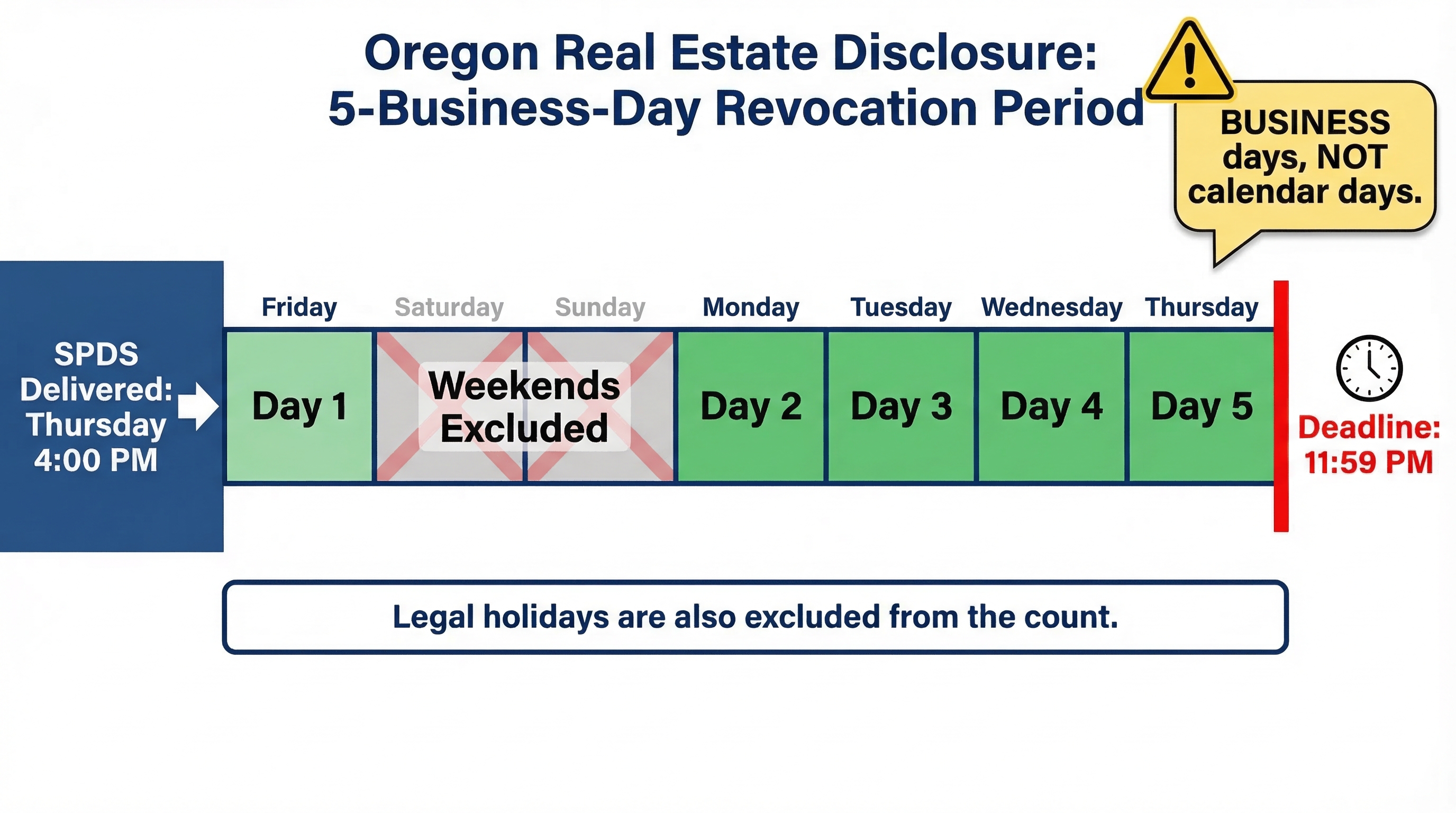
Calculating the five-business-day buyer revocation window under ORS 105.475(1). Weekends and legal holidays don't count toward the total.
If the buyer revokes in time, escrow returns the full earnest money deposit — regardless of any objection from the seller.
Compliance tip — material changes: a common gap in longer escrows is failing to update the SPDS when conditions change materially. No statute automatically restarts the five-day window for an update, but promptly disclosing a newly discovered or worsened defect in writing is still the right move — and it's the best protection against a post-closing misrepresentation claim.
What Happens If a Seller Fails to Disclose — and Who Has to Prove It?
Under ORS 105.475(4), if a seller never delivers the SPDS, the buyer's right to revoke stays open all the way to closing — an open-ended exit with the full deposit returned. Closing doesn't erase liability, either: ORS 105.490(1) makes clear the SPDS doesn't replace common-law remedies. A buyer who later discovers a seller actively concealed a defect can still sue for fraud, misrepresentation, or breach of contract.
Burden of Proof and Documentation (ORS 105.485)
ORS 105.485 puts the burden squarely on the seller to prove lawful delivery of the SPDS, typically through an e-signature audit trail. Proving the seller had actual knowledge of a concealed defect is a different, harder question — and that burden falls to the buyer.
Practical scenario: Three months after closing, a buyer discovers serious foundation settlement and sues. The seller must prove delivery under ORS 105.485, but the buyer must prove the seller actually knew about the settlement beforehand — for example, through a prior contractor estimate addressed to the seller. Buyers should talk to an attorney about how this burden applies to their specific facts.
For agents, the practical risk-management move is coaching sellers on the difference between "No" and "Unknown." A seller who's never used the chimney and can't confirm it works should check "Unknown" — a speculative "No" is an invitation to a lawsuit.
Agent Liability and OREA Discipline (ORS 696.301)
ORS 105.480(1) protects agents somewhat: SPDS representations belong to the seller, not the licensee, and an agent isn't a guarantor of the property's condition. That said, the Oregon Real Estate Agency (OREA) retains real disciplinary authority under ORS 696.301(1). If a listing agent knows about a material defect and lets the seller check "No" without correcting it, the agent is complicit — and OREA can suspend or revoke a license over it. Understanding where that line sits is part of what's covered in Oregon's real estate license requirements.
What Changed Under SB 83 in 2025, and What Should Agents Do in 2026?
During the 2025 session, Oregon enacted Senate Bill 83 (Chapter 590), effective July 24, 2025, amending ORS 105.464 and the statutory SPDS form itself.
Driven by a policy shift on home hardening, SB 83 repealed ORS 477.490 — the statute behind the statewide wildfire hazard map — and voided prior Oregon Department of Forestry hazard-zone orders. The mandatory SPDS form was updated to remove the question asking whether a property is classified as wildland-urban interface.
Defensible-space mandates also shifted from a mandatory statewide program to a model code local municipalities may voluntarily adopt (amendments to ORS 476.392). And R327 wildfire mitigation building code standards became locally optional starting January 1, 2026, under OAR 918-480-0010.
Why this matters right now: because ORS 105.464 dictates the exact statutory language required, a 2024-or-earlier OREF SPDS form no longer satisfies the law. An outdated form is a failure to deliver, full stop.
2026 Compliance Checklist for Oregon Agents
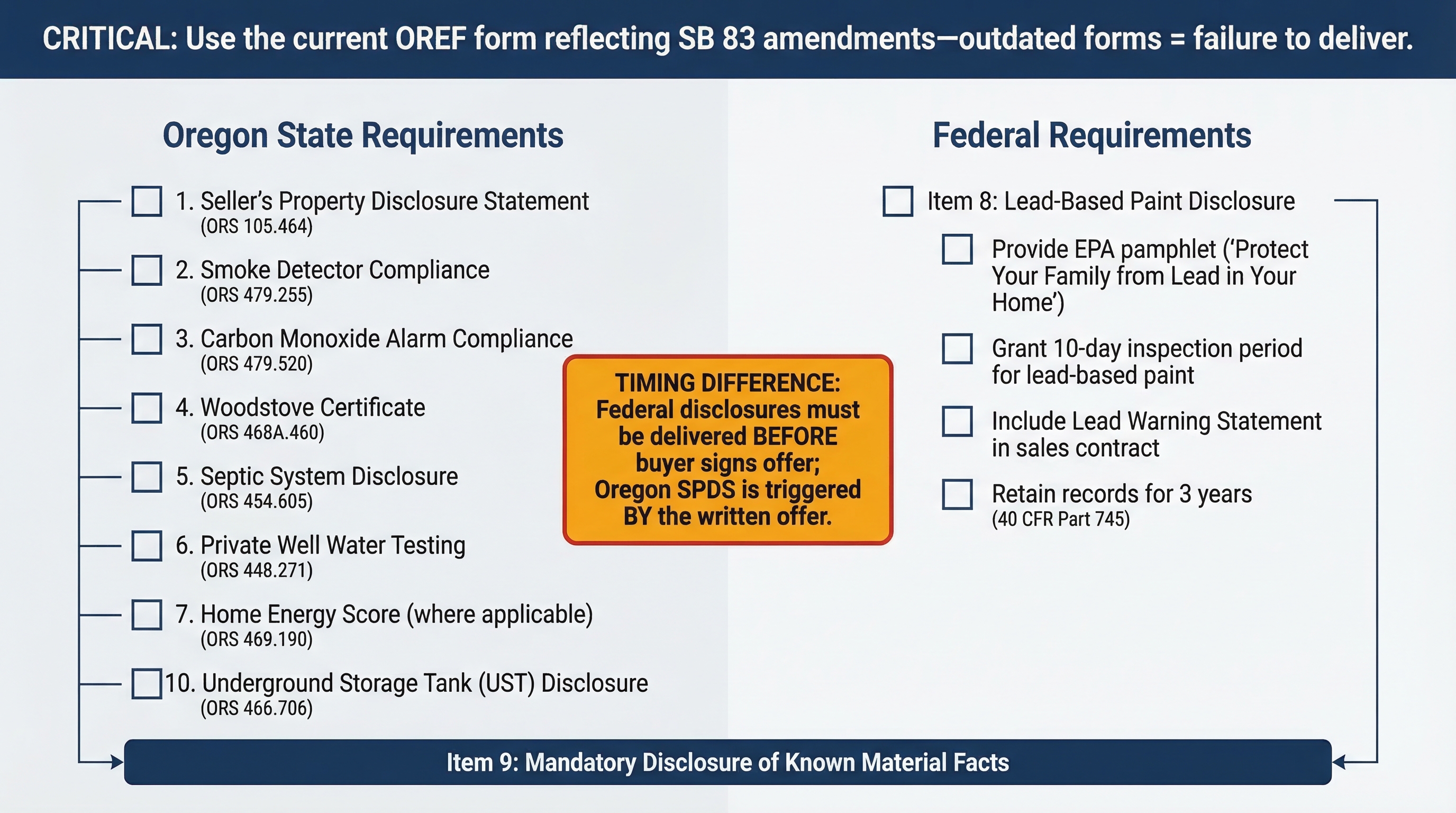
Oregon SPDS and federal lead-paint disclosure requirements, side by side, with the critical timing distinction flagged.
- Verify the form version: confirm your SPDS reflects the SB 83 updates to ORS 105.464 by using the current OREF form.
- Confirm applicability: check the property type against ORS 105.465(1).
- Check for exemptions: evaluate ORS 105.470(1) and, if an exemption applies, follow the OREF form's instructions for documenting it rather than skipping sections.
- Counsel, don't complete: never fill out the SPDS on a seller's behalf — have them answer from actual knowledge.
- Explain "Unknown" vs. "No": a speculative "No" is riskier than an honest "Unknown."
- Deliver promptly: get the SPDS to the buyer as soon as a written offer arrives, per ORS 105.465(2).
- Count business days correctly: exclude weekends and legal holidays per ORS 105.475(1).
- Handle federal lead-paint separately: for pre-1978 homes, follow 42 U.S.C. § 4852d and deliver disclosures before the buyer is obligated — earlier than Oregon's own timing.
- Disclose known material facts: your independent duty under ORS 696.301(1) doesn't go away because the seller signed the form.
- Watch for material changes: if conditions change before closing, get an updated disclosure in writing.
Frequently Asked Questions
What is Oregon's Seller's Property Disclosure Statement (SPDS)?
The SPDS is a statutory form under ORS 105.462 to 105.490 requiring Oregon sellers to disclose what they actually know about a property's condition — title, water, sewage, structure, and more — before closing. It protects buyers but isn't a warranty of condition.
How long do Oregon buyers have to revoke an offer after receiving the SPDS?
Buyers get five business days, not calendar days, from delivery of a valid SPDS to revoke their offer under ORS 105.475. Weekends and legal holidays don't count, so a Thursday delivery gives the buyer until the following Thursday at 11:59 p.m.
What did Senate Bill 83 change about Oregon's disclosure law?
SB 83 (Chapter 590), effective July 24, 2025, removed the wildland-urban interface question from the required SPDS form and repealed the statewide wildfire hazard map under ORS 477.490. Agents still using a pre-2025 SPDS form are no longer in compliance.
Are any Oregon properties exempt from the SPDS requirement?
Yes. ORS 105.470 exempts new construction never previously occupied, sales by financial institutions or through foreclosure, transfers by court-appointed fiduciaries, and government transfers. A renovated-but-previously-occupied home does not qualify for the new-construction exemption.
Can an Oregon real estate agent be disciplined over a seller's inaccurate SPDS?
Yes. ORS 105.480 makes SPDS representations the seller's, not the agent's, but the Oregon Real Estate Agency can still discipline a licensee under ORS 696.301 who knowingly lets a seller misrepresent a material fact instead of correcting it.
Ready to Keep Your Oregon License Current Through 2026?
You've built real expertise handling changes like SB 83 — that's exactly the kind of judgment your clients are paying for. Make sure your next renewal reflects it: the Oregon Pro CE Bundle covers your required Law & Rule and Fair Housing hours plus bonus courses that sharpen exactly the skills this guide touches on — disclosure, valuation, and compliance judgment.
If you're also eyeing the next step in your career, our guide to how to become a principal broker in Oregon walks through the BASS course and experience requirements.
Have questions about your specific renewal timeline or which CE hours you still need? Call us at 425-775-2313 — a real person picks up. You can also browse more guides on the Oregon real estate education blog.
Oregon's SPDS law changed under 2025's SB 83. Learn the 5-business-day revocation rule and 2026 compliance steps to protect your broker license.