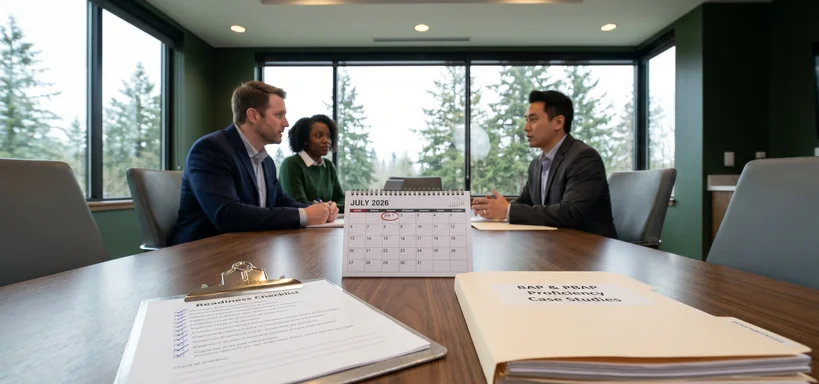
Preparing Your Real Estate Firm for Oregon's New BAP & PBAP Proficiency Assessments
As July 1, 2026, approaches, Oregon real estate firms face a major shift in continuing education and license renewals. If you manage a team, the era of agents clicking through online modules and taking multiple-choice vocabulary quizzes is ending.
Oregon is replacing rote memorization with applied professional judgment. Starting July 1, 2026, the Broker Advanced Practices (BAP) and Principal Broker Advanced Practices (PBAP) courses will require scenario-based, case-study proficiency assessments. Principal brokers must prepare their teams immediately to prevent stalled renewals and administrative complications.
The Legal Shift: What Changes on July 1
Oregon legislation mandates that licensees pass a proficiency assessment, as traditional testing models no longer adequately prepare brokers for complex transactions.
The Oregon Real Estate Agency (OREA) finalized administrative rules outlining this assessment. The BAP course assessment has been completely redesigned. To pass, brokers must complete a 60-question assessment and achieve a minimum score of 75 percent. Beginning July 1, 2026, this assessment will heavily feature case studies and hypothetical scenarios.
Rather than defining terminology, the assessment tests three applied competencies:
- Identifying and addressing client risk.
- Selecting appropriate contract provisions that match client objectives.
- Identifying effective communication protocols during challenging transaction phases.
For managing licensees, the standard is equally rigorous. The PBAP course requires a scenario-based assessment tailored to firm management responsibilities. Principal brokers will be tested on:
- Harm identification and risk mitigation.
- Identifying and correcting office policy gaps.
- Implementing proper supervision and training protocols.
- Executing effective communication and conflict resolution strategies.
- Conducting thorough standard-of-care analyses on broker behavior.
These updated assessments integrate into the standard continuing education framework. Licensees must complete the 26-hour Advanced Practices course alongside the updated 2-hour Law and Rule Required Course (LARRC) and the mandatory 2-hour Fair Housing course.
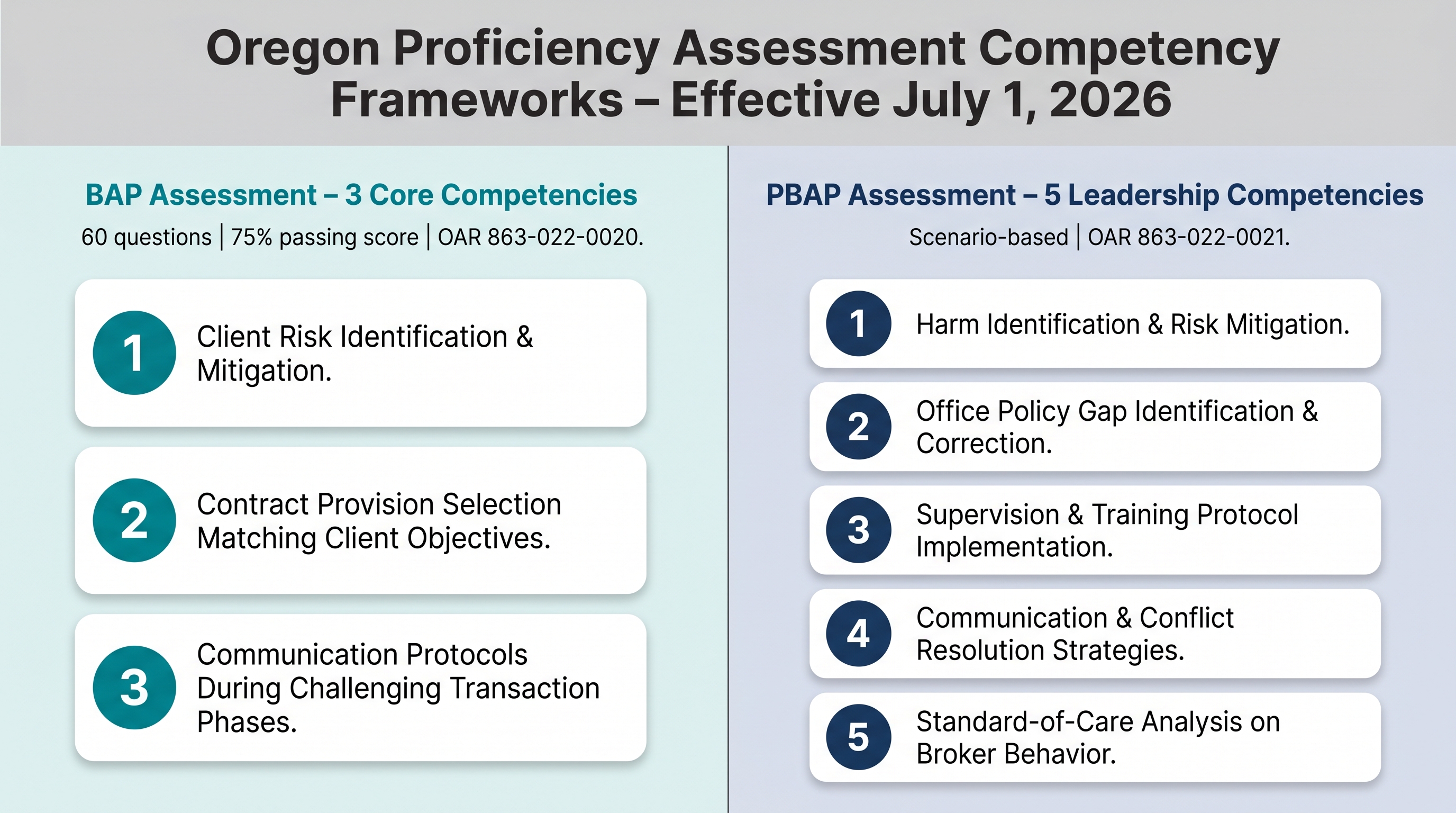
At a Glance: BAP vs. PBAP — the competency frameworks your brokers and leadership must master.
Navigating Renewal Cycle Timing
Firm owners managing teams with staggered renewal dates must understand how the July 1, 2026, effective date interacts with individual deadlines. The July 1 date applies specifically to the assessment format, not the license renewal date itself. If a broker is scheduled to renew in August 2026 but completes their Advanced Practices course before July 1, 2026, they will take the existing standard assessment format. Conversely, any broker completing their course on or after July 1, 2026, regardless of their actual renewal date, will face the new scenario-based assessment.
Principal brokers should help teams plan coursework timing strategically. Brokers who may struggle with the case-study methodology should complete their education before the July 1 transition date.
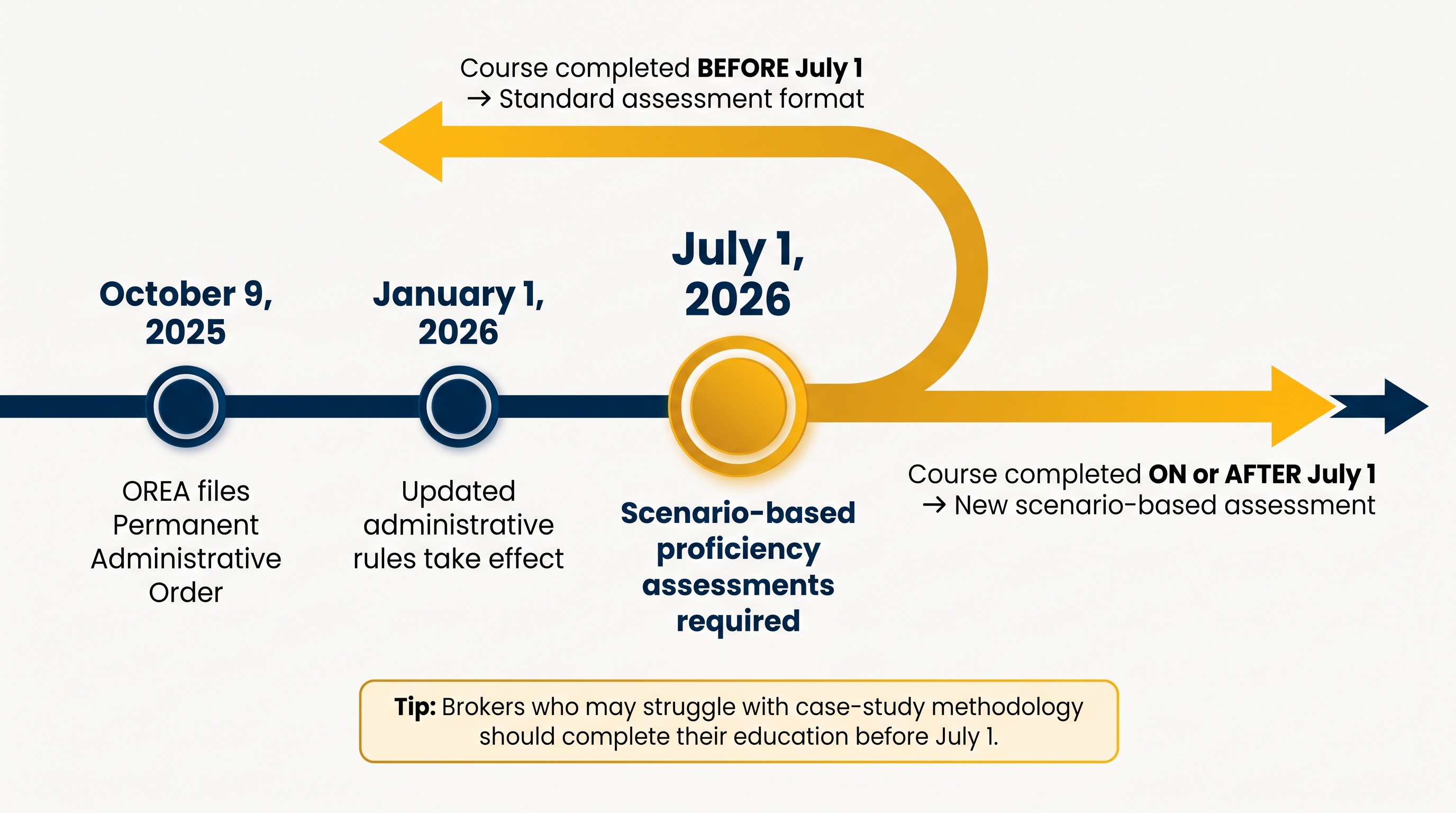
Key Dates: Understanding when the new scenario-based assessment applies to your brokers' renewal timeline.
Why This Matters for Your Firm
This shift from memorization to applied judgment is a significant change, particularly for first-renewal brokers. When newer licensees complete their BAP assessment, they cannot simply look up definitions. They will face complex, multi-variable transaction scenarios, such as a buyer attempting to waive inspections on a property with known structural defects while using FHA financing. They must critically evaluate the situation and identify an appropriate course of action.
For principal brokers, the stakes are direct. Your professional liability is tied to the supervision of your brokers. If your first-renewal brokers cannot apply contract provisions to real-world scenarios, they will struggle to achieve the mandatory 75 percent passing score. If they cannot pass, they cannot renew their license. A lapsed license means stalled transactions, reassigned clients, compromised escrow timelines, and lost revenue.
If your firm is scaling and bringing on newly licensed principal brokers to manage branch offices, those individuals must be prepared to pass the PBAP assessment. They must demonstrate the ability to critically analyze standard-of-care issues and resolve agent-to-agent conflicts before situations escalate into formal OREA complaints.
Actionable Preparation Strategies for Teams
With July 1 just weeks away, firm owners cannot wait until agents face a renewal deadline. Integrating scenario-based proficiency training into your firm's culture must begin now.
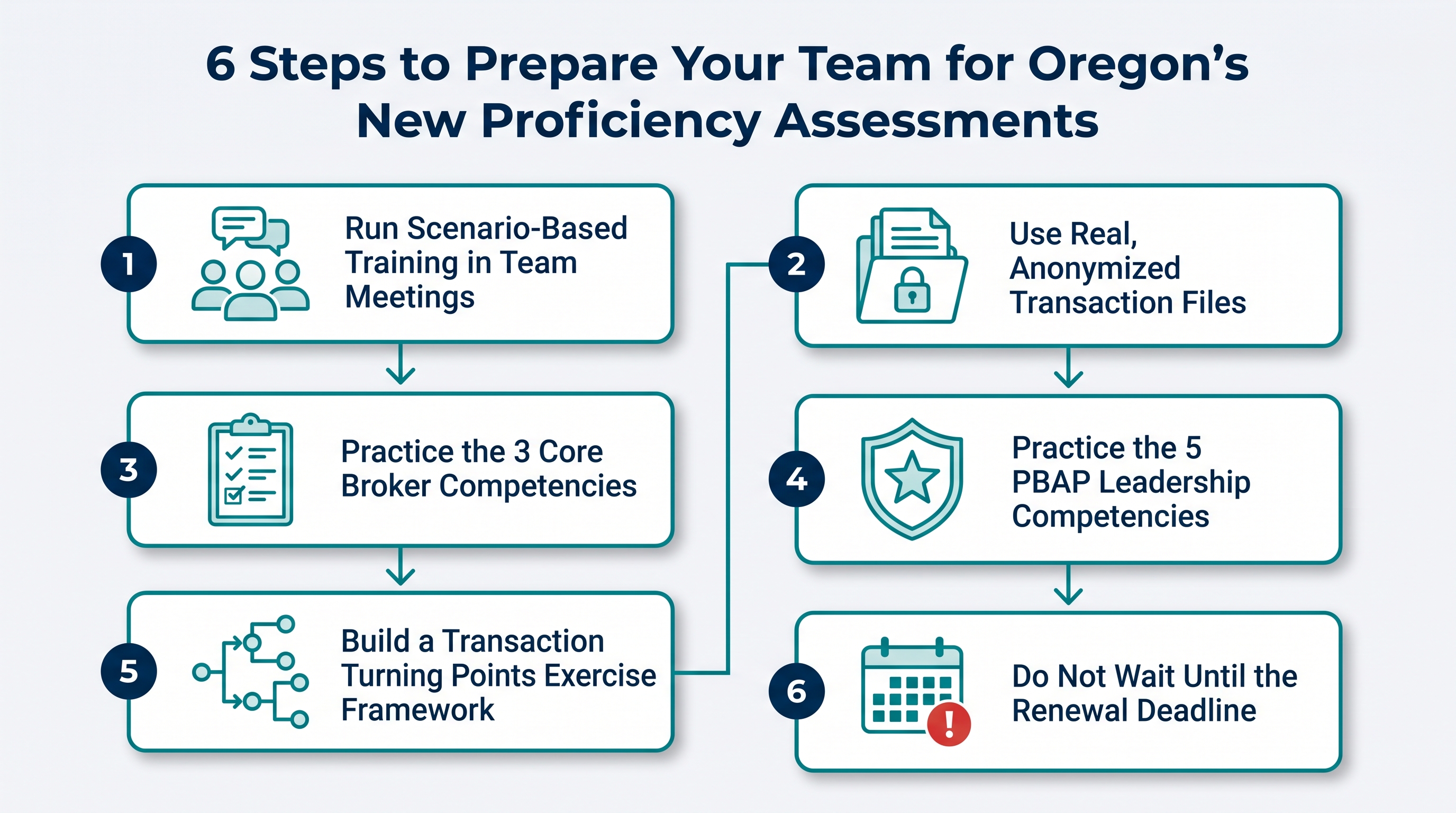
Your Firm's 6-Step Action Plan: Start preparing your team for the new proficiency assessments today.
1. Start Running Scenario-Based Training in Team Meetings Now
Dedicate at least thirty minutes of your weekly team meetings to collaborative problem-solving. Present a real, complex transaction issue and ask your brokers how they would handle it.
2. Use Real, Anonymized Transaction Files
Pull sanitized, anonymized files from your firm's archives where a transaction faced significant hurdles. Remove all client and property identifiers and distribute the core facts. Ask your team to identify where the transaction nearly failed and what steps ultimately saved it.
3. Practice the Three Core Broker Competencies
Design specific exercises around the three mandated competencies.
- Client Risk: Give your team a mock preliminary title report containing an unexpected easement and ask them to identify the risk to a buyer intending to build an accessory dwelling unit (ADU).
- Contract Provisions: Present a scenario where a seller needs to remain in the property for 45 days post-closing. Ask your brokers to identify and complete the exact contract addenda required to accomplish this objective safely under Oregon law.
- Communication Protocols: Provide a scenario involving a low appraisal and ask your brokers to draft the exact email they would send to the listing agent and their buyer.
4. Practice the Five PBAP Competencies for Leadership
For brokers preparing to become principal brokers, or existing principal brokers renewing their licenses, run structured leadership drills. Present a scenario where a broker has accidentally misrepresented a property's square footage, then walk your leadership team through all five PBAP competencies. How is the financial harm identified? What gap in the office manual allowed this to occur? What training protocol should be assigned? How should you communicate with the affected buyer's agent? What does the standard-of-care analysis conclude?
5. Build a "Transaction Turning Points" Exercise Framework
Break a standard real estate transaction into its critical junctures: the initial consultation, the property tour, offer drafting, the inspection period, the appraisal, and the final walkthrough. At each turning point, introduce a sudden complication and require your team to pivot and verbally explain their strategy.
6. Do Not Wait Until the Renewal Deadline
Encourage your team to schedule their Advanced Practices courses early in their renewal cycle. Waiting until the final weeks of a license cycle to tackle a 60-question, scenario-based assessment is a reliable path to administrative complications and potential license lapses.
Failed Assessments and Retake Guidance
The shift to a 75 percent passing threshold raises questions about what happens when a broker does not pass. The OREA does not explicitly cap the number of retake attempts allowed for the Advanced Practices assessment. However, brokers must coordinate directly with their continuing education provider to understand applicable retake options. Providers may impose waiting periods or require licensees to review course material again before permitting another attempt. A broker who fails their assessment 48 hours before their license expires faces a meaningful risk of licensure lapse. Principal brokers should communicate this risk clearly and establish internal timelines that provide adequate buffer for potential retakes.
Administrative Reminders and CE Compliance
As your firm prepares for the new educational standards, reinforcing strict adherence to OREA administrative requirements is equally important. Brokers may not repeat the same continuing education content within the same two-year license cycle. Tracking course completion records is essential to avoid accumulating invalid CE credits. All course completions must be accurately recorded in the OREA eLicense system prior to renewal, and brokers must retain their CE completion certificates for a minimum of three years.
Additionally, remind your team that OREA course approvals automatically expire on December 31 of each year. A broker who begins an Advanced Practices course late in the calendar year must complete it before the course approval resets, or they risk losing their progress entirely.
Finally, firm owners should actively monitor the official Oregon Real Estate Agency website and subscribe to OREA's licensee newsletter to ensure your firm is always operating with the most accurate and current compliance information.
Positioning the Right Advanced Practices Course
Disclosure: This article is published by [Company Name], an OREA-approved continuing education provider.
Because the July 1 shift fundamentally changes how courses are delivered and assessed, selecting the right continuing education provider matters more than ever. Your brokers need a provider whose curriculum is strictly aligned with the new OREA scenario-based proficiency requirements. They need realistic case studies that genuinely prepare them for the assessment.
Our Oregon Advanced Practices course offering is fully OREA-approved and comprehensively built around the new case-study format required by state law. Our BAP and PBAP curricula are designed to guide brokers systematically through complex risk identification, contract selection, and communication protocols.
To support your firm's shift to these new requirements, we offer exclusive partner referral incentives for firms that enroll their teams in our Advanced Practices program. By partnering with us, you ensure your brokers receive compliant, high-quality education that prepares them thoroughly for the proficiency assessment.
Conclusion
The July 1, 2026 deadline is approaching quickly. The era of passive continuing education in Oregon is officially ending, replaced by a rigorous standard of applied professional judgment. As a principal broker, the responsibility for preparing your team rests with you. Begin implementing scenario-based training today, ensure your brokers understand the new assessment competencies, and partner with a CE provider equipped to deliver the updated curriculum. By acting now, you will protect your firm's production, better serve your clients, and elevate the standard of practice across your entire team.
Like this? Become a Marketing Partner.
Marketing Partners co-brand and syndicate this content to their team, get discounted courses for their agents, and earn commissions on referrals.
Sign up →