A Washington State Department of Licensing (DOL) audit notification rarely includes a warning. An email arrives in the Designated Broker's inbox, starting a process that tests your firm's operations. For Washington State brokers, the question is not whether the state will audit your firm, but when.
The DOL conducts routine, remote audits about every three years. Investigations can also start from consumer complaints. The response timeline is strict. Firms must produce master transaction logs and trust account information within two business days, and deliver requested transaction records within five business days.
Failing to produce records carries high stakes. The state can issue fines up to $5,000 per violation. When a single failure repeats across transactions, the financial damage can threaten the firm. Surviving an audit requires a proactive compliance system that protects everyone.
What Auditors Actually Review
When a remote audit begins, auditors look for chronological consistency, systemic controls, and evidence of active supervision. Auditors evaluate your transaction files and firm policies against seven core compliance areas:
- Agency Disclosure Procedures
- Buyer Brokerage Agreements
- Compensation Disclosures
- Earnest Money Handling and Tracking
- Trust Account Management
- Advertising and Marketing Compliance
- Supervision and Delegation Documentation
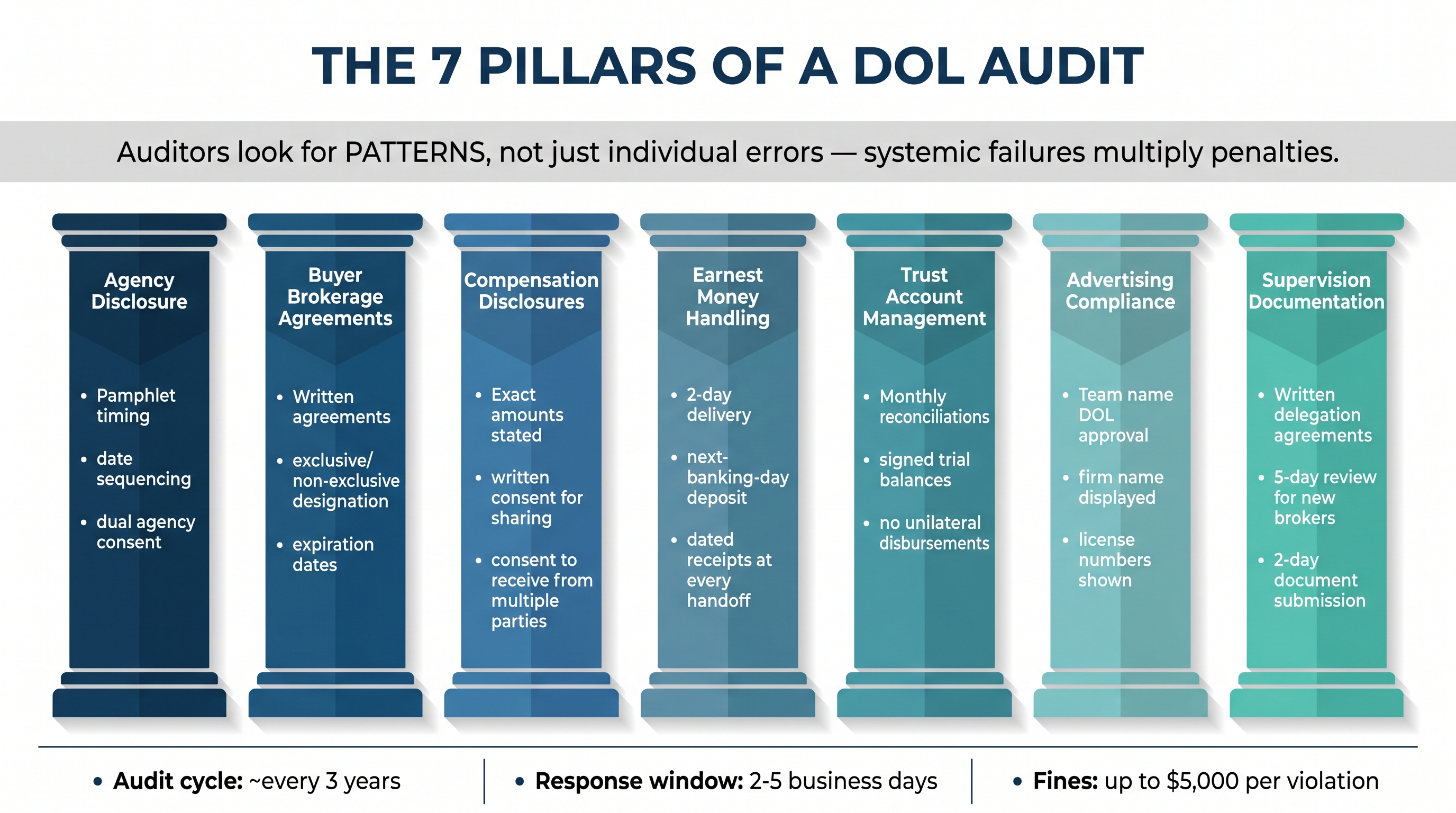
The Seven Pillars of a DOL Audit: A systemic failure in any single pillar can trigger escalating penalties across dozens of transactions.
Auditors look for patterns. A single misdated receipt might prompt a warning. However, a pattern of late earnest money deposits shows a breakdown in supervision and triggers severe penalties. Understanding how auditors evaluate these pillars helps you build a strong compliance system.
The Agency Disclosure & Buyer Brokerage Agreement Compliance System
With the agency law reforms that took effect on January 1, 2024, auditors pay close attention to how and when agency relationships are established. Compliance relies on sequence and timing.
Under Washington law, brokers must give the consumer the Real Estate Brokerage in Washington pamphlet before any written agreements are signed or real estate services are provided. Auditors compare the dates on the pamphlet acknowledgment against the signing date of the buyer brokerage agreement to confirm the proper sequence. Handing a buyer the pamphlet at mutual acceptance is a clear violation.
After pamphlet delivery, the buyer brokerage agreement must meet strict requirements. These agreements must be in writing and contain specific terms. Your compliance system must ensure every agreement clearly states whether the relationship is exclusive or non-exclusive and includes a defined expiration date. If the broker fails to specify a term, the agreement legally defaults to 60 days.
Another closely reviewed element is the consent for dual agency. If the broker will act as a dual agent, the buyer must explicitly consent in writing. Your firm's checklists should enforce a rigid sequence. Pamphlet delivery comes first, buyer brokerage agreement execution comes second, and transaction drafting comes third.
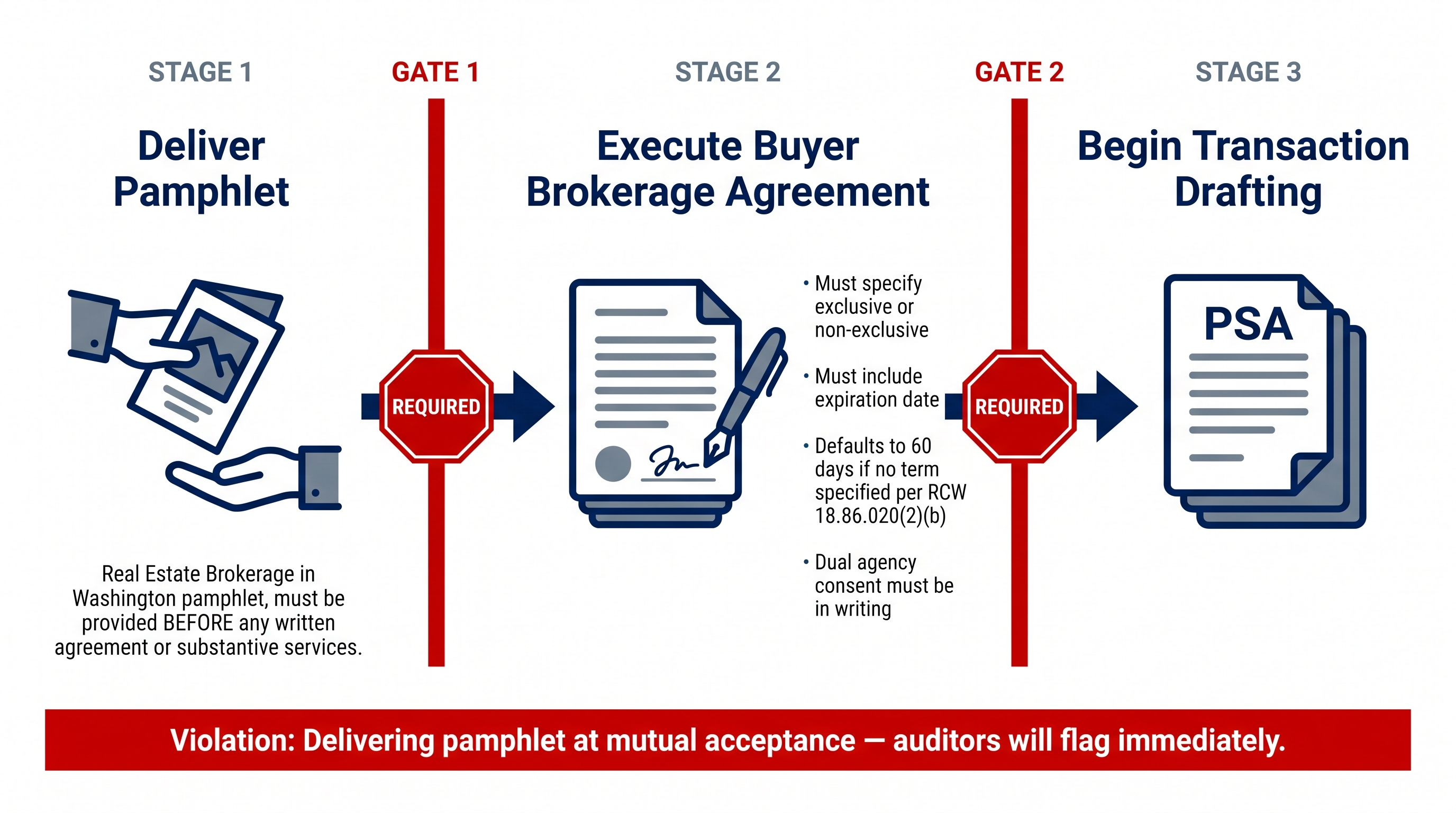
Agency Disclosure Compliance Sequence: Auditors verify this exact chronological order in every transaction file.
Compensation Disclosures: Precision and Transparency
Compensation disclosures are a dedicated focus area in recent audits. Following the 2024 NAR settlement, ensuring complete transparency in broker compensation is an operational necessity. Auditors closely review transactions for strict adherence to compensation disclosure requirements.
Firm owners must ensure that every services agreement explicitly outlines the compensation terms. This includes stating the exact amount the principal agrees to pay. Brokers must obtain written consent to any compensation sharing and confirm consent to receive compensation from more than one party. They must also clearly disclose whether the broker will show properties when no compensation agreement is in place. Careful documentation protects the firm from allegations of hidden fees.
Trust Account & Earnest Money Controls
Mishandling consumer funds is a primary driver of license suspensions and significant financial penalties. Trust account and earnest money compliance involves managing tightly controlled deadlines that leave no room for administrative delay.
The broker must deliver earnest money to their managing broker or designated broker within two business days of the client's signature. Once the firm receives the funds, the deposit must be made into the firm's trust account no later than the next banking day. When funds are held by a third-party escrow agent, the firm must maintain a clear, dated paper trail confirming delivery to escrow within the mandated timeframe.
For firms holding funds in a trust account, state rules establish rigid accounting requirements. Designated brokers must maintain current ledger cards and perform monthly trial balances and reconciliations. These reconciliations must be signed and dated by the designated broker as evidence of active oversight.
Your firm must also enforce a strict disbursement policy. Pre-closing disbursement of earnest money without a signed, written release from both the buyer and the seller is strictly prohibited. Even when a transaction collapses, mutual written instruction is always required. Every time funds change hands, a dated receipt must be generated and retained in the transaction file.
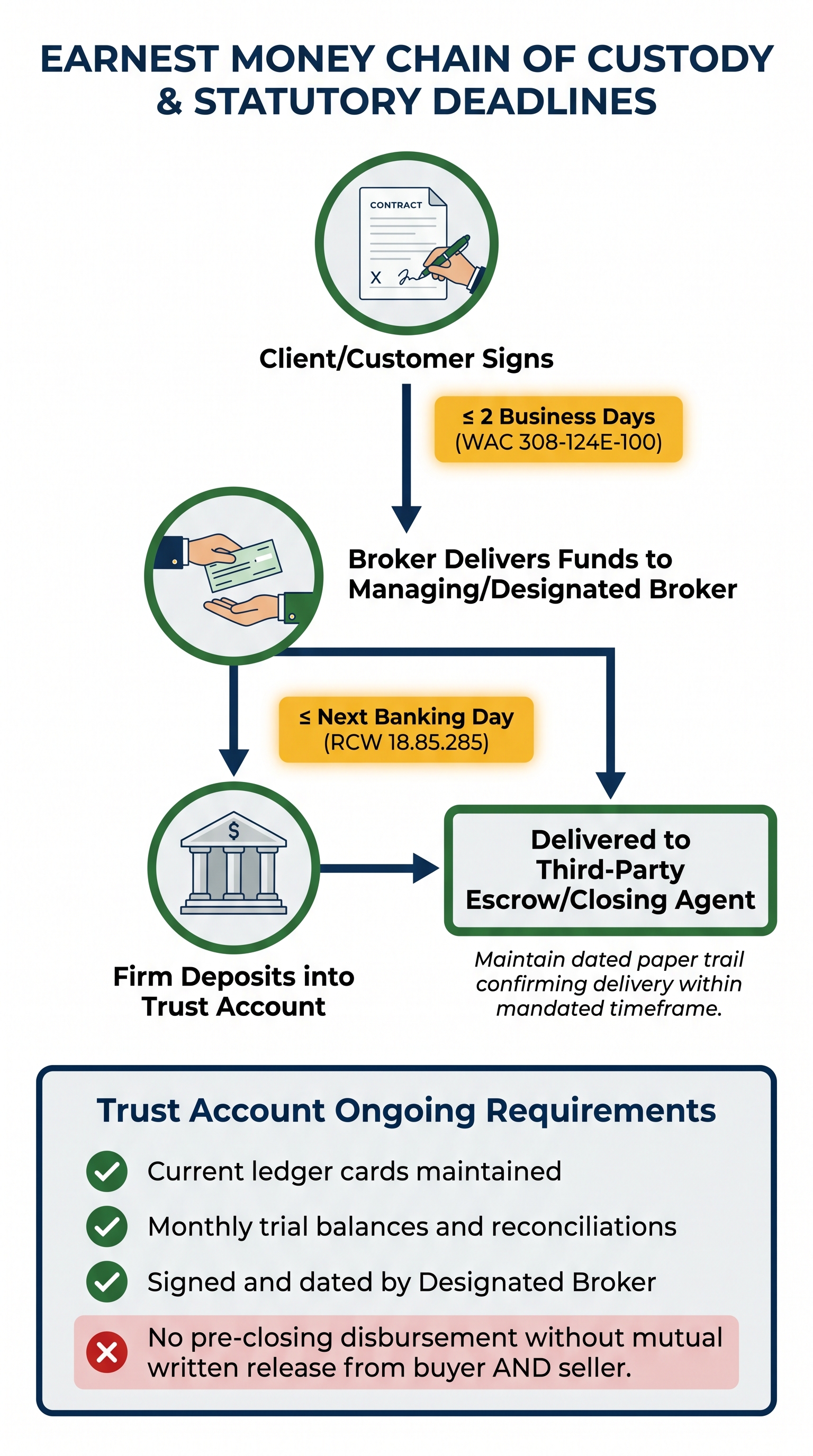
Earnest Money Chain of Custody: Every handoff has a statutory deadline and must produce a dated receipt for the transaction file.
Advertising and Marketing Compliance
Advertising compliance is a frequently overlooked yet highly consequential area. Auditors routinely review a firm's digital footprint, looking closely at social media profiles, websites, and print materials.
Auditors look specifically for team name compliance. They verify that any team names are officially approved by the state and do not deceptively suggest the team operates as a separate business entity from the brokerage. All advertising must prominently display the firm's licensed name and the required license number disclosures where applicable. A broker running non-compliant social media ads or using an unregistered team name is a fast path to disciplinary action. Establishing firm-wide marketing guidelines is essential.
Supervision Documentation That Withstands Scrutiny
In the eyes of the state, the Designated Broker bears ultimate responsibility for all licensed activities. The law permits the delegation of supervisory duties to Managing Brokers, but only when documented precisely.
State law requires that any delegation of authority from a Designated Broker to a Managing Broker be made explicitly in writing. This document must be signed by both parties and readily available for the auditor. Without it, the state considers the Designated Broker to have failed in their oversight responsibility.
Supervision requirements become significantly more strict for newer brokers. Any broker with fewer than two years of licensed experience is subject to heightened supervision. A designated or managing broker must review every contract, listing agreement, and purchase and sale agreement drafted by these brokers within five business days of mutual acceptance. That review must be documented on the firm's internal transaction log.
To make this supervision feasible, Washington law requires all brokers to submit their transaction documents to the firm within two business days of mutual acceptance. Brokers who hold files until closing violate state law and undermine the firm's ability to conduct mandatory supervisory reviews.
Building Your Audit-Ready Compliance System
Knowing the rules is only half the battle. Institutionalizing them into a reliable operational system protects your firm. An audit-ready compliance system removes reliance on individual memory and replaces it with standardized workflows.
First, implement mandatory transaction file checklists. A broker should not be able to advance a transaction or receive a commission split unless the checklist is fully completed, including proper chronological sequencing of agency pamphlets and brokerage agreements.
Second, establish a rigid compliance calendar. Treat trust account reconciliations and the signing of trial balances as non-negotiable appointments. Maintain a running supervision log tracking the five-day contract reviews for brokers with fewer than two years of experience. Conduct quarterly roster audits by running state license lookup verifications for all affiliated licensees.
Third, maintain a standing audit packet. Washington regulations mandate a strict three-year retention period for all real estate transaction records, trust account records, and firm policy manuals. Your packet should include current written firm policies, signed delegation logs, a roster of affiliated brokers with license issuance dates, and sample monthly trust reconciliations.
Finally, build a forward-looking system. Firm managers should prepare to integrate the upcoming June 11, 2026 public marketing requirement into their checklists. This rule prohibits marketing residential property exclusively to a limited group of buyers or brokers unless the property is concurrently marketed to the general public and all other brokers.
Cultivating Compliance Through Education
A strong compliance system cannot rest solely on the Designated Broker acting as an enforcer. True compliance is achieved when every broker in the firm understands not just which documents to submit, but why the state requires them and what deadlines govern their delivery.
Keeping every broker current on these requirements demands ongoing education. Rather than positioning compliance meetings as punitive exercises, firms should frame internal training as a professional risk management tool. Ground your firm's educational strategy in state-mandated Continuing Education topics. Focus regularly on agency law updates, proper contract drafting, and trust account fundamentals. By institutionalizing firm-wide compliance training, managing brokers can ensure their teams remain sharp, well-informed, and prepared for Washington's evolving regulatory landscape.
Like this? Become a Marketing Partner.
Marketing Partners co-brand and syndicate this content to their team, get discounted courses for their agents, and earn commissions on referrals.
Sign up →