Washington State's real estate industry is undergoing a seismic shift in consumer protection and agency law. Since the sweeping reforms of Substitute Senate Bill (SSB) 5191 took effect on January 1, 2024¹, the landscape for real estate professionals has fundamentally changed. As a designated broker or Managing Broker, your supervisory responsibilities have never been more critical. Gone are the days of implied agency; today's regulatory environment demands explicit written agreements, precise timing, and meticulous recordkeeping.
Compounding this pressure is the upcoming Substitute Senate Bill (SSB) 6091, which takes effect on June 11, 2026². This statute strictly regulates how Brokers market residential properties, prohibiting the marketing of a property to an exclusive group without concurrent public marketing. As the regulatory framework tightens, the margin for error shrinks.
Your role as a firm owner or Managing Broker is to bridge the gap between complex statutory language and daily brokerage practice. When Brokers fail to comply, liability inevitably rolls uphill to you. To protect your firm and elevate your team's professionalism, you must actively coach your Brokers to navigate these new regulations. This guide breaks down the five most common agency law pitfalls your Brokers are likely to encounter under Washington's reformed rules, introduces the incoming SSB 6091 requirements, and provides actionable coaching strategies to ensure compliance.
Pitfall 1: Pamphlet Timing and Acknowledgment
The Rule: Under Washington law, Brokers must deliver the newly revised "Real Estate Brokerage in Washington" pamphlet to any party to whom they provide real estate brokerage services³. Crucially, this must happen as soon as reasonably practical—but before the party signs a brokerage services agreement, signs an offer in a real estate transaction, or consents to limited dual agency⁴.
The Pitfall: Brokers often treat the consumer pamphlet as a mere administrative afterthought. A common error is slipping the pamphlet into a stack of closing documents at the signing table, or emailing it as an unmentioned attachment immediately before a deadline. Under the new rules, Brokers must also obtain a written acknowledgment of receipt from the consumer. Failure to deliver the pamphlet on time—or failure to secure the required acknowledgment—invalidates the foundation of the agency relationship and leaves the Broker entirely out of compliance.
Coaching Strategy: Coach your Brokers to use the pamphlet as a meaningful presentation tool rather than a compliance checkbox. Have them introduce it during the initial consultation, before conducting any property tours or engaging in substantive financial discussions.
Role-play the conversation during your weekly sales meetings. A Broker should be able to say confidently: "Before we dive into your specific needs, Washington State law requires me to provide you with this pamphlet outlining your consumer rights and explaining how agency works. Let me highlight a few key points, and then I'll need your signature acknowledging that you received it."
Make it abundantly clear to your team that after-the-fact delivery is a strict liability violation. Instituting a firm-wide habit of leading with the pamphlet not only ensures legal compliance—it also establishes trust and professionalism from the very first interaction.
Coaching Tip: When a Consumer Refuses to Sign
Firm owners frequently field calls from Brokers asking, "What if the consumer refuses to sign the pamphlet acknowledgment or the buyer representation agreement?" You must have a definitive firm policy for this scenario.
If a consumer declines to acknowledge receipt of the pamphlet, instruct your Broker to note the date, time, and method of delivery on their own copy of the acknowledgment, write "Consumer declined to sign" on the signature line, and immediately upload it to the firm's transaction file.
For the buyer representation agreement, however, the rule is absolute: no signed agreement means no representation. If a buyer refuses to execute the required services agreement, your Broker cannot lawfully act as their agent or show them properties. Coach your Brokers to explain clearly and professionally: "State law prohibits me from providing brokerage services without this written agreement." This boundary protects both the Broker's license and your firm.
Pitfall 2: Services Agreement Gaps
The Rule: SSB 5191 mandated written brokerage services agreements for both buyers and sellers⁵. For buyer's Brokers, this introduced a significant paradigm shift. Under the statute, a services agreement must explicitly include several elements: whether it is exclusive or non-exclusive, the duration of the agreement, the Broker's compensation, and whether the buyer consents to limited dual agency. If no duration is specified, the term defaults to 60 days.
The Pitfall: Brokers frequently struggle with the mechanics of the buyer representation agreement. Common errors include leaving the term blank—which inadvertently triggers the 60-day default that may expire mid-transaction—and failing to articulate compensation clearly. Vague compensation clauses or missing expiration dates render the agreement non-compliant and jeopardize the Broker's commission. Many Brokers, unaccustomed to asking buyers for a signature upfront, rush through the document and skip vital checkboxes.
Coaching Strategy: Institute a mandatory contract drafting clinic for your office. Walk your Brokers through your firm's approved buyer services agreement line by line. Emphasize that compensation must be a specific amount or a clearly calculable formula—such as a percentage of the purchase price—rather than ambiguous language like "whatever the seller offers."
Teach your Brokers how to confidently articulate their value proposition so they do not stumble over the compensation clause. Coach them to actively manage the term of the agreement as well. If a buyer's property search extends beyond 60 days, the Broker must secure a written extension before the default period expires. Train them to set calendar alerts at the 45-day mark to evaluate whether an extension is necessary.
Pitfall 3: Limited Dual Agency Confusion
The Rule: The statutory term "dual agent" has been legally replaced with "limited dual agent" to better reflect the restricted duties a Broker carries when representing both parties⁶. Informed, written consent to limited dual agency must also be separately initialed by the consumer in the brokerage services agreement⁷.
The Pitfall: The most significant trap in this area involves in-house or same-firm transactions. When a buyer's Broker and a listing Broker work for the same firm under the same designated broker, the designated broker—and any Managing Broker supervising both—automatically becomes a limited dual agent, even if the individual Brokers represent only their respective clients. Many Brokers fail to explain this nuance to clients, leading to confusion and concern when clients later encounter the limited dual agency disclosure on the purchase and sale agreement. Additionally, Brokers routinely neglect to secure the separately initialed consent for limited dual agency in the original services agreement.
Coaching Strategy: Demystify the same-firm transaction for your team. Create a visual flowchart for your office showing how agency representation flows up to the designated broker. Train your Brokers to address this proactively and transparently: "If you decide to purchase a property listed by another Broker in my firm, my managing broker becomes a limited dual agent to ensure fair dealings—but I will continue to represent only your interests."
Require your document review staff to reject any services agreement where the limited dual agency consent has not been separately initialed. Catching this error early prevents a Broker from having to revisit a client days or weeks later to correct an oversight—a situation that undermines client trust and raises compliance concerns.
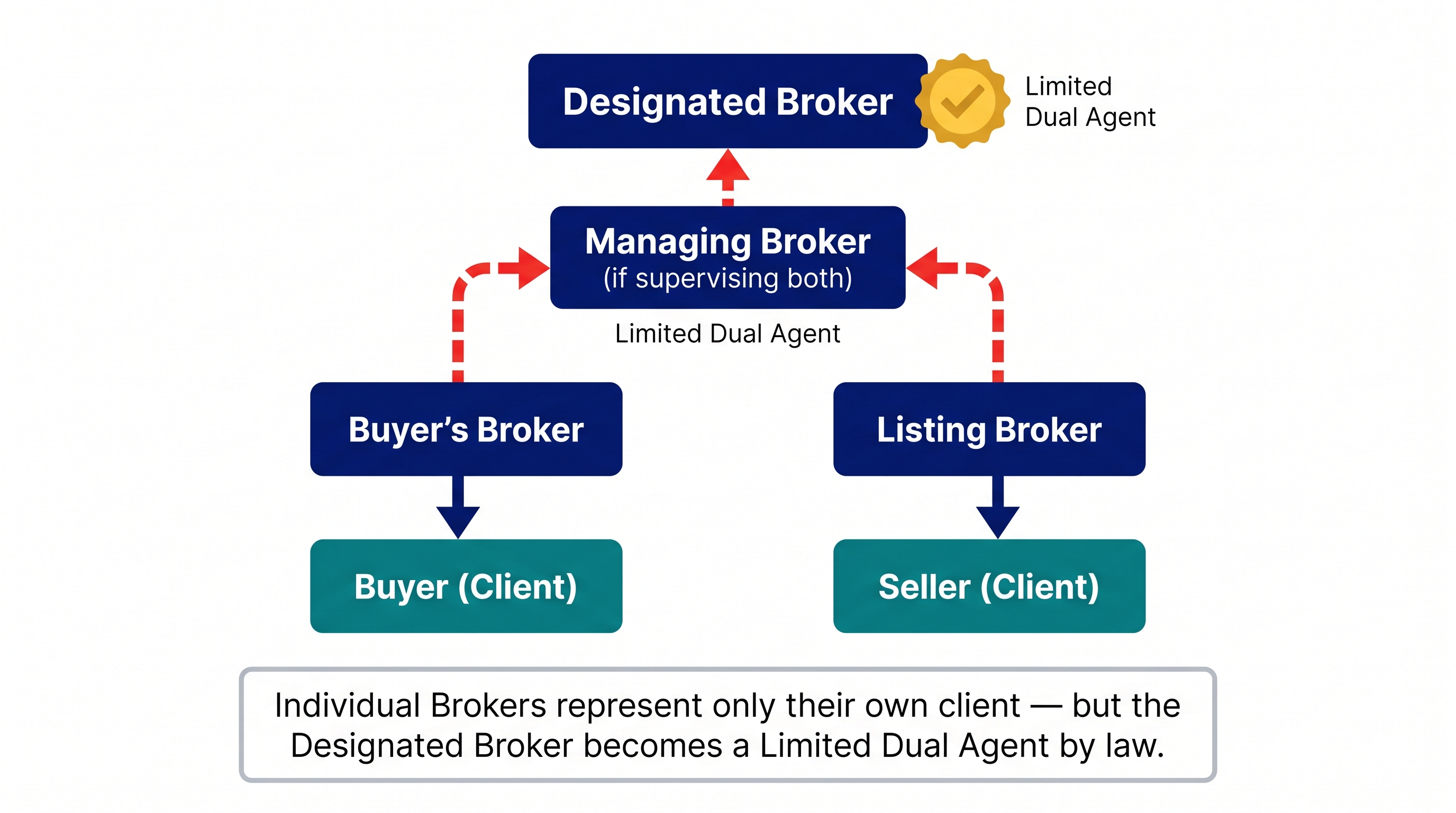
Agency Relationship Flow in Same-Firm Transactions: How limited dual agency is automatically triggered at the Designated Broker level under Washington's reformed agency law.
Pitfall 4: Agency Disclosure Timing and Titling
The Rule: A written agency disclosure must be provided to all parties before they sign an offer⁸. It must clearly state whether the Broker represents the buyer, the seller, both parties, or neither. The statute further specifies that this disclosure must be explicitly titled "Agency Disclosure."
The Pitfall: Brokers often incorrectly assume that an agency provision buried within the standard purchase and sale agreement satisfies this requirement. It does not. If the disclosure is not explicitly titled "Agency Disclosure" or is provided after the offer is signed, it violates the statute. In fast-moving markets, Brokers may rush to secure signatures on an offer and treat the agency disclosure as a secondary concern—a mistake that carries serious consequences.
Coaching Strategy: Implement a firm-wide "No Disclosure, No Offer" policy. Coach your Brokers to place the standalone, properly titled "Agency Disclosure" form at the very front of every digital or physical offer packet.
During the firm's file review process, Managing Brokers must verify that the timestamp on the Agency Disclosure precedes the timestamp on the offer signature. Deliver this message directly to your team: "The agency disclosure is not routine paperwork—it is your legal protection. If you fail to disclose exactly who you represent before your client signs, you expose yourself and this firm to serious disciplinary action." Clarity at the outset prevents disputes later and ensures all parties understand the representation dynamics before committing to a binding transaction.
Pitfall 5: Supervision and Recordkeeping Failures
The Rule: Under WAC 308-124C-140, Brokers must deliver all transaction documents to the firm within two business days of mutual acceptance⁹. Firms must maintain these documents securely¹⁰. Managing Brokers also carry heightened responsibilities¹¹: under WAC 308-124C-125, for Brokers licensed less than two years, the Managing Broker must review all brokerage service contracts within five business days of mutual acceptance¹².
The Pitfall: This is precisely where firm owners and Managing Brokers face direct, personal liability. When a Broker holds a signed agreement for a week without submitting it, or when a Managing Broker fails to document their review of a newly licensed Broker's file within the five-day window, the firm falls out of compliance. With the increased complexity introduced by the new services agreements—and the incoming SSB 6091 marketing restrictions—lax recordkeeping represents a serious and growing liability.
Coaching Strategy: Supervision in today's regulatory environment cannot be passive. Use your transaction management software to create automated, non-negotiable alerts. If a Broker opens a transaction file but does not upload fully signed documents within 48 hours, the system should flag the file and notify the Managing Broker immediately.
For newer Brokers—those with under two years of licensure—establish weekly, mandatory file review meetings. Under the Washington Administrative Code, your review must be demonstrably documented; an informal email saying "looks good" is not sufficient. Use a standardized firm checklist that the Managing Broker signs and dates for each reviewed file. Communicate this expectation clearly: "Timely document submission is not a firm preference—it is a state law requirement, and failure to comply puts every license in this office at risk."
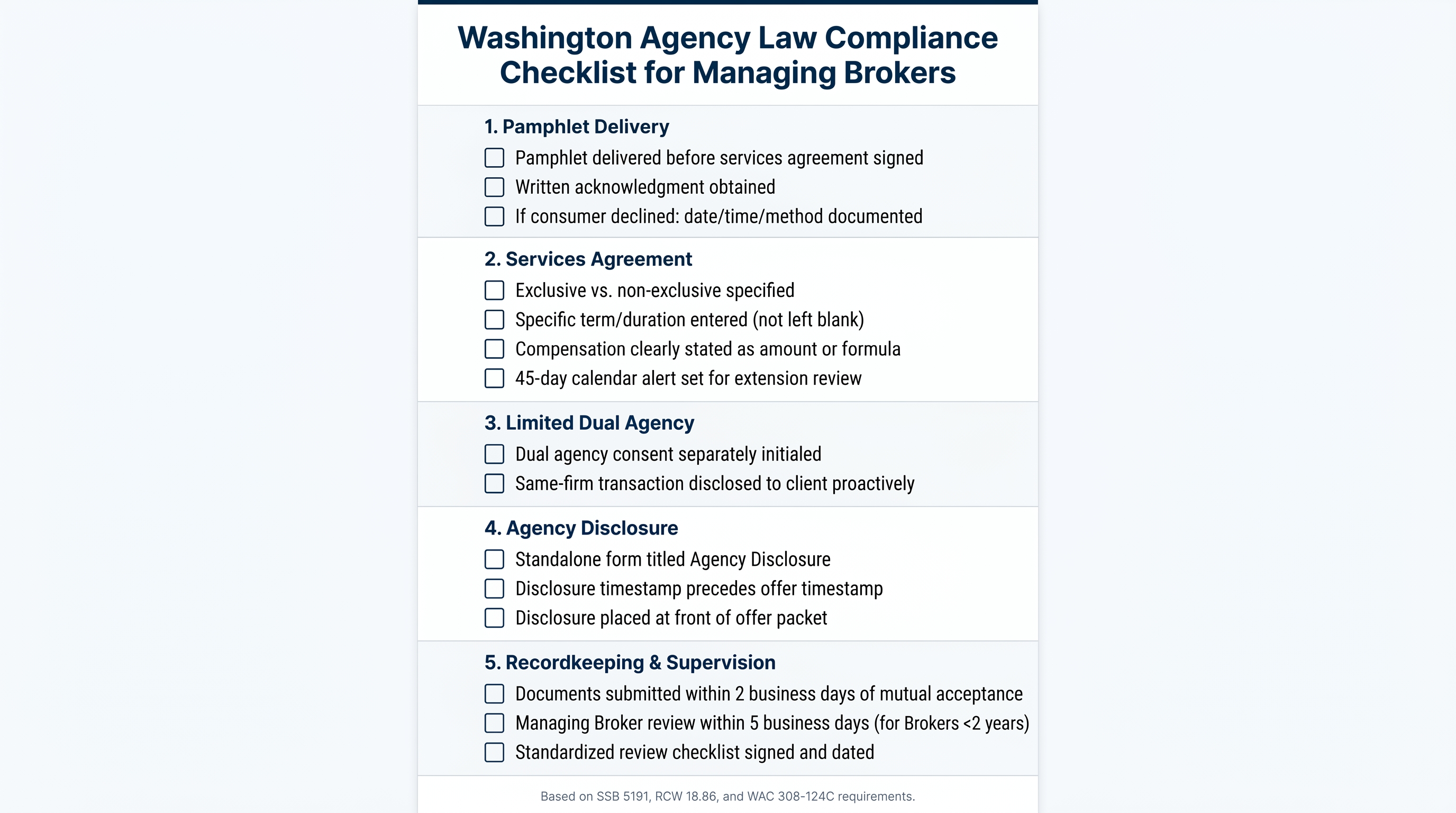
Firm Compliance Checklist: Use this reference to audit every transaction file against Washington's current agency law requirements.
Advisory: Looking Ahead to SSB 6091 (Effective June 11, 2026)
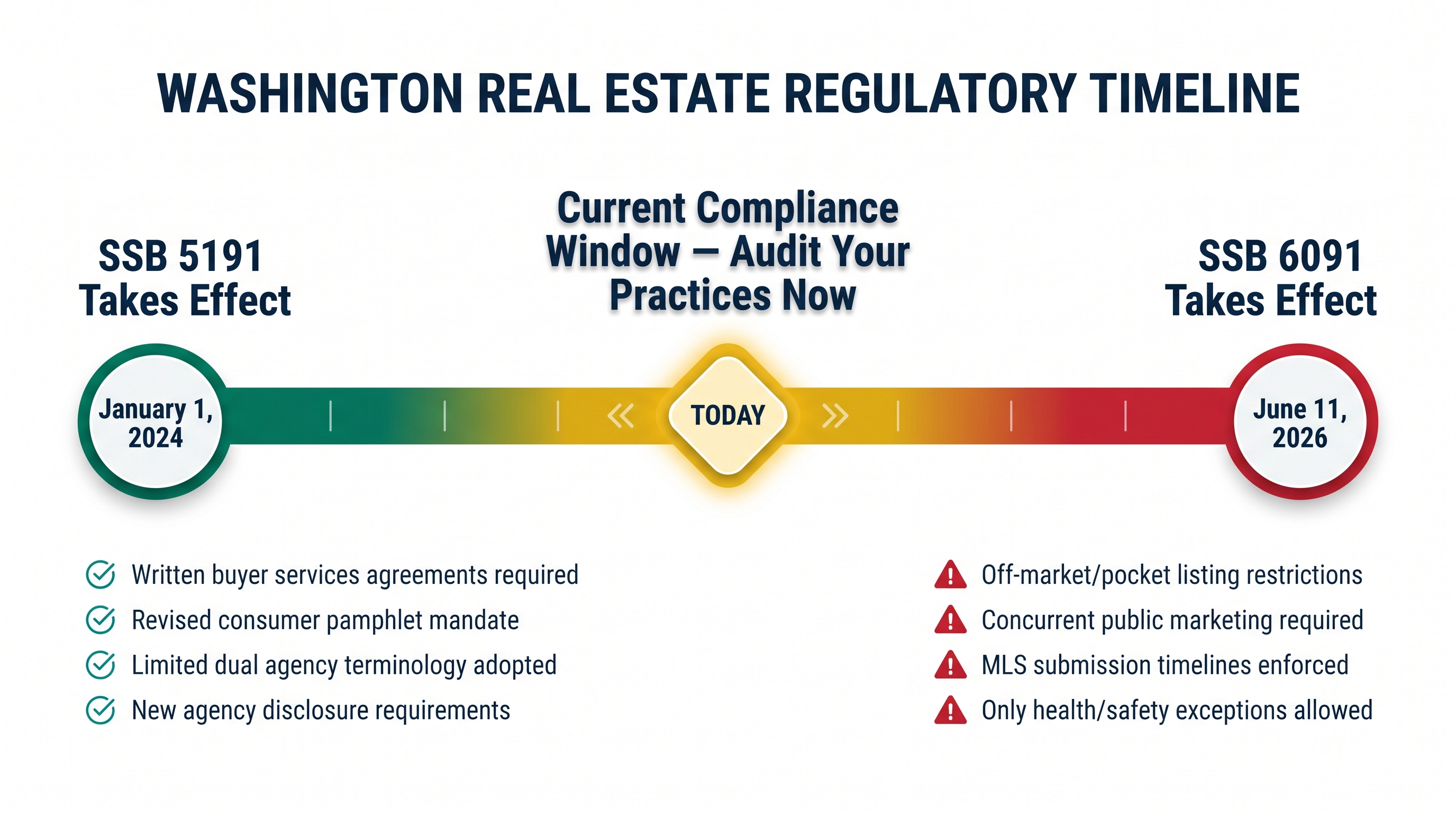
Regulatory Timeline: SSB 5191 is already in effect — SSB 6091 arrives June 11, 2026. The window to update your firm's policies is now.
While SSB 5191 redefined agency representation, the incoming Substitute Senate Bill (SSB) 6091 will fundamentally alter how your firm handles property marketing. Taking effect in June 2026, this legislation effectively prohibits off-market and pocket listings that are marketed exclusively to private networks.
- The Mandate: Once any marketing of a residential property occurs, it must be concurrently marketed to the general public and all other licensed real estate brokers—typically through MLS submission.
- The Implications: Your firm can no longer advertise "coming soon" listings exclusively to an internal firm network or a private group of VIP buyers without concurrent public marketing. The only statutory exception applies when restricting marketing is "reasonably necessary to protect the health or safety of the owner or occupant."
- Action Plan for Firm Owners: Begin updating your listing policies now. Train your listing Brokers that from the moment they promote a property in any capacity—even an email to their private database—the public marketing clock starts. Your compliance teams must monitor MLS submission timelines closely and consistently.
Conclusion: Consequences and the Road Ahead
Failing to adhere to these reformed agency laws is not a minor administrative oversight. Under Washington law, a Broker who violates these provisions is subject to severe disciplinary action under RCW 18.85.361¹³. This enforcement framework grants the Department of Licensing the authority to impose significant penalties for unprofessional conduct, including license suspension, fines of up to $5,000 per violation, and mandatory remedial education. Beyond regulatory discipline, improper agency representation can be used in civil court to invalidate a commission claim—striking the Broker and the firm directly in the revenue stream.
As a designated broker or Managing Broker, you must actively cultivate a culture of unwavering compliance. The Washington Department of Licensing expects you to consistently monitor, train, and correct your Brokers. With SSB 6091 poised to reshape how off-market listings are handled after June 11, 2026, the regulatory burden on firm leadership will only increase.
Start today. Audit your firm's current transaction practices, update your office policy manual, and implement the coaching strategies outlined in this guide. By prioritizing education, clear communication, and robust recordkeeping, you will safeguard your firm's reputation, protect your clients, and position your Brokers to thrive in Washington's increasingly regulated real estate market.
References
- 2023 Wash. Sess. Laws ch. 318. Available at: https://lawfilesext.leg.wa.gov/biennium/2023-24/Pdf/Bills/Session%20Laws/Senate/5191-S.SL.pdf
- 2026 Wash. Sess. Laws ch. 57. Available at: https://lawfilesext.leg.wa.gov/biennium/2025-26/Pdf/Bills/Session%20Laws/Senate/6091-S.SL.pdf
- Wash. Rev. Code (RCW) § 18.86.030(1)(f). Available at: https://app.leg.wa.gov/RCW/default.aspx?cite=18.86.030
- Wash. Rev. Code (RCW) § 18.86.030(1)(f). Available at: https://app.leg.wa.gov/RCW/default.aspx?cite=18.86.030
- Wash. Rev. Code (RCW) § 18.86.020. Available at: https://app.leg.wa.gov/RCW/default.aspx?cite=18.86.020
- Wash. Rev. Code (RCW) § 18.86.010(10). Available at: https://app.leg.wa.gov/RCW/default.aspx?cite=18.86.010
- Wash. Rev. Code (RCW) § 18.86.020(2)(b)(iv). Available at: https://app.leg.wa.gov/RCW/default.aspx?cite=18.86.020
- Wash. Rev. Code (RCW) § 18.86.030(1)(g). Available at: https://app.leg.wa.gov/RCW/default.aspx?cite=18.86.030
- Wash. Admin. Code (WAC) § 308-124C-140(7). Available at: https://app.leg.wa.gov/WAC/default.aspx?cite=308-124C-140
- Wash. Admin. Code (WAC) § 308-124C-105. Available at: https://app.leg.wa.gov/WAC/default.aspx?cite=308-124C-105
- Wash. Admin. Code (WAC) § 308-124C-135. Available at: https://app.leg.wa.gov/WAC/default.aspx?cite=308-124C-135
- Wash. Admin. Code (WAC) § 308-124C-125(9)(c). Available at: https://app.leg.wa.gov/WAC/default.aspx?cite=308-124C-125
- Wash. Rev. Code (RCW) § 18.85.361 & § 18.235.110. Available at: https://app.leg.wa.gov/RCW/default.aspx?cite=18.85.361
Like this? Become a Marketing Partner.
Marketing Partners co-brand and syndicate this content to their team, get discounted courses for their agents, and earn commissions on referrals.
Sign up →